
How to Measure a Car for a Cover: Complete Sizing Guide

Quick Answer
To measure a car for a cover, measure its overall length from bumper to bumper, its widest body width, and its height from the ground to the roof. Keep each measurement straight rather than following the body’s curves. Record mirror width and any fixed accessories separately. Then compare your numbers with the manufacturer’s size chart, as explained in this car cover measuring guide.
Five Quick Measuring Steps
- Park on level ground: Choose a flat, safe place with enough room to walk around the vehicle.
- Measure overall length: Measure straight from the frontmost bumper point to the rearmost point.
- Measure body width: Find the widest body point and record mirror-to-mirror width separately.
- Check vehicle height: Measure vertically from the ground to the highest roof point.
- Compare cover sizes: Check all dimensions and confirm how the maker handles mirrors and accessories.
Important Fit Tip
- Never guess by vehicle type: Two sedans may need different cover sizes, even when they look similar.
Buying a car cover sounds simple until you see all the size options. I’ve found that the best approach is to ignore labels like small, medium, and large at first.
Start with your vehicle’s actual dimensions. This guide explains where to measure, what to include, and how to choose a cover that fits without unwanted slack.
In This Guide
What Measurements Do You Need for a Car Cover?
You need three main measurements: overall length, body width, and vehicle height. Together, these describe the space your cover must fit around.
Car cover sizing is the process of matching those dimensions to a protective cover’s intended vehicle range. A good match should cover the body without excessive pulling or loose fabric.
The Three Main Measurements
- Length: The horizontal distance from the frontmost bumper point to the rearmost vehicle point.
- Width: The horizontal distance across the widest part of the body, excluding mirrors unless instructed otherwise.
- Height: The vertical distance from level ground to the roof’s highest point, with permanent accessories recorded separately.
I suggest recording every measurement in inches. Most US car cover size charts use inches or feet.
Keep the original numbers instead of rounding early. You can round up when comparing them with the manufacturer’s instructions.
What Tools Should You Use?
You don’t need specialist automotive equipment. A few household tools will do the job.
- Long measuring tape: A 25-foot tape works for most passenger vehicles.
- Masking tape: Mark points on the ground when measuring alone.
- Notepad or phone: Record dimensions and accessory details.
- Helper: A second person can make long measurements easier.
- Plumb line: A weighted string helps locate bumper endpoints on the ground.
A flexible tape can be useful around awkward areas. However, don’t measure the vehicle’s full curved surface when the chart requests straight-line dimensions.
Should You Measure in Feet or Inches?
Either unit works if you convert it correctly. However, I prefer inches because they make close size comparisons easier.
For example, 15 feet equals 180 inches. A vehicle measuring 183 inches is slightly longer, even though both may look like 15-foot cars.
Use this simple conversion:
- 1 foot = 12 inches.
- 15 feet = 180 inches.
- 16 feet = 192 inches.
- 17 feet = 204 inches.
Section Takeaway: Record length, width, and height separately. Keep the measurements accurate before choosing a cover size.
How Do You Measure a Car for a Cover Step by Step?
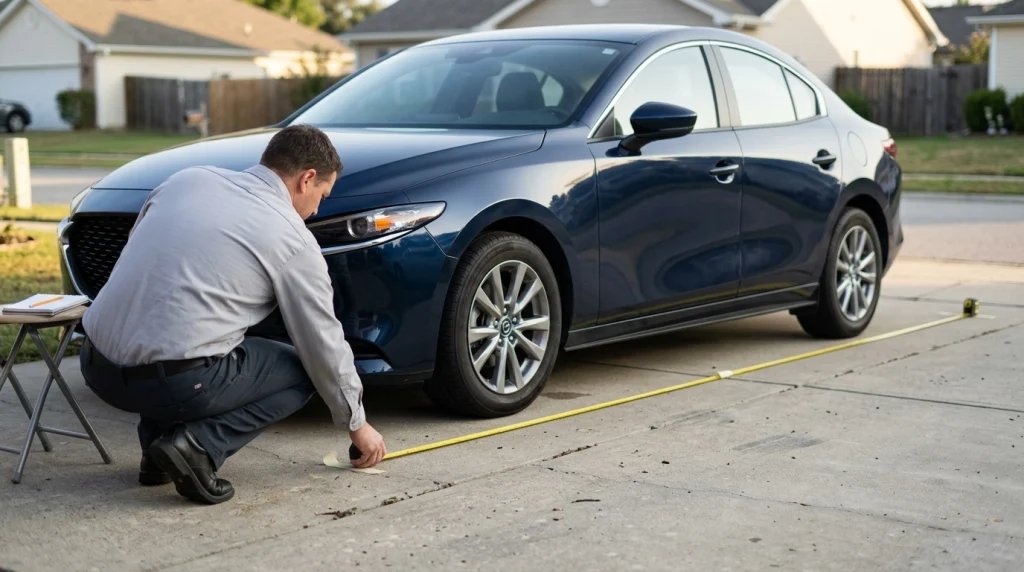
Measure the vehicle while it sits on level ground with its wheels straight. Make sure the car is parked safely and the engine is off.
Take your time around mirrors, bumpers, and roof accessories. These areas can change how a cover fits.
Step 1: Measure the Overall Vehicle Length
Overall length is the straight horizontal distance between the vehicle’s frontmost and rearmost points. It is not the distance over the hood, roof, and trunk.
- Find the most forward point of the front bumper.
- Mark its position on the ground using a vertical reference.
- Repeat at the rearmost bumper or fixed protruding accessory.
- Measure the straight ground distance between both marks.
- Record the result in inches.
Suppose your car measures 181 inches from end to end. Write down 181 inches rather than estimating that it is about 15 feet long.
Check for rear-mounted spare tires, bumper guards, and other fixed additions. They may increase the length the cover needs to accommodate.
Step 2: Measure the Widest Part of the Car
Vehicle width usually means the width across the body, not the mirrors. The exact rule depends on the cover manufacturer.
- Locate the widest body section, often near the fenders.
- Use vertical ground marks to identify its outer edges.
- Measure the straight distance between those marks.
- Record the width without mirrors.
- Measure mirror-to-mirror width separately if possible.
For example, a car might have a 72-inch body width and an 82-inch mirror-to-mirror width. These are different measurements for different sizing purposes.
Some universal covers need mirror clearance within the main cover. Others include shaped mirror pockets.
Step 3: Measure the Vehicle Height
Vehicle height runs vertically from the ground to the highest point of the roof. Do not follow the windshield angle or roof slope.
- Park on flat ground with the tires properly inflated.
- Locate the highest part of the main roof.
- Use a level horizontal reference and vertical measuring tape.
- Measure from the ground to that reference.
- Record the height of fixed roof accessories separately.
If the main roof is 57 inches high, record that number. Then note whether roof rails, bars, or other fittings rise above it.
Keep the tape vertical. A diagonal measurement can make the car seem taller than it is.
Step 4: Check the Body Shape and Cover Drop
Length, width, and height are not the whole story. The car’s shape also changes how the fabric hangs.
A flat-roofed SUV needs a different cover shape than a sloped-roof coupe. Even similar overall dimensions can hide major body differences.
I would check these areas before ordering:
- Front and rear bumper shape.
- Roofline and rear window slope.
- Wheel arch coverage.
- Front splitter or rear diffuser.
- Side mirrors and their folding position.
- Roof racks and raised accessories.
Check the cover’s intended hem position, too. Some covers hang near the lower body, while others provide more wheel coverage.
Step 5: Compare the Numbers With a Size Chart
Once you have all three dimensions, open the manufacturer’s car cover chart. Don’t choose a cover using vehicle length alone.
Check whether your width and height also fall within its recommended range. Confirm that the cover supports your body style and accessories.
For a universal cover, use the smallest suitable size that accommodates all required measurements. Follow the brand’s specific guidance if you fall between sizes.
Section Takeaway: Measure in straight lines and keep accessory dimensions separate. Match the complete vehicle profile, not just its length.
Should You Include Mirrors, Spoilers, and Roof Accessories?
Include any part that the cover must physically fit around, but record it separately first. Manufacturers don’t all use the same measurement rules.
This is one of the most important details when buying a universal car cover.
Should Car Cover Width Include Side Mirrors?
Usually, the main body-width measurement excludes the mirrors. But some brands ask for mirror-to-mirror width.
The safest approach is to record both measurements. Then follow the cover maker’s published instructions.
- Custom-fit cover: Check whether the pattern includes mirror pockets.
- Universal cover: Confirm how it accommodates the mirrors.
- Folding mirrors: Note whether you will fold them before covering.
- Large towing mirrors: Ask the manufacturer about additional clearance.
Do Roof Racks Change Cover Size?
Yes. Permanent roof racks, crossbars, and cargo boxes can change the space needed under a cover.
If you plan to leave them installed, measure their height and position. Confirm that the fabric has enough room to cover them safely.
Sharp corners may need suitable padding. They can otherwise place stress on the cover.
What About Spoilers and Antennas?
A large rear wing or spoiler can affect both fit and fabric tension. The same goes for a raised antenna or unusual roof fitting.
Consider these points before ordering:
- Rear spoiler: Check rear height and added projection.
- Roof antenna: Look for the cover’s antenna instructions.
- Roof cargo box: Confirm that the cover can accommodate its shape.
- Spare tire carrier: Include rearward projection when required.
- Tow hitch: Check clearance and protect sharp contact points.
Don’t force fabric over a rigid antenna. Follow the vehicle and cover instructions before removing or repositioning anything.
How Do You Choose the Right Car Cover Size?
Choose a cover that accommodates all the required dimensions and matches the vehicle’s body style. The correct fit should not require heavy stretching.
It should also avoid excess fabric that can move in the wind.
Car Cover Size Comparison Example
The following numbers show how to evaluate a hypothetical manufacturer’s size chart. They are examples, not universal industry sizes.
| Example Size | Maximum Length | Maximum Body Width | Maximum Height |
|---|---|---|---|
| Example A | 175 in | 70 in | 57 in |
| Example B | 185 in | 74 in | 60 in |
| Example C | 195 in | 78 in | 63 in |
Imagine a sedan that measures 181 inches long, 72 inches wide, and 58 inches high. In this example, Size B accommodates all three dimensions.
Size A would be too small. Size C might fit, but it could leave unnecessary slack.
Universal Cover vs. Custom-Fit Cover
A universal cover fits a range of vehicles. A custom-fit cover uses a pattern designed for a specific vehicle configuration.
| Feature | Universal Cover | Custom-Fit Cover |
|---|---|---|
| Sizing | Dimension ranges | Vehicle-specific pattern |
| Measuring | Usually needed | Often optional on stock vehicles |
| Mirror fit | Varies by product | May include dedicated pockets |
| Vehicle modifications | Check dimensions | May require a revised pattern |
For a standard daily driver, a custom-fit cover can make selection easier. But don’t assume a vehicle-specific pattern will accommodate aftermarket modifications.
A car cover fitting explanation also discusses why universal and modified vehicles often require extra measurement checks.
What if Your Car Is Between Two Cover Sizes?
First, check whether all your measurements fit the smaller size’s stated limits. Some manufacturers give a range rather than one maximum number.
If the smaller cover cannot accommodate your vehicle, don’t try to stretch it. The next size may work if its overall shape remains suitable.
Look for elastic hems, secure straps, and appropriate mirror accommodation. These features can help control excess fabric, but cannot fix a badly mismatched cover.
Can You Use Factory Vehicle Dimensions?
Factory specifications can provide a helpful starting point. You can often find them in vehicle documentation or automotive reference sources.
For general vehicle information, Kelley Blue Book’s car advice is one place to start. Always confirm the exact model year, body style, and trim.
However, factory dimensions may not account for modifications. Measure the actual vehicle when aftermarket parts change its outline.
Section Takeaway: Use the manufacturer’s sizing chart, not a generic small-to-large label. Confirm all dimensions before ordering.
Does Measuring Change for Sedans, SUVs, Trucks, and Hatchbacks?
The basic measurements stay the same, but the shape and accessories differ. That’s why body style matters when selecting a cover.
How to Measure a Sedan
Most sedans have a defined trunk, hood, and passenger cabin. Measure from the front bumper to the farthest point at the rear.
Record the widest body width and highest roof point. Check for a rear spoiler or unusual bumper design.
How to Measure an SUV
SUVs often have taller bodies, roof rails, and rear-mounted accessories. Pay special attention to roof height and rear projections.
A rear spare tire may extend beyond the bumper. Include that distance when the cover needs to enclose it.
How to Measure a Pickup Truck
Measure the full vehicle length, not just the truck bed. The cab, bed, bumpers, and attached equipment all influence the fit.
Record the cab height and any raised accessories. A camper shell or bed rack can change the cover type needed.
Don’t substitute bed length for overall vehicle length. Those measurements serve different purposes.
How to Measure a Hatchback or Wagon
Measure from bumper to bumper as usual. Pay attention to the upright or sloping rear hatch shape.
A rear roof spoiler may affect cover tension. Check whether the chosen product has enough rear coverage.
How to Measure a Convertible or Modified Car
For a convertible, take measurements with the roof fully closed. That represents the shape the cover will normally protect.
Modified vehicles need extra care. Aftermarket body kits, wide fenders, and large wings can make factory-based fit charts inaccurate.
- Lowered cars: Check the hem position and lower-body clearance.
- Wide-body kits: Measure the actual maximum body width.
- Large spoilers: Check height and rearward projection.
- Custom bumpers: Measure overall length after installation.
Don’t assume that a cover made for a standard trim will fit a modified version. Contact the seller when the changes are substantial.
What Car Cover Measuring Mistakes Should You Avoid?
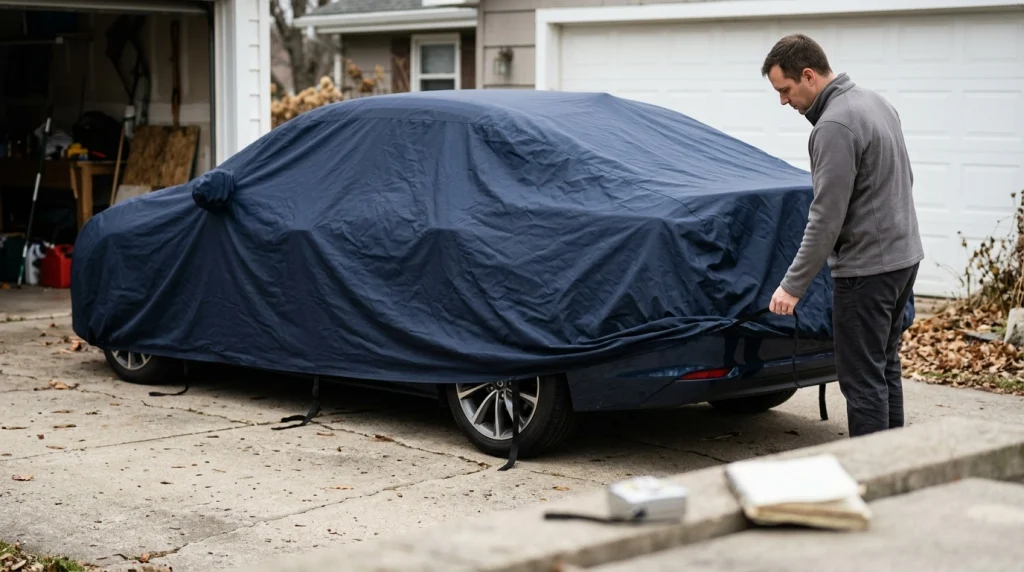
The biggest measuring mistakes come from using the wrong points or ignoring the size chart. Most are easy to prevent.
Mistake 1: Measuring Over the Roof
Running a tape over the hood, windshield, roof, and trunk does not give overall vehicle length. It measures a curved surface.
Use a straight horizontal bumper-to-bumper measurement instead.
Mistake 2: Ignoring the Mirror Instructions
Some guides exclude mirrors from body width. Others require them to be included.
Record both numbers and confirm which one the manufacturer uses. That simple check prevents avoidable sizing errors.
Mistake 3: Buying by Vehicle Category Alone
Not all compact SUVs share the same dimensions. Sedans also vary in length, width, and height.
Use vehicle categories to narrow your search, not to make the final decision.
Mistake 4: Forgetting Fixed Accessories
A cargo box, tow bar, or rear spare tire can change the fit. Measure those items if they remain installed under the cover.
Also consider sharp edges that could damage the material.
Mistake 5: Choosing an Oversized Cover
A cover with too much loose material can flap when exposed to wind. That movement may rub against dusty paint.
Look for a close fit with suitable fastening points. Don’t rely on excess fabric to accommodate an incompatible body shape.
Mistake 6: Covering a Dirty or Hot Vehicle
Correct sizing does not remove the need for good cover care. Dirt trapped between the fabric and paint can create scratches when the cover moves.
Clean the vehicle before covering it. Follow the cover manufacturer’s instructions about drying and hot exhaust parts.
Final Fit Checklist
- Overall length measured correctly.
- Body width recorded without mirrors.
- Mirror-to-mirror width noted separately.
- Ground-to-roof height measured.
- Fixed accessories checked.
- Body style matched with the cover design.
- Manufacturer’s size chart reviewed.
- Cover material and intended indoor or outdoor use confirmed.
- Hem and fastening system checked.
After buying, test the fit gently. The cover should settle over the body without forcing seams or stretching over sharp accessories.
Section Takeaway: Measure carefully, check accessories, and follow the actual product instructions. A secure fit matters more than the size label.
Frequently Asked Questions
1. How do I know what size car cover I need?
Measure your car’s overall length, widest body width, and ground-to-roof height. Compare all three with the manufacturer’s sizing chart.
Also check the vehicle body style and fixed accessories. Don’t rely on small, medium, or large labels alone.
2. Do I measure a car cover with the mirrors open or closed?
Measure the main body width without mirrors, then record mirror-to-mirror width. If the mirrors fold, note the width in your usual covered position.
Some covers include mirror pockets, while others don’t. Always follow the product’s measurement instructions.
3. Should I buy a car cover slightly bigger than my car?
A little extra room may be useful when you fall between two sizes. However, the cover should not be so loose that it moves heavily in the wind.
Choose a product that accommodates all the required dimensions and offers a suitable securing system.
4. Can I use the same car cover for different vehicles?
Possibly, if both vehicles fit the cover’s stated dimensions and body-shape requirements. A universal cover may accommodate several similar models.
A custom-fit cover is less likely to fit a different vehicle properly. Check each car’s dimensions before sharing one cover.
5. What is the most important measurement for a car cover?
Overall length is often the first measurement used to narrow universal-cover sizes. But width and height are also important.
A cover with enough length may still be too narrow or too short along the sides. Check every required dimension.
6. Can I measure a car for a cover by myself?
Yes. Mark the bumper endpoints on level ground and measure between them. Use the same approach for body width.
A helper makes the process easier, especially for SUVs and trucks. Recheck unusual measurements before ordering.
7. Do I need to measure my car for a custom-fit cover?
Not always. Many custom-fit cover sellers use the vehicle’s year, make, model, trim, and body style to select a pattern.
However, modified vehicles may need additional measurements. Confirm whether roof accessories, spoilers, or body kits affect compatibility.
Final Thoughts: Measure Once, Choose the Right Cover
Knowing how to measure a car for a cover makes shopping much easier. You only need a few tools and three main dimensions.
Measure the length, body width, and height accurately. Then check mirror clearance, accessories, and the manufacturer’s sizing chart.
My advice is simple: don’t guess based on how big your car looks. A few careful measurements can help you avoid a poorly fitting cover and an unnecessary return.
Before you buy, save your dimensions and compare them with the exact cover you want. That final check is worth the effort.
