
How to Check Oil Level in Bmw 328i

Regularly checking your BMW 328i’s oil level is a non-negotiable maintenance task that protects your engine from costly damage. This guide covers both the traditional dipstick method for older models and the electronic system for newer ones, ensuring you get an accurate reading every time. Learn the precise steps, when to check, and exactly what to do if your oil is low, using the correct BMW-approved oil type.
So, you’re the proud owner of a BMW 328i. That sleek, sporty sedan or coupe is a masterpiece of German engineering, a true driver’s car. But like any high-performance machine, its heart—the engine—demands respect and consistent care. And at the very core of that care is one simple, often overlooked, ritual: checking the oil. It might seem basic, but for a precision instrument like your 328i, understanding how to check oil level in BMW 328i is fundamental knowledge. It’s the single most important check you can perform yourself to ensure your Bimmer’s longevity and avoid a wallet-draining engine repair. This guide will walk you through everything, from the philosophy of oil to the exact button presses on your iDrive, making you a confident caretaker of your Bavarian masterpiece.
Key Takeaways
- Your BMW 328i’s engine relies on clean oil at the correct level to function properly; neglecting this check risks severe engine wear and failure.
- There are two primary methods: the physical dipstick (common in older models) and the electronic oil level sensor accessed via the iDrive system (common in newer models).
- Always check the oil when the engine is warm but has been turned off for at least 5-10 minutes on level ground for the most accurate reading.
- Using the correct oil specification (like BMW LL-04 or LL-17 FE+) is as important as the level itself; using the wrong oil can damage sensitive engine components.
- If the oil level is low, add only the exact oil type BMW specifies, doing so slowly and re-checking frequently to avoid overfilling, which is equally dangerous.
- A consistently dropping oil level between checks signals a potential leak or oil consumption issue that needs immediate professional diagnosis.
- After adding oil or performing maintenance, you may need to reset the service reminder; consult your owner’s manual for the specific procedure for your model year.
📑 Table of Contents
- Understanding Your BMW 328i’s Oil System: More Than Just a Lubricant
- Why Checking Your Oil is Non-Negotiable: Beyond the Checklist
- The Perfect Time and Place: Setting Up for an Accurate Reading
- Method 1: The Traditional Dipstick Check (For Models with a Dipstick)
- Method 2: The Electronic Oil Level Check via iDrive (For Models Without a Dipstick)
- Interpreting the Results: From “OK” to “Emergency”
- When and How Often to Add Oil: Proactive Maintenance
Understanding Your BMW 328i’s Oil System: More Than Just a Lubricant
Before we get our hands dirty, let’s appreciate what we’re checking. Engine oil isn’t just a slippery liquid; it’s the lifeblood of your engine. It performs four critical jobs: it lubricates moving parts to prevent metal-on-metal contact, it cools hotspots the coolant can’t reach, it cleans by suspending combustion byproducts, and it protects against corrosion. In a high-revving, turbocharged engine like the one in most 328i models (the N20 or B48 turbo four-cylinder), these functions are pushed to their limits. The oil works harder, gets hotter, and degrades faster. This is why maintaining the exact correct oil level is so crucial. Too little oil, and you get catastrophic friction and overheating. Too much oil, and the crankshaft can whip it into a frothy, aerated foam that can’t lubricate properly, leading to the same kind of damage. The “just right” level is the sweet spot your engine was engineered for.
The Evolution: Dipstick vs. Electronic Monitoring
This is the first big decision you’ll face when learning how to check oil level in BMW 328i. BMW phased out the traditional dipstick in many models around the 2012-2013 model year, moving to a sealed system with an electronic oil level sensor. Your specific method depends entirely on your production year and model.
- Physical Dipstick: Found on earlier 328i models (typically pre-2012 F30 chassis and all E90/E92/E93 models). It’s a simple, direct, and foolproof method you control yourself.
- Electronic Oil Level Sensor (iDrive): Standard on most later F30/F31/F32/F36 328i models. The car’s computer measures the level via a sensor in the oil pan and displays it on the iDrive screen. It’s convenient but requires understanding the interface and, occasionally, a reset procedure.
We’ll cover both in detail. If you’re unsure which system your car has, a quick look under the hood for a yellow or red dipstick handle will tell you. If you don’t see one, you have the electronic system. For a deeper dive into general oil checking principles that apply to all cars, you can reference a comprehensive guide like this one on how to check the oil in a car.
Why Checking Your Oil is Non-Negotiable: Beyond the Checklist
You might think, “My car has an oil life monitor, and I get regular changes. Why bother?” Great questions. Let’s break down the compelling reasons.
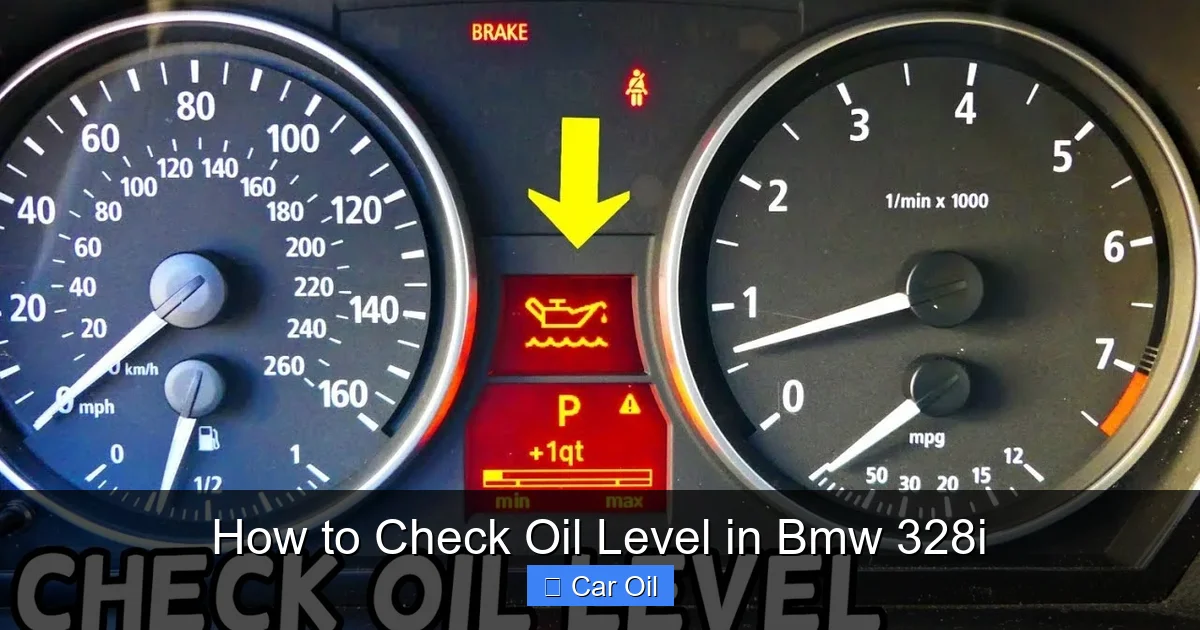
Visual guide about How to Check Oil Level in Bmw 328i
Image source: i.ytimg.com
The Oil Life Monitor is Not a Level Gauge
This is the most common misconception. The oil life service indicator calculates when to change the oil based on engine revolutions, temperature, and time. It does not tell you the quantity of oil in the sump. A car can have 0% oil life remaining but a perfect oil level, or it can have 80% oil life left but be a quart low due to a minor leak or normal “oil consumption” (some engines burn a tiny amount of oil over time). You must check the level independently.
Detecting Problems Before They Become Catastrophes
A simple check can reveal a host of brewing issues:
- Gradual Oil Loss: Finding the level consistently dropping (e.g., a quart every 1,000 miles) points to worn seals, a leaking gasket, or a turbocharger seal issue. Catching a small leak early is a $200 fix; ignoring it until the engine seizes is a $5,000+ rebuild.
- Contaminated Oil: If the oil on your dipstick looks milky or frothy, it could mean coolant is leaking into the oil (a head gasket issue). If it’s extremely dark and gritty immediately after a change, it suggests an internal engine problem.
- Incorrect Oil Type: While checking, you can also note the oil’s condition. If it seems too thin or has an unusual smell, it might be the wrong viscosity. Using the correct BMW-spec oil is vital. Understanding specifications is key, and resources on how much oil needs to be in a car often include details on the right type.
The Perfect Time and Place: Setting Up for an Accurate Reading
Timing and conditions are everything. An inaccurate check is worse than no check because it gives you false confidence.

Visual guide about How to Check Oil Level in Bmw 328i
Image source: i.ytimg.com
Engine Temperature: The Golden Rule
For the most accurate reading on a BMW 328i, you want the engine to be warm but not hot. The ideal scenario is after a normal drive of at least 15-20 minutes, allowing the oil to heat up and circulate fully, then park the car on a level surface and turn it off. Wait 5-10 minutes. This allows the oil to drain back from the cylinder heads and turbo into the oil pan, settling around the dipstick or sensor. Checking immediately after a hard drive (engine scorching hot) can give a false “low” reading as oil is still distributed throughout the engine. Checking when stone-cold can also be slightly low as oil hasn’t fully settled. The 5-10 minute warm-soak is your best practice.
Level Ground is Non-Negotiable
This cannot be stressed enough. You must park your 328i on a perfectly level surface—a flat garage floor or a dead-level parking spot. If the car is on a slope, the oil will pool to the low side, and your dipstick or sensor will give a wildly inaccurate reading. Always engage the parking brake and ensure the transmission is in Park (or Neutral for a manual).
Method 1: The Traditional Dipstick Check (For Models with a Dipstick)
If your 328i has a dipstick, this is a hands-on, reliable method. Let’s get to it.
Visual guide about How to Check Oil Level in Bmw 328i
Image source: cdn.bmwblog.com
Step-by-Step: Pull, Wipe, Reinsert, Read
- Locate the Dipstick: Open the hood. The dipstick is usually a bright yellow or red looped handle, often with an oil can icon on it. It’s typically near the front of the engine bay, on the driver’s side. If you’re unsure, your owner’s manual will have a labeled diagram.
- First Pull & Wipe: Pull the dipstick all the way out. Using a clean lint-free rag or paper towel, wipe it completely clean. This removes all old oil, giving you a fresh baseline.
- Reinsert Fully: Now, push the dipstick all the way back into its tube until it seats fully. Don’t just drop it; make sure it’s seated correctly, as an improper seat can skew the reading.
- Second Pull & Read: Pull the dipstick out again and examine the end. You’ll see two marks, holes, or a cross-hatched area. The lower mark is “MIN” or “LOW.” The upper mark is “MAX” or “FULL.” The oil level should be between these two marks, ideally right at or near the “FULL” mark. The dipstick is designed to be read by holding it vertically; the oil will cling to it and show a clear line.
Interpreting the Dipstick: What the Oil is Telling You
Now, look at the oil on the stick. Note its level, but also its color and consistency.
- Color & Clarity: Fresh, clean BMW-spec oil is typically amber or light brown when new. As it ages, it darkens. This is normal. However, if it’s jet black and gritty after a recent change, or if it looks milky or foamy, that’s a red flag. Milky oil suggests coolant contamination.
- Level: If it’s between MIN and MAX, you’re good. If it’s at or below MIN, you need to add oil immediately. If it’s significantly above MAX (overfilled), you need to drain some—overfilling is a serious issue that can cause aeration and increased pressure.
For a broader understanding of oil levels across different vehicles, articles like how to check oil level on car quickly and accurately offer universal tips that reinforce these fundamentals.
Method 2: The Electronic Oil Level Check via iDrive (For Models Without a Dipstick)
For your later-model 328i, the process is digital but just as important. The car’s computer constantly monitors the oil level using a sensor in the oil pan, but you must access it correctly.
Accessing the Oil Level Menu
- Start Conditions: Ensure the car is on level ground and the engine is warm but has been turned off for at least 5 minutes. The system requires a “settling” period for an accurate reading.
- Ignition On: Turn the ignition to the “ON” position (power on, but do not start the engine). You’ll see the iDrive screen light up.
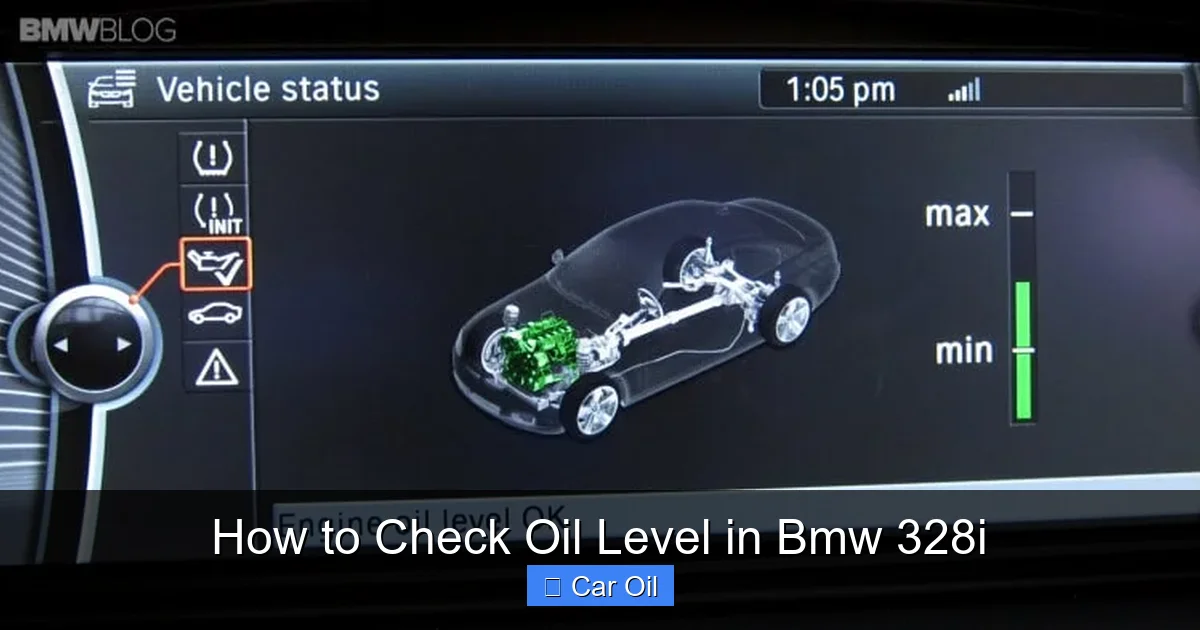
- Navigate the iDrive Menu: Use the iDrive controller knob to navigate. The exact menu path can vary slightly by year, but it’s typically: CAR > Vehicle Settings > Service Functions > Oil Level or Vehicle Info > Service Requirements > Oil Level. Your owner’s manual is the ultimate authority here.
- Read the Display: The screen will show a graphic, often a dipstick or a bar graph, with an indicator. It will say something like “Oil level OK,” “Oil level max,” or “Oil level min. Add 1.0 qt.” It may also show a precise measurement in liters or quarts from “MIN” to “MAX.”
The Crucial “Reset” or “Update” Procedure
This is a critical step many people miss. After you add oil, or sometimes just after checking, the system may need to be told to re-measure. If you just added a quart and the screen still says “MIN,” don’t add more! Instead, you often need to:
- With the engine off and ignition on, navigate back to the oil level menu.
- There should be an option like “Update” or “Reset.” Select it.
- The system will then prompt you to perform a check. It may ask you to turn the ignition off and on again, or it may simply say “Checking…” for 30-60 seconds as the sensor takes a new reading after the oil has settled.
- After this procedure, the new, correct level should display.
If your car has a service indicator light for “Oil Service” or “Engine Oil,” this is separate from the level check. Resetting that after an oil change is a different procedure. For details on service intervals specific to your BMW 3 Series, a dedicated article on how often to change oil in a BMW 3 Series can provide model-year-specific guidance.
Interpreting the Results: From “OK” to “Emergency”
Whether you’re looking at a dipstick or an iDrive screen, knowing what the result means is the final piece of the puzzle.
The “OK” or Normal Zone
If your oil level is between the marks on the dipstick or the iDrive says “Oil level OK” and shows the indicator in the green/safe zone, fantastic. Your engine is safe from immediate low-oil danger. Your job is done until the next check. Make a mental note of the exact level. Is it exactly at MAX? At halfway? This helps you track consumption over time.
The “Low” or “MIN” Warning
This is your engine’s cry for help. If the dipstick shows at or below MIN, or the iDrive explicitly says “Oil level min” or shows a red bar, you must add oil immediately, but only after a few crucial steps.
- Do Not Start the Engine: If the level is critically low, do not run the engine. Driving even a short distance with insufficient oil can cause instantaneous, irreversible damage.
- Identify the Correct Oil: This is paramount. Your BMW 328i requires oil that meets specific BMW Longlife specifications. Common ones for the N20/B48 engines are BMW LL-04 or the newer BMW LL-17 FE+. The exact spec is in your owner’s manual under “Capacities” or “Fluids.” It will also be on the oil cap. Using generic 5W-30 might not be enough. The oil must be explicitly approved for BMW’s advanced engine technology. For a general guide on adding oil, the principles in how to put oil in the car apply, but the fluid type is the critical variable.
- Add Slowly: Open the oil filler cap (located on top of the valve cover, usually with a yellow cap). Using a clean funnel, add approximately half a quart (0.5L) at a time of the correct oil.
- Re-Check: After adding, wait a minute for the oil to settle, then re-check using your method (dipstick or iDrive update). Repeat until the level is in the safe zone, ideally just below the MAX/FULL mark. Never overfill.
The “Overfull” Situation
If your dipstick shows oil above the MAX mark, or the iDrive shows “MAX” and you suspect overfill (maybe from a recent service), you have a problem. Overfilled oil can cause aeration (foaming), increased crankcase pressure, seal leaks, and can even lead to catastrophic engine failure. The only safe remedy is to drain the excess. This is best done by a professional, as it involves removing the drain plug. Do not try to siphon it out through the filler; you risk introducing contaminants. If you’ve just overfilled, drive minimally to a service center.
When and How Often to Add Oil: Proactive Maintenance
Checking is step one. Acting on what you find is step two. But how often should you be doing this check?
The Recommended Frequency
For a BMW 328i, a good rule of thumb is to check the oil level at least once a month and before any long road trip. If you have an older model or one that burns a known amount of oil, check it every other fuel fill-up. Don’t rely solely on the service interval. The oil life monitor tells you about oil quality; you are responsible for oil quantity.
Adding Oil: The Right Way
When adding, always use a funnel to avoid spills. Pour slowly. After adding a quart, re-check. It’s easier to add more than to remove excess. Always use a high-quality oil that meets BMW’s specification. The cap itself usually says the specification, like “BMW Longlife-04.” If in doubt, consult your manual or a BMW specialist. Using the wrong oil, even if the level is correct, can harm the engine over time. For detailed instructions on the physical act of adding fluid, a step-by-step resource on how to fill oil in car can be helpful for beginners.
What to Do if Oil is Consuming Too Fast
If you find yourself adding more than a quart every 1,000-1,500 miles, your 328i has an oil consumption issue. This is not uncommon on some high-mileage N20 engines. Potential causes include worn piston rings, valve stem seals, or a failing turbocharger seal. Document how much you add and when. This information is vital for your mechanic. A systematic check for oil leaks should be performed to rule out external leaks first before diagnosing internal consumption.
Frequently Asked Questions
Should I check the oil when the engine is hot or cold?
For a BMW 328i, the ideal is when the engine is warm (after a 15+ minute drive) but has been turned off for 5-10 minutes on level ground. This allows the oil to fully settle in the pan for an accurate reading. Never check immediately after a hard run when the engine is scorching hot, and a stone-cold check can be slightly low.
My BMW has no dipstick. Is the electronic oil level reading reliable?
Yes, the electronic system is generally reliable, but it has specific requirements. The engine must be warm and off for several minutes on level ground. You must also use the “Update” function in the iDrive menu after adding oil or sometimes just to get a fresh reading. If the system shows “Oil level min” or a red warning, treat it as a true emergency low-oil condition.
What specific oil should I use if my BMW 328i is low?
You must use oil that meets BMW’s Longlife specification. For most 328i models with the N20 or B48 engine, this is BMW LL-04 or LL-17 FE+. The exact specification is listed on your oil cap and in your owner’s manual under “Capacities.” Using the wrong oil, even briefly, can damage sensitive components like the turbocharger and catalytic converters.
What does it mean if my oil level is fine but the service light is on?
The service light (or “Oil Service” indicator) is based on an oil life algorithm that counts engine revolutions and temperature. It is completely separate from the oil level gauge. A lit service light means it’s time for an oil and filter change based on time and usage, even if your oil level is perfect. You should schedule this service promptly.
My electronic oil level sensor shows “OK,” but I suspect a problem. What should I do?
Trust but verify. Perform a manual check if possible (some models with electronic systems still have a hidden dipstick for service techs). Also, monitor the level closely over a few weeks. If you notice a steady decline (e.g., losing a quart every 1,000 miles), have a mechanic perform a diagnostic for low oil pressure or consumption issues, even if the sensor hasn’t triggered a warning yet.
Can I reset the oil service reminder myself after adding oil?
You can often reset the oil service reminder via the iDrive menu (usually under “Vehicle Settings” > “Service Functions” > “Reset Service Items”). However, the procedure varies by model year. Resetting the service light does not check or fix the oil level. You must perform the separate oil level check/update procedure. If you are unsure, consult your owner’s manual or a professional. After a proper oil and filter change at a shop, they will reset it for you.