
How to Check Engine Codes on a 2015 Jeep Cherokee

Diagnosing your 2015 Jeep Cherokee’s check engine light is a straightforward DIY task that can save you time and money. You can retrieve trouble codes using the vehicle’s built-in diagnostic menu, a standalone OBD2 scanner, or a smartphone adapter with an app. Once you have the code, it points you toward the problem area, but professional diagnosis is often needed for the final fix.
That little glowing check engine light in your 2015 Jeep Cherokee’s instrument cluster can be a source of major anxiety. Is it a simple loose gas cap, or is your SUV on the verge of a costly breakdown? The good news is that you don’t have to wait in the dark. One of the most empowering things you can do as a vehicle owner is to learn how to check engine codes on a 2015 Jeep Cherokee. It’s not magic—it’s just reading the computer’s own report card. This guide will walk you through every method, from the no-tool built-in trick to using advanced scanners, so you can stop guessing and start diagnosing.
Key Takeaways
- The 2015 Cherokee uses the universal OBD2 system: This standardized protocol means any OBD2-compliant scanner will work, making code retrieval accessible and affordable.
- You have three main methods: Use the Cherokee’s own dash menu (no tools needed), a basic code reader, or a advanced Bluetooth/Wi-Fi scanner with a smartphone app for more data.
- Codes are clues, not diagnoses: A code like P0301 indicates a misfire in cylinder 1, but the cause could be a spark plug, coil, or fuel issue—further troubleshooting is required.
- Never clear codes without fixing the problem: Simply erasing the light without repair will cause it to return, and you’ll lose valuable diagnostic data that can help track intermittent issues.
- Some issues require a professional: Problems with the transmission, complex emissions systems, or manufacturer-specific codes often need advanced tools and expertise.
📑 Table of Contents
- Understanding Your Cherokee’s OBD2 System
- Preparing to Check Engine Codes on Your 2015 Jeep Cherokee
- Method 1: Using the Cherokee’s Built-in Diagnostic Menu
- Method 2: Using a Dedicated OBD2 Scanner
- Method 3: Smartphone Adapters & Apps
- Understanding and Interpreting the Codes
- What to Do After Finding the Code
- When to Seek Professional Help
- Conclusion
Understanding Your Cherokee’s OBD2 System
Before we dive into the “how,” let’s cover the “what.” Your 2015 Jeep Cherokee is equipped with an On-Board Diagnostics II (OBD2) system. This is a government-mandated, standardized computer system that monitors all the engine and emissions-related components. When it detects a problem outside of acceptable parameters, it logs a Diagnostic Trouble Code (DTC) and illuminates the check engine light.
What is an OBD2 Code?
An OBD2 code is a five-character alphanumeric code. The first character is a letter (P, C, B, or U), and the remaining four are numbers.
- P-codes: Powertrain (engine and transmission). These are the most common for check engine lights. P0XXX are generic codes, while P1XXX are manufacturer-specific.
- C-codes: Chassis (ABS, steering).
- B-codes: Body (airbags, climate control).
- U-codes: Network (communication between modules).
For a 2015 Jeep Cherokee, you’ll almost exclusively deal with P-codes for engine and transmission issues. For example, P0300 means “Random/Multiple Cylinder Misfire Detected,” while P0420 means “Catalyst System Efficiency Below Threshold.” Knowing the code is the first step; understanding what it means for your specific vehicle is the next.
Why Your Cherokee’s System is Special
The 2015 Cherokee (KL platform) is part of the Fiat Chrysler Automobiles (FCA) family. Its computer systems are sophisticated, and while it uses standard OBD2, some of its advanced features and manufacturer-specific codes are best read with a scanner that has good FCA coverage. Don’t worry—the basic methods we’ll cover will get you the essential codes.
Preparing to Check Engine Codes on Your 2015 Jeep Cherokee
Getting ready is simple, but a few steps ensure a smooth process.
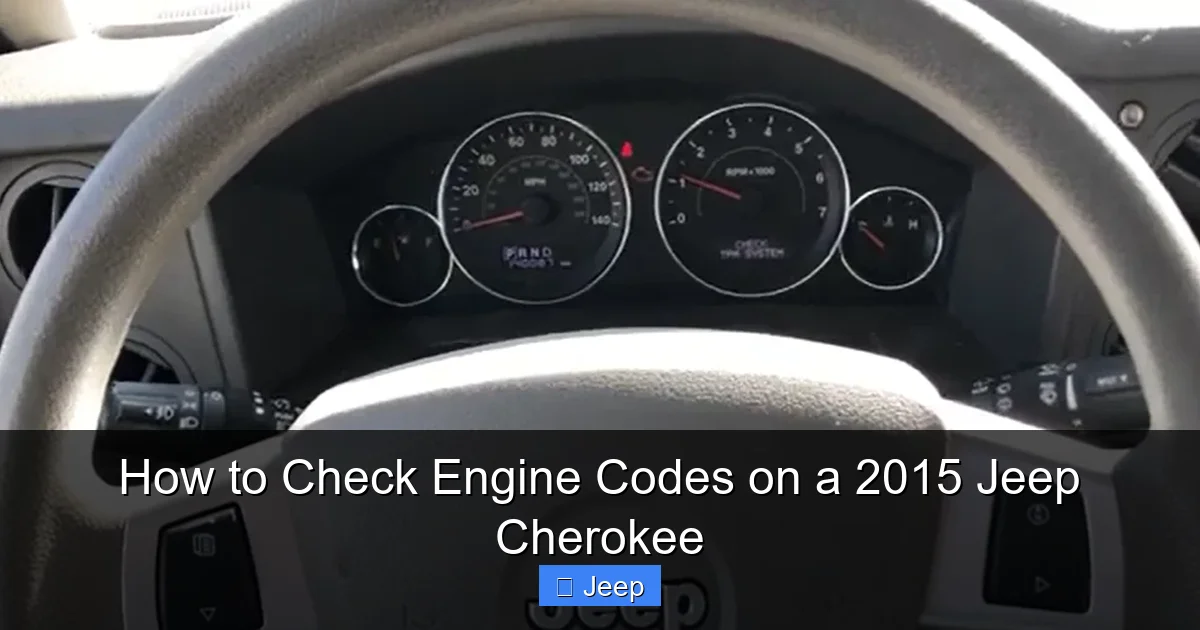
Visual guide about How to Check Engine Codes on a 2015 Jeep Cherokee
Image source: adventurejeep.com
Safety First
Park your Cherokee on a level surface, set the parking brake, and leave the engine off. You’ll need to turn the ignition to the “On” position (the position right before the engine starts, where all your dash lights come on) but do not start the engine. This powers the OBD2 port and the vehicle’s computer without engaging the systems.
Locate the OBD2 Port
The OBD2 port is a trapezoidal-shaped connector, usually 16-pin, mandated to be within two feet of the steering wheel. In your 2015 Cherokee, it’s almost always found under the dashboard, to the left of the steering column, near the driver’s knee. You might need to remove a small plastic cover. It’s the only port of that shape in that area.
Gather Your Tools (Based on Method)
What you need depends on your chosen method:
- Method 1 (Built-in Menu): Nothing but your Cherokee’s ignition key and the driver information display buttons.
- Method 2 (Basic Scanner): A generic OBD2 code reader/scanner (available from $20-$60).
- Method 3 (Smartphone): An OBD2 Bluetooth or Wi-Fi adapter (like an OBDLink or ELM327-based dongle) and a compatible smartphone app (e.g., Torque Pro for Android, OBD Fusion for iOS).
If you’re using an external scanner or adapter, ensure your phone is charged. For the built-in method, just you and your Cherokee.
Method 1: Using the Cherokee’s Built-in Diagnostic Menu
This is the ultimate “no-tool” method, exclusive to certain Jeep models. It’s a hidden feature that many owners don’t know about. It will read and display stored OBD2 codes directly on your instrument cluster’s screen.

Visual guide about How to Check Engine Codes on a 2015 Jeep Cherokee
Image source: adventurejeep.com
Step-by-Step Instructions
- Enter the Ignition: Turn the key to the “On” position (do not start the engine). All dash lights should illuminate.
- Access the Menu: Using the steering wheel-mounted controls (the buttons on the back of the right-side stalk or the left side of the steering column), navigate to the “Vehicle Info” or “Diagnostics” menu. The exact label can vary. On a 2015 Cherokee, you often press the “Menu” button on the left stalk, then use the up/down arrows to find “Diagnostics” or “System Check.”
- Initiate the Scan: Once in the Diagnostics menu, you may see options like “Read DTCs” (Diagnostic Trouble Codes) or “Continuous Memory.” Select “Read DTCs” or a similar option. The system will communicate with the engine computer.
- View the Codes: After a few seconds, the screen will display one or more codes. It will typically show something like “P0301” or “P0455.” Write these down. You may need to scroll through multiple codes if more than one is stored.
- Interpret (Basic): The Cherokee’s dash display will not give you a description—just the code. You’ll need to look up the meaning elsewhere (we’ll cover that later).
Pro Tip: This method is great for a quick check, but it only reads the codes stored in the engine’s primary memory. It may not access all module-specific codes or provide the rich data a scanner can.
Method 2: Using a Dedicated OBD2 Scanner
This is the most common and reliable method. A dedicated scanner gives you more control, better code definitions, and often the ability to clear codes after a repair.

Visual guide about How to Check Engine Codes on a 2015 Jeep Cherokee
Image source: cartireinflator.com
Choosing the Right Scanner for Your Cherokee
Any scanner that says “OBD2” or “OBDII” compatible with 1996+ vehicles will plug in and read basic powertrain codes. For a 2015 Jeep Cherokee, consider:
- Basic Readers ($20-$50): Like the Autel AutoLink AL319 or Innova 3160. They read and erase codes, view live data, and are simple to use. Perfect for most DIYers.
- Enhanced Scanners ($100-$300): Like the Autel MaxiCOM MK808 or Launch CRP123. These have better FCA/Jeep coverage, can read manufacturer-specific codes, access other modules (ABS, airbag), and perform basic bi-directional tests.
- Professional-Level ($500+): Like the Snap-on Zeus or Motorola handhelds. Overkill for most home users.
For a 2015 Jeep Cherokee, a mid-range scanner with good Fiat Chrysler coverage is a sweet spot. If you’re on a budget, a basic ELM327-based Bluetooth dongle with a good app (Method 3) can be nearly as capable.
Connecting and Reading Codes
- Connect: With the ignition on (engine off), plug the scanner’s cable into the OBD2 port under your Cherokee’s dash.
- Power On: Turn the scanner on. It will usually power up from the vehicle’s OBD2 port.
- Select Vehicle: Some scanners ask you to select the make, model, and year. Choose Jeep, Cherokee, and 2015.
- Read Codes: Navigate the menu to “Read Codes” or “Scan for DTCs.” The scanner will communicate with the PCM (Powertrain Control Module).
- Record: The screen will display all stored codes. Write down the full code (e.g., P0420) and the description. Many scanners also show a “Pending” or “Permanent” status. Note this. A “Pending” code means the fault has occurred once but hasn’t yet met the criteria to be set as a confirmed fault.
- Erase (Later): Do not erase the codes yet. First, diagnose and fix the problem. After the repair, you can use the “Erase Codes” function. The scanner will then confirm the light is off.
Method 3: Smartphone Adapters & Apps
This is a versatile and often cheaper method that turns your phone into a powerful scan tool.
Hardware: The Bluetooth/Wi-Fi Adapter
You need a small OBD2 adapter that plugs into your Cherokee’s port and broadcasts a signal. The most common are:
- Bluetooth (Android): Very common, works with Torque Pro app. Reliable and inexpensive.
- Wi-Fi (iOS/Android): Required for iPhones/iPads, as they don’t support classic Bluetooth for this. Works with apps like OBD Fusion.
- Recommended: OBDLink MX+ or OBDLink LX. They are faster, more reliable, and have better FCA/Jeep protocol support than cheap generic ELM327 clones.
Software: The App
Download a compatible app. Popular choices:
- Torque Pro (Android): The gold standard. Highly customizable, reads codes, shows live data in gauges/graphs, and has a massive community-created PID database for Jeeps.
- OBD Fusion (iOS): Excellent, feature-rich app for iPhone users.
- JScan (Android/iOS): Specifically designed for FCA/Jeep/Chrysler/Dodge/Ram vehicles. It can access many manufacturer-specific systems, perform resets (like steering angle sensor calibration), and is highly recommended for deeper work on your Cherokee.
How to Connect and Use
- Install: Plug the adapter into the Cherokee’s OBD2 port with the ignition on.
- Pair: On your phone, go to Bluetooth/Wi-Fi settings, find the adapter (often named “OBDII” or “OBDLink”), and pair/connect.
- Open App: Launch your chosen app. It should automatically connect to the adapter.
- Read Codes: In the app, find the “Read DTCs” or “Scan” function. The app will pull all stored codes from the Cherokee’s computer.
- View Details: Tap on a code to see its full definition (generic and often manufacturer-specific). Apps like Torque and JScan also let you look up what the code means for your vehicle.
- Live Data: This is the killer feature. You can monitor engine RPM, coolant temp, oxygen sensor voltages, and more in real-time. This is invaluable for confirming an issue. For example, if you have a misfire code (P0301), you can watch the short-term fuel trim or the specific cylinder’s misfire count while the engine runs.
Using a smartphone method is often the most informative and cost-effective way to check engine codes on a 2015 Jeep Cherokee.
Understanding and Interpreting the Codes
You’ve got a list of codes. Now what? A code is a starting point, not the final answer. Let’s break down what you’re seeing.
Code Structure and Severity
Look at the first digit after the letter:
- 0 or 2: Generic (SAE) codes. These are universal across all OBD2 vehicles.
- 1: Manufacturer-specific codes. These are unique to FCA/Jeep and require more specific knowledge. A scanner with good FCA coverage will show the description.
- 3, 4, etc.: Often reserved for network or future codes.
The last digit often indicates the specific subsystem. For example, in the P0XXX series:
- P00XX: Air/Fuel Flow
- P01XX: Air/Fuel Flow (more specific)
- P02XX: Fuel Injector Circuit
- P03XX: Ignition System/Misfire
- P04XX: Auxiliary Emissions Controls
- P05XX: Speed Control & Idle Control
- P06XX: Computer Output Circuit
- P07XX: Transmission
- P08XX: Transmission
- P09XX: Transmission
- P0AXX to P0FXX: Hybrid/EV, more recent systems
Common 2015 Jeep Cherokee Engine Codes
While many codes are possible, some appear more frequently on the KL Cherokee:
- P0300-P0306: Cylinder Misfire. P0300 is random/multiple; P0301 is cylinder 1, etc. Causes: spark plugs, ignition coils, fuel injectors, vacuum leaks, low compression.
- P0420: Catalyst System Efficiency Below Threshold. Usually means the catalytic converter is failing or there’s an exhaust leak before it. Do not ignore this; it can lead to expensive repairs.
- P0455: Evaporative Emission System Leak Detected (Large). Almost always a loose or faulty gas cap, but can also be a leak in the charcoal canister or vent lines.
- P0171/P0174: System Too Lean (Bank 1/Bank 2). The engine is getting too much air or not enough fuel. Check for vacuum leaks, dirty MAF sensor, or weak fuel pump.
- P0128: Coolant Thermostat (Coolant Temperature Below Thermostat Regulating Temperature). Often a faulty thermostat, but can also indicate a low coolant level or a bad coolant temperature sensor.
- P0562: System Voltage. The charging system voltage is too low. Could be a failing alternator, bad battery, or corroded connections.
For manufacturer-specific codes (P1XXX), a scanner with FCA coverage or a service manual is essential. For example, a code like P1E00 might relate to the Cherokee’s specific hybrid system (if equipped) or a transmission solenoid issue.
Using Live Data to Confirm
This is where you move from code to diagnosis. Let’s use P0171 (System Too Lean) as an example. The code says the air/fuel mixture is too lean. But is it a sensor problem or a real vacuum leak?
- Connect your scanner and view live data.
- Look at the Long-Term Fuel Trim (LTFT) and Short-Term Fuel Trim (STFT) values at idle and under light load.
- If both trims are high positive (e.g., +20% or more), the computer is adding a lot of fuel to compensate for too much air—a classic sign of a vacuum leak.
- You can then perform a smoke test on the intake system to find the leak.
- If the trims are normal, the culprit might be a faulty MAF (Mass Air Flow) sensor or an O2 sensor.
Live data transforms a simple code into a diagnostic process. If you’re not comfortable with this step, that’s when you seek professional help.
What to Do After Finding the Code
You’ve written down P0420 and P0455. Now the real work begins.
Step 1: Research the Specific Code for Your Cherokee
Don’t just Google “P0420.” Search “P0420 2015 Jeep Cherokee.” You’ll find forums like Jeep Cherokee Forum (JCF) or Allpar where thousands of owners have discussed the exact same code on the same model year. This is an invaluable resource. You’ll learn that on a 2015 Cherokee with a 2.4L or 3.2L engine, P0420 is often caused by a failing catalytic converter, but sometimes by a bad rear O2 sensor or an exhaust leak.
Step 2: Perform Basic Visual and Physical Checks
Before you start replacing parts, do this:
- Check for obvious issues: Is the gas cap tight? (For P0455). Are any vacuum hoses disconnected or cracked? (For lean codes or misfires). Are there any damaged wires or connectors near the engine?
- Inspect the engine: Look for oil leaks (which can foul spark plugs), coolant leaks, or damaged components.
- Check fluid levels: Engine oil, coolant, and transmission fluid. Low levels can trigger warnings.
Step 3: Simple Tests Based on the Code
- For Misfire Codes (P030X): Swap the suspect ignition coil and spark plug with a known good cylinder. Clear the codes and see if the misfire moves to the new cylinder. If it does, you’ve found the bad part.
- For Oxygen Sensor Codes: Monitor the O2 sensor live data. A slow, lazy sensor will have a flat voltage curve. A contaminated sensor may read stuck rich or lean.
- For Evap Codes (P0455): Tighten the gas cap until it clicks. If the code returns after a few drive cycles, the cap is faulty. A smoke test at a shop is the definitive way to find a leak in the system.
Step 4: Repair, Then Clear the Code
Once you’ve identified and fixed the faulty component (e.g., replaced spark plug, tightened gas cap, fixed vacuum leak), you must clear the stored codes. Use your scanner’s “Erase Codes” function. After clearing, drive the vehicle normally for a few drive cycles (usually 3-5, where the vehicle reaches operating temperature and is driven at various speeds). The check engine light should stay off. If it returns, the repair may not have been successful, or there is a secondary issue.
A Note on Permanent Codes
Some 2015 Cherokee codes, especially serious emissions-related ones, can set as “Permanent” codes. These cannot be erased by a standard scan tool until the vehicle’s self-tests pass successfully after the repair. This is a feature to prevent people from simply clearing codes before an emissions test. If you fix a P0420, you must drive the vehicle through its “drive cycle” so the computer verifies the catalytic converter is working again. Only then will the permanent code clear. This is another area where professional scan tools with “Drive Cycle” monitors are helpful. You can also find the specific drive cycle procedure for your 2015 Cherokee in a service manual or online forums.
When to Seek Professional Help
DIY is great, but there are clear boundaries. Know when to put the scanner down and call a pro.
- Transmission Codes (P07XX, P08XX, P09XX): These often indicate internal solenoid or pressure issues. Diagnosis requires advanced knowledge and sometimes a transmission-specific scanner.
- Complex Manufacturer-Specific Codes: If your code starts with P1 and your basic scanner only gives a number, you need a pro with a high-end scanner like a Chrysler WiTech or a top-tier aftermarket tool.
- Codes that return immediately after a repair: This suggests a misdiagnosis or a more complex, interconnected problem.
- No Codes, but Light is On: Rare, but possible if the PCM has an internal fault or a communication issue with another module (a U-code).
- Safety-Related Systems: If you also have ABS, traction control, or airbag lights on, these systems share data. A professional with a full-system scanner is needed to diagnose the network.
- You’re not comfortable: If the troubleshooting steps involve removing major components or you’re unsure, it’s cheaper in the long run to pay for a correct diagnosis than to throw parts at the problem.
A reputable independent mechanic or a Jeep dealership’s service department will have the tools and experience to handle complex 2015 Jeep Cherokee issues. For simple fixes like a gas cap or spark plugs, stick with DIY.
Conclusion
Learning how to check engine codes on a 2015 Jeep Cherokee demystifies the check engine light and puts you back in control. Start with the built-in dash menu method for a quick, free check. For more depth, invest in a good Bluetooth adapter and an app like Torque Pro or JScan. Remember, the code is a symptom, not the disease. Use it as a starting point for logical, methodical troubleshooting. Start simple—check the gas cap, listen for vacuum leaks, inspect for obvious damage. Consult the massive online Cherokee community for model-specific wisdom. And know your limits. For complex issues, a professional’s expertise is a worthwhile investment to keep your Cherokee running strong and reliable for years to come. Now, go pop that hood, plug in that scanner, and see what your Cherokee is trying to tell you.
Frequently Asked Questions
Can I drive my 2015 Jeep Cherokee with the check engine light on?
It depends on the code. If the light is steady and the vehicle runs normally, a short trip to get it diagnosed is usually okay. However, if the light is flashing, or you notice severe misfires, loss of power, or overheating, stop driving immediately. A flashing light indicates a condition that can damage the catalytic converter. When in doubt, have it towed.
What’s the difference between a stored code and a pending code?
A pending code means the computer has detected an issue once but it hasn’t yet occurred frequently enough or under the right conditions to be confirmed. A stored (or active) code means the fault has been confirmed. A pending code will become stored if the problem persists. Clearing a pending code before it becomes stored can make diagnosing intermittent problems harder.
Should I clear the check engine light code myself after a repair?
Yes, but only after you are confident the repair is complete. Clearing the code resets the system and allows the vehicle’s computer to run its self-tests again. If the problem is truly fixed, the light will stay off. If it returns quickly, your repair failed. Never clear a code without addressing the underlying issue, as it will just come back and you’ll lose the historical data that might help diagnose an intermittent problem.
What’s the best affordable scanner for a 2015 Jeep Cherokee?
For a balance of cost and capability, we recommend an OBDLink MX+ or LX Bluetooth/Wi-Fi adapter paired with the JScan app (for deep FCA/Jeep access) or Torque Pro (for general OBD2 and live data). This combo costs around $80-$120 and provides far more functionality than a $30 generic scanner, including better access to manufacturer-specific codes and systems.
My Cherokee has a code for the catalyst system (P0420). Does this mean I need a new catalytic converter?
Not necessarily. While a failed catalytic converter is the most common cause, other issues can trigger P0420. First, check for exhaust leaks before the converter, as these can fool the oxygen sensors. Also, inspect and test the rear (downstream) O2 sensor—a lazy or faulty sensor can set this code. A proper diagnosis using live data to monitor the O2 sensor activity is required before replacing the expensive converter.
Are there any codes I can’t read with a basic OBD2 scanner on my Cherokee?
Yes. A basic, generic OBD2 scanner will only read generic P0XXX codes and provide a basic definition. It will not read manufacturer-specific codes (P1XXX), codes for other vehicle modules (like the ABS module, body control module, or transmission control module), or allow you to perform advanced functions like steering angle sensor calibration or module reprogramming. For those, you need a scanner with specific Fiat Chrysler Automobiles (FCA) coverage, like the JScan app with an OBDLink adapter or a professional-grade scan tool.
