How to Change Kpa to Psi on a Subaru

Contents
- 1 Key Takeaways
- 2 📑 Table of Contents
- 3 Why Does the Pressure Unit Matter?
- 4 Understanding kPa and PSI: A Quick Science Lesson
- 5 How to Change kPa to PSI on Different Subaru Models
- 6 Manual Conversion: When You Can’t Change the Unit
- 7 Why Proper Tire Pressure Is Critical for Subaru Owners
- 8 Tips for Maintaining Accurate Tire Pressure
- 9 What If the Setting Won’t Stick?
- 10 Final Thoughts: Make the Switch for Clarity and Confidence
- 11 Frequently Asked Questions


Changing kPa to PSI on a Subaru is simple and ensures you read tire pressure in a unit you understand. This guide walks you through the steps for various Subaru models and explains why the conversion matters for safety and performance.
If you’ve ever glanced at your Subaru’s tire pressure monitoring system (TPMS) and seen a number followed by “kPa,” you might have paused and thought, “Wait—what does that mean?” You’re not alone. Many Subaru owners in the United States are more familiar with PSI (pounds per square inch) when it comes to tire pressure, yet their dashboard displays readings in kPa (kilopascals). This can be confusing, especially when you’re trying to follow the recommended tire pressure listed in your owner’s manual or on the door jamb sticker—which is almost always in PSI.
The good news? You don’t have to guess or do mental math every time you check your tires. Most modern Subarus allow you to change the pressure unit from kPa to PSI directly through the vehicle’s settings. It’s a quick adjustment that can make a big difference in how confidently you maintain your car. Whether you’re preparing for a long road trip, tuning up your ride for better fuel economy, or just trying to stay safe on wet roads, knowing your tire pressure in the right unit is essential.
In this guide, we’ll walk you through everything you need to know about changing kPa to PSI on a Subaru. We’ll cover why the difference matters, how to make the switch on various models, and what to do if your car doesn’t support the change. Plus, we’ll share practical tips for maintaining proper tire pressure—because no matter the unit, accuracy is key.
Key Takeaways
- Understanding the units: kPa (kilopascals) and PSI (pounds per square inch) are both measures of pressure, but PSI is more commonly used in the U.S.
- Why the conversion matters: Proper tire pressure improves fuel efficiency, tire life, and driving safety—knowing your pressure in the right unit helps maintain it.
- Subaru models vary: Not all Subarus allow unit changes via the dashboard; some require a trip to the dealer or a diagnostic tool.
- DIY methods exist: Many newer models let you switch units using the steering wheel controls and multi-information display.
- Manual conversion is an option: If your Subaru doesn’t support unit changes, you can convert kPa to PSI using a simple formula or online calculator.
- Regular checks are essential: Always verify tire pressure when tires are cold for the most accurate reading, regardless of the unit.
- Consult your owner’s manual: The best source for model-specific instructions on changing pressure units or accessing vehicle settings.
📑 Table of Contents
- Why Does the Pressure Unit Matter?
- Understanding kPa and PSI: A Quick Science Lesson
- How to Change kPa to PSI on Different Subaru Models
- Manual Conversion: When You Can’t Change the Unit
- Why Proper Tire Pressure Is Critical for Subaru Owners
- Tips for Maintaining Accurate Tire Pressure
- What If the Setting Won’t Stick?
- Final Thoughts: Make the Switch for Clarity and Confidence
Why Does the Pressure Unit Matter?
At first glance, kPa and PSI might seem like just two ways of saying the same thing—and technically, they are. Both measure pressure, which in this case refers to the amount of air inside your tires. However, the difference lies in the scale and regional preference. PSI is the standard unit used in the United States, while kPa is part of the metric system and more common in Europe and other parts of the world.
For Subaru owners in the U.S., seeing kPa on the dashboard can be disorienting. Most tire pressure recommendations—whether from the manufacturer, tire shops, or gas station air pumps—are given in PSI. If your car shows 220 kPa, you might not immediately know if that’s too high, too low, or just right. This confusion can lead to underinflated or overinflated tires, both of which come with risks.
Underinflated tires increase rolling resistance, which reduces fuel efficiency and causes uneven tire wear. They also generate more heat, raising the risk of a blowout, especially on long drives or in hot weather. Overinflated tires, on the other hand, have a smaller contact patch with the road, leading to reduced traction, harsher rides, and faster wear in the center of the tread.
By switching your Subaru’s display to PSI, you align your car’s readings with the standards you’re already using. This makes it easier to follow the recommended pressure (usually between 32 and 36 PSI for most Subaru models), check your tires regularly, and respond quickly if there’s a leak or temperature-related change.
Understanding kPa and PSI: A Quick Science Lesson
Visual guide about How to Change Kpa to Psi on a Subaru
Image source: i.postimg.cc
Before we dive into the how-to, let’s clear up what kPa and PSI actually mean—and why they’re different.
PSI stands for “pounds per square inch.” It measures how many pounds of force are applied to one square inch of area. This unit has been used in the U.S. for decades, especially in automotive and industrial applications. When you pump air into your tires at a gas station, the gauge reads in PSI. Most tire manufacturers also list maximum pressure and recommended inflation in PSI.
kPa, or kilopascals, is a metric unit of pressure. One kPa equals 1,000 pascals, and one pascal is defined as one newton of force per square meter. While it sounds more scientific, kPa is simply another way to express pressure—just on a different scale.
So how do they compare? Here’s the key conversion:
– 1 PSI ≈ 6.895 kPa
– 1 kPa ≈ 0.145 PSI
That means if your Subaru shows 220 kPa, you can convert it to PSI by dividing by 6.895:
220 ÷ 6.895 ≈ 31.9 PSI
Or, if you prefer to multiply:
220 × 0.145 ≈ 31.9 PSI
This puts your tire pressure right in the typical range for a Subaru, which is usually around 32–36 PSI. But doing this math every time you check your tires is tedious—and unnecessary. That’s why changing the display unit is so helpful.
How to Change kPa to PSI on Different Subaru Models

Visual guide about How to Change Kpa to Psi on a Subaru
Image source: i.ytimg.com
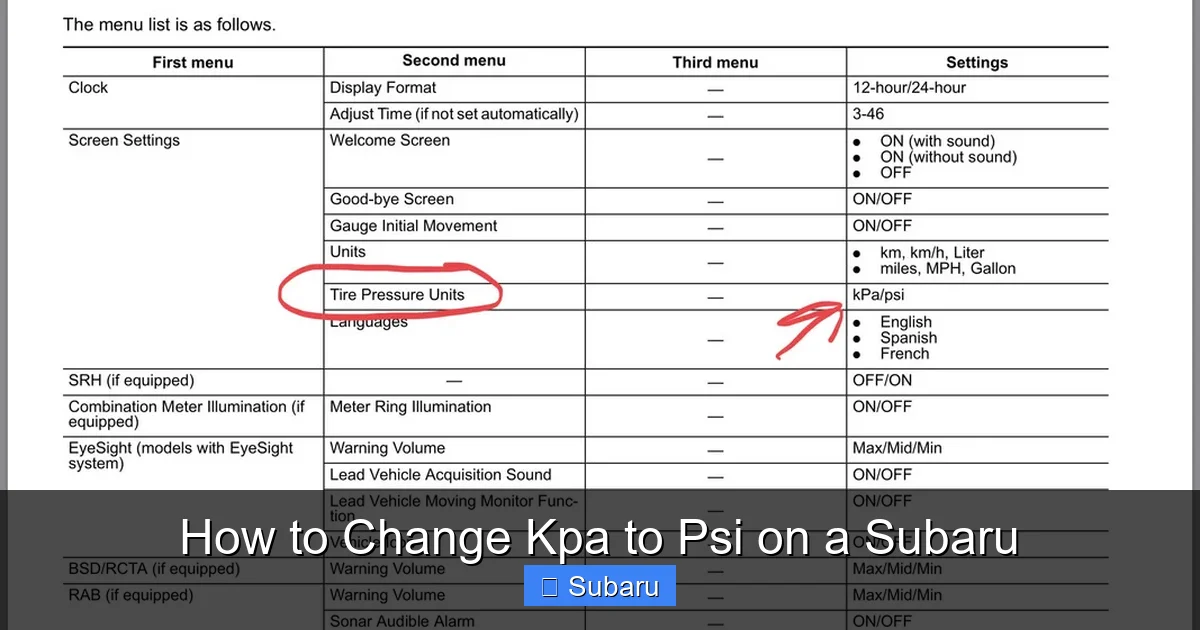
The process for changing the pressure unit from kPa to PSI varies depending on your Subaru’s year, model, and infotainment system. Some models make it easy with intuitive menus, while others require a bit more digging—or even a visit to the dealer. Let’s break it down by generation and system type.
Subaru Models with STARLINK Infotainment (2015 and Newer)
If your Subaru has the STARLINK multimedia system—common in models like the Outback, Forester, Impreza, and Crosstrek from 2015 onward—you can usually change the pressure unit through the vehicle settings menu.
Here’s how:
1. Start your car and let the system boot up.
2. Press the “Home” button on the touchscreen or steering wheel.
3. Navigate to “Settings” (often represented by a gear icon).
4. Select “Vehicle” or “Vehicle Settings.”
5. Look for “Tire Pressure” or “TPMS Settings.”
6. Choose “Units” or “Pressure Unit.”
7. Switch from “kPa” to “PSI.”
8. Confirm the change.
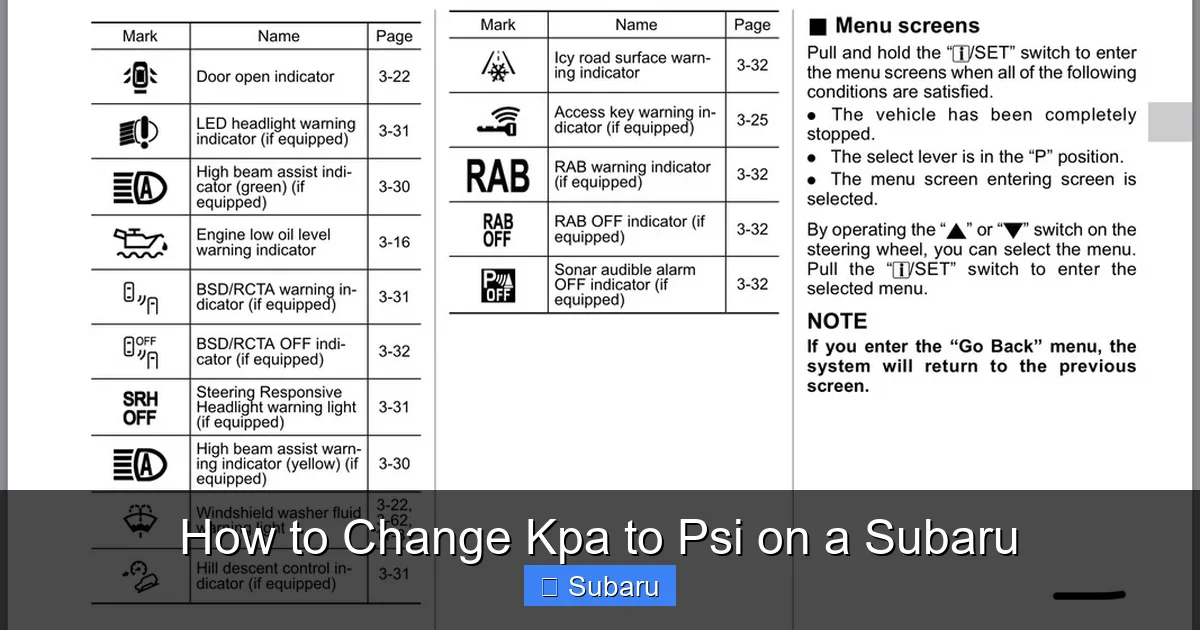
On some models, you may need to use the steering wheel controls instead of the touchscreen. Use the arrow buttons to scroll through the multi-information display (MID) on the instrument cluster. Look for a “Settings” or “Menu” option, then find “Unit” or “Display Settings.” From there, you can toggle between kPa and PSI.
Older Subaru Models (Pre-2015)
For older Subarus—like the 2010–2014 Legacy or 2008–2013 Forester—the process might not be as straightforward. Many of these vehicles don’t allow unit changes through the dashboard. Instead, the TPMS system may only display kPa, and there’s no built-in option to switch.
In these cases, you have a few options:
– **Use a manual conversion:** Keep a conversion chart or use your phone to calculate PSI from kPa.
– **Visit a Subaru dealer:** Some older models can have the unit changed using a factory diagnostic tool (like Subaru Select Monitor). A technician can reprogram the system to display PSI.
– **Install an aftermarket TPMS:** If you frequently tow, drive off-road, or just want more control, consider adding an aftermarket tire pressure monitoring system that displays in PSI.
Subaru WRX, STI, and Performance Models
Performance-oriented Subarus like the WRX and STI often come with more advanced driver displays. On models with the Driver Controlled Center Differential (DCCD) and multi-function displays, you may find the unit change option under “Vehicle Settings” or “Instrument Panel.”
For example, in a 2020 WRX STI:
1. Press the “Menu” button on the steering wheel.
2. Scroll to “Settings” using the arrow keys.
3. Select “Display” or “Units.”
4. Choose “Pressure Unit” and switch to PSI.
Always refer to your owner’s manual for model-specific instructions, as menu layouts can vary.
Subaru Ascent, Outback, and Newer SUVs (2020+)
Newer SUVs like the Ascent and updated Outback models often feature larger touchscreens and more intuitive menus. The process is similar to STARLINK systems but may include voice commands or smartphone integration.
Try saying, “Hey Subaru, change tire pressure units to PSI,” if your model supports voice control. Otherwise, follow the standard menu path:
– Home > Settings > Vehicle > TPMS > Units > PSI
Some models also allow you to customize the instrument cluster display. You can choose to show PSI prominently while keeping other metrics in metric units.
Manual Conversion: When You Can’t Change the Unit

Visual guide about How to Change Kpa to Psi on a Subaru
Image source: i.ytimg.com
If your Subaru doesn’t support changing the pressure unit—or if you’re in a pinch and need to check your tires quickly—manual conversion is a reliable fallback.
As mentioned earlier, the formula is simple:
PSI = kPa ÷ 6.895
or
PSI = kPa × 0.145
Let’s look at a few examples:
– 200 kPa = 200 ÷ 6.895 ≈ 29.0 PSI
– 230 kPa = 230 × 0.145 ≈ 33.4 PSI
– 250 kPa = 250 ÷ 6.895 ≈ 36.3 PSI
You can do this math on your phone’s calculator, or use a conversion app. Many tire shops and gas stations also have conversion charts posted near the air pumps.
Another tip: Create a quick reference sticker. Write down common kPa-to-PSI conversions and place it on your garage wall or inside your glove compartment. For example:
– 200 kPa = 29 PSI
– 210 kPa = 30 PSI
– 220 kPa = 32 PSI
– 230 kPa = 33 PSI
– 240 kPa = 35 PSI
– 250 kPa = 36 PSI
This way, you can glance at your dashboard, match the kPa reading to your chart, and know exactly what PSI you’re dealing with.
Why Proper Tire Pressure Is Critical for Subaru Owners
Subarus are known for their all-wheel drive, rugged capability, and safety features—but none of that matters if your tires aren’t properly inflated. Proper tire pressure is one of the simplest yet most impactful maintenance tasks you can do.
Here’s why it’s so important:
– **Safety:** Correctly inflated tires provide better grip, shorter braking distances, and improved handling—especially in rain, snow, or on gravel roads where Subarus often shine.
– **Fuel Efficiency:** Underinflated tires increase rolling resistance, forcing your engine to work harder. Keeping tires at the right PSI can improve gas mileage by up to 3%.
– **Tire Longevity:** Even wear means your tires last longer. Overinflated tires wear down the center; underinflated ones wear the edges. Both lead to premature replacement.
– **Ride Comfort:** The right pressure absorbs road shocks better, giving you a smoother, quieter ride.
– **TPMS Accuracy:** Your Subaru’s TPMS is designed to alert you when pressure drops below a safe threshold. But if you’re reading kPa and don’t know the equivalent in PSI, you might miss a warning.
Most Subaru models recommend a tire pressure of 32–36 PSI when the tires are cold (i.e., the car hasn’t been driven for at least three hours). Always check pressure in the morning or after the car has sat overnight for the most accurate reading.
Tips for Maintaining Accurate Tire Pressure
Changing the unit is just the first step. To get the most out of your Subaru—and your tires—follow these best practices:
– **Check monthly:** Make it a habit to check tire pressure at least once a month. Temperature changes can cause pressure to drop or rise.
– **Use a quality gauge:** Don’t rely solely on gas station gauges, which can be inaccurate. Invest in a digital or dial tire pressure gauge for home use.
– **Don’t forget the spare:** If your Subaru comes with a full-size spare, check its pressure too. You never know when you’ll need it.
– **Adjust for load:** If you’re carrying heavy cargo or passengers, increase pressure slightly (check your manual for guidelines).
– **Watch the weather:** For every 10°F drop in temperature, tire pressure decreases by about 1 PSI. In winter, check more frequently.
– **Reset the TPMS after changes:** If you adjust pressure or rotate tires, use the TPMS reset button (usually under the steering column) to ensure accurate alerts.
What If the Setting Won’t Stick?
Sometimes, after changing the unit to PSI, it reverts back to kPa after turning the car off and on. This can be frustrating, but it’s usually fixable.
First, make sure you’re following the correct steps for your model. Some systems require you to press “OK” or “Confirm” after selecting PSI. Others may need the ignition to be in “ON” mode (not just accessory) for the change to save.
If the setting still won’t stick, try these troubleshooting steps:
– Disconnect the battery for 10 minutes to reset the vehicle’s electronics.
– Update your STARLINK system via Wi-Fi or USB if an update is available.
– Visit a Subaru dealer for a software refresh or module reprogramming.
In rare cases, a faulty TPMS sensor or instrument cluster may prevent unit changes. A diagnostic scan can identify the issue.
Final Thoughts: Make the Switch for Clarity and Confidence
Changing kPa to PSI on your Subaru isn’t just about convenience—it’s about clarity, safety, and control. When you understand your tire pressure in the units you use every day, you’re more likely to maintain it properly. That means better performance, longer tire life, and safer drives—whether you’re cruising down the highway or exploring backcountry trails.
While not all Subarus make the switch easy, most modern models do. And for those that don’t, manual conversion is a reliable backup. Take a few minutes to check your owner’s manual, explore your dashboard settings, or visit a dealer if needed. Your tires—and your peace of mind—will thank you.
Remember: a well-maintained Subaru is a happy Subaru. And it all starts with the right pressure.
Frequently Asked Questions
Can I change kPa to PSI on all Subaru models?
Not all Subaru models allow you to change the pressure unit from kPa to PSI. Newer models with STARLINK infotainment usually support the change, but older vehicles may require a dealer visit or manual conversion.
Where is the TPMS reset button on a Subaru?
The TPMS reset button is typically located under the steering column, near the driver’s knee. It’s labeled “TPMS” or “Reset.” Press and hold it until the TPMS light blinks, then release.
What is the recommended tire pressure for a Subaru?
Most Subaru models recommend a tire pressure of 32–36 PSI when the tires are cold. Check the sticker on the driver’s door jamb or your owner’s manual for the exact number.
Can I use an app to convert kPa to PSI?
Yes! Many free apps and online calculators can instantly convert kPa to PSI. Just search “kPa to PSI converter” on your phone or browser.
Why does my Subaru show kPa instead of PSI?
Some Subaru models are programmed to display pressure in kPa, especially if they were manufactured for global markets. You can usually change this in the vehicle settings.
Is it safe to drive with incorrect tire pressure?
Driving with underinflated or overinflated tires can reduce fuel efficiency, cause uneven wear, and increase the risk of a blowout. Always maintain the recommended PSI for safety and performance.