
How Suzuki Designs Compact Vehicles

Suzuki’s compact vehicle design philosophy centers on smart engineering, fuel efficiency, and user-friendly innovation. By prioritizing space optimization, lightweight materials, and driver comfort, Suzuki creates cars that punch above their size—perfect for city driving and everyday adventures.
When you think of compact cars, images of tiny trunks, cramped back seats, and underpowered engines might come to mind. But Suzuki has spent decades rewriting that narrative. Their compact vehicles—like the Swift, Baleno, and Jimny—prove that small doesn’t mean small-minded. In fact, Suzuki designs compact vehicles with a bold vision: to deliver maximum value, efficiency, and joy in a minimal footprint. Whether you’re navigating narrow Tokyo streets or cruising through European villages, Suzuki’s compact cars are built to fit—and thrive—in tight spaces.
What sets Suzuki apart isn’t just the size of their cars, but the intelligence behind their design. From the drawing board to the assembly line, every decision is guided by a simple yet powerful principle: do more with less. This isn’t about cutting corners—it’s about smart engineering. Suzuki’s designers and engineers work in harmony to create vehicles that feel spacious, drive smoothly, and use every inch wisely. They don’t just build small cars; they build *smart* small cars.
Key Takeaways
- Space Optimization: Suzuki uses clever interior layouts and modular designs to maximize cabin and cargo space in small footprints.
- Lightweight Engineering: Advanced materials and efficient chassis design reduce weight, improving fuel economy and handling.
- Fuel Efficiency Focus: Suzuki integrates efficient engines and hybrid technology to deliver low emissions and high mileage.
- User-Centric Design: Interiors prioritize comfort, intuitive controls, and modern tech for a seamless driving experience.
- Safety Innovations: Compact models come equipped with advanced driver-assist systems and robust safety structures.
- Global Adaptability: Suzuki tailors compact vehicles to meet diverse market needs, from urban Japan to rural India.
- Sustainable Practices: The brand emphasizes eco-friendly manufacturing and recyclable materials in its design process.
📑 Table of Contents
- The Philosophy Behind Suzuki’s Compact Design
- Smart Space Utilization: Making the Most of Every Inch
- Lightweight Engineering for Better Performance and Efficiency
- Fuel Efficiency and Eco-Friendly Innovations
- Safety Without Compromise
- Global Design, Local Relevance
- The Future of Suzuki’s Compact Vehicles
The Philosophy Behind Suzuki’s Compact Design
At the heart of Suzuki’s approach is a deep understanding of real-world driving needs. The company was founded in 1909 as a loom manufacturer, but by the 1950s, it had shifted focus to motorcycles and eventually automobiles. This evolution gave Suzuki a unique perspective—one rooted in practicality and accessibility. Unlike some automakers that chase luxury or performance at all costs, Suzuki aims to make reliable, efficient transportation available to the masses.
This philosophy is especially evident in their compact vehicle lineup. Suzuki doesn’t design cars for showrooms alone; they design them for real people in real places. In countries like India, Japan, and South Africa, where traffic congestion, narrow roads, and fuel costs are daily concerns, Suzuki’s compact cars offer a lifeline. They’re easy to park, cheap to run, and surprisingly capable.
One of the core tenets of Suzuki’s design philosophy is “Small is Smart.” This isn’t just a marketing slogan—it’s a guiding principle. Engineers are challenged to innovate within constraints, not despite them. For example, instead of adding bulk to increase safety, they use high-tensile steel in strategic areas to reinforce the cabin without adding weight. Instead of expanding the wheelbase for comfort, they optimize seat design and suspension tuning to make the ride feel smoother.
Another key element is modularity. Suzuki designs platforms that can be adapted across multiple models. The HEARTECT platform, introduced in 2014, underpins popular models like the Swift, Baleno, and Ignis. This shared architecture allows Suzuki to reduce development costs, improve quality control, and speed up production—all while maintaining flexibility. A modular approach also means that features like hybrid systems or advanced infotainment can be rolled out across the range more efficiently.
Smart Space Utilization: Making the Most of Every Inch

Visual guide about How Suzuki Designs Compact Vehicles
Image source: carsguide-res.cloudinary.com
One of the biggest challenges in compact car design is space. How do you make a small car feel roomy? Suzuki’s answer lies in intelligent packaging. They treat interior space like a puzzle—every component must serve a purpose and fit seamlessly.
Take the Suzuki Swift, for instance. Despite its compact exterior, the Swift offers surprising legroom and headroom. This is achieved through a combination of low dashboard design, slim seats, and a flat floor in the rear. The fuel tank is positioned under the front seats, freeing up space in the rear. Even the door panels are sculpted to maximize elbow room without widening the car.
Suzuki also uses what they call “functional minimalism.” This means eliminating unnecessary clutter and focusing on essentials. The center console in the Baleno, for example, features a clean layout with intuitive controls. The gear shifter is positioned for easy reach, and the climate controls are large and tactile. There’s no need for a massive touchscreen when a well-placed dial does the job better.
Storage is another area where Suzuki excels. Compact cars often suffer from limited cargo space, but Suzuki counters this with clever solutions. The Jimny, despite its rugged off-road credentials, includes under-seat storage, door pockets, and a fold-flat rear seat. The Ignis offers a dual-level trunk floor, allowing you to hide valuables or create a flat loading surface.
Even the exterior design contributes to space efficiency. Suzuki’s compact vehicles often feature short overhangs—the distance between the wheels and the front or rear bumper. This not only improves maneuverability but also allows for a longer wheelbase relative to the overall length. A longer wheelbase means more interior space, even in a small car.
Lightweight Engineering for Better Performance and Efficiency
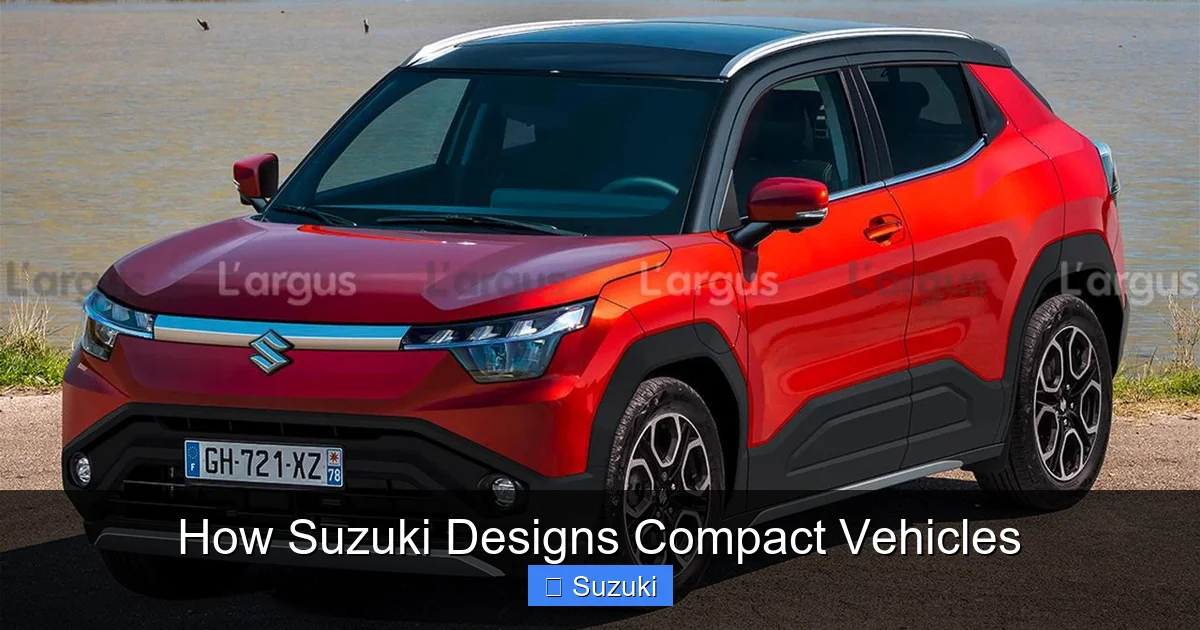
Visual guide about How Suzuki Designs Compact Vehicles
Image source: largus.fr
Weight is the enemy of efficiency. The heavier a car is, the more fuel it burns and the harder it is to stop and steer. Suzuki has long been a pioneer in lightweight engineering, and it’s a cornerstone of their compact vehicle design.
The HEARTECT platform, mentioned earlier, is a prime example. It uses a combination of high-tensile steel, aluminum, and advanced welding techniques to create a rigid yet lightweight body. This not only improves fuel economy but also enhances safety and handling. A lighter car accelerates faster, brakes shorter, and corners more confidently.
Suzuki’s engineers also focus on reducing weight in smaller components. For instance, they use plastic fuel tanks instead of metal ones, saving several kilograms. The suspension system is designed with lightweight materials like aluminum control arms and composite springs. Even the wheels are optimized—smaller diameters and lighter alloys reduce unsprung mass, which improves ride quality.
This lightweight approach pays off in real-world performance. The Suzuki Swift, for example, weighs around 900 kg (1,984 lbs) in its base form. That’s lighter than many competitors, including some larger hatchbacks. Despite its small size, the Swift feels agile and responsive, thanks in part to its low weight.
But lightweight doesn’t mean flimsy. Suzuki ensures that every gram saved doesn’t compromise safety. The body structure is designed to absorb and disperse crash energy efficiently. In fact, many Suzuki compact models have earned high safety ratings from organizations like Euro NCAP and Global NCAP.
Fuel Efficiency and Eco-Friendly Innovations

Visual guide about How Suzuki Designs Compact Vehicles
Image source: globalsuzuki.com
Fuel efficiency isn’t just a nice-to-have—it’s a necessity for compact car buyers. Suzuki understands this, and they’ve made efficiency a top priority in their design process.
One of the key tools in their arsenal is the Boosterjet engine family. These are small-displacement turbocharged engines that deliver strong performance without guzzling fuel. The 1.0-liter Boosterjet three-cylinder engine, used in the Swift and Baleno, produces around 111 horsepower while achieving over 20 km/l (approximately 47 mpg) in real-world driving. That’s impressive for a car that can also sprint from 0 to 100 km/h in under 10 seconds.
Suzuki also embraces hybrid technology. The mild-hybrid system, available in models like the Swift Hybrid and Vitara Hybrid, uses a small electric motor to assist the gasoline engine during acceleration and restart the engine seamlessly at stops. This reduces fuel consumption and emissions, especially in city driving.
But efficiency isn’t just about the engine. Suzuki looks at the whole vehicle. Aerodynamics play a big role—every curve and contour is designed to reduce drag. The Swift, for example, has a drag coefficient of just 0.32 Cd, which is excellent for a compact hatchback. Even the underbody is smoothed to improve airflow.
Tire choice also matters. Suzuki equips its compact cars with low-rolling-resistance tires that reduce friction without sacrificing grip. And the transmission is optimized for efficiency—many models come with a continuously variable transmission (CVT) that keeps the engine in its most efficient range.
Suzuki’s commitment to sustainability goes beyond the car itself. The company uses eco-friendly materials in production, such as recycled plastics and bio-based fabrics. They also aim to reduce CO2 emissions across their manufacturing process, with goals to achieve carbon neutrality by 2050.
Safety Without Compromise
Some people assume that small cars are less safe. Suzuki proves otherwise. Their compact vehicles are packed with safety features that rival those of larger, more expensive models.
The foundation of Suzuki’s safety strategy is the TECT (Total Effective Control Technology) body structure. This design uses a network of high-strength steel beams to create a protective cage around the passenger compartment. In a crash, energy is channeled away from the occupants and absorbed by crumple zones at the front and rear.
But safety isn’t just about surviving a crash—it’s about avoiding one in the first place. That’s why Suzuki equips its compact cars with advanced driver-assist systems (ADAS). Features like dual sensor brake support (automatic emergency braking), lane departure warning, and adaptive cruise control are available even on base models in many markets.
Take the Suzuki Swift, for example. In Europe, it comes standard with six airbags, ABS with EBD, and electronic stability control. Higher trims add features like blind-spot monitoring and rear cross-traffic alert. The Jimny, despite its rugged design, includes hill hold control and hill descent control—essential for off-road safety.
Suzuki also pays attention to visibility. Large windows, slim A-pillars, and well-placed mirrors reduce blind spots. The dashboard is designed to minimize glare, and many models offer rearview cameras as standard.
Testing is rigorous. Suzuki vehicles undergo thousands of crash simulations and real-world tests to ensure they meet or exceed global safety standards. The brand’s commitment to safety has earned it recognition from safety organizations worldwide.
Global Design, Local Relevance
Suzuki doesn’t design one-size-fits-all cars. Instead, they tailor their compact vehicles to meet the needs of different markets. This global mindset is a key strength.
In Japan, where parking space is at a premium, Suzuki offers kei cars—ultra-compact vehicles like the Alto and Wagon R. These cars are less than 3.5 meters long and have engines under 660cc, qualifying for tax and insurance benefits. They’re perfect for city dwellers who need something tiny, efficient, and affordable.
In India, Suzuki dominates the compact car market with models like the Swift, Dzire, and Baleno. These cars are designed for high mileage, low maintenance, and durability on rough roads. They feature reinforced suspensions, dust-proof cabins, and easy-to-repair components.
In Europe, Suzuki focuses on style, efficiency, and technology. The Swift and Vitara are popular for their sporty looks, hybrid options, and advanced infotainment systems. The Jimny has gained a cult following for its retro design and off-road capability.
This adaptability is possible because Suzuki’s design process is collaborative. Engineers, designers, and market researchers work together to understand local needs. For example, in tropical climates, Suzuki adds features like enhanced air conditioning and rust-resistant coatings. In colder regions, they offer heated seats and improved cold-start performance.
Suzuki also listens to customer feedback. Regular surveys and owner clinics help the company refine its designs. If drivers complain about a noisy cabin, Suzuki works to improve insulation. If they want more USB ports, Suzuki adds them in the next model year.
The Future of Suzuki’s Compact Vehicles
As the automotive world shifts toward electrification and connectivity, Suzuki is evolving its compact vehicle design to stay ahead.
The company has already launched the Swift Hybrid and is developing full electric models. The eVX concept, unveiled in 2023, hints at a future electric SUV based on the compact platform. It features a modern design, long-range battery, and advanced driver assistance.
Suzuki is also investing in smart mobility. Their compact cars are increasingly connected, with features like smartphone integration, over-the-air updates, and cloud-based services. The next generation of Suzuki vehicles will likely include more AI-driven features, such as predictive maintenance and personalized driving modes.
But even as technology advances, Suzuki remains committed to its core values: simplicity, efficiency, and accessibility. The future of compact vehicles isn’t just about being small—it’s about being smart, sustainable, and suited to real lives.
Whether you’re a city commuter, a weekend adventurer, or a budget-conscious family, Suzuki designs compact vehicles that work for you. They prove that great things really do come in small packages.
Frequently Asked Questions
What makes Suzuki’s compact cars different from other small vehicles?
Suzuki focuses on smart engineering, space optimization, and lightweight design to create compact cars that feel roomy, drive well, and use fuel efficiently. Their vehicles are built with real-world needs in mind, not just style or size.
Are Suzuki compact cars safe despite their small size?
Yes. Suzuki uses high-strength steel, advanced safety structures, and modern driver-assist systems to ensure their compact cars meet high safety standards. Many models have earned top ratings from global safety organizations.
How does Suzuki maximize interior space in small cars?
Suzuki uses low dashboards, slim seats, flat floors, and clever storage solutions. They also position components like the fuel tank under the seats to free up cabin and trunk space.
Do Suzuki compact cars offer good fuel economy?
Absolutely. With efficient engines like the Boosterjet turbo and mild-hybrid systems, Suzuki compact cars deliver excellent mileage—often over 20 km/l (47 mpg) in real-world driving.
Can Suzuki compact cars handle off-road conditions?
Yes, especially models like the Jimny. It features a ladder frame, part-time 4WD, and advanced off-road systems like hill descent control, making it capable on rough terrain.
Are Suzuki compact vehicles available worldwide?
Yes. Suzuki tailors its compact models to different markets—offering kei cars in Japan, rugged hatchbacks in India, and hybrid SUVs in Europe—ensuring relevance and performance everywhere.