How Much Should I Pay for a 2025 Toyota Corolla Cross?

Contents
- 1 Key Takeaways
- 2 📑 Table of Contents
- 3 Decoding the Sticker: Understanding MSRP and Invoice Price
- 4 The Trim Level Ladder: How Features Affect Price
- 5 The Mandatory Extras: Destination, Fees, and Taxes
- 6 Dealer Add-Ons: The Profit Centers You Can Avoid
- 7 Your Secret Weapons: Incentives and Financing
- 8 The Negotiation Game: Your Path to the “Out-the-Door” Price
- 9 Putting It All Together: A Real-World Example
- 10 Frequently Asked Questions



The 2025 Toyota Corolla Cross starts around $26,000 for the base L trim, with fully-loaded Hybrid AWD models nearing $34,000. Your final “out-the-door” price will be higher due to mandatory fees, taxes, and potential dealer add-ons. To get the best deal, research the exact invoice price for your desired trim, shop multiple dealers, and always negotiate on the total cost, not just the monthly payment. Understanding manufacturer incentives and your own financing options is key to paying a fair price.
So, you’ve got your eye on the 2025 Toyota Corolla Cross. Smart move. It’s one of the most popular compact SUVs on the market for a reason: great fuel economy, Toyota’s legendary reliability, and a practical size that fits city life and weekend adventures. But before you sprint to the dealership, the big question looms: How much should I actually pay for a 2025 Toyota Corolla Cross? Sticker shock is real, and the “MSRP” you see online is just the starting point of a much larger financial conversation. Let’s pop the hood on pricing and break down every single component that will determine your final cost.
Think of buying a car like building a sandwich. The MSRP is your basic bread and cheese. But then you add the taxes (the mayo), the fees (the pickles), the dealer add-ons (the fancy avocado toast upgrade), and your financing (the bill at the end). To know what you’re truly paying, you need to understand the whole sandwich, not just the first ingredient. We’re going to slice through the marketing, decode the window sticker, and give you a clear, actionable roadmap to a fair price on a 2025 Corolla Cross.
Key Takeaways
- Starting MSRP is a Baseline: The manufacturer’s suggested retail price (MSRP) for the 2025 Corolla Cross begins near $26,000, but this is rarely the final price you pay.
- Trim Level Drives Price: Moving from the base L to the top-tier XLE or Hybrid AWD can add $4,000-$8,000 to the sticker price. Choose features you truly need.
- Fees & Taxes Are Non-Negotiable: Expect to pay destination fees (~$1,300), title/registration, and sales tax. These are fixed costs added to the negotiated vehicle price.
- Dealer Add-Ons Are Often Marked Up: Items like VIN etching, fabric protection, or nitrogen-filled tires are high-profit for dealers. Politely decline these to lower your cost.
- Incentives Can Lower Your Cost: Check Toyota’s current offers for cash bonuses or low-APR financing. These are applied after negotiations and directly reduce your amount financed.
- Negotiate the “Out-the-Door” Price: Never negotiate monthly payments. Focus on the total vehicle cost including all fees before discussing financing or trade-ins.
- Financing Impacts Total Cost: A lower interest rate can save thousands over the loan term. Get pre-approved from your bank/credit union before visiting the dealer for leverage.
📑 Table of Contents
- Decoding the Sticker: Understanding MSRP and Invoice Price
- The Trim Level Ladder: How Features Affect Price
- The Mandatory Extras: Destination, Fees, and Taxes
- Dealer Add-Ons: The Profit Centers You Can Avoid
- Your Secret Weapons: Incentives and Financing
- The Negotiation Game: Your Path to the “Out-the-Door” Price
- Putting It All Together: A Real-World Example
Decoding the Sticker: Understanding MSRP and Invoice Price
The first number you’ll see everywhere is the MSRP, or Manufacturer’s Suggested Retail Price. For the 2025 Corolla Cross, Toyota has announced the base model (the L trim with front-wheel drive) starts at an MSRP of approximately $26,000. This is the price Toyota recommends dealers sell the car for. But it’s crucial to understand that this is a suggestion. The dealer’s actual cost for the car is lower. That cost is called the “invoice price.”
The Gap Between MSRP and Invoice
The invoice price is what the dealer pays Toyota for the vehicle, before any incentives. For a popular model like the Corolla Cross, the gap between MSRP and invoice is typically smaller than for a low-demand luxury sedan—maybe $1,000 to $2,500 on a base model. Why? Because it sells quickly. Dealers have less incentive to discount a car that’s already in high demand. However, on higher trims or less popular colors, that gap can widen. Your goal is to find out the true invoice price for the exact VIN or configuration you want.
How do you find it? Use reputable online resources like Edmunds, Kelley Blue Book (KBB), or TrueCar. They provide estimated invoice prices based on dealer reports. Let’s look at a practical example:
- 2025 Corolla Cross L FWD: MSRP ~$26,000 | Estimated Invoice ~$24,200
- 2025 Corolla Cross XLE AWD: MSRP ~$31,500 | Estimated Invoice ~$29,000
This $2,500 spread on the XLE is your initial negotiating room before any dealer fees or add-ons are considered. Knowing these numbers turns you from a casual browser into an informed negotiator.
The Trim Level Ladder: How Features Affect Price
The Corolla Cross lineup is straightforward, but each step up adds significant cost. Here’s a typical 2025 trim breakdown (exact pricing will be confirmed closer to sale date).

Visual guide about How Much Should I Pay for a 2025 Toyota Corolla Cross?
Image source: di-sitebuilder-assets.dealerinspire.com
Base Model: L Trim (FWD or AWD)
This is your entry point. The L trim includes essential Toyota Safety Sense 3.0 (adaptive cruise, lane-keeping, automatic emergency braking), an 8-inch infotainment screen with wireless Apple CarPlay/Android Auto, and a capable 2.0L 4-cylinder engine. It’s a fantastic value car. The choice here is FWD vs. AWD. AWD adds about $1,500-$2,000 to the MSRP and is worth it if you face snow or wet conditions regularly.
The Sweet Spot: LE and XLE Trims
Most buyers land here. The LE adds keyless entry, a power driver’s seat, and some interior comfort features for about a $2,000 jump from the L. The XLE is the popular “fully-loaded” gas model. It adds a sunroof, premium cloth seats, blind-spot monitoring, and 18-inch wheels. Expect to pay an additional $2,500-$3,000 from the LE to the XLE. This trim offers the best balance of features and price for most families.
Efficiency King: Hybrid Trims (LE & XLE)
The Hybrid model uses a 2.0L 4-cylinder paired with an electric motor for an impressive EPA estimate of around 42 MPG combined. This powertrain is only available on LE and XLE trims. The hybrid premium is typically $1,300-$1,800 over the equivalent gas trim. If you drive 15,000 miles a year and gas averages $3.50/gallon, the hybrid can save you over $700 annually. Do the math for your mileage to see if the upfront cost pays off.
The Mandatory Extras: Destination, Fees, and Taxes
Here’s where the sticker price starts to balloon. These are not dealer profits (except the doc fee, which is capped in many states) but are mandatory costs you must pay.
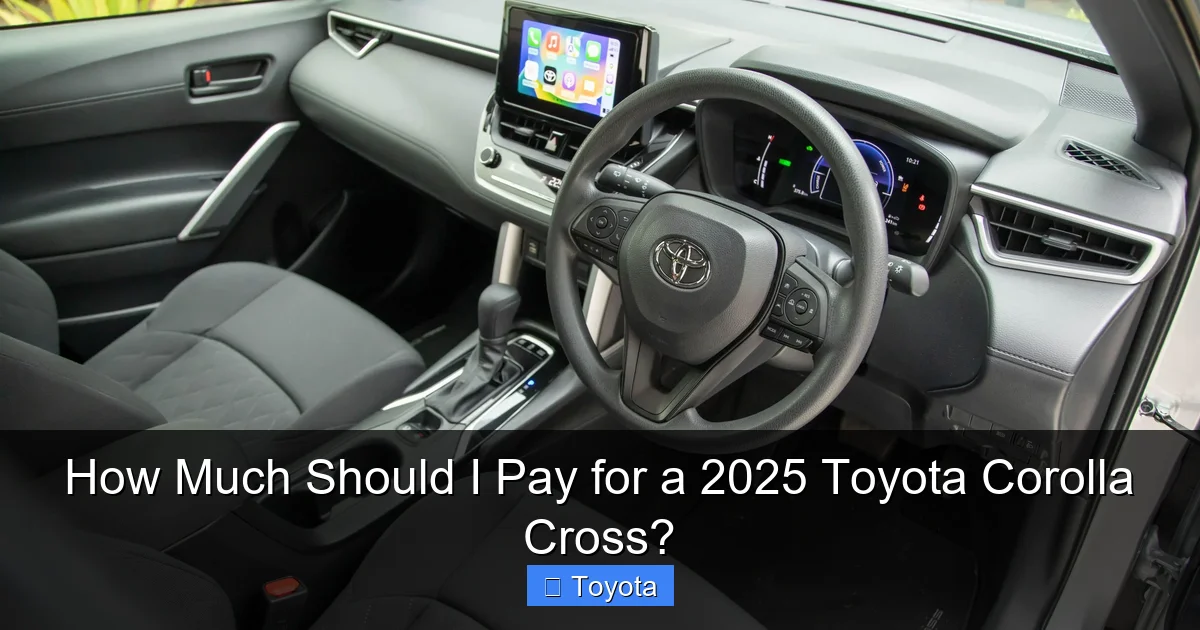
Visual guide about How Much Should I Pay for a 2025 Toyota Corolla Cross?
Image source: images.carexpert.com.au
Destination Charge
This is a non-negotiable fee Toyota charges to ship the vehicle from the factory (likely in Alabama) to your dealership. For the Corolla Cross, it’s consistently around $1,300. This is added to the MSRP before any negotiation begins. It’s a fixed cost, but it’s part of your total vehicle price.
Government Fees: Title, Registration, and Sales Tax
These are set by your state and local government. Title and registration fees are usually a few hundred dollars. The big one is sales tax. This is a percentage of the total purchase price (including the destination charge). Sales tax rates vary wildly—from 0% in some states to over 10% in others. For a $30,000 car in a 7% tax state, that’s $2,100 added to your cost. You cannot avoid this. Use your state’s DMV website to calculate the exact registration and title fees.
Dealer Documentation (Doc) Fee
This is a fee dealers charge to “process your paperwork.” In many states, this fee is regulated and capped (e.g., $100-$500). In others, it’s unregulated and can be a $500-$1,000 profit center. Ask the dealer upfront what their doc fee is and if it’s capped by state law. If it’s excessive, it’s a negotiation point, or you can factor it into your overall offer.
Dealer Add-Ons: The Profit Centers You Can Avoid
This is the dealer’s playground and your primary target for cost reduction. These items are often presented in the finance office as “necessary” or “protective,” but they are almost always sold at a massive markup and can be purchased elsewhere for less.
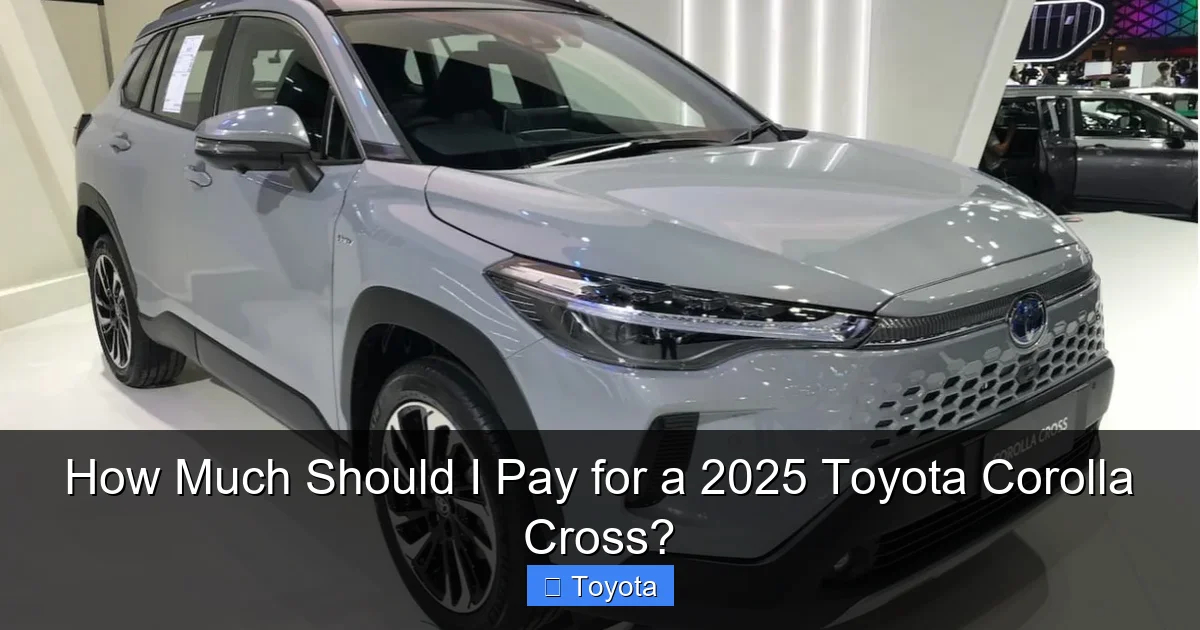
Visual guide about How Much Should I Pay for a 2025 Toyota Corolla Cross?
Image source: toyotaofbristol.com
Common Add-Ons to Decline
- VIN Etching: (Window etching of your VIN) Dealers charge $200-$500. You can buy a kit and do it yourself for $20.
- Fabric/Floor Protection: A basic all-weather floor mat set from the parts department costs $150. Dealers charge $400-$800 for a “package.”
- Window Tinting: Often applied with cheap film. Get it done professionally afterward for better quality and lower price.
- Nitrogen-Filled Tires: The benefit over regular air is negligible for daily driving. It’s a $50-$100 gimmick.
- Extended Warranties/Service Contracts: These are high-profit products. You can often purchase Toyota’s official extended warranty later from a third party for less, or decline entirely if you plan to keep the car only through the basic warranty period.
Strategy: When the finance manager presents these, simply say, “No thank you, I’m not interested in any add-ons today.” Be polite but firm. Your focus is on the vehicle price. If they insist a product is required, know your state’s laws—very few things are legally mandatory beyond the vehicle itself and basic insurance.
Your Secret Weapons: Incentives and Financing
Before you even negotiate, check Toyota’s national and regional incentives. These are direct discounts from Toyota Motor Corporation and are applied after you agree on a selling price.
Cash Rebates and Low-APR Financing
Toyota frequently offers either a cash rebate or a low-interest APR loan (like 0.9% for 60 months) on new models, but rarely both. The cash rebate is usually the better deal if you can secure your own reasonable financing (e.g., 4-5% from a credit union). The low-APR is excellent if you qualify and plan to finance through Toyota. Always calculate which saves you more money over the life of the loan. These incentives are often targeted—they might require you to be a current Toyota owner, a college graduate, or a member of a specific organization. Check the “Offers” page on Toyota.com for your zip code.
Lease vs. Buy Considerations
If your goal is lower monthly payments and driving a new car every 3 years, leasing is an option. The Corolla Cross is a great lease candidate due to its strong residual value (what it’s predicted to be worth at lease-end). Lease payments are based on the depreciation (the difference between selling price and residual value). To get a good lease, you still need a low capitalized cost (the negotiated selling price). Use an online lease calculator and know the money factor (lease interest rate) and residual percentage. A typical lease might be around $250-$350/month with $2,000-$3,000 due at signing for a well-optioned model. For more on how monthly payments translate to total cost, you can read our guide on how much car you can lease for $300 a month.
The Negotiation Game: Your Path to the “Out-the-Door” Price
This is the most critical phase. Your mantra is: “What is your best out-the-door price?” This single number includes the vehicle selling price, destination, all government fees, and the dealer’s doc fee. It excludes sales tax, which you’ll pay separately to the DMV.
Step 1: Research and Initial Contact
Using the invoice price from KBB/Edmunds, determine your target selling price. A realistic initial offer is $500-$1,000 above invoice for a high-demand model. For example, if invoice is $29,000, start at $29,500. Email 3-5 dealerships in your area with this script: “I am in the market for a 2025 Toyota Corolla Cross XLE AWD in [Color]. I am ready to purchase this week. Please send me your best, all-in, out-the-door price via email. Please include all fees, destination, and your doc fee. This price will be the sole basis for my decision.”
Step 2: The Dance and the Walk-Away
Dealers will call, not email. They want to talk. Stick to your guns. “I prefer the written offer so I can compare accurately.” If they refuse, that’s a red flag. When you get offers, compare the out-the-door numbers. The lowest one is your benchmark. Call the other dealers and say, “Dealer X offered me $32,100 out-the-door. Can you beat it?” This creates competition. If they won’t, you have your price. If they do, get it in writing. Be prepared to walk away. There are more Corolla Crosses out there. The power is in your willingness to leave.
Step 3: Financing and Trade-In Separation
Once you have a firm out-the-door vehicle price, then discuss financing. If you have a pre-approval from your bank (which you should get), you have leverage. Say, “I have a pre-approval at 4.5%. Can you beat that?” If they offer a lower rate, great. If not, use your bank. Never discuss your trade-in until after the new car price is set. The trade-in value is a separate negotiation. Know your trade’s value using KBB or Edmunds. For maintenance on your current Toyota, understanding costs like an oil change at Toyota can help you decide if keeping it is worthwhile versus trading up.
Putting It All Together: A Real-World Example
Let’s build a final cost for a typical buyer: a 2025 Toyota Corolla Cross XLE AWD in a mid-range color.
- MSRP: $31,500
- Negotiated Selling Price (from invoice $29,000): $29,800 (a $1,800 discount from MSRP)
- Destination Charge: $1,300
- Government Fees (Title/Reg): $400 (estimate)
- Dealer Doc Fee (capped): $200
- Subtotal (Vehicle + All Fees): $31,700
- Sales Tax (7% on subtotal): $2,219
- Total “Out-the-Door” Cost (Before Financing): $33,919
Now, apply a national incentive—say a $1,000 cash rebate. That brings your final cost before tax to $32,919. If you finance $28,000 (after a $5,000 down payment) at 4.5% for 60 months, your monthly payment would be about $520. If you qualify for Toyota’s 0.9% APR, that payment drops to $503. See the difference incentives and rates make? This is the complete picture you need.
Final Pro Tip: The last days of a quarter or calendar year are often the best times to buy. Dealerships have sales targets to hit and may be more flexible on price to move inventory. Be patient, do your homework, and remember: you are not buying a monthly payment, you are buying a $30,000+ asset. Paying an extra $1,000 over invoice because you didn’t negotiate is like throwing that money in the trunk and forgetting about it. Be smart, be prepared, and you’ll drive home in your 2025 Corolla Cross at a price you can feel good about.
Frequently Asked Questions
What is the absolute lowest price I can expect on a 2025 Corolla Cross?
The lowest realistic price is typically $1,000-$1,500 above the dealer’s true invoice cost for a base L FWD model, especially if there are no dealer add-ons. For a popular, well-equipped XLE AWD, expect to pay closer to the MSRP initially, but use competing dealer bids to chip away at it. Always calculate the final “out-the-door” cost for true comparison.
Which Corolla Cross trim offers the best value for money?
For most buyers, the Corolla Cross LE (gas or hybrid) offers the best value. It adds key comfort and convenience features like keyless entry and a power driver’s seat over the base L for a moderate price increase. The XLE is great if you want a sunroof and premium seats, but the LE is the sweet spot for daily usability without extra cost.
Are there any guaranteed cash incentives for the 2025 model?
Incentives change monthly and are not guaranteed. You must check Toyota’s official website for your specific location and trim. Common offers include cash bonuses for recent college graduates, military personnel, or loyalty/competitive rebates for current owners of non-Toyota vehicles. These are applied after the vehicle price is set.
How much will dealer fees really add to my cost?
Expect a non-negotiable destination charge of ~$1,300. The dealer doc fee varies by state (from $100 to over $800). State title and registration fees are usually $200-$500. Sales tax is the largest variable, based on your local rate. Altogether, mandatory fees and taxes will add $2,000-$5,000+ to your final cost before any financing.
Should I buy an extended warranty at the dealership?
Most financial advisors recommend declining the dealer’s extended warranty in the finance office. You can often purchase Toyota’s genuine extended warranty later from a third-party provider for less, or choose to self-insure for repairs. If you do want one, negotiate its price separately or ask for the “Toyota Extra Care” plan cost without the markup.
What is the total cost of ownership for a 2025 Corolla Cross?
Beyond purchase price, budget for insurance (get quotes beforehand), fuel (the Hybrid gets ~42 MPG, gas models ~30 MPG), and maintenance. A Toyota oil change typically costs $50-$80 at a dealership. Tires, brakes, and other scheduled maintenance are relatively affordable due to the model’s popularity. A 5-year ownership cost (fuel, insurance, maintenance) can add $10,000-$15,000 to your purchase price.