
How Much Car Can I Lease for $300 a Month?

Leasing a car for $300 a month is possible—but your options depend on factors like credit score, down payment, and vehicle type. With smart planning and realistic expectations, you can drive a reliable, modern car without breaking the bank.
So, you’re thinking about leasing a car—and you’ve got a budget of $300 a month. That’s a solid starting point, but here’s the real question: *What kind of car can you actually get for that price?* The answer isn’t one-size-fits-all. It depends on your credit, how much you’re willing to put down, the type of vehicle you want, and even the time of year you’re shopping.
Leasing has become a popular alternative to buying, especially for people who want lower monthly payments, enjoy driving a new car every few years, or don’t want to deal with long-term maintenance costs. But while leasing can be more affordable upfront, it’s not always the cheapest option over time. Still, if you’re focused on keeping your monthly payment around $300, leasing opens up a range of practical, fuel-efficient, and surprisingly well-equipped vehicles.
In this guide, we’ll walk you through exactly what you can expect when leasing a car for $300 a month. We’ll break down the key factors that influence your payment, show you real-world examples of cars you can lease at this price, and share insider tips to help you get the best deal. Whether you’re a first-time lessee or just looking to upgrade your ride without overspending, this article will give you the clarity and confidence to make a smart decision.
Key Takeaways
- Your credit score matters: A higher score (700+) unlocks better lease deals and lower monthly payments.
- Down payments reduce monthly costs: Putting $2,000–$3,000 down can make a $300/month lease more achievable.
- Compact and economy cars dominate this budget: Think Honda Civic, Toyota Corolla, or Hyundai Elantra.
- Lease terms affect affordability: 36-month leases with 10,000–12,000 miles per year are most common at this price.
- Manufacturer incentives help: Look for special lease offers, especially at the end of model years.
- Negotiate the capitalized cost: Lowering the car’s negotiated price directly reduces your monthly payment.
- Read the fine print: Watch for excess mileage fees, wear-and-tear charges, and early termination penalties.
📑 Table of Contents
Understanding How Car Leasing Works
Before we dive into what you can get for $300 a month, let’s make sure we’re on the same page about how leasing actually works. At its core, leasing is like renting a car for a fixed period—usually 24 to 36 months. Instead of paying off the entire value of the vehicle (like you would when buying), you’re only paying for the car’s depreciation during your lease term, plus interest and fees.
Here’s a simple way to think about it: when you buy a car, you own it (or owe money on it) until it’s paid off. When you lease, you’re essentially paying for the portion of the car’s value that it loses while you drive it. For example, if a new car is worth $25,000 today and is expected to be worth $15,000 after three years, you’re paying for that $10,000 drop in value—plus finance charges and taxes.
This structure is why leasing often results in lower monthly payments than buying. You’re not covering the full cost of the car, just the part you “use up” during your lease. But there are trade-offs. You don’t own the car at the end of the lease, and you’re typically restricted by mileage limits (usually 10,000 to 15,000 miles per year). Go over, and you’ll pay extra. You’re also responsible for keeping the car in good condition—excessive wear and tear can lead to additional charges.
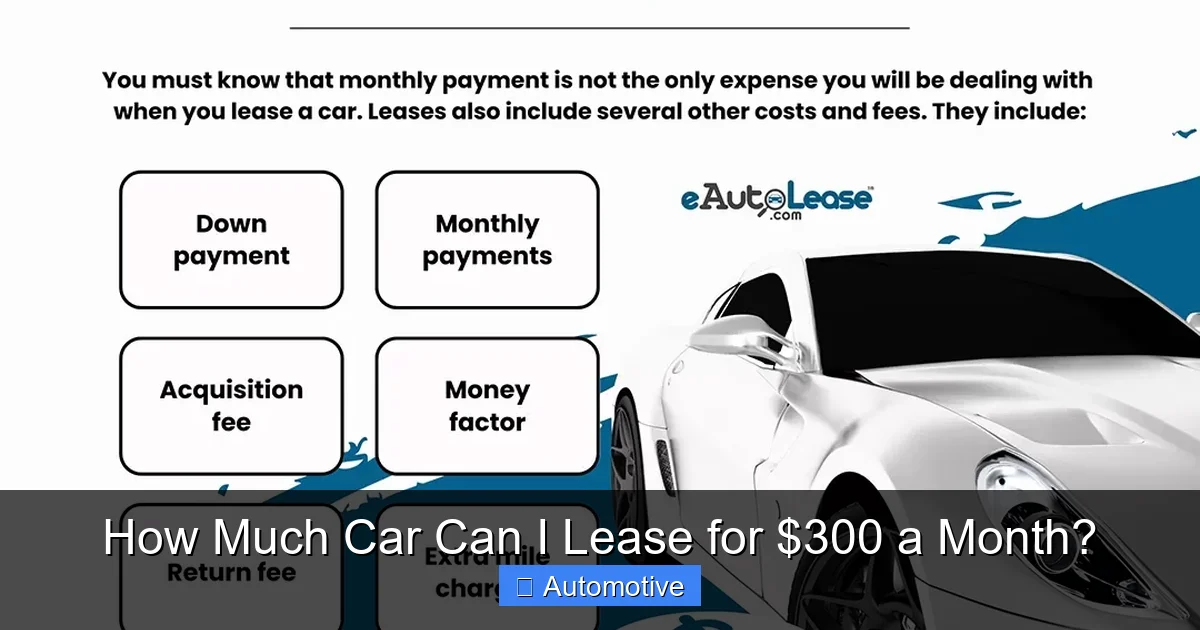
Another key point: leasing isn’t just about the sticker price. Your monthly payment is calculated using several factors, including the car’s negotiated price (called the capitalized cost), the residual value (what the car is expected to be worth at the end of the lease), the money factor (similar to an interest rate), and any upfront fees or down payments.
So, when you see a lease advertised for $299 a month, that number is the result of all these variables working together. And while $300 a month might seem like a tight budget, it’s actually quite common—especially for compact cars, sedans, and small SUVs. The trick is knowing how to maximize your budget by understanding and influencing those key factors.
What Affects Your Monthly Lease Payment?
Visual guide about How Much Car Can I Lease for $300 a Month?
Image source: esign.com
Now that you know the basics, let’s talk about what actually determines whether you can lease a car for $300 a month. It’s not just about the car’s price tag. Several factors come into play, and understanding them can help you stretch your budget further.
1. Your Credit Score
Your credit score is one of the biggest influencers of your lease payment. Lenders use it to assess how risky it is to lease you a car. If you have excellent credit (typically 720 or higher), you’ll qualify for the best money factors (lease interest rates) and may even get special promotional offers. But if your score is lower—say, in the 600s or below—you might face higher finance charges, which can push your monthly payment above $300, even for a modest car.
For example, a person with a 750 credit score might get a money factor of 0.00125 (equivalent to about 3% APR), while someone with a 650 score might be offered 0.00250 (about 6% APR). That difference can add $20–$40 to your monthly payment. So, if you’re aiming for $300 a month, improving your credit before leasing can make a big difference.
2. Down Payment (Cap Cost Reduction)
The more you put down upfront, the lower your monthly payment will be. This is called a “capitalized cost reduction,” and it works just like a down payment on a loan. For instance, putting $3,000 down on a $25,000 car reduces the amount you’re financing to $22,000, which directly lowers your monthly payment.
Many lease deals advertise “$0 down” to make them sound more appealing, but that often means higher monthly payments. If you can afford to put $2,000–$3,000 down, you’ll have a much better chance of staying within your $300 budget. Just remember: this money is not refundable if you end the lease early, so only put down what you’re comfortable losing.
3. Lease Term and Mileage
Most leases are 24, 36, or 48 months long. Shorter terms (like 24 months) often have higher monthly payments because you’re paying off the depreciation faster. A 36-month lease is usually the sweet spot for balancing affordability and flexibility.
Mileage limits also play a role. Standard leases allow 10,000 to 12,000 miles per year. If you drive more than that, you can prepay for extra miles (usually $0.10–$0.25 per mile) to avoid surprise charges later. But if you know you’ll drive less, you can negotiate a lower mileage allowance, which may reduce your payment slightly.
4. Vehicle Depreciation and Residual Value
Some cars lose value faster than others. Leasing companies use something called the “residual value” to predict how much a car will be worth at the end of the lease. The higher the residual, the lower your monthly payment—because you’re paying for less depreciation.
For example, a Toyota Camry might have a 60% residual value after three years, meaning it’s expected to retain 60% of its original value. A luxury SUV with high depreciation might only have a 45% residual. That’s why you’ll often find better lease deals on reliable, popular models that hold their value well.
5. Manufacturer Incentives and Promotions
Automakers frequently offer special lease deals to move inventory, especially at the end of the model year or during holiday sales events. These can include cash incentives, reduced money factors, or even waived acquisition fees. For example, a manufacturer might offer $2,000 in lease cash or a 0.00100 money factor (about 2.4% APR) on a specific model.
Timing your lease around these promotions can make a $300 monthly payment much more achievable—even on a slightly more upscale vehicle. Always ask dealers about current incentives, and check manufacturer websites for national offers.
6. Negotiating the Capitalized Cost
Just like when buying a car, you can (and should) negotiate the price of a leased vehicle. The capitalized cost is the starting point for your lease calculation, so lowering it by even a few hundred dollars can reduce your monthly payment significantly.
Don’t focus only on the monthly payment. Instead, negotiate the out-the-door price of the car first. Once you have a fair deal, then structure the lease terms around that number. This approach gives you more control and helps avoid dealer markups disguised as “low payments.”
What Cars Can You Actually Lease for $300 a Month?
Visual guide about How Much Car Can I Lease for $300 a Month?
Image source: eautolease.com
Now for the fun part: what can you drive for $300 a month? The good news is that there are plenty of solid, reliable, and even stylish options in this price range—especially if you’re open to compact cars, sedans, and small crossovers.
Keep in mind that exact pricing varies by region, dealer, and current incentives, but here are some real-world examples of vehicles commonly available for around $300/month with a reasonable down payment (typically $2,000–$3,000) and a 36-month lease term.
Compact Sedans
These are the workhorses of the leasing world—affordable, fuel-efficient, and packed with modern features.
– **Honda Civic**: One of the most popular leases under $300. The base LX trim offers excellent reliability, a comfortable ride, and Honda Sensing safety suite standard. With a $2,500 down payment, you can often lease a Civic for $289–$319/month.
– **Toyota Corolla**: Known for its longevity and low cost of ownership. The LE trim includes Toyota Safety Sense 3.0, Apple CarPlay, and a user-friendly infotainment system. Lease deals frequently bring the Corolla into the $299/month range.
– **Hyundai Elantra**: Offers a lot of value for the money, with a sleek design, long warranty, and advanced tech. Hyundai often runs aggressive lease promotions, making the Elantra a strong contender under $300.
Subcompact and Economy Cars
If you’re looking to maximize value, these smaller cars deliver big on affordability.
– **Nissan Versa**: One of the most budget-friendly new cars on the market. The base S trim is basic but reliable, and higher trims add features like a 7-inch touchscreen and automatic emergency braking. With incentives, the Versa can lease for under $250/month.
– **Kia Rio**: Compact, efficient, and backed by Kia’s 10-year/100,000-mile powertrain warranty. The Rio offers a surprising amount of interior space and modern amenities for its class.
Small SUVs and Crossovers
SUVs are in high demand, but you can still find compact models that fit a $300 budget.
– **Honda HR-V**: A subcompact SUV with a spacious interior, versatile cargo area, and excellent fuel economy. Lease deals often bring the HR-V into the $299–$329/month range with a moderate down payment.
– **Hyundai Kona**: Stylish, tech-savvy, and available with all-wheel drive. Hyundai’s frequent promotions make the Kona a popular lease under $300.
– **Mazda CX-30**: Slightly more upscale than its competitors, with a premium interior and engaging driving dynamics. Mazda often offers competitive lease rates, especially on lower trims.
Hybrids and Fuel-Efficient Options
If you want to save on gas without going full electric, hybrids are a great choice.
– **Toyota Prius**: The iconic hybrid is still one of the most efficient cars on the road. While the base model might stretch your budget slightly, end-of-year deals can bring it close to $300/month.
– **Hyundai Ioniq Hybrid**: Offers Prius-level efficiency with a more modern design and generous warranty. Hyundai’s lease incentives often make the Ioniq Hybrid a smart pick under $300.
What You Probably Can’t Get for $300
While $300 a month opens up a lot of doors, it’s important to set realistic expectations. You’re unlikely to lease a luxury vehicle (like a BMW, Mercedes, or Audi), a full-size SUV (like a Ford Explorer or Toyota Highlander), or a high-performance car (like a Mustang or WRX) at this price—unless you put down a very large down payment or find an unusually generous promotion.
Even mid-range SUVs like the Honda CR-V or Toyota RAV4 typically start around $350–$400/month with minimal down. So if you’re set on a larger vehicle, you may need to increase your budget or consider a used lease (more on that below).
Tips to Stretch Your $300 Lease Budget

Visual guide about How Much Car Can I Lease for $300 a Month?
Image source: consumerauto.us
Want to get the most bang for your buck? Here are some proven strategies to help you lease a great car for $300 a month—or even less.
1. Shop at the Right Time
Timing is everything in leasing. The end of the month, quarter, or model year (typically August–September) is when dealers are most motivated to meet sales quotas and clear out inventory. You’ll find the best deals during these periods, including lower money factors and cash incentives.
2. Compare Multiple Offers
Don’t settle for the first lease quote you get. Get quotes from at least three different dealerships—preferably ones that carry the same brand. Use online tools like Edmunds, Leasehackr, or TrueCar to compare real-world lease deals and see what others are paying in your area.
3. Consider a Used or Off-Lease Vehicle
Leasing a certified pre-owned (CPO) car or an off-lease vehicle can be a smart way to get more car for your money. These cars have already taken the biggest depreciation hit, so their residual values are higher and lease payments are lower. Just make sure the vehicle comes with a warranty and has been inspected.
4. Avoid Excessive Add-Ons
Dealers may try to sell you extras like fabric protection, paint sealant, or gap insurance. While some of these can be useful, they add to your capitalized cost and increase your monthly payment. Only buy what you truly need—and consider purchasing gap insurance separately, as it’s often cheaper outside the dealership.
5. Keep Your Mileage Low
If you don’t drive much, opt for a lower mileage allowance (e.g., 7,500 miles per year instead of 12,000). This can reduce your payment by $10–$20/month. Just be honest about your driving habits—getting hit with excess mileage fees at the end of the lease can cost hundreds.
6. Improve Your Credit Before Leasing
If your credit score is below 700, consider taking a few months to pay down debt, correct errors on your credit report, and avoid new credit applications. Even a 30–50 point increase can qualify you for better lease terms and save you hundreds over the life of the lease.
7. Negotiate the Out-the-Door Price
As mentioned earlier, focus on negotiating the total price of the car, not just the monthly payment. A lower capitalized cost means a lower payment, regardless of the lease structure. Bring invoice pricing and competitor quotes to the table to strengthen your position.
The Pros and Cons of Leasing for $300 a Month
Leasing a car for $300 a month isn’t right for everyone. Let’s weigh the benefits and drawbacks so you can decide if it’s the best move for your lifestyle and finances.
Pros
– **Lower monthly payments:** You’ll pay less than you would for a loan on the same vehicle.
– **Drive a new car every few years:** Enjoy the latest tech, safety features, and warranties.
– **Lower maintenance costs:** Most leases fall within the manufacturer’s warranty period, so major repairs are covered.
– **No long-term commitment:** Return the car at the end of the lease and walk away (assuming no excess wear or mileage).
– **Tax advantages for business use:** If you use the car for work, you may be able to deduct a portion of the lease payments.
Cons
– **No ownership:** You don’t build equity, and you’ll always have a car payment if you keep leasing.
– **Mileage restrictions:** Exceeding your limit can result in hefty fees.
– **Wear-and-tear charges:** You’re responsible for returning the car in good condition.
– **Early termination fees:** Ending the lease early can be expensive.
– **Potentially higher long-term cost:** Over many years, leasing can cost more than buying and keeping a car.
If you value flexibility, enjoy driving new cars, and don’t mind not owning, leasing for $300 a month can be a smart financial move. But if you drive a lot, prefer to own your vehicle, or plan to keep a car for 10+ years, buying might be the better long-term choice.
Final Thoughts: Is a $300 Lease Right for You?
So, how much car can you lease for $300 a month? The answer is: more than you might think. With the right combination of credit, down payment, timing, and vehicle choice, you can drive a reliable, modern, and even stylish car without overspending.
Compact sedans like the Honda Civic and Toyota Corolla are the most common options in this price range, but small SUVs like the Hyundai Kona and Mazda CX-30 are also within reach—especially with current incentives. The key is to do your homework, negotiate wisely, and avoid common leasing pitfalls.
Remember, leasing isn’t just about the monthly payment. It’s about understanding the total cost, knowing your limits, and making a decision that fits your lifestyle. Whether you’re a student, a young professional, or just someone who wants to keep their car expenses predictable, a $300 lease can be a practical and satisfying choice.
So go ahead—start shopping, compare offers, and get behind the wheel of a car that fits your budget and your life.
Frequently Asked Questions
Can I lease a car for $300 a month with bad credit?
It’s possible, but challenging. With a lower credit score (below 650), you may face higher interest rates and larger down payments. Consider improving your credit first or look for subvented lease programs that offer more flexibility.
Do I need a down payment to lease for $300 a month?
Not always, but a down payment (typically $2,000–$3,000) makes it much easier to stay within budget. Without one, you may need excellent credit and strong incentives to hit the $300 mark.
What happens if I go over my mileage limit?
You’ll be charged per mile—usually $0.10 to $0.25—at the end of the lease. To avoid this, estimate your annual driving accurately or prepay for extra miles upfront.
Can I lease a used car for $300 a month?
Yes! Leasing certified pre-owned or off-lease vehicles can offer lower payments since the car has already depreciated. Just ensure it’s under warranty and in good condition.
Are lease payments tax-deductible?
Only if you use the car for business. You may be able to deduct a portion of the lease payments based on business use percentage. Consult a tax professional for details.
What’s the best time of year to lease a car?
The end of the month, quarter, or model year (August–September) often brings the best deals as dealers aim to meet sales targets and clear inventory.