
How Much Is a Toyota Catalytic Converter Worth Scrap?

The scrap value of a Toyota catalytic converter can range dramatically from $50 to over $1,000, primarily based on the specific model, engine size, and the amount of precious metals (platinum, palladium, rhodium) it contains. Hybrid models like the Prius often command the highest prices due to their larger, metal-rich converters. To get the best price, you must identify your exact Toyota model and engine, get multiple quotes from reputable scrap yards, and understand that prices fluctuate daily with the precious metals market.
Key Takeaways
- Value is Model-Specific: A catalytic converter from a Toyota Tacoma with a 4-cylinder engine is worth far less than one from a Tundra 5.7L V8 or a Prius hybrid. Your exact model and engine code are critical.
- Precious Metals Rule the Price: The converter’s worth is tied to the recoverable amounts of platinum, palladium, and rhodium. Hybrids and larger vehicles typically have more of these metals, increasing value.
- Condition Matters: A whole, undamaged, OEM converter will fetch the highest price. Severely damaged or aftermarket converters are worth significantly less.
- Prices Change Daily: Scrap values are tied to the live commodities market for precious metals. Always check for current rates before selling.
- Beware of Theft & Legality: Catalytic converter theft is rampant. Selling a converter requires proof of ownership. Know your local laws to avoid legal trouble.
- Get Multiple Quotes: Scrap yards and specialized buyers offer varying prices. Get at least 3 quotes, and be prepared to provide photos and vehicle details.
- Hybrids Are Top Tier: Toyota hybrids (Prius, Camry Hybrid, RAV4 Hybrid) consistently have the most valuable scrap converters due to their unique, metal-heavy design.
📑 Table of Contents
Introduction: Unlocking the Hidden Value Under Your Toyota
You’re staring at the undercarriage of your Toyota, maybe after an exhaust repair or a visit from a thief, and you see it: the catalytic converter. That seemingly mundane metal canister is one of the most valuable parts on your entire vehicle when it comes to scrap. But asking “how much is a Toyota catalytic converter worth scrap?” is like asking “how much is a tool worth?” The answer depends entirely on the specific tool. A socket wrench is different from a power drill. Similarly, a catalytic converter from a 2005 Toyota Corolla is worlds apart in value from one off a 2015 Toyota Tundra. This guide will crack the code. We’ll break down exactly what makes these components so valuable, how to identify what you have, and the smart strategies to turn that scrap metal into the maximum cash in your pocket.
First, let’s understand the ‘why.’ Catalytic converters are emissions control devices. They use precious metals—platinum, palladium, and rhodium—as catalysts to transform harmful exhaust gases into less harmful ones. These metals are rare, expensive, and fully recyclable. Scrap metal recyclers and specialized smelters pay top dollar for converters because they can extract and reuse these precious resources. Your Toyota’s converter is essentially a small, dense vault of valuable metals. The key is figuring out how much is inside.
The Core Factors That Determine Scrap Value
It’s not just about the Toyota badge on the hood. Several critical factors converge to set the price. Understanding these will help you set realistic expectations and identify a fair offer.
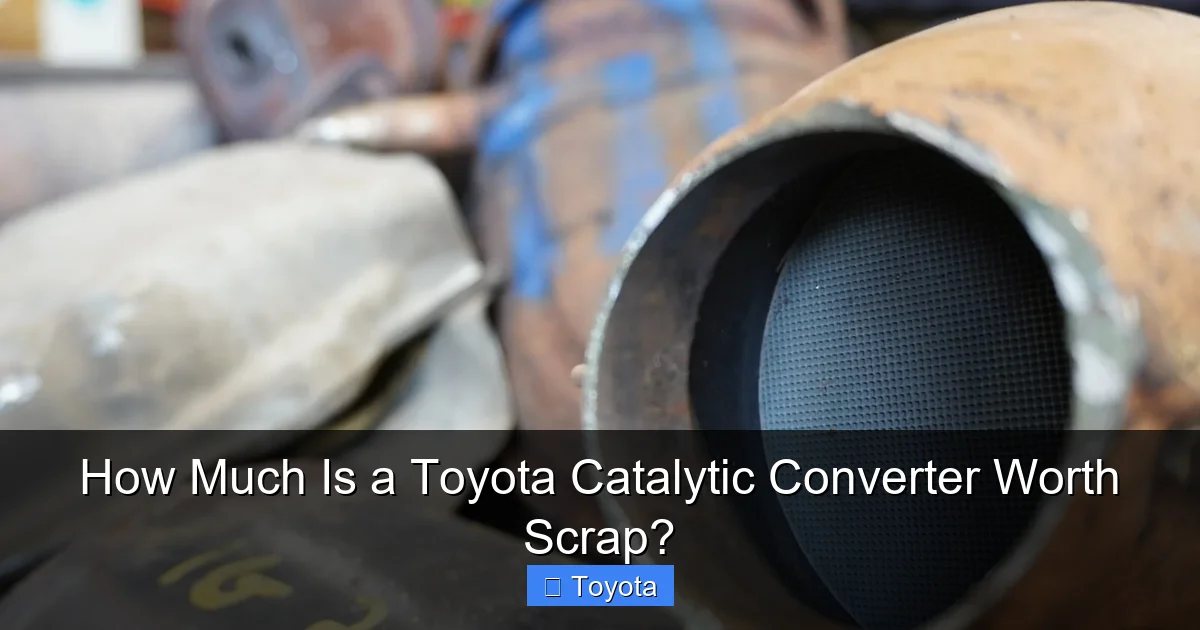
Visual guide about How Much Is a Toyota Catalytic Converter Worth Scrap?
Image source: j6p7h8r9.delivery.rocketcdn.me
1. The Precious Metals Content (The #1 Driver)
This is the heart of the matter. The amount of platinum-group metals (PGMs) varies wildly. Factors influencing this include:
- Vehicle Type & Emissions Standards: Larger trucks and SUVs (Tundra, Sequoia, 4Runner) with bigger engines need larger converters to handle more exhaust, often containing more PGMs. Strict emissions standards, like those in California, also require more efficient (and metal-rich) catalysts.
- Hybrid Technology: This is the golden ticket. Toyota hybrids use a unique system. Their gasoline engine doesn’t always run, so the catalytic converter can’t rely on exhaust heat to work efficiently. To solve this, they use converters loaded with a higher concentration of precious metals and often a different substrate design. A Toyota Prius catalytic converter is famously one of the most valuable in the scrap world. When researching, you’ll find articles specifically detailing the high scrap value of a 2013 Toyota Prius, and this principle applies across most hybrid models.
- OEM vs. Aftermarket: Original Equipment Manufacturer (OEM) converters from Toyota are designed for maximum efficiency and longevity, using optimal amounts of PGMs. Aftermarket or “universal” converters often use less expensive materials or different washcoat technologies to meet minimum standards at a lower cost, making them less valuable for scrap.
2. The Specific Toyota Model and Engine
Your Toyota’s model year and, most importantly, its specific engine code are the first things a serious buyer will ask for. This isn’t casual curiosity; it’s the primary key to identifying your converter’s “recipe.”
- Engine Size & Cylinders: A V8 engine (like the 5.7L in a Tundra) produces more exhaust gas than a 4-cylinder (like the 2.5L in a Camry). Its converter is physically larger and typically holds more precious metals.
- Diesel vs. Gasoline: Diesel engines, found in some older Toyota trucks (like some Hilux models sold internationally), use a different type of catalyst (often a Diesel Oxidation Catalyst and/or SCR system) with a different metal profile. Their value is calculated separately.
- Model Generations: Toyota changes emissions systems between model generations. A 2004 Toyota RAV4 converter is different from a 2016 one. Even within the same model year, a 2004 Toyota RAV4 with the 2.4L engine will have a different converter than one with the 3.4L V6. You must know your vehicle’s exact specifications.
3. Physical Condition and Completeness
What you see is what you get, literally. A converter that is:
- Whole & Undamaged: The shell is intact, the catalytic substrate (the honeycomb inside) is not crushed or melted. This is worth the full estimated value.
- Cut or Partial: If it’s been cut off the exhaust pipe, that’s fine and common. But if the ceramic or metallic substrate is broken, shattered, or contaminated with oil/antifreeze, its value plummets because recovering the metals becomes much harder and less efficient.
- Aftermarket “Bolt-On”: Some aftermarket converters are visibly different—often larger, with different weld patterns or labels. Buyers will discount these heavily.
4. Geographic Location and Current Metal Prices
The scrap metal industry is a global commodity market. The price you get is influenced by:
- Live Precious Metals Spot Prices: The daily trading prices for platinum, palladium, and rhodium on exchanges like the NYMEX are the baseline. When these prices spike or drop, converter scrap values follow, usually with a slight lag.
- Local Competition & Demand: Areas with many smelters or high-volume scrap yards may offer slightly better prices due to competition. Port cities might have different dynamics than inland areas.
- Your Buyer’s Reach: A small local yard might sell to a regional broker, who sells to a national processor, who sells to an international smelter. Each step adds a margin. Selling directly to a large processor or specialized converter buyer often gets you closer to the “top” price.
Typical Toyota Catalytic Converter Scrap Value Ranges by Model
Now for the numbers. Remember, these are estimates based on recent market averages for whole, OEM converters in good condition. Prices change daily. These ranges are for the converter core itself, not the entire exhaust system.
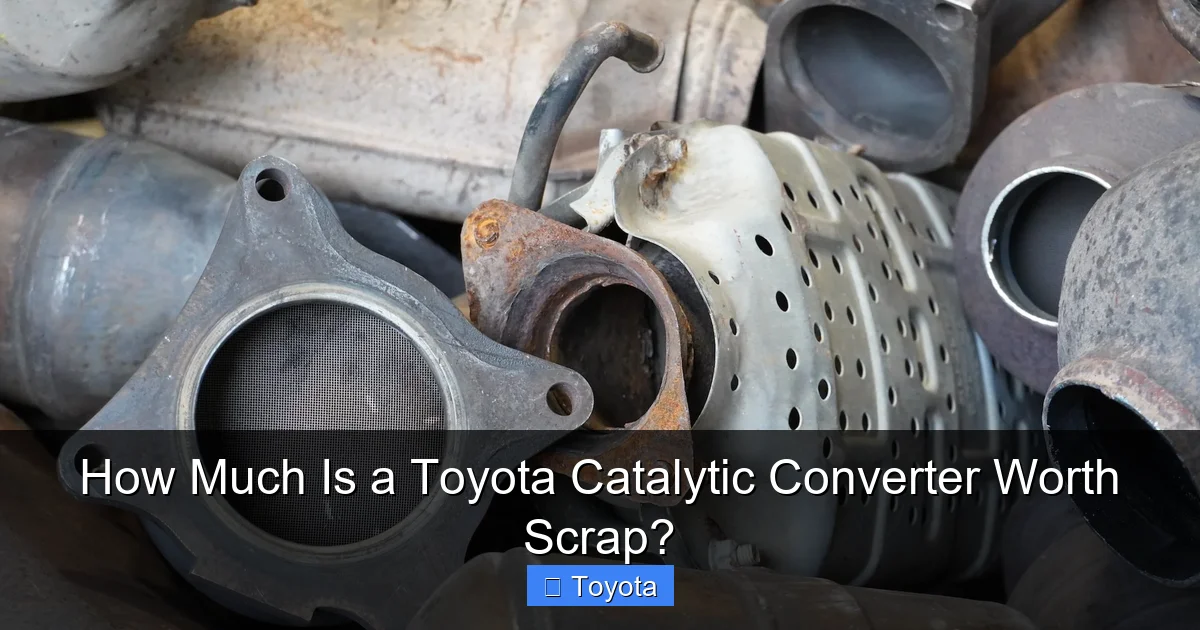
Visual guide about How Much Is a Toyota Catalytic Converter Worth Scrap?
Image source: rrcats.com
The High-End Tier: Hybrids & Large Displacement Engines
These are the “blue chip” stocks of Toyota scrap converters.
- Toyota Prius (All Hybrid Models): The undisputed leader. Thanks to its unique, metal-heavy converter designed for a gas engine that doesn’t always run, scrap values consistently range from $400 to over $1,000+ for a single unit. A 2013 Toyota Prius converter is a prime example of this high-value category. The value can be so high that theft of Prius converters is a significant problem.
- Toyota Tundra (5.7L V8) & Sequoia (5.7L V8): These full-size trucks and SUVs have massive, multi-converter systems (often two or three units). Each individual converter can be worth $150 to $400+. The total value for the entire system can easily exceed $800-$1,200.
- Toyota Land Cruiser (5.7L V8): Similar to the Tundra/Sequoia, these have large, valuable converters. Expect $150 to $350+ per unit.
- Toyota 4Runner (4.0L V6): The V6 models have a substantial single converter, often worth $100 to $250+. The older 4-cylinder models are worth considerably less.
The Mid-Range Tier: Popular 4-Cylinders & V6s
These are your common family sedans and SUVs. Values are respectable but not spectacular.
- Toyota Camry (2.5L 4-cylinder & 3.5L V6): The 4-cylinder converter typically falls in the $50 to $120 range. The V6 is larger and can be worth $80 to $180. The Camry Hybrid, however, would be in the high-end tier due to its hybrid system.
- Toyota RAV4 (2.5L 4-cylinder): The standard gasoline RAV4 has a moderately sized converter worth approximately $60 to $130. The RAV4 Hybrid again soars into the $400-$800+ range.
- Toyota Corolla (All 4-cylinder models): A compact car means a smaller converter. Expect values around $40 to $90. A 2016 Toyota Corolla will fall squarely in this mid-range for its standard engine.
- Toyota Tacoma (2.7L 4-cylinder & 3.5L V6): The V6 Tacoma has a decent-sized single converter, often worth $70 to $150. The 4-cylinder is on the lower end, $40 to $80.
- Toyota Sienna (3.5L V6): As a large minivan, its converter is substantial. Values are typically $80 to $180.
The Lower-End Tier: Small 4-Cylinders & Older Models
These have smaller converters with less precious metal load.
- Toyota Yaris, Scion xA/xB, Older Echo: Very small, light converters. Scrap value is often just $20 to $50. The cost of removal and transport can sometimes eat into the profit.
- Very Old Models (Pre-1996 OBD-II): Early catalytic converters used different technologies and often less precious metal. A 1985 Toyota Pickup converter will have minimal scrap value compared to a modern one, likely under $30.
Critical Note: Many modern vehicles, including Toyotas, use multiple converters (a “front” and “rear” or “underfloor” converter). Sometimes a “pre-cat” is located close to the engine. These smaller pre-cats can be surprisingly valuable on their own, especially on turbocharged models. Always count how many converter units are on the vehicle.
How to Get the Best Price: A Seller’s Action Plan
Knowing the potential value is only half the battle. Here is your step-by-step guide to maximizing your return.
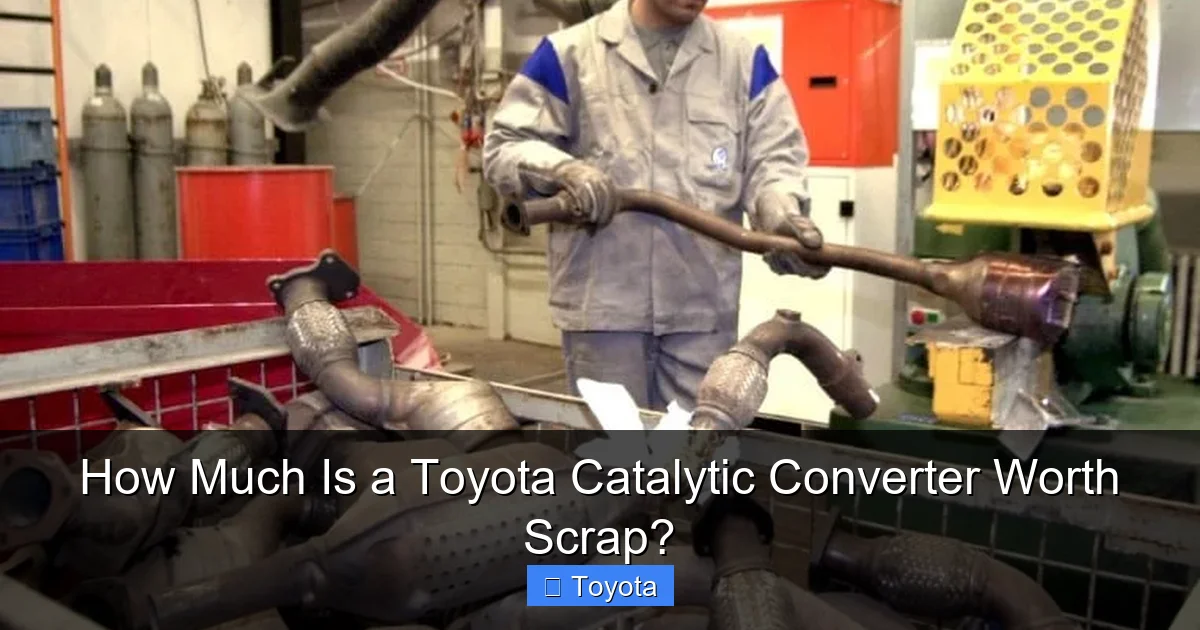
Visual guide about How Much Is a Toyota Catalytic Converter Worth Scrap?
Image source: autoemc.net
Step 1: Identify Your Converter with Military Precision
You cannot sell effectively if you don’t know what you have.
- Find Your VIN: The 17-digit Vehicle Identification Number is your ultimate key. It encodes the year, make, model, engine, and plant. You can decode it for free using online VIN decoders.
- Know Your Engine Code: This is the most critical piece. For example, the code for a 2020 Tacoma 3.5L V6 is “2GR-FKS.” For a 2018 RAV4 2.5L, it’s “2AR-FE.” This code is often on a sticker under the hood or in your owner’s manual. When you call a buyer, saying “I have a 2018 RAV4 with the 2AR-FE engine” tells them exactly what you have.
- Take Clear, Detailed Photos: Photograph the entire converter from multiple angles. Get close-ups of any stamps, labels, or weld points. Show it next to a common object (like a soda can) for scale. A good photo set gets you a more accurate initial quote.
Step 2: Research and Get Multiple Quotes
Do not take the first offer.
- Call Specialists First: Search for “catalytic converter buyers” or “precious metal recyclers” in your area. These businesses specialize in this and will pay more than a general scrap yard that treats it as just another piece of metal.
- Use Online Quote Tools: Many specialist buyers have online forms where you upload photos and VIN details for a quote. This is efficient for comparison.
- Get at Least 3 Quotes: Explain your situation to each buyer. A reputable one will ask for the VIN and photos before giving a firm number. Be wary of anyone offering a high price sight-unseen—they may lowball you upon inspection.
Step 3: Understand Pricing Structures
How you’re paid matters.
- Per Unit Price: The best method. They quote a flat dollar amount for your specific converter (e.g., “$285 for the rear converter on a 2015 Tundra 5.7L”).
- Per Pound Price: Less common for whole converters, as they have different weights. They might offer “$X per pound for catalytic material.” You need to know the approximate weight of your specific converter to judge fairness.
- Percentage of Metal Value: Some smelters will offer a percentage (e.g., 70-85%) of the current spot metal value contained in your converter. This is complex and usually for large-volume sellers.
Step 4: Prepare for the Sale & Logistics
- Proof of Ownership: You must have the vehicle’s title, registration, or a bill of sale. This is non-negotiable and required by law in most places to combat metal theft.
- Removal: Unless you’re an expert, have a mechanic remove it. Cutting exhaust pipes incorrectly can damage other parts. A professional can also confirm it’s the OEM unit.
- Transport: Catalytic converters are surprisingly heavy (20-50+ lbs). Be prepared to lift it safely or have the buyer arrange pickup (sometimes for a fee or only for large quantities).
Legal and Ethical Considerations: Don’t Get Burned
The scrap metal world has a dark side: catalytic converter theft. This has led to strict regulations.
Proof of Ownership is Law
In response to the theft epidemic, most states and provinces have enacted laws requiring scrap yards to record the seller’s information, vehicle details, and maintain proof of ownership (title, registration) for a set period. Selling without this documentation is illegal and can get you arrested for receiving stolen property. Always have your paperwork in order.
The Aftermarket Converter Caveat
If your converter was replaced with an aftermarket part, you must disclose this. Selling it as an OEM unit is fraud. Aftermarket units are legal to sell, but their value is lower, and the buyer must be informed. Keep your repair receipts.
Environmental Responsibility
Reputable recyclers handle the hazardous materials in converters properly. They use sealed furnaces to extract metals and manage the residual waste. Avoid buyers who seem to be melting them down in open pits or who ask you to remove the ceramic substrate yourself—this material can be hazardous and is illegal to dispose of improperly.
The Big Picture: Is It Worth It?
For most Toyota owners, selling a used catalytic converter is a straightforward way to recoup some value from a part that would otherwise cost hundreds to replace. The potential return is significant, especially for hybrid and large-engine owners.
However, it’s not a get-rich-quick scheme. The process requires research, legwork, and patience. The value is volatile. If you have a common 4-cylinder sedan, the effort might not be worth the $50-$80 you could get. But if you’re scrapping a totaled Toyota Tundra, a Toyota Prius, or a Toyota 4Runner, the converter could be one of the most valuable single parts from the wreck, making the effort highly profitable.
Ultimately, knowledge is your greatest asset. By identifying your exact part, understanding the market drivers, and selling to the right buyer with proper documentation, you can ensure that the question “how much is a Toyota catalytic converter worth scrap?” ends with a satisfying and profitable answer for you.
Frequently Asked Questions
What’s the average price for a Toyota catalytic converter?
There is no single average. Prices range from $50 for a small 4-cylinder car to over $1,000 for a hybrid Prius. Your specific model, engine, and the converter’s condition are the only factors that determine value.
How can I find out exactly what catalytic converter is on my Toyota?
Is it legal to sell my Toyota’s catalytic converter?
Yes, but with strict conditions. You must provide legal proof of ownership, such as the vehicle’s title or registration, to a licensed scrap dealer. Laws vary by state but are designed to prevent the sale of stolen converters.
Why are Toyota Prius catalytic converters so valuable?
Prius converters are exceptionally valuable due to Toyota’s hybrid system design. The engine doesn’t always run, so the converter must work efficiently at lower temperatures, requiring a higher concentration of precious metals like platinum and rhodium.
Should I remove the catalytic converter myself?
Unless you have significant mechanical experience, no. Improper removal can damage the exhaust system, oxygen sensors, or undercarriage. It’s also physically heavy and awkward. A professional mechanic can remove it safely and correctly.
What’s the difference between a scrap yard and a catalytic converter buyer?
A general scrap yard pays by the pound for mixed metal and may not have the expertise to identify specific converter values. A specialized catalytic converter buyer understands the precious metal content, has direct relationships with smelters, and will pay a much higher, model-specific price for your converter.