How Much Is a 2009 Ford F-150 Worth?

Contents
- 1 Key Takeaways
- 2 📑 Table of Contents
- 3 Why the 2009 F-150 Still Matters: More Than Just a Number
- 4 Price Breakdown: What You’ll Actually Pay (Or Get) by Trim and Condition
- 5 The Value Equation: 5 Critical Factors That Change the Price
- 6 Buying vs. Selling: Two Different Games with the Same Truck
- 7 How to Get an Accurate Value: Tools and Tactics
- 8 The Future of Your F-150: Depreciation Curve and Long-Term Outlook
- 9 Conclusion: Defining the True Worth of a 2009 Ford F-150
- 10 Frequently Asked Questions

Car Cup Holder Expander

Rear View Camera

Car Tissue Holder

Car Scratch Remover
A 2009 Ford F-150 typically ranges from $5,000 to $15,000 in 2024, depending heavily on trim, condition, mileage, and region. Base XL models with high mileage sit at the lower end, while well-maintained Lariat or King Ranch trucks with modest miles can command premium prices. Its value is bolstered by the F-150’s legendary durability and parts availability, but age-related wear and fuel economy are key considerations. Understanding these variables is crucial whether you’re buying a reliable workhorse or selling your trusted truck.
So, you’re looking at a 2009 Ford F-150. Maybe it’s the trusty work truck in your neighbor’s driveway. Maybe it’s the listing that popped up online with a price that seems too good to be true. Or maybe you’re the one parking it in your own driveway, wondering if it’s time to part ways. The question “How much is a 2009 Ford F-150 worth?” seems simple, but the answer is a winding road through condition, geography, and pure, unadulterated nostalgia. As a vehicle that defined an era of truck building, the twelfth-generation F-150 isn’t just a piece of metal; it’s a cultural icon. And its worth today tells a story about durability, practicality, and the simple, unyielding truth of automotive depreciation.
Let’s be clear: this isn’t your grandpa’s F-150. Well, okay, it technically could be, but the 2007-2014 generation was a major leap. It was the first F-150 to really embrace car-like comfort and styling while keeping its truck heart beating strong. For 2009, Ford offered a staggering array of trims—from the bare-bones XL work truck to the opulent Platinum—and a menu of engines that included the legendary 5.4L Triton V8, the efficient 4.6L V8, and the surprisingly peppy 3.5L EcoBoost V6 (though the EcoBoost was 2011+). This variety is the first and biggest reason there’s no single price tag. A 2009 Ford F-150’s worth is a conversation, not a number. We’re going to have that conversation, break down every factor, and leave you with the knowledge to buy, sell, or simply understand this machine’s place in the automotive world.
Key Takeaways
- Depreciation is significant but stabilizing: A new 2009 F-150 has lost about 75-80% of its value, but models from the late 2000s have passed their steepest depreciation curve, making them solid value propositions.
- Trim level is the #1 price driver: The difference between a base XL and a top-tier Lariat or Platinum can be $5,000 or more. Engine size (V8 vs. V6) and cab/bed configuration also drastically affect price.
- Condition and maintenance history outweigh mileage: A meticulously maintained truck with 200,000 miles can be worth more than a neglected one with 100,000 miles. Full service records are golden.
- Regional demand varies wildly: Trucks hold the highest value in rural areas, the South, and the Midwest. In major coastal cities, the same truck may fetch 15-20% less.
- Private party sales yield the best value for sellers: Trading in a 15-year-old truck to a dealership will result in a lowball offer. Selling privately or through an online marketplace maximizes your return.
- Buyers should budget for immediate maintenance: Even a “great” 2009 F-150 will likely need new brakes, tires, shocks, or minor repairs. Factor $1,500-$3,000 into your purchase price for safety and reliability.
- It’s a truck for needs, not wants: The 2009 F-150 excels at utility and reliability but lacks modern safety tech, fuel efficiency, and infotainment. It’s a tool, not a luxury item.
📑 Table of Contents
- Why the 2009 F-150 Still Matters: More Than Just a Number
- Price Breakdown: What You’ll Actually Pay (Or Get) by Trim and Condition
- The Value Equation: 5 Critical Factors That Change the Price
- Buying vs. Selling: Two Different Games with the Same Truck
- How to Get an Accurate Value: Tools and Tactics
- The Future of Your F-150: Depreciation Curve and Long-Term Outlook
- Conclusion: Defining the True Worth of a 2009 Ford F-150
Why the 2009 F-150 Still Matters: More Than Just a Number
Before we dive into dollars and cents, we need to understand the “why.” Why does a 15-year-old pickup still generate so much interest? The answer lies in its perfect storm of timing and engineering. The 2009 model year landed right in the middle of this generation’s run, benefiting from early manufacturing kinks being worked out while still being old enough to have shed the steepest part of its depreciation curve. It’s the sweet spot for used truck buyers: new enough to be reliable and comfortable, old enough to be affordable.
The Legend of the Twelfth Generation
Ford completely redesigned the F-150 for 2004 and carried that platform through 2014. The 2009 model is a product of that mature design. It featured a fully boxed frame for superior rigidity, independent front suspension for a smoother ride, and a crew cab (SuperCrew) option that made it a true family hauler. This generation moved the F-150 from being a pure utility vehicle to a versatile lifestyle truck. You could tow a boat on Saturday and take the kids to soccer practice on Sunday without complaint. That dual-purpose capability is a huge part of its enduring appeal and value.
Parts Availability and the “Heirloom” Factor
Here’s a secret weapon for the 2009 F-150’s value: parts are everywhere. As the best-selling vehicle in America for decades, there is a staggering aftermarket and OEM parts supply. Need a new bed liner, a replacement door handle, or a rebuilt transmission? It’s a quick online order or a junkyard visit away. This reduces long-term ownership costs dramatically. For a buyer, it means peace of mind. For a seller, it means your truck isn’t a “parts-only” project; it’s a repairable asset. This inherent support network keeps a floor under its value that many other 15-year-old cars don’t have. You can even compare this to something like a 2009 Honda Civic, which also boasts great parts availability but in a completely different, less utilitarian segment.
The Powertrain Palette: Triton vs. Modular
Your engine choice is a massive value determinant. The 5.4L 3-valve Triton V8 (found in most trims) is the quintessential F-150 engine of this era. It’s torquey, generally reliable (with known spark plug issues that are now a well-understood fix), and can tow up to 9,000 lbs when properly equipped. The 4.6L 2-valve Modular V8 (in some XL and STX models) is less powerful but simpler and can be slightly more fuel-efficient. The presence of either V8 adds significant value over the base V6. A truck with the 5.4L will almost always be priced higher than an identical truck with the 4.6L, all else being equal. This engine reputation is baked into the 2009 Ford F-150 worth calculation.
Price Breakdown: What You’ll Actually Pay (Or Get) by Trim and Condition
Now, the meat. Let’s talk numbers. Remember, all prices are estimates for private party sales in average condition as of early 2024. Dealer prices will be 10-20% higher, and auction or “as-is” prices can be 30% lower. We’ll use the National Automobile Dealers Association (NADA) guides and real-world listings as our compass.

Visual guide about How Much Is a 2009 Ford F-150 Worth?
Image source: m.media-amazon.com
The Bottom Rung: XL and STX (Work Trucks)
These are the no-frills, vinyl-seat, steel-wheel warriors. They’re the trucks that started life on job sites and farms. For a 2009 F-150 XL SuperCab with the 4.6L V8, 4×2, and 120,000+ miles, you’re looking at a base price of $5,000 to $7,500. If it’s a 4×4 or has the more desirable 5.4L V8, add $1,000-$2,000. A pristine, low-mileage (under 80,000 miles) XL with a clean history can push $9,000-$10,000. The STX trim, which added a few cosmetic upgrades like alloy wheels and a console, sits in a similar bracket. These are the value kings if you need a truck for utility and nothing else. Their worth is purely functional.
The Sweet Spot: XLT and FX2/FX4
This is where most of the action is. The XLT was (and is) the volume seller. It added cloth seats, air conditioning (standard on XL too, but worth noting), keyless entry, and better audio. A 2009 F-150 XLT SuperCrew 4×4 with the 5.4L V8 and 150,000 miles is a very common listing. Expect to pay $7,500 to $11,000 for one in good, driver-ready condition. The FX2 (2WD) and FX4 (4WD) were off-road or appearance packages that added skid plates, off-road tires, and unique styling. They command a $500-$1,500 premium over a standard XLT. This is the trim where you find the best balance of features, capability, and price. It’s the “worth it” zone for most buyers.
The Premium Tier: Lariat, King Ranch, and Platinum
Here, we’re talking about a different vehicle. The Lariat added leather seats, a power driver’s seat, heated mirrors, and a premium audio system. The King Ranch brought in that iconic western-themed leather and wood trim. The Platinum was the top dog, with nearly every option standard: navigation, sunroof, heated/cooled seats, and more. A well-kept 2009 F-150 Lariat SuperCrew 4×4 with 120,000 miles will start around $10,000 and can climb to $15,000+ if it’s a Platinum or has exceptionally low miles. The King Ranch sits in the middle, with its unique appeal sometimes fetching a small premium over the Lariat for the right buyer. These trims hold their value remarkably well because they offer a near-luxury experience at a fraction of the original cost.
The Wild Cards: Harley-Davidson Edition and special packages
Ford collaborated with Harley-Davidson for a special edition in 2009. It featured unique black and silver paint, badging, and premium audio. These are niche vehicles. For a Harley-Davidson edition in excellent condition, you might see a $1,000-$2,500 premium over an equivalent Lariat. However, the market is small, so it’s not a guaranteed value booster. Its worth is highly dependent on finding a buyer who cares about that specific branding.
Real-World Example: Three Trucks, Three Prices
To make it concrete, imagine three 2009 Ford F-150 SuperCrew 4×4 trucks with the 5.4L V8 for sale this week:
- Truck A: XL trim, 220,000 miles, needs a transmission rebuild, rust on the rocker panels. Worth: $3,500-$4,500 (parts truck or project).
- Truck B: XLT trim, 150,000 miles, full service records, new tires and brakes, minor cosmetic wear. Worth: $9,500-$10,500 (average, reliable driver).
- Truck C: Lariat trim, 85,000 miles, single owner, garage kept, flawless interior, all maintenance done at dealer. Worth: $13,000-$14,500 (premium, low-mileage gem).
The spread is huge, and it all comes down to the factors we’ll discuss next.
The Value Equation: 5 Critical Factors That Change the Price
Trim and miles are the headline numbers, but the real valuation happens in the details. Think of these as the fine print on the price tag of a 2009 Ford F-150.
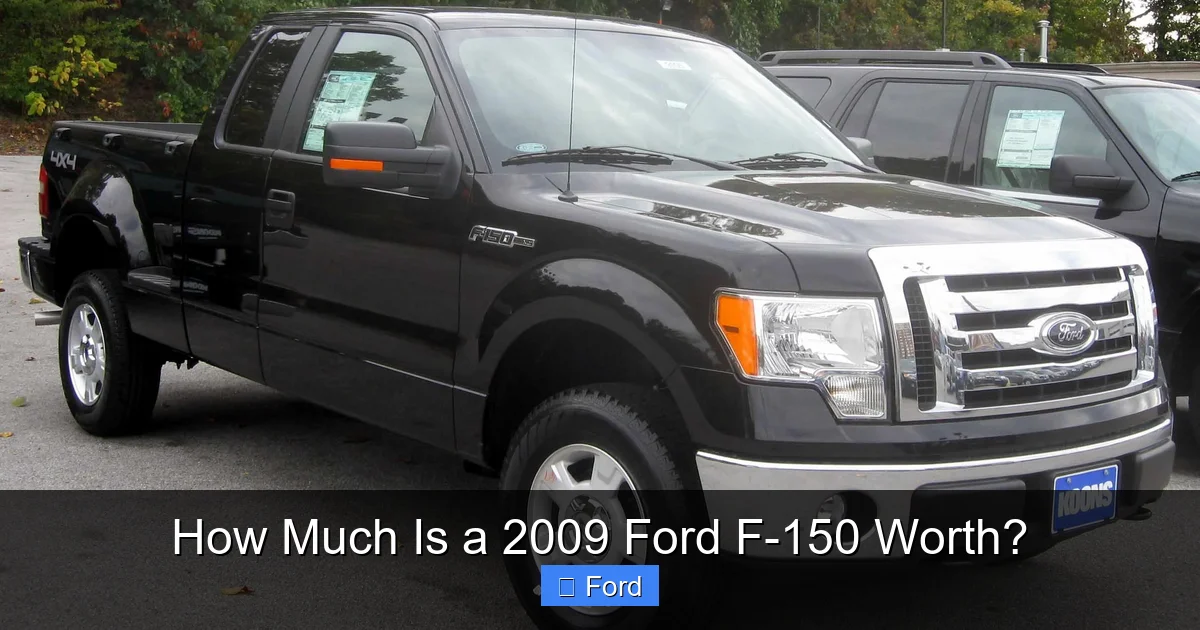
Visual guide about How Much Is a 2009 Ford F-150 Worth?
Image source: upload.wikimedia.org
1. The Holy Grail: Maintenance History
A stack of receipts is worth its weight in gold. A truck with documented oil changes, timing belt/chain service (if applicable to its engine), and major component replacements (transmission, differential) will command a 10-20% premium over an identical truck with no history. Why? It removes the biggest fear of buying an old truck: hidden catastrophic failure. For a seller, having this paperwork is the single best way to maximize your return. For a buyer, walking away from a truck without it is often the smartest move, unless the price is heavily discounted to account for the risk.
2. The Rust Monster: Geography and Corrosion
This cannot be overstated. A 2009 F-150 from Arizona or Texas will be worth thousands more than an identical truck from Michigan or the Northeast, where road salt feasts on metal. Check the rocker panels, cab corners, frame, and rear wheel wells. Surface rust is one thing; structural rot is a deal-breaker that slashes value by 50% or more. A clean undercarriage is a massive value signal. The regional demand also plays in; a 4×4 pickup is worth more in the snowbelt and rural areas than in sunny California cities, where you might compare it to a 2009 Toyota Highlander for family duty.
3. The Mechanical Health Report
Beyond history, the current state is everything. Does the transmission shift smoothly? Any whining from the rear end? Does the 5.4L V8 have the infamous “spark plug pop” issue (a known $1,000 repair)? Are the front suspension components (ball joints, tie rods) fresh? A pre-purchase inspection by a trusted mechanic is non-negotiable for a buyer. The cost of the inspection ($150-$250) is trivial compared to finding a $3,000 hidden problem. For a seller, addressing known issues before listing directly increases the final sale price. The mechanical integrity is the core of a truck’s worth.
4. The Option Checkbox: Engine, Cab, Bed, and Drivetrain
We touched on trim, but the specifics matter.
- Engine: 5.4L V8 > 4.6L V8 > V6. The 5.4L is the king.
- Cab: SuperCrew (4 full doors) > SuperCab (2 small rear doors) > Regular Cab. SuperCrew is most valuable.
- Bed: 5.5′ (short), 6.5′ (standard), 8′ (long). Short beds on SuperCrews are less common and sometimes more desirable for personal use. Long beds on regular cabs are for work.
- Drivetrain: 4×4 commands a $1,500-$2,500 premium over 4×2 in most markets. Limited slip differentials add a few hundred.
5. The “Just Because” Factors: Color, Wheels, and Mods
Yes, these matter, just not as much. Bright colors (red, blue) or classic shades (white, black) sell faster than oddball greens or browns. Upgraded alloy wheels (like the 20″ on Platinum models) add value. Aftermarket modifications are a huge wild card. A professionally installed lift kit, leveling kit, and nice wheels can add value for a specific buyer but will turn off others who want a stock truck. OEM accessories (like a factory running board or tonneau cover) are neutral-to-positive. Huge, poorly done mods (big lifts, loud exhausts, cheap body kits) often destroy resale value. They signal “abused” to many buyers.
Buying vs. Selling: Two Different Games with the Same Truck
Knowing the 2009 Ford F-150 worth is only half the battle. How you interact with that number changes everything based on which side of the transaction you’re on.

Visual guide about How Much Is a 2009 Ford F-150 Worth?
Image source: netcarshow.com
For the Buyer: How to Get a Fair Deal and a Good Truck
Your goal is not to find the cheapest truck; it’s to find the best truck for your money. Start by knowing the NADA or KBB value for your specific configuration (year, trim, engine, miles, options). Use this as your negotiation anchor. Then, follow these rules:
- Inspect, inspect, inspect: Never buy sight-unseen. Look for rust, fluid leaks, tire wear patterns (which can indicate alignment issues), and signs of major body work (mismatched paint, large gaps).
- Test drive everything: Test all gears, 4×4 engagement, windows, locks, HVAC, and infotainment. Listen for noises. Does the steering feel tight or loose?
- Get a vehicle history report: Carfax or AutoCheck is a must. Look for title issues, accident reports, and consistent odometer readings. A clean report is a good start, not a guarantee.
- Budget for the “new-to-you” repairs: As stated earlier, plan on $1,500-$3,000 immediately after purchase. This covers brakes, tires, fluids, and any deferred maintenance. If you buy a truck that needs nothing, you got incredibly lucky.
- Negotiate from the “as-is” price: If the seller states “as-is,” that’s your starting point. Use your inspection findings to argue for a lower price that covers needed repairs. “The left headlight is cracked and the transmission slips into gear. Based on the $2,500 I’ll need to spend to fix that, my offer is $X.”
For the Seller: Maximizing Your Return
Selling a 15-year-old truck is about presentation and honesty. Your goal is to find the one buyer who sees exactly what you have and is willing to pay for it.
- Clean it like it’s going on a date: This is the cheapest and most effective thing you can do. Thoroughly wash, wax, and detail the interior. Remove all personal items. A clean truck feels well-cared-for.
- Gather all paperwork: Title, registration, and every single maintenance record you have. Create a simple folder. This is your value booster.
- Take excellent photos: Shoot in good light. Get pictures of the exterior from all angles, the interior (front and back), the engine bay, and the undercarriage (if it’s clean). Show the VIN. Good photos get clicks.
- Write a brutally honest ad: List all known issues. “Needs new rear brakes soon,” or “Has a small oil seep from the valve cover gasket.” Honesty builds trust and filters out tire-kickers. It also justifies your asking price.
- Price it right from the start: Check comps on Facebook Marketplace, Craigslist, and eBay Sold Listings. Price it 5-10% above your “must-have” number to leave room for negotiation. Overpricing will kill interest.
- Consider the trade-in or scrap alternative: If your truck is truly at the end of its life (severe rust, blown engine), selling it for parts or to a scrapyard might be easier. The value is then in its components, not as a whole vehicle. This is a different calculation entirely, similar to researching how much a catalytic converter is worth for scrap for other vehicles.
How to Get an Accurate Value: Tools and Tactics
Don’t just guess. Use the right tools to triangulate a true number.
The Big Three Valuation Guides
Start here. They’re free and provide a solid baseline.
- NADA Guides: The industry standard, especially for trucks. It’s very good at factoring in optional equipment. Use the “Used Price” for your exact zip code.
- Kelley Blue Book (KBB): Great for consumer-friendly ranges (Trade-In, Private Party, Suggested Retail). It’s a bit more optimistic on condition, so be honest with yourself when selecting “Good” vs. “Fair.”
- Edmunds: Its True Market Value (TMV) is excellent because it aggregates real sales data. It often provides the most realistic “what people are actually paying” figure.
Check all three. They should be within a few thousand dollars of each other. The average of the three is your starting point.
The Real-World Check: Local Listings
This is the most important step. Go to Facebook Marketplace, Craigslist, and Autotrader. Search for “2009 Ford F-150” in your zip code and a 200-mile radius. Don’t just look at the asking prices; look at the sold listings if the platform shows them (Facebook does not, but Autotrader sometimes does). How long do they sit? What trims and miles are actually selling? You’ll often see that the lowest-priced, decent trucks sell in days, while overpriced ones sit for months. This real-time data trumps any guidebook.
The Professional Opinion
If you’re serious about buying, get a pre-purchase inspection. The mechanic’s written report is an objective valuation of the truck’s mechanical condition. If you’re selling, getting a “certified pre-owned” style inspection from a reputable shop and including that report in your listing is a fantastic way to justify a higher price and sell faster.
The Future of Your F-150: Depreciation Curve and Long-Term Outlook
Where does the 2009 F-150 go from here? The bad news: it will continue to lose value. The good news: it’s losing value at a much slower rate now.
The Flattening Curve
The first five years of a new vehicle’s life are brutal for depreciation. By year 10-15, the curve flattens significantly. A 2009 F-150 has already lost about 80% of its original MSRP. In the next five years, it might lose another 10-15%, not 30%. This makes it a relatively stable used asset. Barring a major economic collapse or a catastrophic shift in fuel prices (making all V8 trucks undesirable), its value will plateau around the $4,000-$8,000 range for running, average-condition examples by 2030. Collectible, low-mileage, special-edition models could even start to appreciate slightly in niche circles, much like how people now seek out clean 2007 Ford F150 models.
It’s a Tool, Not an Investment (Usually)
Unless you have a pristine, sub-50,000-mile Platinum or a highly optioned Harley-Davidson edition stored in a climate-controlled garage, do not buy a 2009 F-150 as an investment. Buy it because it’s a capable, affordable, repairable tool. Its worth is in its utility. It will cost you money to own (insurance, fuel, maintenance, repairs). The goal is for the total cost of ownership to be less than the utility you extract from it. For thousands of owners, that equation works perfectly. That’s the real measure of its worth.
Conclusion: Defining the True Worth of a 2009 Ford F-150
So, how much is a 2009 Ford F-150 worth? The final answer is: it’s worth what a willing buyer and a willing seller agree it’s worth, based on a complex mix of objective data and subjective desire. Objectively, we’ve laid out the price ranges: $5,000 for a rough runner, up to $15,000+ for a pristine, high-trim example. Subjectively, its worth is tied to its role in your life. Is it the truck that will finally let you haul that camper? Is it the reliable workhorse for your small business? Is it the project you’ll restore with your son? That personal value can’t be quantified.
The 2009 F-150 represents a peak of practicality in the used truck market. It’s old enough to be affordable, new enough to be comfortable, and supported by an ocean of parts and knowledge. Its weaknesses—fuel economy, aging components, lack of modern safety tech—are clear. Its strengths—towing capacity, space, durability, and sheer simplicity—are equally clear. Whether you’re handing over cash or signing over a title, understanding these dynamics is the key to a fair transaction. Do your homework, inspect meticulously, and know your budget. The right 2009 F-150 is out there, and its true worth is the value it brings to you, every time you turn the key.
Frequently Asked Questions
What is the most common problem with a 2009 Ford F-150?
The most frequently cited issue for the 5.4L V8 is spark plug failure due to the two-piece design, which can cause a plug to blow out of the head. This is a known, fixable problem costing $1,000-$2,500. Other common issues include leaking rear axle seals and failure of the camshaft phasers, which cause a ticking noise. A thorough pre-purchase inspection is critical to identify these.
Which 2009 F-150 trim offers the best value for the money?
The XLT trim consistently offers the best balance. It includes key features like cloth seats, improved audio, and keyless entry over the base XL, without the significant price jump of the Lariat. For buyers seeking capability and comfort without luxury frills, a well-maintained XLT is the sweet spot in the 2009 Ford F-150 worth spectrum.
How many miles is too many for a 2009 Ford F-150?
There’s no hard cutoff, as maintenance history is more important than the odometer. A truck with 250,000 miles and full records can be a better buy than one with 120,000 miles and none. However, once you pass 200,000 miles, you should budget for major component wear (transmission, engine seals, suspension). At that point, the purchase price should reflect the high-mileage reality.
Is the 5.4L Triton V8 a reliable engine in the 2009 F-150?
Yes, with a major caveat. The 3-valve 5.4L is generally robust and powerful, but it is notorious for the spark plug issue mentioned above. If the spark plugs have been replaced with the updated single-piece design (a common repair), the engine is considered very reliable for its age. Always ask for proof of this repair.
Should I buy a 2009 F-150 with rust?
Surface rust on the body is mostly cosmetic and can be repaired. Major structural rust on the frame, cab corners, or rocker panels is a deal-breaker. It compromises safety and is extremely expensive to fix properly. If the rust is merely surface-level, factor the cost of a proper sanding and repaint into your offer. If it’s structural, walk away.
How does the value of a 2009 F-150 compare to a 2009 Toyota Tundra or Chevy Silverado?
In the used market, the F-150 typically holds a slight edge in value over its GM rivals (Silverado/Sierra) from this era due to higher sales volume and parts availability. It generally trails the 2009 Toyota Tundra, which has a reputation for exceptional long-term reliability and thus retains value slightly better. However, a well-equipped F-150 Lariat will often cost more than a base-model Tundra. For a direct comparison, you might look at the 2009 Hyundai Sonata to see how a reliable sedan from the same year holds value, but in a completely different category.