How Much Does It Cost to Replace U-joints on a Toyota Tacoma?

Contents
- 1 Key Takeaways
- 2 📑 Table of Contents
- 3 What Are U-Joints and Why Do They Matter on a Tacoma?
- 4 Breaking Down the Cost: Parts, Labor, and Everything In-Between
- 5 DIY vs. Professional Replacement: Which Path is Right for You?
- 6 A Step-by-Step Look at the Professional Replacement Process
- 7 How to Know Your U-Joints Are Failing: The 5 Key Symptoms
- 8 Maximizing Value: Smart Tips for Tacoma Owners
- 9 Conclusion: A Necessary Investment in Your Tacoma’s Health
- 10 Frequently Asked Questions


Replacing the U-joints on a Toyota Tacoma typically costs between $300 and $800 for professional service, with parts accounting for $50-$200 and labor for $250-$600. The exact price depends on your Tacoma’s model year, drivetrain (2WD vs 4WD), and whether you use OEM or aftermarket parts. While a skilled DIYer can save on labor, improper installation risks severe drivetrain damage. Key signs of failure include clunking noises, vibration, and leaks, and addressing the issue promptly prevents costlier repairs to the driveshaft or transmission.
So, you’re hearing a clunking sound from under your Toyota Tacoma, or you feel a new vibration at certain speeds. Your mind immediately goes to the usual suspects: tires, brakes, or wheel bearings. But what if the culprit is something smaller, hidden in the middle of your truck—the universal joints, or U-joints for short? These humble, cross-shaped components are critical to your Tacoma’s drivetrain, transferring power from the transmission to the wheels. When they fail, they don’t just make noise; they can strand you or cause catastrophic damage. Understanding the cost to replace U-joints on a Toyota Tacoma isn’t just about price—it’s about understanding a vital piece of your truck’s anatomy and the value of timely maintenance.
For Tacoma owners, this is more than a theoretical question. The Tacoma’s reputation as a rugged, reliable workhorse is built on its robust drivetrain. The U-joints are a key link in that chain. Whether you have a 2005 base model or a 2023 TRD Pro, the principles are the same, but the specifics of cost and complexity can vary. This guide will walk you through everything you need to know, breaking down the bottom line, the factors that influence it, and helping you decide the best path forward for your truck and your wallet.
Key Takeaways
- Total Cost Range: Professional replacement for a Toyota Tacoma U-joint averages $300 to $800, with high-end 4WD models or specialty shops on the upper end.
- Parts vs. Labor: U-joint parts themselves are relatively inexpensive ($50-$200), but labor is the major cost due to the intensive disassembly required.
- DIY Potential: Experienced mechanics can save $250-$600 on labor but require specific tools, a safe workspace, and precise installation knowledge to avoid danger.
- Failure Signs: Listen for clunking or squeaking noises (especially when shifting or accelerating), feel for vibrations, and inspect for grease leaks from the joint caps.
- Prevention is Key: Regular lubrication (if equipped with grease fittings) and avoiding extreme stress (like aggressive off-roading in 4WD on dry pavement) extend U-joint life.
- Model Matters: Later model Tacomas (2016+) may have slightly different labor times or part designs, and 4WD models require replacing U-joints on both front and rear driveshafts.
- Don’t Ignore It: Driving with a severely worn U-joint can destroy the driveshaft, yoke, or even the transmission output shaft, leading to repairs costing over $1,500.
📑 Table of Contents
- What Are U-Joints and Why Do They Matter on a Tacoma?
- Breaking Down the Cost: Parts, Labor, and Everything In-Between
- DIY vs. Professional Replacement: Which Path is Right for You?
- A Step-by-Step Look at the Professional Replacement Process
- How to Know Your U-Joints Are Failing: The 5 Key Symptoms
- Maximizing Value: Smart Tips for Tacoma Owners
- Conclusion: A Necessary Investment in Your Tacoma’s Health
What Are U-Joints and Why Do They Matter on a Tacoma?
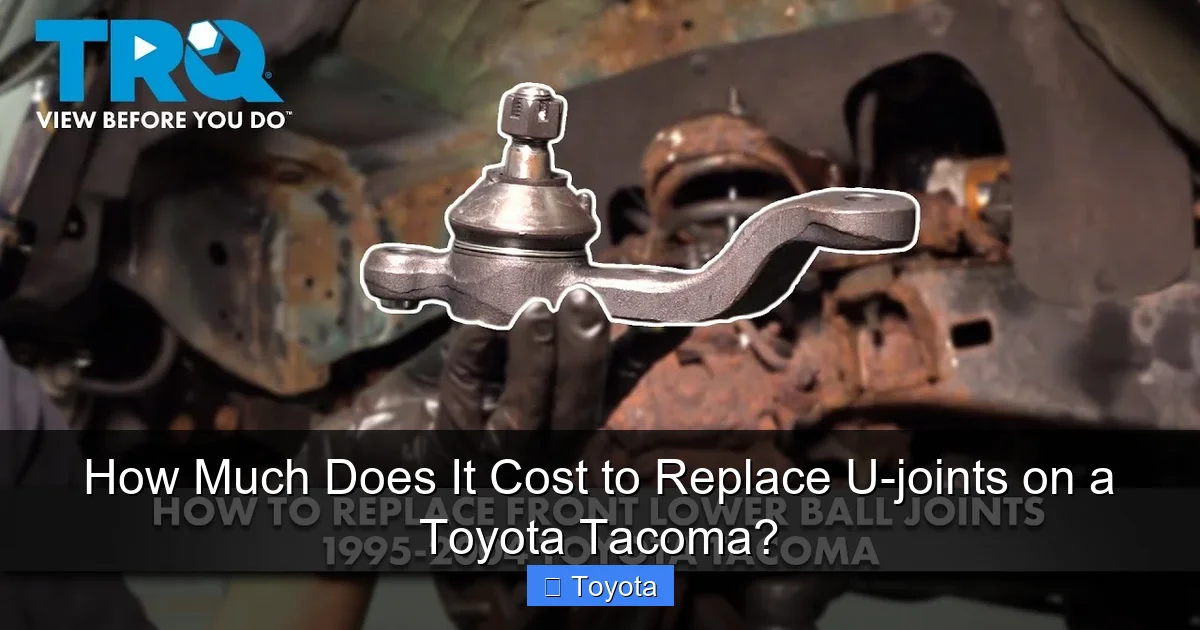
Before we dive into dollars and cents, let’s get familiar with the part itself. A universal joint, or U-joint, is a mechanical coupling that allows a driveshaft to transmit rotary power despite changes in angle. Your Tacoma’s transmission output shaft and the differentials on the axles are fixed in place. The driveshafts that connect them have to move up and down with the suspension and articulate as you turn. U-joints accommodate this movement. They consist of a cross-shaped “spider” and four bearing caps, all held together by a journal cross and sealed with rubber boots to keep grease in and contaminants out.
In a Toyota Tacoma, you’ll find U-joints in two primary locations:
- Front Driveshaft (4WD Models): A two-piece driveshaft with two U-joints: one at the transmission (or transfer case) and one at the front differential.
- Rear Driveshaft (All Models): A single-piece driveshaft with two U-joints: one at the transmission and one at the rear differential.
Some earlier Tacomas (pre-2005) and specific configurations might have a single-piece front shaft, but the principle is identical. Each joint is a wear item. Over time, the grease leaks out, dirt and water get in, the bearings wear, and the joint develops play. This play translates directly into the clunks and vibrations you feel and hear.
The Cascading Effect of a Failed U-Joint
It’s crucial to understand that a U-joint doesn’t exist in a vacuum. When one fails, it places abnormal stress on the entire drivetrain system. A severely worn U-joint can:
- Destroy the driveshaft yoke it connects to.
- Damage the transmission output seal, causing a fluid leak.
- In extreme cases, send a vibration so severe it cracks the transmission case or differential housing.
- Finally, if it completely separates, the driveshaft can flail around under the truck, potentially puncturing the fuel tank or causing a total loss of control.
This is why replacing a bad U-joint is not a “maybe later” repair. It’s an immediate “do it now” item. The cost of a U-joint replacement is cheap insurance against a multi-thousand-dollar drivetrain disaster. If you’re dealing with other fluid leaks, it’s a good time to check out our guide on how much does it cost to fix an oil leak on a car, as keeping all fluids sealed is part of holistic vehicle care.
Breaking Down the Cost: Parts, Labor, and Everything In-Between
Now, to the heart of the matter. The total bill for a Toyota Tacoma U-joint replacement is a sum of several parts. Let’s dissect each one.
Visual guide about How Much Does It Cost to Replace U-joints on a Toyota Tacoma?
Image source: i.ytimg.com
Part 1: The U-Joint Itself
The raw part cost is surprisingly low. A single U-joint for a Tacoma typically ranges from $25 to $100, depending on the source and quality.
- OEM (Original Equipment Manufacturer): Toyota genuine parts run $70-$120 per joint. They are guaranteed to fit and meet the original spec, but you’re paying a premium for the brand.
- Premium Aftermarket: Brands like Spicer (Dana), Moog, or NTN are often considered superior to many OEMs. They use higher-grade bearings and better heat treatment. Expect $50-$100 per joint.
- Standard Aftermarket: Generic parts store brands. They will work, but their lifespan may be shorter, especially if you off-road or tow. Cost: $25-$60 per joint.
Important Note: You will likely need two U-joints for the rear driveshaft and two for the front (on 4WD models). Shops almost always recommend replacing both joints on a given shaft at the same time because the labor is identical, and the other joint is likely on its way out. So, for a 4WD Tacoma, you’re looking at 4 joints. For a 2WD, you need 2. Therefore, parts cost for a full job is typically $100-$400 for all necessary joints.
Part 2: Labor—The Big Variable
This is where the real money is. Replacing a U-joint is not a simple “unbolt and bolt” job. It’s intensive because the driveshaft must be completely removed from the vehicle. Here’s the basic process:
- Vehicle is lifted and supported.
- Rear (or front) driveshaft is unbolted from the transmission/differential and removed.
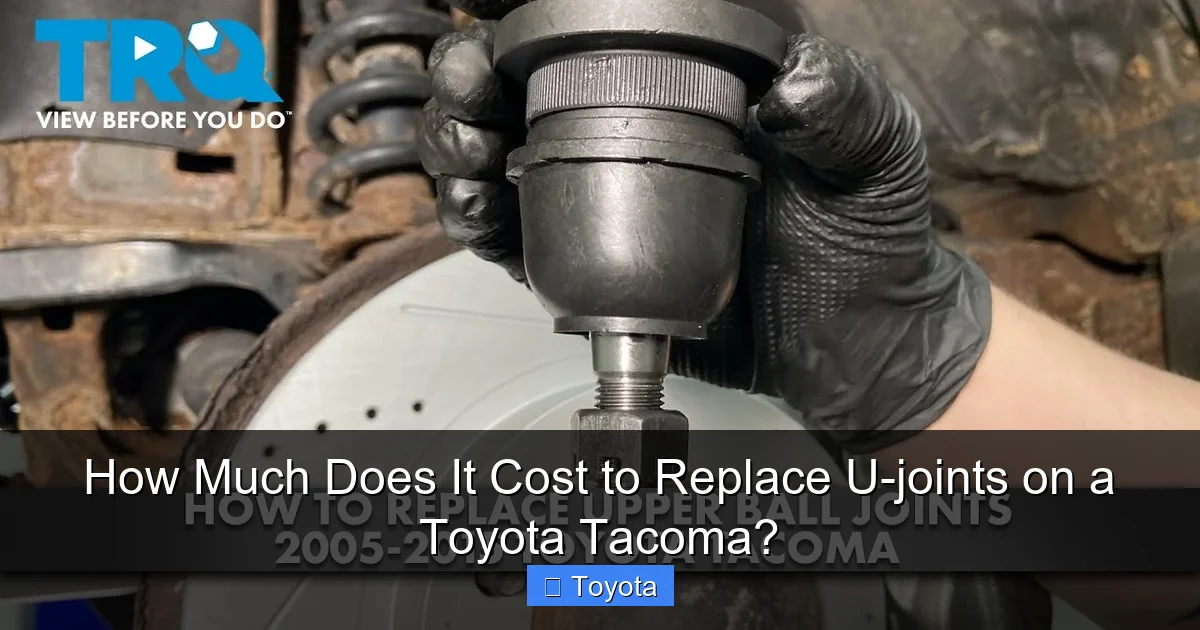
- The old U-joint is pressed out of the yoke. This requires a hydraulic press or a massive C-clamp and a lot of careful force.
- The new U-joint is pressed into the yoke, requiring precise alignment to avoid damaging the seals.
- The driveshaft is meticulously balanced (if removed from the vehicle) and reinstalled.
- All bolts are torqued to specification.
Labor time per U-joint (or per shaft pair) is typically 1.5 to 3 hours, depending on the mechanic’s experience and the Tacoma’s condition (rust is a huge factor). At a standard shop rate of $100-$150 per hour, this means $150-$450 in labor *per shaft*. For a 4WD truck with two shafts, labor can easily hit $300-$900.
Part 3: Additional Supplies and Fees
Don’t forget the small stuff that adds up:
- Boots and Clamps: If you’re just replacing the joint itself, you should replace the rubber boot and its retaining clamps to ensure the new joint stays lubricated and clean. A boot kit is usually $10-$30 per joint.
- Grease: Some U-joints are “lube-for-life” and sealed. Others have a grease fitting and require packing with high-quality grease. Factor in $5-$10.
- Shop Supplies: This covers rags, brake cleaner, thread locker, etc. Usually a flat fee ($20-$50).
- Miscellaneous: If the yoke or other drivetrain components are damaged (common with long-neglected U-joints), you could be looking at $200-$600 for a new yoke or even a remanufactured driveshaft.
- Taxes and Fees: Don’t forget sales tax on parts and any environmental disposal fees.
Total Cost Scenarios
Let’s put it all together for a typical 2015 Toyota Tacoma 4WD.
- Budget Scenario (DIY with basic aftermarket parts): 4 joints @ $40 = $160. Boots/clamps @ $15 x 4 = $60. Total Parts: ~$220. Your time: 4-6 hours. Risk: High if you lack the proper press and experience.
- Typical Independent Shop (Good Aftermarket Parts): Parts: $250. Labor (4 hrs @ $125/hr): $500. Shop supplies: $40. Total: $790.
- Dealership (OEM Parts, Higher Labor Rate): Parts: $450. Labor (4.5 hrs @ $150/hr): $675. Total: $1,125+.
- Mobile Mechanic: Might be 10-20% cheaper than a shop, but they still need to do all the work in your driveway.
For a 2WD Tacoma, subtract the cost of the front shaft’s two U-joints and associated labor, bringing the total down roughly $250-$400.
DIY vs. Professional Replacement: Which Path is Right for You?
This is the million-dollar question. The potential to save several hundred dollars is tempting, but the risks are significant. Let’s evaluate honestly.
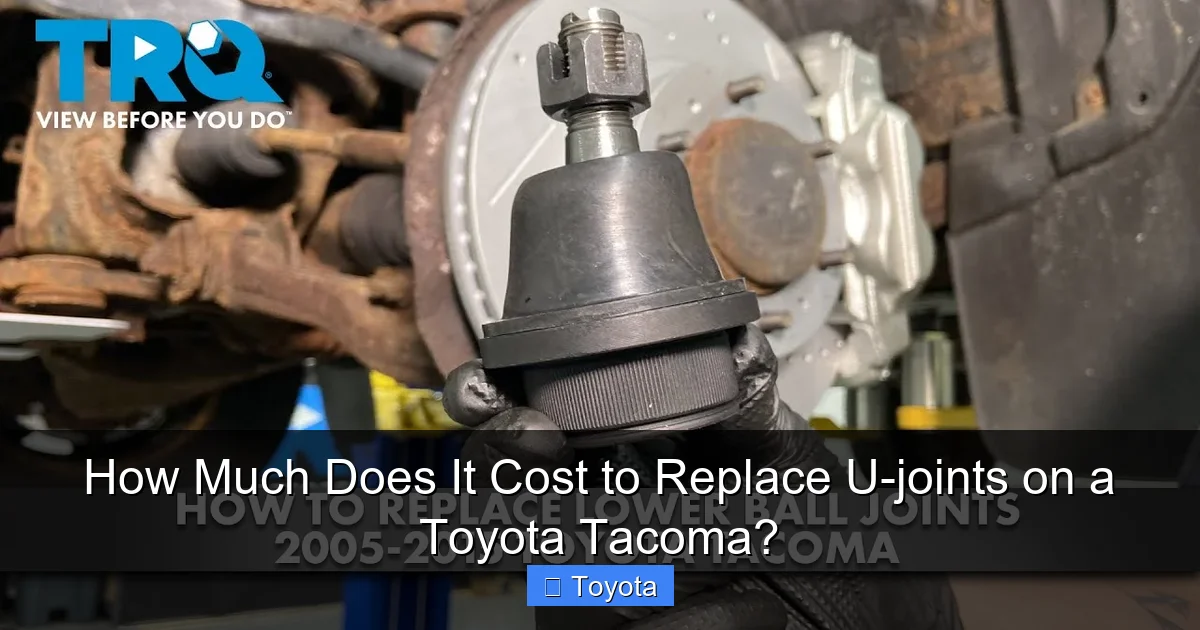
Visual guide about How Much Does It Cost to Replace U-joints on a Toyota Tacoma?
Image source: video-thumbnails-1a.s3.amazonaws.com
The Case for DIY
You should consider doing it yourself if:
- You have a **hydraulic press** or a very high-quality, large C-clamp setup. Pressing U-joints in and out requires significant, even force. A hammer and punch will destroy the joint and the yoke.
- You have **experience with drivetrain work** and understand the critical need for balancing. An unbalanced driveshaft will destroy your transmission bearings.
- You have a **safe, clean workspace** with the truck securely lifted on jack stands. A falling truck is fatal.
- You are replacing the joints on a **rear-wheel-drive Tacoma**. The rear shaft is simpler and often easier to access than the front shaft on 4WD models.
- Your truck is **not rusted solid**. Bolts on a Tacoma from a snowy state can be seized beyond belief.
The DIY Process in a Nutshell: You’ll need a full socket set, torque wrench, pry bars, hammer, punch, the press or clamps, and new joints/boots/grease. The steps involve removing skid plates, unbolting the shaft (watch for the splines—they must go back in the same orientation!), pressing out the old joint, pressing in the new one, reinstalling the boot, greasing (if applicable), and reinstalling the shaft with precise torque. Then, you must road-test carefully for vibration.
The Case for Professional Service
Go to a shop if:
- You lack the **specialized tools** (hydraulic press is the big one).
- You are uncomfortable with the **safety risks** (working under a vehicle, handling a heavy driveshaft).
- Your Tacoma has significant **rust**. A professional shop has impact guns, heat, and penetrating oil to deal with this.
- You want a **warranty**. Reputable shops warranty their work for 12 months/12,000 miles. If you DIY and mess up, you own the full cost of the fix.
- It’s a **4WD front driveshaft**. This is often the trickier job due to access issues and the need to work around the transfer case.
- You value your **time and sanity**. What you save in cash, you may spend in frustration and a full day of hard, dirty work.
Pro Tip: If you want to save money but lack a press, call around to local transmission shops or machine shops. Some will press your new U-joint into your clean, old yoke for a fee of $20-$50 per joint. You do all the removal and reinstallation; they do the precise pressing. This is an excellent middle ground.
A Step-by-Step Look at the Professional Replacement Process
Knowing what’s involved helps you understand the labor cost and ask intelligent questions of your mechanic. Here’s a simplified overview of what a good technician will do on your Tacoma.
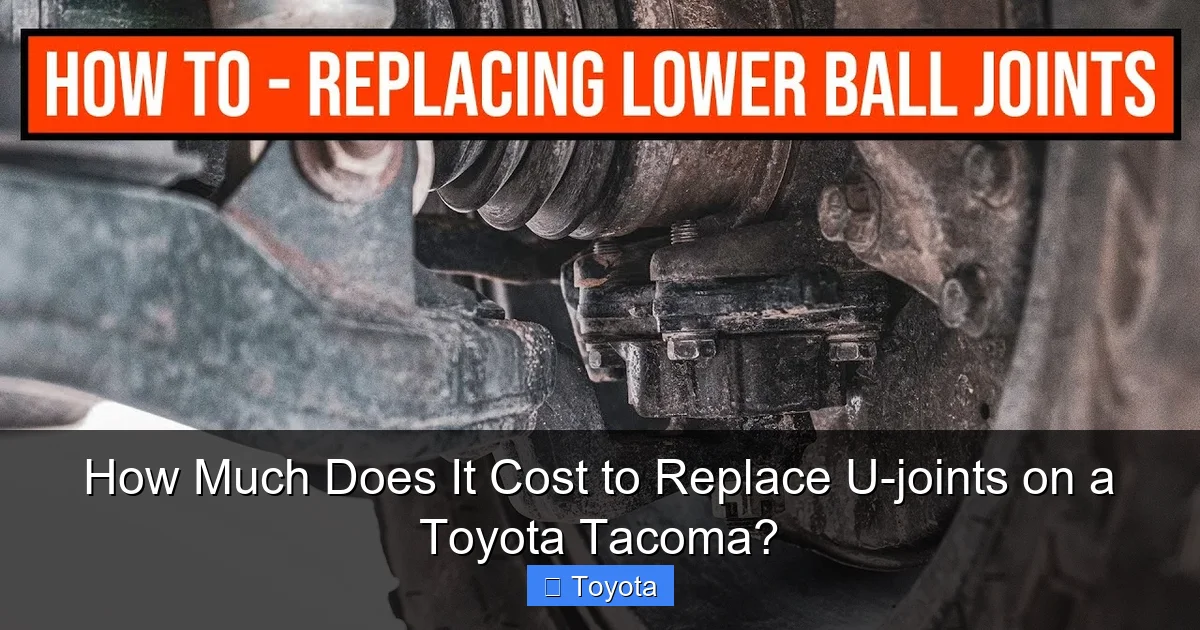
Visual guide about How Much Does It Cost to Replace U-joints on a Toyota Tacoma?
Image source: i.ytimg.com
1. Diagnosis and Vehicle Preparation
The mechanic will first confirm the U-joint is the problem, often by checking for play in the joint by hand (with the shaft removed) or by road-testing to pinpoint the noise/vibration location. The truck is then lifted on a lift or jack stands. The skid plates (if equipped) and any heat shields around the driveshaft are removed for clear access.
2. Driveshaft Removal
This is the most time-consuming part for the beginner, but a pro makes it look easy. The technician will:
- Mark the orientation of the driveshaft relative to the differential yoke and transmission output shaft. This is critical for maintaining balance.
- Apply penetrating oil to all bolts (especially on rusty trucks).
- Unbolt the rear (and/or front) driveshaft from both ends. They often have large, torque-to-yield bolts that require impact guns and specific sockets.
- Carefully lower and remove the driveshaft, taking care not to let it hang by the yokes or damage the splines.
3. U-Joint Press-Out and Press-In
The removed driveshaft is taken to a press. The old joint is pressed out of the yoke. The new joint, with its new boot and clamps loosely in place, is pressed in. The mechanic ensures the joint is fully seated and the bearing caps are aligned correctly. The boot is then fully secured with the clamps. If the U-joint has a grease fitting, it is packed with grease at this stage.
4. Driveshaft Balancing and Reinstallation
This is non-negotiable. Even if the shaft was balanced before, removing and reinstalling it can slightly alter the balance. A professional shop will spin the shaft on a balancer and add small weights if needed. The shaft is then carefully lifted back into place, aligned with the marks made earlier, and bolted up. All bolts are torqued to Toyota’s specification—this is vital, as under-torqued bolts can fail, and over-torqued ones can stretch and break.
5. Final Check and Test Drive
Skid plates are reinstalled. The truck is lowered. The mechanic will spin the driveshaft by hand to ensure it turns freely without binding. Finally, a thorough road test is conducted at various speeds to verify the vibration is gone and no new noises are present.
How to Know Your U-Joints Are Failing: The 5 Key Symptoms
You don’t need to wait for a complete breakdown. Catch these signs early to minimize cost and danger.
1. The Classic “Clunk”
This is the most common symptom. You hear a distinct, hollow clunk or thunk when:
- Shifting from Drive to Reverse (or vice versa).
- Applying power from a stop (accelerating).
- Lifting off the throttle (decelerating).
- Going over a bump.
The sound comes from the metal-on-metal impact of a joint with excessive play snapping into a new position under load.
2. A Constant Vibration
A vibration that increases with vehicle speed, usually starting around 30-45 mph and intensifying as you go faster. It’s often felt in the seat, floorboard, or steering wheel (if it’s the front shaft). This is caused by the U-joint’s rotational imbalance as it spins. A vibration that changes with engine RPM but not road speed is more likely an engine or transmission mount issue.
3. Squeaking or Chirping
A high-pitched squeak or chirp that changes with vehicle speed. This is the sound of a dry U-joint. The grease has leaked out of a torn boot, and the metal bearings are screaming for lubrication. This is an early warning sign. If caught now, you may only need to replace the boot and repack the joint (if it’s a serviceable type), which is far cheaper than a full joint replacement.
4. Visual Inspection: Grease Leaks and Rust
Get under your Tacoma (safely!) and look at the U-joint boots. They are the rubber, accordion-like covers at the end of each joint.
- Good: Boot is intact, pliable, and full of grease. No cracks or tears.
- Bad: Boot is cracked, torn, or missing entirely. You’ll see dried, caked grease around the joint and possibly on the underside of the truck. Rust may be forming on the joint itself. If you see black, gritty grease, the joint is already contaminated and failing.
5. Driveshaft Movement
With the truck safely lifted and the transmission in neutral, you can try to grasp the driveshaft near the U-joint and try to twist or wiggle it. There should be virtually no perceptible play. Any noticeable clunking movement means the joint’s bearings are worn. Be extremely careful performing this check.
Maximizing Value: Smart Tips for Tacoma Owners
Whether you pay a shop or turn a wrench yourself, these strategies will help you get the best value and longest-lasting repair.
Always Replace in Pairs (or Quads)
As mentioned, if one U-joint on a driveshaft has failed, the other is on borrowed time. The labor to replace both at once is only marginally more (maybe an extra 15-30 minutes). Paying for two separate labor bills later is financially foolish. Insist on replacing both joints on a given shaft. For a 4WD Tacoma, strongly consider doing all four at once if you’re already in there, as the front and rear shafts often have similar wear patterns.
Choose the Right Part for Your Use Case
Don’t just buy the cheapest joint at the parts store.
- Daily Driver / Highway: A premium aftermarket brand (Moog, Spicer) is perfect. They offer excellent longevity at a good price.
- Heavy Off-Road / Towing: Consider a heavy-duty aftermarket joint or even OEM. The extra stress of rocks, mud, and constant torque demands the strongest possible component. Some off-road shops offer U-joints with larger bearings or special seals.
- Budget Replacement: If money is extremely tight, a standard aftermarket joint is acceptable, but budget for a potential repeat job in 2-3 years instead of 5-7.
The “While You’re In There” Opportunity
Since the driveshaft is out, it’s the perfect time to inspect and service other related components for a fraction of the extra labor cost:
- Center Support Bearing (if equipped): Some Tacomas have a carrier bearing that supports the two-piece rear driveshaft. If it’s noisy (a growl that changes with speed), replace it now.
- Yokes and Seals: Have the mechanic inspect the transmission and differential yokes for wear or damage. Replace the transmission output shaft seal if it shows any sign of leaking. A transmission fluid leak is a separate, serious issue.
- Driveshaft Balance: Ensure the shop balances the shaft after reinstalling the new joints. This is crucial.
- Overall Inspection: Ask them to look at the condition of the transmission fluid (if the seal is disturbed) and the general state of the undercarriage.
This is where proactive maintenance pays off. While you’re addressing your U-joints, you might also want to consider other cosmetic or functional upgrades. For instance, if your Tacoma’s paint is looking tired, you can explore how much does it cost to paint a Toyota Tacoma as a separate project to keep your truck looking sharp.
Negotiate and Compare
Get at least three detailed written estimates. They should break down parts (with brand names), labor hours, labor rate, and shop supplies. Be wary of quotes that seem too low—they may be using the cheapest parts and planning to cut corners on labor time. Ask if the quote includes balancing. Ask about the warranty on parts and labor. A reputable shop will stand behind their work.
Conclusion: A Necessary Investment in Your Tacoma’s Health
The cost to replace U-joints on a Toyota Tacoma, while significant, is a fundamental and non-negotiable maintenance item for a rear-wheel or four-wheel-drive vehicle. It’s the price of admission for owning a capable truck that can carry a load, tow a trailer, or tackle a backcountry trail. Viewing this repair as an expense is the wrong mindset; it’s an investment in the continued reliability and safety of your vehicle.
By understanding the cost drivers—the modest price of the parts versus the substantial labor—you can make an informed decision. You can choose to invest in high-quality parts and professional installation for peace of mind and a long-term fix, or you can leverage your mechanical skills and tools to save money, accepting the inherent risks and time commitment. Either way, ignoring the symptoms is the most expensive choice of all. The quiet hum of a healthy driveshaft is one of the pleasures of a well-maintained Tacoma. Don’t let a failing U-joint rob you of that. Listen to your truck, address the clunks early, and keep your legendary Toyota on the road and trail for years to come.
Frequently Asked Questions
How long do U-joints typically last on a Toyota Tacoma?
There’s no set mileage, but with proper maintenance and normal driving, they often last 100,000 miles or more. Severe off-roading, towing, and driving through deep water or mud can drastically shorten their lifespan. Regular inspections are key.
Can I still drive my Tacoma with a bad U-joint?
You can drive a short distance at very low speed to a repair shop if the play is minimal and there’s no vibration. However, driving any distance or at highway speeds with a severely worn U-joint is extremely dangerous and can cause total drivetrain failure. It’s a “repair immediately” situation.
Is the cost different for a 2WD versus a 4WD Tacoma?
Yes, significantly. A 2WD Tacoma has only a rear driveshaft with two U-joints. A 4WD has both a rear and a front driveshaft, requiring four U-joints total. The labor on the front shaft is often more complex, so the total cost for a 4WD is typically $300-$500 more than for a 2WD.
How often should I have my U-joints inspected?
Have them checked during any major service, like a transmission fluid change or differential service. As a rule of thumb, inspect them visually and manually for play at least once a year, or every 15,000 miles, especially if you drive in harsh conditions.
What’s the difference between a U-joint and a CV joint?
Both transfer power at an angle, but U-joints are used on driveshafts (between the transmission and axles) and operate at higher angles. CV (Constant Velocity) joints are used on front-wheel-drive half-shafts and on independent rear suspensions, and they can operate at much greater angles without vibration. Tacomas use U-joints on their solid-axle driveshafts.
Do I need to replace the driveshaft itself when replacing U-joints?
Usually no. The driveshaft tube itself rarely fails. You only need to replace the driveshaft if the yokes (the end pieces) are worn or damaged, which can happen if a U-joint failed catastrophically. In most cases, you’re just pressing new joints into the existing, reusable yokes.