
How Often Should You Change Transmission Fluid on a Toyota Corolla

Knowing when to change your Toyota Corolla’s transmission fluid is critical for avoiding costly repairs. The classic advice of “every 30,000 miles” is outdated for many modern Corollas, especially those with sealed CVTs. Your definitive interval depends heavily on your specific model year, transmission type (automatic, manual, or CVT), and driving conditions. Always start with your owner’s manual, but be prepared to adjust that schedule if you frequently drive in severe conditions like stop-and-go traffic or extreme temperatures. Ignoring this vital maintenance can lead to slipping, harsh shifts, and ultimately, transmission failure.
Let’s be honest: when you think about maintaining your trusty Toyota Corolla, your mind probably jumps to oil changes, tire rotations, and maybe brake pads. The transmission? That’s the mysterious, heavy box under the car that’s supposed to last forever, right? Well, not exactly. The transmission fluid coursing through it is its lifeblood, and knowing when to change it is one of the most important—and often misunderstood—pieces of maintenance for your Corolla. Get this wrong, and you could be facing a repair bill that makes your eyes water. Get it right, and your Corolla’s transmission can easily outlast the rest of the car. So, how often should you change transmission fluid in a Toyota Corolla? The answer isn’t as simple as “every 30,000 miles.” Buckle up; we’re diving deep into the details for every generation and transmission type.
Key Takeaways
- There is no single mileage interval for all Corollas. Recommendations range from “lifetime” (sealed CVT) to every 60,000-100,000 miles for older automatics, depending on the model year and transmission type.
- Your driving style matters more than the odometer. Severe driving conditions—like heavy city traffic, towing, or extreme heat/cold—can degrade fluid faster, requiring more frequent changes than the standard schedule.
- Check your fluid’s condition regularly, not just its mileage. Healthy fluid is bright red and smells slightly sweet. Dark brown/black fluid or a burnt odor means it’s time for a change, regardless of mileage.
- “Lifetime” fluid for CVTs means lifetime of the warranty, not the car. Many mechanics recommend proactive CVT fluid changes between 60,000-100,000 miles for long-term reliability, even if the manual says “lifetime.”
- Neglecting transmission fluid leads to expensive problems. Old, contaminated fluid loses its lubricating and cooling properties, causing accelerated wear, slipping gears, erratic shifting, and potential total transmission failure.
- The process differs by transmission type. Traditional automatics often need a full fluid flush. Sealed CVTs may require a special procedure at a dealership. Manual transmissions have their own intervals and fluid types (gear oil).
- Professional service is often recommended for modern Corollas. Especially for CVTs and sealed units, incorrect fluid or procedure can cause damage. A specialist ensures the correct fluid and process is used.
📑 Table of Contents
- Understanding Your Corolla’s Transmission: It’s Not One-Size-Fits-All
- Manufacturer Guidelines vs. Real-World Recommendations
- Factors That Can Shorten Your Fluid’s Lifespan
- Warning Signs Your Fluid Is Past Its Prime
- DIY vs. Professional Service: Which Route Should You Take?
- Transmission Fluid in the Context of Overall Toyota Corolla Maintenance
- The Bottom Line: A Practical Schedule for Every Corolla Owner
Understanding Your Corolla’s Transmission: It’s Not One-Size-Fits-All
To answer the “how often” question, we first need to identify what we’re talking about. Over its long production run, the Corolla has been equipped with three main types of transmissions: the traditional automatic, the manual, and the modern Continuously Variable Transmission (CVT). Each has different fluid requirements and service intervals. Your model year is the ultimate decider.
The Traditional Automatic (Aisin-Warner 4-Speed, 5-Speed, 6-Speed)
If you own a Corolla from the 1990s through the early 2010s (roughly models 1991-2013), you almost certainly have a conventional automatic transmission with fixed gear ratios. These are robust, proven units, often paired with the reliable Aisin-Warner family of transmissions. For these, the classic “every 30,000 to 60,000 miles” rule often applies. Toyota’s official recommendation for many of these models was typically “every 60,000 miles” under normal conditions. However, many mechanics and enthusiasts argue that for ultimate longevity, a change every 30,000-40,000 miles is a smart precaution, especially if the car is used for a lot of city driving. The fluid used here is Toyota Genuine ATF (Automatic Transmission Fluid) Type T-IV or equivalent.
The Modern CVT (Continuously Variable Transmission)
Starting with the 2014 model year (for the North American market), Toyota began phasing in its K-series CVT in the Corolla. This transmission uses a belt and pulley system instead of gears to provide an infinite number of gear ratios, optimizing fuel efficiency. The fluid in a CVT, Toyota Genuine CVT Fluid FE or FC, is highly specialized. It must handle extreme pressures and temperatures within the pulley system. Here’s where it gets tricky: for many CVT-equipped Corollas (2014-2022), Toyota’s official stance in the owner’s manual is to use “Lifetime” fluid. This is the single biggest point of confusion. In automotive engineering terms, “lifetime” typically refers to the lifespan of the warranty (e.g., 5 years/60,000 miles), not the theoretical lifespan of the transmission itself. The consensus among transmission specialists is that proactive CVT fluid changes between 60,000 and 100,000 miles are a wise investment to prevent premature wear and ensure smooth operation for the long haul. Note: The 2023+ Corolla offers a traditional 8-speed automatic or a CVT depending on the trim, so always check your manual.
The Manual Transmission
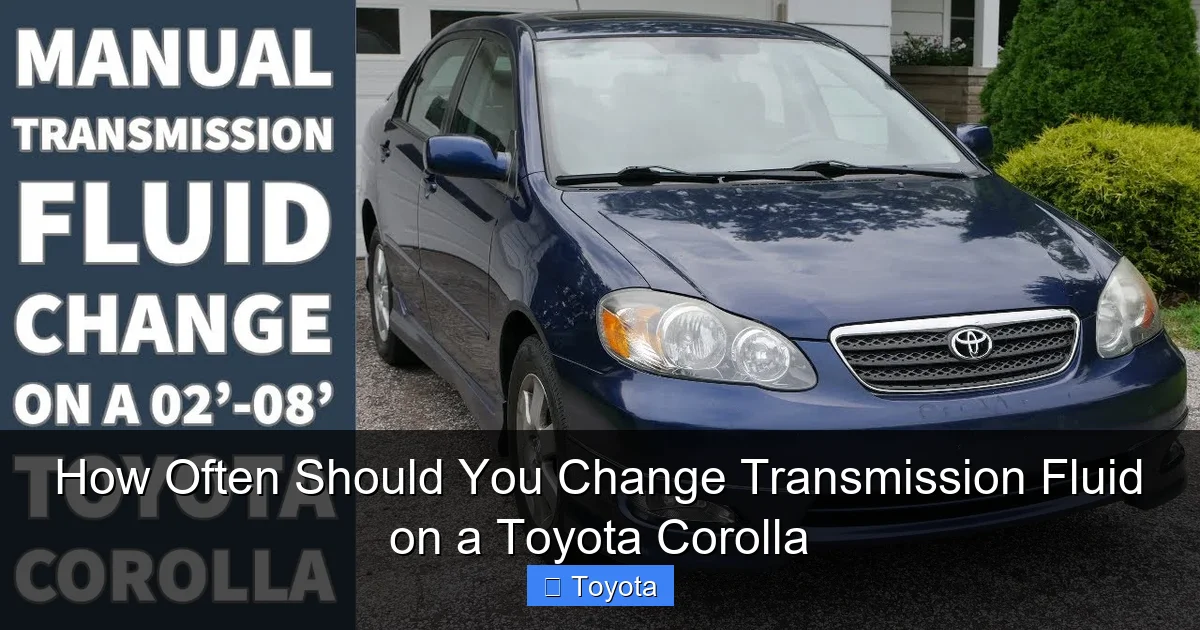
For the purists and efficiency seekers who chose the stick shift (available on base models for many years), the maintenance is different. Manual transmissions use gear oil (like Toyota Gear Oil GL-4 or GL-5), not ATF. The interval is much longer, typically every 30,000 to 60,000 miles for severe service, or even up to 100,000 miles under normal conditions. The process is also simpler, often just a drain and fill, as there’s no torque converter or valve body to flush. However, a worn clutch can contaminate the fluid with particulates, so if you notice a gritty feel or difficulty shifting, a fluid change is a good first diagnostic step.
Manufacturer Guidelines vs. Real-World Recommendations
Your owner’s manual is the primary source of truth. Let’s look at some generalized examples, but remember: your manual is the law for your specific VIN.
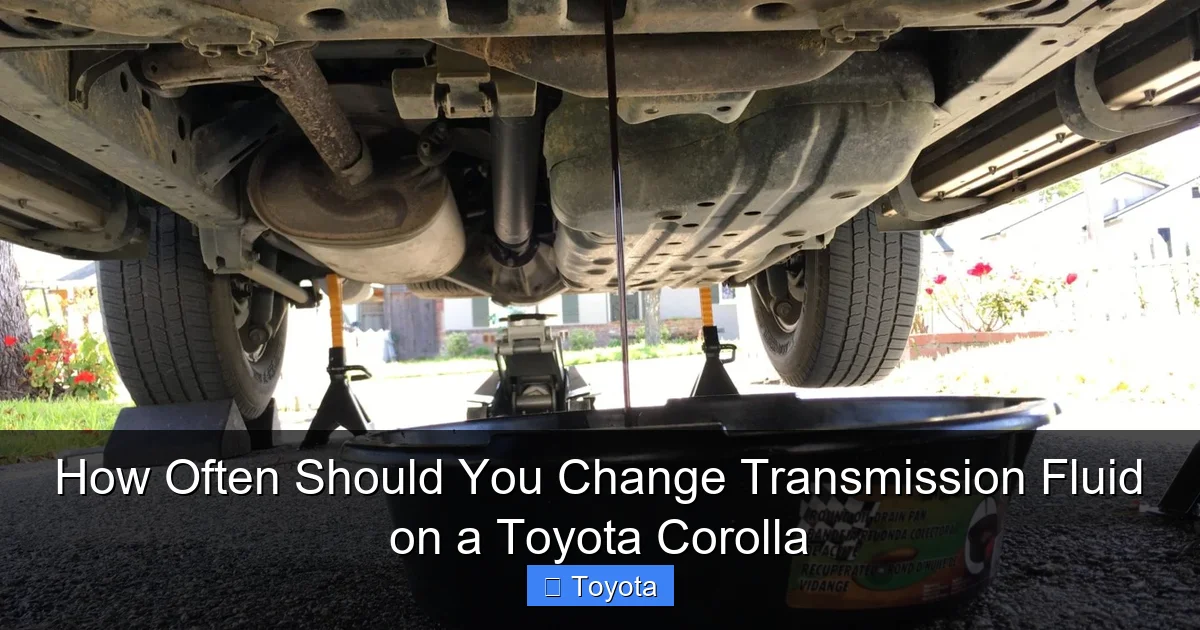
Visual guide about How Often Should You Change Transmission Fluid on a Toyota Corolla
Image source: img.toyotask.com
What the Manual Says (The Minimum Standard)
For a 2020 Toyota Corolla SE with a CVT, the manual might state: “Under normal driving conditions, the CVT fluid is considered lifetime and does not require replacement.” For a 2010 Corolla with a 4-speed automatic, it will likely say: “Inspect every 30,000 miles, change every 60,000 miles.” These are the baseline, warranty-covering recommendations. Toyota designs its vehicles to meet these standards reliably. However, “normal driving conditions” is a key phrase that almost no one truly meets.
The “Severe Service” Adjustment (The Realistic Standard)
Every owner’s manual has a “Severe Service” schedule. This includes:
- Extensive idling or stop-and-go traffic in hot weather.
- Driving in extremely cold or hot temperatures.
- Towing a trailer or using a roof rack frequently.
- Driving in mountainous areas or on dusty/sandy roads.
- Short trips (less than 5 miles) where the transmission never fully warms up.
If you check even one of these boxes, you should follow the “Severe Service” schedule, which typically halves the normal interval. For a modern Corolla CVT, that might mean considering a change at 60,000 miles instead of waiting indefinitely. For a 2012 Corolla automatic, it might mean changing at 30,000 miles instead of 60,000. This is the most practical and protective approach for the vast majority of drivers.
Factors That Can Shorten Your Fluid’s Lifespan
Mileage is a convenient metric, but it’s not the cause of fluid degradation; heat and contamination are. Understanding what kills transmission fluid helps you judge your own needs.
Visual guide about How Often Should You Change Transmission Fluid on a Toyota Corolla
Image source: i.ytimg.com
Heat: The Silent Killer
Transmission fluid oxidizes and breaks down when subjected to high temperatures. While the transmission has a cooler (often part of the radiator), aggressive driving, towing, climbing long grades, or even a slightly clogged cooler can send fluid temperatures soaring. Once fluid gets too hot, it loses viscosity, its ability to lubricate diminishes, and it can turn into a varnish-like substance that clogs small passages. A transmission fluid temperature gauge is a great tool for those who tow or drive hard.
Contamination: The Grind
Over time, tiny metal particles from normal clutch and gear wear circulate in the fluid. A transmission filter (if equipped) catches some, but not all. These particles act as an abrasive, grinding away at precision components. Fluid also absorbs moisture over time, which can cause corrosion and reduce its boiling point. This is why fluid turns dark brown or black—it’s full of suspended contaminants and oxidized byproducts.
The “Sealed” Unit Myth
Modern CVTs are often called “sealed for life.” This is a misnomer. They are sealed to prevent user error and to meet emissions/maintenance-free marketing claims. They are not hermetically sealed. There is still a breather, and fluid still degrades. There is no service plug or dipstick for the owner. A fluid change on these requires a specialized machine at a dealership or transmission shop to pump out the old fluid and refill it. Don’t let the “sealed” label fool you into thinking it never needs service.
Warning Signs Your Fluid Is Past Its Prime
Don’t wait for a major failure. Your transmission will give you subtle (and not-so-subtle) hints that the fluid needs attention. Catching these early can save thousands.
Visual guide about How Often Should You Change Transmission Fluid on a Toyota Corolla
Image source: i.ytimg.com
Visual and Olfactory Inspection (For Models With a Dipstick)
If your Corolla has a transmission dipstick (most pre-2014 automatics and manuals do), check it monthly. Wipe the stick on a white paper towel. Fresh, healthy ATF is a translucent, cherry red color. If it’s:
- Dark Brown or Black: It’s oxidized and contaminated. Change it immediately.
- Milky or Pinkish Foam: This indicates coolant contamination (a sign of a failed internal radiator seal), which is a serious problem requiring immediate diagnosis.
Also, smell it. Fresh fluid has a slightly sweet, petroleum-like odor. A burnt, acrid smell means the fluid has been overheating and is damaged.
Driving Symptoms (For All Models)
These are red flags, especially if they appear gradually:
- Delayed or Hesitant Shifts: The transmission takes a second longer than usual to engage Drive or Reverse, or between gears on an automatic.
- Harsh or Jerky Shifts: Shifts feel like a thump or a slam instead of a smooth transition.
- Slipping: The engine revs high (like it’s in neutral) for a moment before the car accelerates. You feel a loss of power.
- Unusual Noises: Whining, humming, or clunking sounds that change with engine speed or gear changes.
- CVT-Specific Symptoms: A “rubber band” feeling (engine revs but car speed lags), a high-pitched whine that changes with acceleration, or sudden, unexpected simulated gear shifts (in some models programmed for a faux-stepped feel).
If you experience any of these, check the fluid level and condition first. If the fluid is fine, the issue is likely internal and needs a professional diagnosis.
DIY vs. Professional Service: Which Route Should You Take?
For a traditional automatic or manual transmission in an older Corolla, a fluid change is a manageable DIY project for someone with basic mechanical skills. For a modern CVT, it’s almost always a job for the pros. Here’s the breakdown.
The DIY Route (Older Automatics & Manuals)
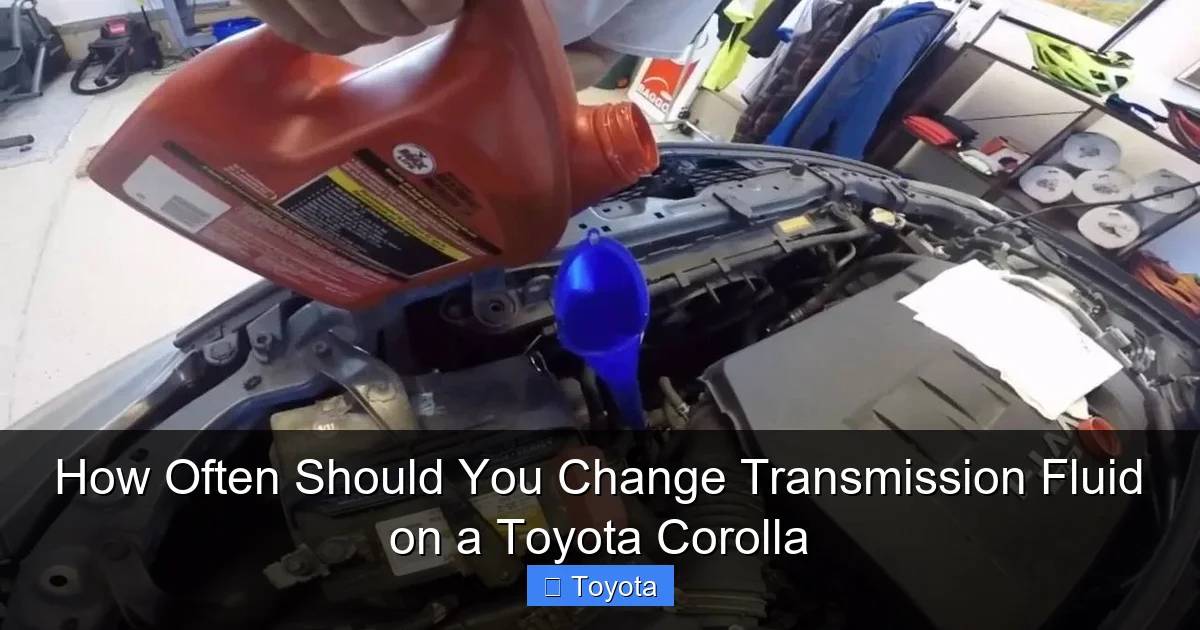
What’s involved: You’ll need the correct fluid (check manual for spec—e.g., Toyota WS, Type T-IV), a new drain plug washer/gasket, a drain pan, a funnel, and basic hand tools. The process is: warm up the car, elevate it, remove the drain plug, let it drain, replace the plug and washer, refill via the dipstick tube to the correct level. It’s a “drain and fill,” which replaces about 40-50% of the fluid. For a more thorough change, you can repeat the process after running the car and shifting through gears to circulate new fluid.
Pros: Saves money on labor. You know it was done with the correct fluid.
Cons: Messy. You must be meticulous about getting the level exactly right. Disposing of old fluid properly is your responsibility. You won’t get a 100% fluid exchange like a professional flush machine.
The Professional Route (CVTs & Sealed Units)
What’s involved: A shop uses a specialized transmission fluid exchanger machine. This connects to the transmission’s cooling line, allowing it to pump out old fluid while simultaneously pumping in new fluid. This achieves a near-100% fluid exchange. They also use the exact OEM-specified fluid.
Pros: Complete fluid replacement. No mess for you. Often comes with a warranty. Critical for CVTs where incorrect fluid or procedure can cause damage.
Cons: More expensive ($150-$300 at a reputable independent shop, $250-$400+ at a dealer).
Our Verdict: If your Corolla has a dipstick and a traditional automatic or manual, DIY is fine if you’re comfortable. If it’s a CVT (most 2014+), or if you’re unsure about any step, pay for professional service. The cost of a fluid change is a tiny fraction of a transmission rebuild. You can also find great guides on how to check transmission fluid on other models, like a Honda Civic, to understand the general process, but always use the Toyota-specific fluid and procedure for your Corolla.
Transmission Fluid in the Context of Overall Toyota Corolla Maintenance
Your transmission doesn’t exist in a vacuum. Its health is tied to the overall health of your vehicle. This is where a holistic maintenance mindset pays off.
Synthetic Oil Changes: The Foundation
Using a high-quality synthetic oil and changing it on schedule (typically every 5,000-10,000 miles) keeps your engine running cleanly and at optimal temperature. An engine that runs efficiently produces less heat that can soak into the transmission, especially in front-wheel-drive cars like the Corolla where the transmission is right next to the engine. A well-maintained engine is a less stressful load on the transmission. For specifics on your Corolla’s engine oil, refer to guides on how often to change synthetic oil, as the principles are similar: quality fluid and regular changes are key.
Cooling System Health
As mentioned, the transmission often uses the engine’s radiator to cool its fluid. If your radiator is clogged, your thermostat is stuck, or your coolant is old and ineffective, your transmission fluid can run hotter than it should. Regular coolant changes (typically every 30,000-50,000 miles or 5 years for Toyota’s pink Super Long Life Coolant) ensure your entire thermal management system is working. You can learn the exact interval for your Toyota’s antifreeze here. A failing water pump or a stuck thermostat can also cause localized hot spots.
Driving Habits
No fluid change can overcome brutal driving habits. Constantly flooring the accelerator, “riding” the brakes while in gear (which loads the transmission), or frequently launching from a stop will generate immense heat and stress. Smooth, predictable driving is the best free maintenance you can give your transmission. Also, always come to a complete stop before shifting between Drive and Reverse. This simple habit saves immense wear on the transmission’s parking pawl and internal bands/clutches.
The Bottom Line: A Practical Schedule for Every Corolla Owner
After all that, here is a simplified, actionable cheat sheet. But remember: your owner’s manual overrides this.
- Pre-2014 Automatic (4/5/6-Speed): Every 60,000 miles under normal conditions. Every 30,000 miles under severe conditions. If the fluid has never been changed on a high-mileage car (>150k), proceed with caution. A “panic” change on severely degraded fluid can sometimes dislodge sludge and cause issues. Consult a trusted shop first.
- 2014-2022 CVT: Proactive change every 60,000-80,000 miles. Even if the manual says “lifetime,” this is the smart money move for long-term ownership. If you plan to keep the car past 150,000 miles, do not skip this.
- 2023+ (8-Speed Auto or CVT): Follow the manual. The new 8-speed automatic likely has a 60,000-mile interval. The CVT recommendation may still be “lifetime” but follow the 60k-80k proactive advice.
- Any Year Manual: Every 30,000-60,000 miles. Inspect fluid for metal shavings. Change if gritty or dark.
Final Pro Tip: When you do have the fluid changed, ask to see the old fluid. It’s a great visual indicator of your transmission’s internal health. Bright red is good. Dark brown with a burnt smell is a warning. Jet black is a cry for help.
Your Toyota Corolla is famous for its reliability. A big part of that reputation is due to sensible, proactive maintenance. By understanding your specific transmission, adjusting for your real-world driving, and keeping that vital fluid clean and fresh, you’re not just servicing a car—you’re protecting a trusted companion for hundreds of thousands of miles. Don’t guess. Check your manual, inspect your fluid if possible, and make a plan. Your future self, and your wallet, will thank you.
Frequently Asked Questions
Can I mix different brands of Toyota transmission fluid?
No, you should never mix different brands or specifications of transmission fluid. CVT fluid, in particular, is highly engineered for specific materials and pressures. Mixing fluids can break down their chemical properties, lead to poor lubrication, and cause catastrophic damage. Always use the exact fluid specification (e.g., Toyota WS, Toyota CVT FE) listed in your owner’s manual.
How much does a Toyota Corolla transmission fluid change cost?
The cost varies dramatically. For an older Corolla with a drain-and-fill DIY job, it’s just the cost of fluid ($25-$50). At a quick-lube shop, a basic drain-and-fill might run $100-$150. For a professional flush on a traditional automatic, expect $150-$300. For a CVT fluid exchange using a machine at a dealership or specialty shop, the price is typically $250-$450. Always get a quote based on your specific model year and transmission type.
Is a transmission fluid flush necessary, or is a drain and fill enough?
For most older Corollas with a conventional automatic, a simple drain and fill (replacing ~40% of fluid) done regularly is sufficient. A full flush is more thorough but can be riskier on high-mileage transmissions with unknown service history. For modern CVTs, a “flush” using a machine is the standard procedure because there is no dipstick or simple drain plug; it’s the only way to completely replace the fluid. Always follow the manufacturer’s recommended procedure for your specific transmission.
What happens if I never change my transmission fluid?
Eventually, the fluid will degrade, lose its lubricating and cooling properties, and become laden with metal shavings and sludge. This leads to accelerated wear on clutches, bands, and planetary gears. You’ll experience symptoms like slipping, harsh shifts, and delayed engagement. Ultimately, this neglect will cause the transmission to overheat and fail completely, requiring a rebuild or replacement that can cost $3,000-$6,000 or more.
How can I check my transmission fluid level and condition?
First, consult your owner’s manual for the exact procedure, as it differs. Generally, you must drive the car to warm up the transmission, park on level ground, and leave the engine running (for most automatics). Then, pull the dipstick, wipe it clean, reinsert it fully, and pull it out again to read the level. The fluid should be between the “Hot” marks. To check condition, wipe some on a white paper towel—it should be bright red and clear. If it’s dark, smells burnt, or has particles, it needs service. Note: Many modern Corollas (especially CVTs) have no user-serviceable dipstick; level checks require a professional.
Can bad transmission fluid affect fuel economy?
Yes, indirectly. Old, thick, or contaminated transmission fluid creates more internal drag and friction. The transmission has to work harder to do its job, which puts an additional load on the engine. This can cause a slight drop in fuel economy, especially in stop-and-go driving where the transmission is constantly shifting. While not the biggest factor (tire pressure and driving habits are bigger), maintaining clean fluid helps the entire drivetrain run efficiently.