
How Do You Reset the Trac Off Light on a Toyota Corolla?

The TRAC Off light on your Toyota Corolla indicates the Traction Control System is disabled, either manually or due to a fault. Resetting it often involves simply pressing the TRAC Off button again. However, if the light returns or a check engine light is also on, a deeper diagnostic issue with wheel speed sensors, the ABS module, or wiring exists and requires professional scanning. Never ignore a persistent TRAC Off light, as it means your safety systems are compromised.
Key Takeaways
- TRAC is a critical safety feature: The Traction Control System prevents wheel spin during acceleration, especially on slippery surfaces, and works closely with your ABS.
- The light has two main triggers: It illuminates when you manually turn TRAC off via the dashboard button, or automatically when the car’s computer detects a fault in the system.
- A simple button press often resets it: If you manually turned TRAC off, pressing the TRAC Off button again will usually turn the light off and re-engage the system.
- A persistent light needs a diagnosis: If the light comes back on after a reset or a check engine light is present, a fault code needs to be read with an OBD-II scanner to find the root cause.
- Common culprits are sensors and wiring: Faulty wheel speed sensors, damaged wiring to the ABS module, or a failed steering angle sensor are frequent reasons for an automatic TRAC Off illumination.
- Driving with it on is safe but unsupported: You can drive with the TRAC Off light on, but you lose traction control, making your car more prone to spinning wheels in wet or icy conditions.
- Some resets require professional tools: Certain system faults, especially after repairing a sensor, may require a dealer-level scan tool to clear the code and re-initialize the system.
📑 Table of Contents
- What is TRAC and Why It Matters for Your Corolla
- Common Reasons Your TRAC Off Light Comes On Automatically
- Essential Preparation Before You Attempt Any Reset
- The Manual Reset Procedure: The Button Press Method
- Using an OBD-II Scan Tool for Diagnosis and Reset
- Post-Reset: Verification and What to Monitor
- Knowing When Professional Help is Necessary
- Conclusion: Safety Over Simplicity
What is TRAC and Why It Matters for Your Corolla
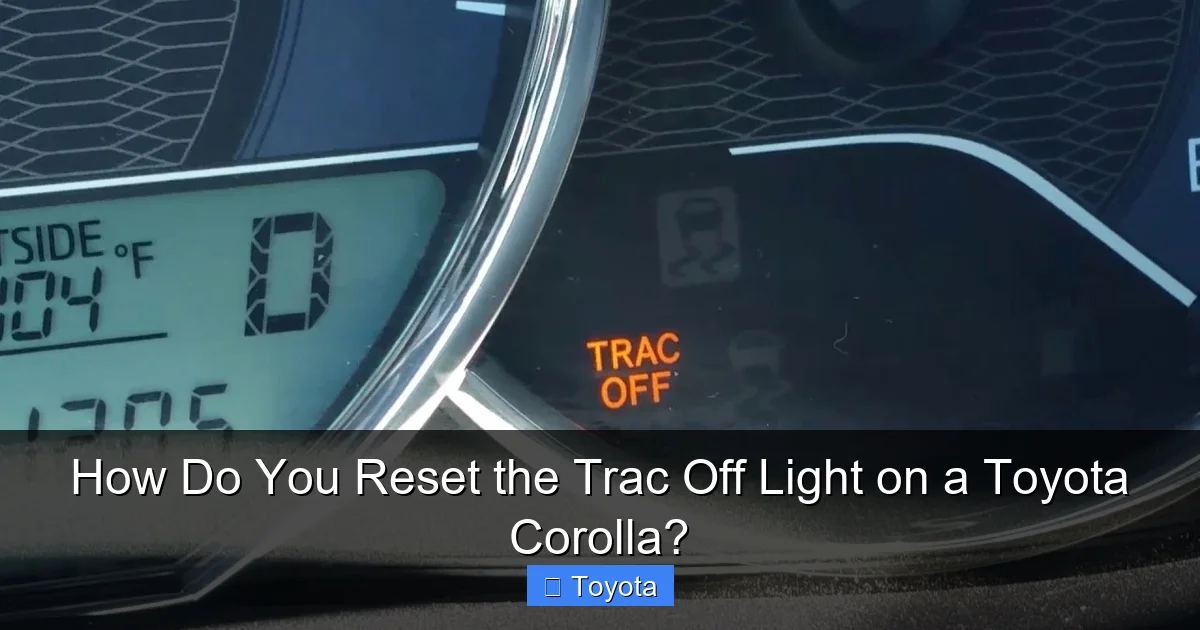
Ever see that little car with squiggly lines icon light up on your Toyota Corolla’s dash? That’s your TRAC Off light. TRAC stands for Traction Control. It’s one of those modern safety systems you barely notice until it’s not working—or until you need it desperately. Think of TRAC as your car’s smart guardian against wheel spin. When you accelerate on a wet road, ice, or even loose gravel, the system automatically steps in. It uses the same wheel speed sensors as your Anti-lock Braking System (ABS) to detect if one wheel is spinning faster than the others. When it spots this, it can subtly reduce engine power or apply the brake to the spinning wheel, transferring torque to the wheel with grip. It’s a fantastic tool for maintaining control during those tricky moments.
In your Toyota Corolla, this system is seamlessly integrated. For many drivers, it’s always on, working silently in the background. But you have the manual override. That TRAC Off button on your dash or steering wheel lets you turn it off. You might do this if you’re stuck in deep snow or sand and need a bit of wheel spin to “rock” the car free. When you do that, the TRAC Off light comes on to remind you the system is disabled. The problem arises when that light comes on without you pressing the button. That’s your car’s way of saying, “Hey, something’s wrong with my traction control, and I’ve shut it down to prevent a bigger issue.” This automatic illumination is the focus of our guide—figuring out why it happened and how to reset it properly.
Common Reasons Your TRAC Off Light Comes On Automatically
Before we dive into resetting the light, we must understand why it turned on by itself. Resetting a symptom without fixing the cause is like taking a fever reducer without treating the infection—it provides temporary relief but the underlying problem remains. The TRAC system is deeply tied to your car’s ABS and overall stability controls. A fault anywhere in that network can trigger the TRAC Off light. Here are the most frequent culprits.
Visual guide about How Do You Reset the Trac Off Light on a Toyota Corolla?
Image source: i.ytimg.com
Faulty Wheel Speed Sensors
This is the #1 suspect. Each wheel has a sensor that tells the computer how fast it’s spinning. If one sensor fails, sends a weird signal, or gets damaged by road debris, the computer gets confused. It can’t reliably determine if a wheel is slipping, so for safety, it disables the entire TRAC (and often VSC/Stability Control) system. You’ll typically see both the TRAC Off light and the VSC Off light, and very often a check engine light will accompany them with codes like C0200, C0201, etc., pointing to a specific wheel’s sensor.
Problems with the ABS Module or Wiring
The brain of the operation is the ABS hydraulic control unit and its associated electronics. Corroded connectors, frayed wires from constant movement near the wheels, or internal failure of the module itself can break the communication chain. A short circuit or open circuit in the wiring harness is a common issue, especially in older Corollas where wires can get chafed.
Steering Angle Sensor Calibration or Failure
TRAC and Stability Control need to know which direction you’re steering. The steering angle sensor provides this data. If this sensor loses calibration (which can happen after a steering wheel alignment or a minor impact) or fails, the system deems its data unreliable and shuts down. A steering angle sensor issue often presents with an erratic or non-responsive steering feel and will store a specific diagnostic trouble code.
Low System Voltage or Battery Issues
Your car’s computer is sensitive to voltage. A weak or failing battery, or a poor charging system, can cause voltage to dip below the threshold the ABS/TRAC module needs. This can trigger a system shutdown and illuminate the TRAC Off light. It’s a good idea to check battery health if you see this light alongside other electrical gremlins. For related electrical issues, understanding how to reset the battery light on a Toyota Corolla is useful, as a persistent battery light could be the root cause of multiple system warnings.
Manual Switch or Circuit Failure
Less common, but possible. The physical TRAC Off button itself could be stuck or shorted, telling the computer you’ve permanently turned it off. The circuit that reads the button’s status could also have a fault.
So, you’ve identified the light is on unexpectedly. Your first step isn’t always to grab a tool and try to reset it. It’s to observe. Is the check engine light on? Is the VSC light on? Are you experiencing any unusual brake pedal feel, strange noises when braking, or a steering wheel that feels off? These clues are vital for diagnosis.
Essential Preparation Before You Attempt Any Reset
Rushing into a reset without preparation can lead to frustration or, worse, masking a serious safety issue. Here’s your pre-reset checklist.
Visual guide about How Do You Reset the Trac Off Light on a Toyota Corolla?
Image source: diycarexpert.com
1. Safety First: Park and Secure. Ensure your Corolla is parked on a level surface, engine off, parking brake set, and the key removed (or fob away from the car if you have push-button start). You don’t want the car to move unexpectedly.
2. Perform a Basic Visual Inspection. Pop the hood and look for obvious issues. Check the battery terminals for heavy corrosion (a sign of voltage problems). Look under the car near each wheel for any damaged wiring or sensors that might have been knocked loose. Wheel speed sensors are located near the brake calipers. Make sure they’re plugged in and the wiring looks intact, not pinched or rubbing against the tire.
3. Check Fuses. Your owner’s manual will have a fuse box diagram. Locate the fuse for the “ABS,” “TRAC,” “VSC,” or “Brake System.” Pull it with a fuse puller or needle-nose pliers and check if the metal strip inside is broken. If it’s blown, replace it with a new fuse of the exact same amperage. A blown fuse is a simple fix that might solve the problem immediately. However, if the new fuse blows right away, you have a short circuit that needs professional diagnosis.
4. Note All Dashboard Lights. Before you do anything, take a mental note or a photo of your entire instrument cluster. Which lights are on? TRAC Off? VSC Off? Check Engine? Battery? This information is critical if you need to take it to a mechanic. It tells them which systems are communicating with each other.
5. Understand Your Model Year’s Method. The reset procedure can vary slightly between generations of Corolla. The general method is similar, but knowing if you have a 2014-2018 or a 2019+ model helps. We’ll cover the universal manual method first, which works for the vast majority.
The Manual Reset Procedure: The Button Press Method
This is the simplest, most common reset and should always be your first attempt—but only after you’ve done the prep above and determined there’s no obvious damage or multiple warning lights. This method assumes the light came on because you (or someone) accidentally pressed the TRAC Off button.
Visual guide about How Do You Reset the Trac Off Light on a Toyota Corolla?
Image source: vehiclefreak.com
Step-by-Step Button Reset
Step 1: Sit in the driver’s seat. Ensure the car is in “Park” (automatic) or neutral (manual) with the parking brake set. The ignition should be in the “ON” position (all dash lights on, engine off). If you have a push-button start, press the button once without touching the brake pedal to enter “ACC” or “ON” mode.
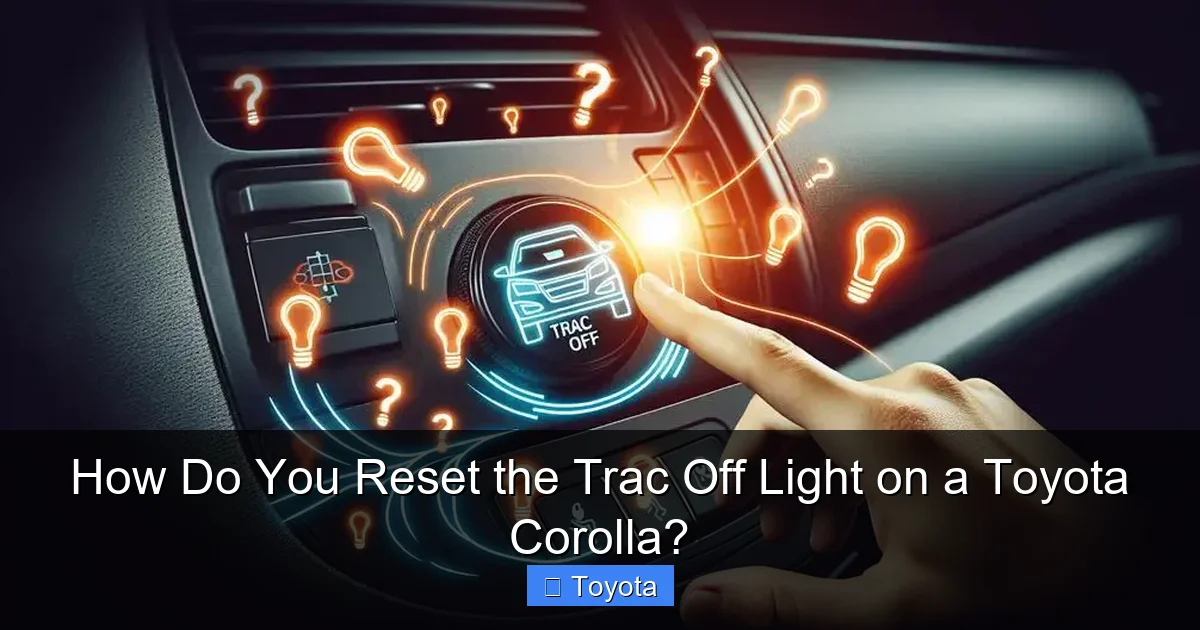
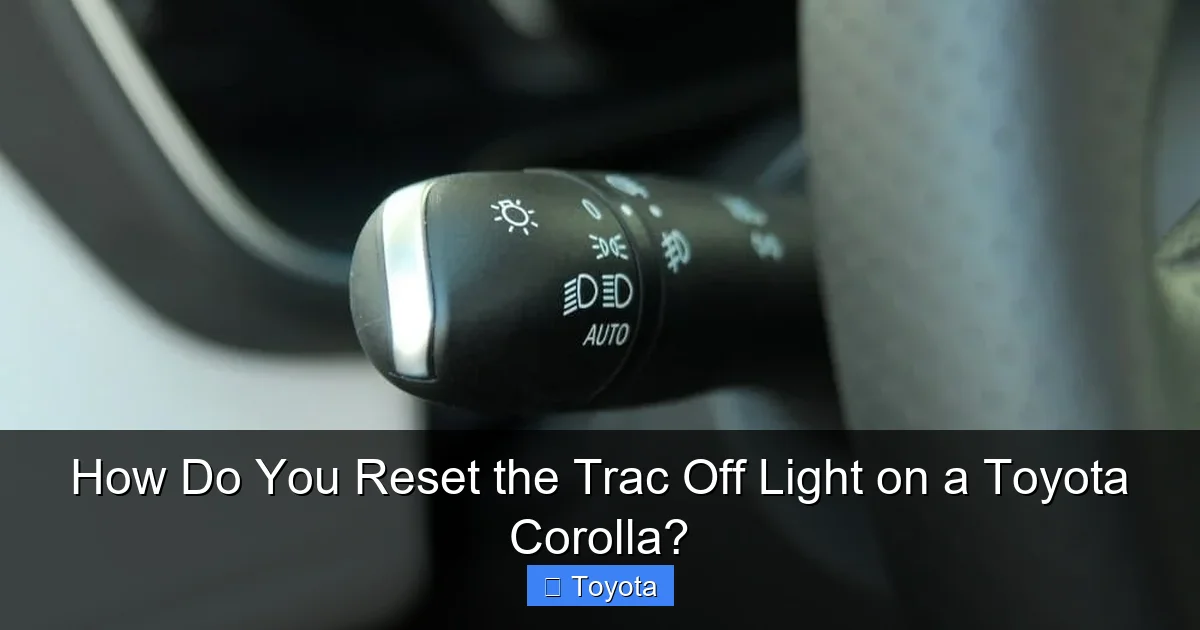
Step 2: Locate the TRAC Off button. In most modern Corollas (2014+), it’s on the dashboard to the left of the steering wheel, often near the headlight switch. In some models, it might be on the steering wheel column or the center console. It’s usually labeled with a car icon and “TRAC OFF” or the squiggly lines symbol.
Step 3: Press and release the TRAC Off button firmly. You should hear or feel a distinct click. Watch the instrument cluster.
Step 4: Observe the TRAC Off light. In a successful reset, the light should turn off immediately or within a few seconds. You might also see a brief “TRAC OFF” message appear and disappear on the multi-information display. The system is now re-engaged and will automatically activate the next time you drive.
Step 5: Start the engine. Let it idle for a moment, then gently press the accelerator pedal while parked (in Park/Neutral). You shouldn’t feel any unusual intervention, which is normal when stationary. The real test is a careful drive.
Step 6: Test Drive. Find a safe, empty, dry parking lot. Accelerate moderately from a stop. You should not feel the engine power being reduced abruptly. If you try a very aggressive launch on a wet surface, you might feel the system subtly intervene to prevent wheel spin—that’s it working! If the TRAC Off light stays off during and after this test, your reset was successful and the light was likely just a manual toggle.
What If the Light Comes Back On Immediately?
If you perform the button press and the light goes off but then reappears within minutes or after a short drive, do not keep trying to reset it. This is a clear indicator of an active fault. The car’s computer has detected the problem again and has shut the system down. Your focus must now shift to diagnosing the cause. At this point, you need to read the diagnostic trouble codes (DTCs) stored in the car’s computer.
Using an OBD-II Scan Tool for Diagnosis and Reset
For a persistent TRAC Off light, especially with a check engine light present, a simple button press won’t cut it. You need to access the car’s diagnostic system. This is where an OBD-II scanner becomes essential. You can use a basic code reader or a more advanced Bluetooth/wifi scanner paired with a smartphone app (like Torque, OBD Fusion, or the dealer-grade Techstream).
Reading the Fault Codes
Step 1: Locate the OBD-II port. It’s under the dashboard, usually to the left of the steering column, near the driver’s knee area. It’s a 16-pin trapezoidal connector.
Step 2: Plug in your scanner with the ignition in the “ON” position (engine off).
Step 3: Follow the scanner’s instructions to connect and read codes. You’re looking for codes that start with “C” (for chassis) rather than “P” (for power-train). Common codes related to TRAC/ABS/VSC are:
- C0200-C0205: Wheel Speed Sensor (Right/Left Front/Rear) Circuit.
- C1225-C1229: ABS Actuator/Solenoid Circuit.
- C1245-C1249: Steering Angle Sensor Circuit.
- C1336-C1339: Abnormal variation in wheel speed signals.
- U0121, U0129: Lost communication with ABS or Yaw Rate Sensor module.
Step 4: Write down all the codes. Do not just clear them yet! The code is your roadmap. A code for the left front wheel speed sensor (C0200) tells you exactly where to start looking—inspect that sensor, its connector, and the wiring leading to it. If you clear the codes without fixing the issue, the light will return, often within a single drive cycle.
Clearing Codes and Resetting the System
Once you have physically inspected and repaired or replaced the faulty component (e.g., you replaced a corroded wheel speed sensor connector or installed a new sensor), you can then use the scanner to clear the codes.
Step 1: With your repair complete, reconnect the scanner. Navigate to the “Erase Codes” or “Clear DTCs” function.
Step 2: Clear all codes. The TRAC Off light should extinguish immediately.
Step 3: Perform a “Relearn” or “Initialize” procedure if required. **This is critical.** Many systems, particularly the steering angle sensor and some ABS modules, require a calibration procedure after repair or disconnection. This often involves turning the steering wheel lock-to-lock a few times with the ignition on, or driving the car at a specific speed (usually above 30 mph) for a few minutes so the sensors can recalibrate. Your scanner’s manual or a factory repair guide for your specific model year will specify if this is needed. Skipping this step can cause the light to return instantly.
Step 4: Take a comprehensive test drive under various conditions (gentle acceleration, light braking, turning) to ensure the system remains functional and the light stays off.
When a Basic Scanner Isn’t Enough
Sometimes, the fault is more complex or the system requires a proprietary dealer-level scan tool to perform final adaptations. If you’ve replaced a wheel speed sensor and the light returns after a code clear, or if you have no codes but the light is still on, it may be time to visit a professional. They have the advanced tools to monitor live sensor data, perform module resets, and conduct system calibrations that consumer-grade scanners cannot.
Post-Reset: Verification and What to Monitor
You’ve turned the light off. The job isn’t done yet. You must verify the system is truly operational.
Perform a Functional Test: As mentioned, find a safe, slippery surface if possible (a wet, empty parking lot). Accelerate from a stop with moderate throttle. You should feel the car’s power back off slightly if the wheels start to spin, and you’ll see the TRAC icon flash on the dash as it intervenes. This is the system engaging. If you feel no intervention and the light stays off, that’s a good sign.
Monitor for Recurrence: Drive normally for at least 50-100 miles. Keep an eye on the dash. Does the light come back on during a drive? Does it only come on after you’ve made a sharp turn or hit a bump? Intermittent issues are often wiring problems that flex when the car moves.
Check for Related Symptoms: Are your brakes feeling spongy or pulling to one side? Is your steering wheel off-center when driving straight? These could indicate a more serious issue with the ABS module or steering sensor that needs immediate attention. It’s also wise to ensure your other maintenance lights are in check. For example, if you’re also dealing with a maintenance required light, you might want to consult a guide on how to turn off the maintenance light on a Toyota to keep your entire dashboard clear of distractions.
Knowing When Professional Help is Necessary
There is pride in DIY auto repair. But some jobs are best left to the experts, especially when it involves your car’s safety systems. Here are the clear signs it’s time to call a mechanic or dealership.
The Light Returns Immediately or Persists After a Repair: You’ve replaced the suspected wheel speed sensor, cleared the codes, and the light is back on within one drive cycle. This suggests either the new part is defective, the installation was incorrect, or there’s a deeper wiring/communication fault that needs advanced diagnostics.
Multiple System Lights Are On: If you have the TRAC Off light, VSC Off light, and Check Engine light all illuminated simultaneously, it points to a more widespread communication failure or a major sensor issue that requires professional-grade scan tools to diagnose properly.
No Codes Are Stored, but Light is On: This is a tricky scenario. It can indicate a failed TRAC Off switch, a problem with the instrument cluster itself, or an issue with the body control module that a basic OBD-II scanner cannot see. A technician with a factory-specific diagnostic computer can access all vehicle modules.
You’re Uncomfortable or Lack Tools: If the idea of crawling under the car, dealing with corroded connectors, or using a scan tool is daunting, that’s okay. A proper diagnosis and repair at a reputable shop will give you peace of mind and ensure the system is 100% functional for your safety.
Safety is Non-Negotiable: Remember, TRAC and Stability Control are life-saving systems in an emergency. If you cannot confidently restore full functionality, do not drive the car in hazardous conditions. Have it towed to a professional.
Conclusion: Safety Over Simplicity
Resetting the TRAC Off light on your Toyota Corolla is often a simple affair—a quick press of a button. But when it’s not, it’s a symptom of a potentially serious issue within your car’s safety network. The key is to be methodical. Start with the simplest manual reset. If that fails, move to diagnostics with a code scanner. Always fix the underlying cause indicated by the fault codes before attempting to clear them. A persistent TRAC Off light means your car has voluntarily disabled a key system to prevent unpredictable behavior. Heed that warning. Whether you’re a DIY enthusiast tackling a wheel speed sensor replacement or a driver choosing to seek professional help, the ultimate goal is the same: to restore your Corolla’s full suite of electronic safety aids, ensuring you have maximum control and protection on every journey. Don’t just turn off the light; understand why it came on.
Frequently Asked Questions
Can I drive my Corolla with the TRAC Off light on?
Yes, you can physically drive the car, but you will be without traction control. This means your wheels can spin more easily during acceleration on wet, icy, or loose surfaces, increasing the risk of losing control. It’s safe in dry, ideal conditions but strongly discouraged in any adverse weather. You should diagnose and fix the issue as soon as possible.
Will disconnecting the battery reset the TRAC Off light?
Disconnecting the battery will reset the car’s computer memory and may turn off the light temporarily. However, if the underlying fault (like a bad sensor) still exists, the light will return once the system runs its self-diagnostic checks, usually within a few minutes of driving. This is not a proper fix and merely masks the problem.
How much does it cost to fix a TRAC Off light?
The cost varies wildly based on the cause. A simple manual reset costs nothing. Replacing a faulty wheel speed sensor typically ranges from $150 to $300 per sensor (part + labor). More complex issues like a faulty ABS module or extensive wiring repair can cost $500 to over $1,000. A diagnostic fee (often $80-$120) is usually charged just to identify the problem.
Is the TRAC Off light the same as the VSC Off light?
They are closely related but not identical. TRAC (Traction Control) specifically manages wheel spin during acceleration. VSC (Vehicle Stability Control) manages side-to-side slide during cornering. In most Toyotas, including the Corolla, these systems are integrated. A fault in one often disables both, so you’ll see both lights. The TRAC Off button usually disables both systems together.
Why does my TRAC Off light flash when I drive?
A flashing TRAC Off light (or more commonly, a flashing traction control icon without the “OFF” text) is normal. It indicates the system is active and currently intervening to prevent wheel slip. The steady “TRAC OFF” light means the system is disabled. So, flashing is good; a steady light means it’s off.
Could a bad alignment cause the TRAC Off light to come on?
Indirectly, yes. A severe misalignment can cause unusual tire wear that might affect wheel speed sensor readings. More commonly, a collision or impact that knocks the steering out of alignment can also jolt or damage the sensitive steering angle sensor, which is crucial for stability control. After any major alignment or steering work, a steering angle sensor calibration is often required.
