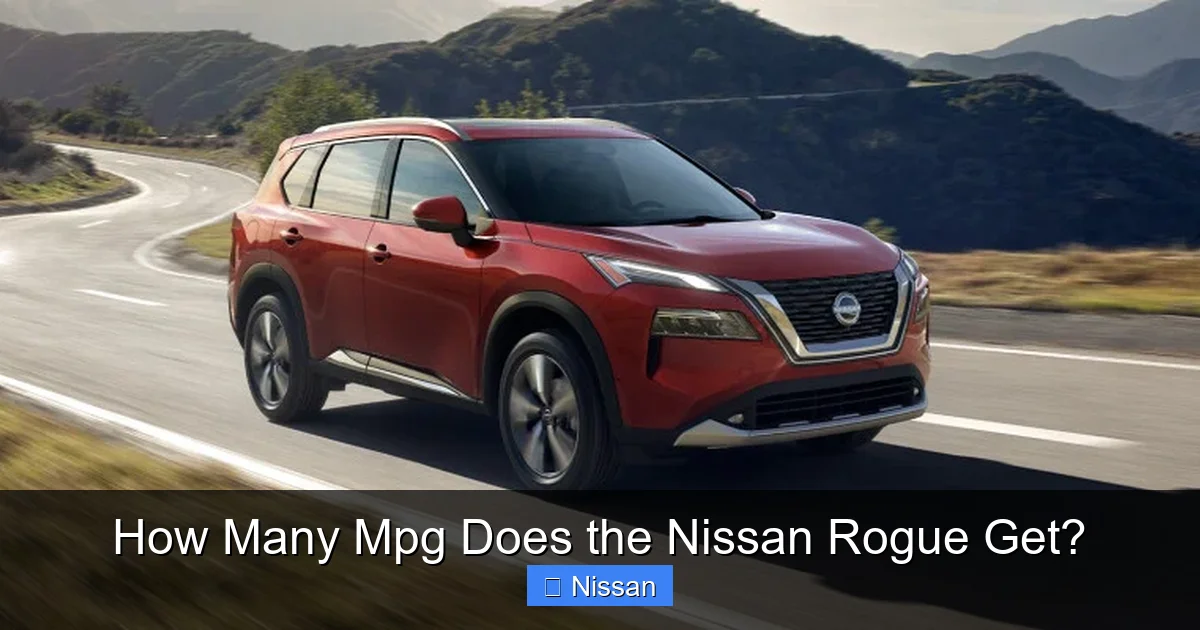
How Many Mpg Does the Nissan Rogue Get?

Contents
- 1 Key Takeaways
- 2 📑 Table of Contents
- 3 Understanding the Nissan Rogue’s Fuel Economy Ratings
- 4 How Model Year Affects the Nissan Rogue’s MPG
- 5 Front-Wheel Drive vs. All-Wheel Drive: Which Is More Efficient?
- 6 Factors That Influence Real-World MPG in the Nissan Rogue
- 7 Comparing the Nissan Rogue to Competitors
- 8 Future of Fuel Efficiency: Will Nissan Offer a Hybrid Rogue?
- 9 Tips to Maximize Your Nissan Rogue’s MPG
- 10 Conclusion
- 11 Frequently Asked Questions


The Nissan Rogue delivers impressive fuel economy, averaging 27–35 MPG depending on the model year, trim, and drivetrain. With its efficient engine and smart design, the Rogue stands out as one of the most fuel-efficient compact SUVs on the market today.
If you’re in the market for a reliable, stylish, and fuel-efficient compact SUV, the Nissan Rogue is likely on your shortlist. One of the most common questions potential buyers ask is: How many MPG does the Nissan Rogue get? It’s a smart question—fuel economy directly affects your monthly budget, environmental impact, and overall driving experience. Whether you’re commuting daily, taking weekend road trips, or shuttling kids to school, knowing your vehicle’s miles per gallon (MPG) helps you plan better and save money at the pump.
The good news? The Nissan Rogue has consistently ranked among the top fuel-efficient SUVs in its class. Over the past decade, Nissan has refined the Rogue’s engineering to deliver better performance without sacrificing efficiency. From its aerodynamic design to its advanced engine technology, every detail is optimized to help you go farther on less fuel. But the exact MPG you’ll get depends on several factors—including the model year, engine type, drivetrain, and how you drive. So, let’s dive into the numbers, break down the differences, and give you a clear picture of what to expect from this popular SUV.
Key Takeaways
- EPA-estimated fuel economy ranges from 27 to 35 MPG combined depending on the model year and configuration, with newer models offering better efficiency.
- Front-wheel drive (FWD) models are more fuel-efficient than all-wheel drive (AWD) versions, typically by 1–2 MPG.
- The 2023 and 2024 Nissan Rogue with the 1.5L turbocharged three-cylinder engine achieves up to 33 MPG combined, making it one of the most efficient in its class.
- Driving habits, terrain, and climate significantly impact real-world MPG—smooth acceleration and proper tire pressure can boost efficiency.
- Nissan’s Eco Mode and continuously variable transmission (CVT) help optimize fuel usage during city and highway driving.
- Hybrid and plug-in hybrid versions are not currently available, but Nissan may introduce electrified options in future models.
- Regular maintenance, such as oil changes and air filter replacements, helps maintain optimal fuel economy over time.
📑 Table of Contents
- Understanding the Nissan Rogue’s Fuel Economy Ratings
- How Model Year Affects the Nissan Rogue’s MPG
- Front-Wheel Drive vs. All-Wheel Drive: Which Is More Efficient?
- Factors That Influence Real-World MPG in the Nissan Rogue
- Comparing the Nissan Rogue to Competitors
- Future of Fuel Efficiency: Will Nissan Offer a Hybrid Rogue?
- Tips to Maximize Your Nissan Rogue’s MPG
- Conclusion
Understanding the Nissan Rogue’s Fuel Economy Ratings
When evaluating how many MPG the Nissan Rogue gets, it’s important to understand how fuel economy is measured and reported. The Environmental Protection Agency (EPA) provides standardized estimates for city, highway, and combined driving. These numbers are based on controlled tests that simulate real-world conditions, but your actual mileage may vary.
The EPA rates fuel economy in three categories:
– City MPG: Simulates stop-and-go driving with frequent idling and low-speed maneuvers.
– Highway MPG: Reflects steady-speed driving on open roads with minimal traffic.
– Combined MPG: A weighted average of 55% city and 45% highway driving, giving a balanced estimate for most drivers.
For the Nissan Rogue, these ratings have improved significantly over the years. Earlier models (2014–2020) typically achieved around 26–33 MPG combined, depending on the engine and drivetrain. However, with the introduction of the redesigned 2021 model and the new 1.5L turbocharged engine in 2023, fuel efficiency has reached new heights. The latest Rogues now boast up to 33 MPG combined, placing them among the most efficient non-hybrid compact SUVs available today.
City vs. Highway MPG: What to Expect
Let’s break it down further. In city driving, the Nissan Rogue generally achieves between 26 and 30 MPG. This is thanks to its responsive CVT (continuously variable transmission), which keeps the engine in its most efficient RPM range during frequent stops and starts. Features like start-stop technology (which shuts off the engine at red lights) also help reduce fuel waste in traffic.
On the highway, the Rogue shines even brighter. With its aerodynamic body and efficient engine tuning, it can reach up to 35 MPG on long, steady drives. This makes it an excellent choice for commuters who spend a lot of time on freeways or for families planning road trips. The difference between city and highway MPG is typical for vehicles in this segment—most compact SUVs see a 5–7 MPG improvement on the highway compared to city driving.
Combined MPG: The Real-World Benchmark
While city and highway numbers are helpful, the combined MPG is the best indicator of what you’ll experience in everyday driving. For the 2023 and 2024 Nissan Rogue with front-wheel drive, the EPA estimates a combined fuel economy of 33 MPG. That’s impressive for a vehicle that seats five comfortably and offers generous cargo space.
To put that in perspective, driving 15,000 miles per year at 33 MPG means you’ll use about 455 gallons of gasoline. At an average national price of $3.50 per gallon, that’s roughly $1,592 per year in fuel costs. Compare that to a less efficient SUV getting 25 MPG—over $2,100 annually—and the savings become clear. Over five years, the Rogue could save you more than $2,500 in fuel alone.
How Model Year Affects the Nissan Rogue’s MPG

Visual guide about How Many Mpg Does the Nissan Rogue Get?
Image source: dealerinspire-image-library-prod.s3.us-east-1.amazonaws.com
Not all Nissan Rogues are created equal when it comes to fuel economy. The model year plays a significant role in determining how many MPG you’ll get. Nissan has made several key updates over the years that have boosted efficiency, so it’s worth knowing the differences.
2014–2020 Nissan Rogue: The Early Years
The first-generation Rogue (2014–2018) and the refreshed second-generation model (2019–2020) were powered by a 2.5L four-cylinder engine producing around 170 horsepower. These models offered solid performance but were less efficient than today’s versions.
– 2014–2018 Rogue (FWD): 26 MPG city / 33 MPG highway / 29 MPG combined
– 2019–2020 Rogue (FWD): 27 MPG city / 35 MPG highway / 30 MPG combined
The 2019–2020 models saw a slight improvement due to aerodynamic enhancements and a more refined CVT. However, they still lagged behind newer competitors in terms of efficiency.
2021–2022 Nissan Rogue: A Major Redesign
The 2021 model year marked a complete redesign of the Rogue. Nissan introduced a new platform, updated styling, and a more efficient 2.5L four-cylinder engine with 181 horsepower. This engine featured direct fuel injection and variable valve timing, which improved both power and fuel economy.
– 2021–2022 Rogue (FWD): 27 MPG city / 35 MPG highway / 30 MPG combined
– 2021–2022 Rogue (AWD): 26 MPG city / 33 MPG highway / 29 MPG combined
While the numbers looked similar to previous years, real-world testing showed better consistency and smoother power delivery. The new design also reduced weight and improved aerodynamics, contributing to more stable fuel efficiency across different driving conditions.
2023–2024 Nissan Rogue: The Efficiency Leader
The biggest leap in fuel economy came with the 2023 model year, when Nissan introduced a brand-new 1.5L turbocharged three-cylinder engine. This engine, paired with a revised CVT, delivers 201 horsepower—more than the old 2.5L—while using less fuel.
– 2023–2024 Rogue (FWD): 30 MPG city / 37 MPG highway / 33 MPG combined
– 2023–2024 Rogue (AWD): 29 MPG city / 35 MPG highway / 31 MPG combined
This represents a significant improvement, especially in city driving. The turbocharged engine provides strong low-end torque, reducing the need for heavy acceleration, which helps save fuel. Additionally, the new engine is lighter, further improving efficiency.
Front-Wheel Drive vs. All-Wheel Drive: Which Is More Efficient?

Visual guide about How Many Mpg Does the Nissan Rogue Get?
Image source: dealerinspire-image-library-prod.s3.us-east-1.amazonaws.com
One of the most common decisions buyers face is whether to choose front-wheel drive (FWD) or all-wheel drive (AWD). While AWD offers better traction in snow, rain, or off-road conditions, it comes at a cost—fuel economy.
The Efficiency Gap Between FWD and AWD
In general, FWD models are more fuel-efficient than their AWD counterparts. The difference typically ranges from 1 to 2 MPG combined, depending on the model year. For example:
– The 2023 Rogue FWD gets 33 MPG combined.
– The 2023 Rogue AWD gets 31 MPG combined.
That 2 MPG difference may not seem like much, but over 15,000 miles per year, it adds up to about 30 extra gallons of gas—roughly $105 at current prices. Over five years, that’s over $500 in additional fuel costs.
Why AWD Uses More Fuel
All-wheel drive systems require additional components—like a rear differential, driveshaft, and transfer case—that add weight and mechanical resistance. This extra weight means the engine has to work harder to move the vehicle, especially during acceleration. Additionally, power is constantly being sent to all four wheels, even when it’s not needed, which increases fuel consumption.
That said, modern AWD systems in the Rogue are designed to be smart. The Intelligent AWD system primarily powers the front wheels under normal conditions and only sends power to the rear when traction is needed. This helps minimize fuel loss, but it still can’t match the efficiency of a pure FWD setup.
When to Choose AWD
If you live in an area with frequent snow, heavy rain, or unpaved roads, AWD may be worth the slight drop in MPG. The added confidence and safety can outweigh the fuel cost, especially during winter months. However, if you primarily drive in mild climates and stick to paved roads, FWD is the smarter choice for maximizing fuel economy.
Factors That Influence Real-World MPG in the Nissan Rogue
Visual guide about How Many Mpg Does the Nissan Rogue Get?
Image source: dealerinspire-image-library-prod.s3.us-east-1.amazonaws.com
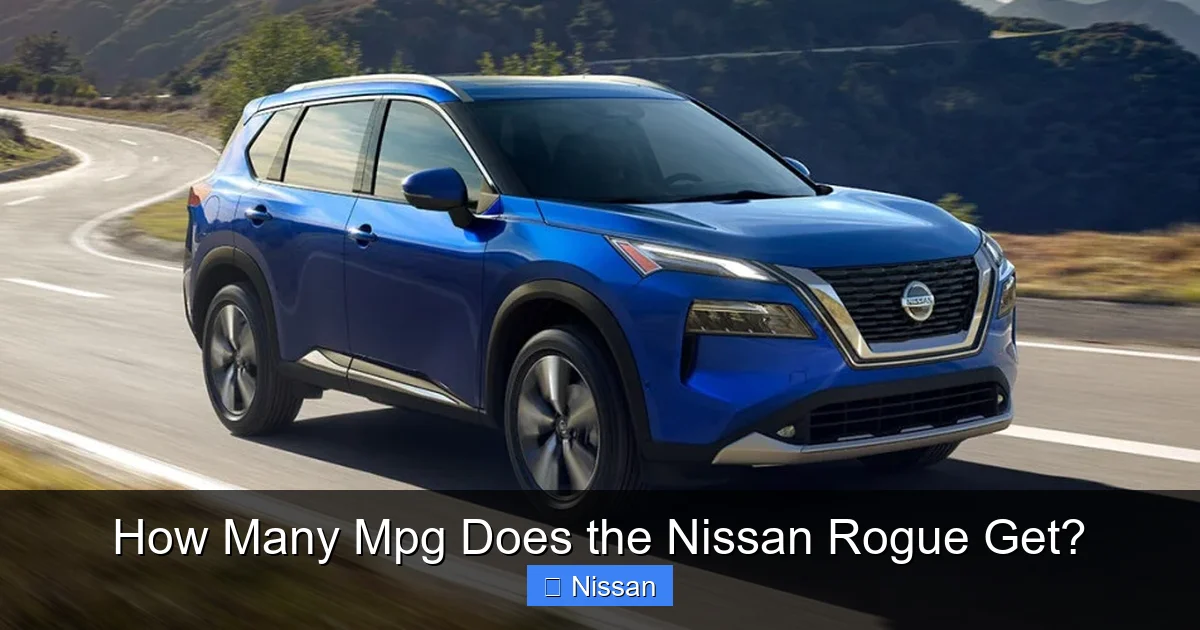
While EPA ratings provide a useful baseline, your actual fuel economy will depend on several real-world factors. Understanding these can help you get the most out of your Rogue’s efficiency.
Driving Habits Matter
How you drive has a huge impact on fuel economy. Aggressive acceleration, hard braking, and speeding can reduce your MPG by 15–30% compared to smooth, steady driving. For example, accelerating quickly from a stoplight might feel satisfying, but it burns more fuel than gradually building speed.
Tip: Use the Rogue’s Eco Mode, which adjusts throttle response, transmission shifts, and climate control to prioritize fuel efficiency. You’ll notice a smoother, more relaxed driving feel—and better mileage.
Tire Pressure and Maintenance
Underinflated tires increase rolling resistance, which forces the engine to work harder. Check your tire pressure monthly and keep it at the recommended level (usually listed on the driver’s door jamb). Properly inflated tires can improve fuel economy by up to 3%.
Regular maintenance is also key. A dirty air filter, worn spark plugs, or old engine oil can reduce efficiency. Follow Nissan’s recommended service schedule to keep your Rogue running at its best.
Climate and Terrain
Cold weather reduces fuel economy because engines take longer to warm up and cabin heating uses extra energy. In winter, you might see a 10–20% drop in MPG, especially for short trips.
Hilly or mountainous terrain also affects efficiency. Driving uphill requires more power, while downhill driving can recover some energy through regenerative braking—though the Rogue doesn’t have a hybrid system to store it. If you live in a hilly area, expect slightly lower MPG than the EPA estimates.
Cargo and Passenger Load
The more weight your Rogue carries, the more fuel it uses. An extra 100 pounds in the trunk can reduce fuel economy by about 1–2%. Avoid carrying unnecessary items, and remove roof racks when not in use—they create drag and can lower highway MPG by 5–10%.
Comparing the Nissan Rogue to Competitors
To truly understand how many MPG the Nissan Rogue gets, it helps to compare it to similar vehicles in the compact SUV segment. Let’s look at a few key rivals.
Nissan Rogue vs. Honda CR-V
The Honda CR-V is one of the Rogue’s closest competitors. The 2023 CR-V with FWD gets 28 MPG city / 34 MPG highway / 30 MPG combined. That’s slightly less than the Rogue’s 33 MPG combined. The CR-V offers a hybrid version that achieves up to 40 MPG combined, but the standard gas model falls short of the Rogue’s efficiency.
Nissan Rogue vs. Toyota RAV4
The 2023 Toyota RAV4 (gas-only) gets 27 MPG city / 35 MPG highway / 30 MPG combined. Like the CR-V, it’s available as a hybrid with up to 40 MPG, but the base model doesn’t match the Rogue’s 33 MPG. The RAV4 also tends to be heavier, which affects fuel economy.
Nissan Rogue vs. Mazda CX-5
The Mazda CX-5 emphasizes driving dynamics over fuel efficiency. The 2023 CX-5 gets 24 MPG city / 30 MPG highway / 26 MPG combined—significantly lower than the Rogue. While it offers a more engaging drive, it’s not the best choice if fuel economy is your top priority.
The Verdict
Among non-hybrid compact SUVs, the 2023–2024 Nissan Rogue stands out as one of the most fuel-efficient options. Its 33 MPG combined rating beats most competitors, offering a great balance of space, features, and efficiency.
Future of Fuel Efficiency: Will Nissan Offer a Hybrid Rogue?
As of 2024, the Nissan Rogue does not offer a hybrid or plug-in hybrid version. However, Nissan has been investing heavily in electrification across its lineup, including the fully electric Ariya SUV.
While there’s no official announcement about a hybrid Rogue, industry trends suggest it’s likely in the works. Competitors like Honda, Toyota, and Ford already offer hybrid versions of their compact SUVs, and Nissan will need to keep up. A hybrid Rogue could potentially achieve 40+ MPG combined, making it even more appealing to eco-conscious buyers.
For now, the turbocharged 1.5L engine delivers impressive efficiency without the complexity of a hybrid system. But if fuel economy is your top concern, keep an eye on future model announcements.
Tips to Maximize Your Nissan Rogue’s MPG
Getting the most out of your Rogue’s fuel economy doesn’t require major changes—just a few smart habits.
- Use Eco Mode: Activate Eco Mode to soften throttle response and optimize systems for efficiency.
- Maintain Steady Speeds: Use cruise control on the highway to avoid unnecessary acceleration and braking.
- Keep Tires Inflated: Check pressure monthly and inflate to the recommended PSI.
- Avoid Idling: Turn off the engine if you’re stopped for more than a minute.
- Plan Trips Efficiently: Combine errands into one trip to reduce cold starts and total mileage.
- Remove Excess Weight: Clear out the trunk and avoid hauling unnecessary cargo.
Conclusion
So, how many MPG does the Nissan Rogue get? The answer depends on the model year, drivetrain, and your driving habits—but the latest Rogues deliver an impressive 33 MPG combined with front-wheel drive. That’s among the best in the compact SUV class, offering a winning mix of space, comfort, and efficiency.
Whether you’re commuting to work, exploring the countryside, or running daily errands, the Rogue helps you save money at the pump without sacrificing performance or style. With smart driving habits and regular maintenance, you can stretch every gallon even further.
While it may not have a hybrid option yet, the 2023–2024 Rogue proves that a gas-powered SUV can be both powerful and efficient. If you’re looking for a reliable, fuel-sipping vehicle that doesn’t compromise on features, the Nissan Rogue is a top contender.
Frequently Asked Questions
What is the best MPG the Nissan Rogue has ever achieved?
The highest EPA-estimated fuel economy for the Nissan Rogue is 33 MPG combined, achieved by the 2023 and 2024 models with front-wheel drive and the 1.5L turbocharged engine. This makes it one of the most efficient non-hybrid compact SUVs on the market.
Does the Nissan Rogue AWD get worse gas mileage?
Yes, the all-wheel drive (AWD) version of the Nissan Rogue typically gets 1–2 MPG less than the front-wheel drive (FWD) model. For example, the 2023 Rogue AWD gets 31 MPG combined, compared to 33 MPG for the FWD version.
Can driving habits really affect the Nissan Rogue’s MPG?
Absolutely. Aggressive driving, speeding, and frequent hard braking can reduce fuel economy by 15–30%. Using Eco Mode, maintaining steady speeds, and keeping tires properly inflated can significantly improve your real-world MPG.
Is the 2024 Nissan Rogue more fuel-efficient than the 2021 model?
Yes, the 2024 Rogue is more efficient due to its new 1.5L turbocharged engine. The 2021 model gets 30 MPG combined (FWD), while the 2024 model achieves 33 MPG combined—a notable improvement in fuel economy.
Does the Nissan Rogue have a hybrid version?
As of 2024, the Nissan Rogue does not offer a hybrid or plug-in hybrid version. However, Nissan may introduce electrified options in future model years to compete with rivals like the Toyota RAV4 Hybrid and Honda CR-V Hybrid.
How does the Nissan Rogue compare to the Toyota RAV4 in fuel economy?
The 2023 Nissan Rogue (FWD) gets 33 MPG combined, while the 2023 Toyota RAV4 (gas-only) gets 30 MPG combined. The Rogue is more efficient in its standard form, though the RAV4 offers a hybrid version with higher MPG.