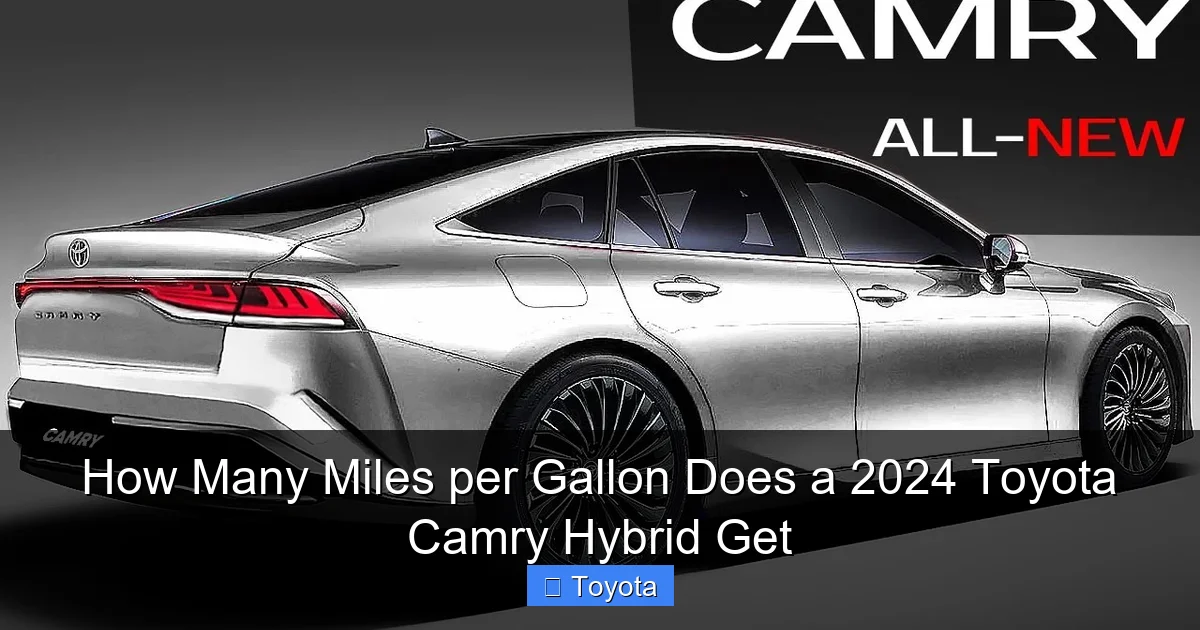
How Many Miles per Gallon Does a 2024 Toyota Camry Hybrid Get

Contents
- 1 Key Takeaways
- 2 📑 Table of Contents
- 3 Decoding the Official EPA Fuel Economy Ratings
- 4 The Engineering Magic: How the Camry Hybrid Achieves Such High MPG
- 5 Real-World MPG: What Actual Owners Are Seeing
- 6 Comparing the Hybrid to the Gas-Only Camry and Other Models
- 7 Maximizing Your Own Camry Hybrid MPG: Practical Tips
- 8 The Big Picture: Ownership Cost and Environmental Impact
- 9 Frequently Asked Questions

Portable Air Pump

Car Door Edge Guard

Dashboard Polish

Car Wireless Charger Mount
The 2024 Toyota Camry Hybrid delivers exceptional fuel efficiency, with EPA ratings of up to 52 MPG combined. Its exact miles per gallon vary slightly by trim, with the LE model achieving the highest ratings. Real-world driving typically yields excellent results, making it a top choice for cost-conscious and eco-friendly drivers seeking a reliable midsize sedan.
Let’s be honest: when you’re shopping for a new car, one of the very first questions that pops into your head is, “How much is this going to cost me at the pump?” In today’s world, where fuel prices seem to dance to their own unpredictable rhythm, that question isn’t just casual curiosity—it’s a critical part of your budget and your peace of mind. If you’ve found yourself eyeing the legendary Toyota Camry, you’re already looking at one of America’s most trusted and popular sedans. But the real game-changer, the model that truly turns “good” into “great,” is the Camry Hybrid. So, the question on everyone’s lips is: just how many miles per gallon does a 2024 Toyota Camry Hybrid get? Buckle up, because we’re diving deep into the numbers, the technology, and the real-world experience to give you the complete picture.
The 2024 Toyota Camry Hybrid isn’t just a Camry with a battery slapped on. It’s a meticulously engineered masterpiece of efficiency, representing the culmination of over two decades of Toyota’s hybrid leadership. It blends the spacious, comfortable, and feature-rich DNA of the standard Camry with a powertrain designed to squeeze every last drop of energy from every gallon of gasoline. To understand its MPG, we need to look at the official EPA ratings, the brilliant engineering behind them, and the practical factors that influence what you’ll see on your own dashboard day after day.
Key Takeaways
- Class-Leading Efficiency: The 2024 Camry Hybrid offers some of the highest MPG ratings in the competitive midsize sedan category, a significant advantage over its non-hybrid siblings and many rivals.
- Trim-Level Variations: Fuel economy differs slightly across trims, with the lightweight LE model generally posting the best numbers, while heavier XLE and XSE trims see a minor, often negligible, drop.
- Real-World vs. EPA: While EPA numbers are a reliable guide, actual miles per gallon depend heavily on driving habits, terrain, climate, and vehicle maintenance, with many owners reporting figures at or above EPA estimates.
- Hybrid System Synergy: The seamless interplay between the 2.5L gas engine and electric motor(s), especially in city driving, is the core reason for its stellar fuel sipping, a technology Toyota has perfected over decades.
- Long-Term Ownership Value: Superior fuel economy directly translates to lower lifetime fuel costs and reduced environmental impact, complementing the Camry’s renowned reliability and strong resale value.
- No Compromise on Performance: Achieving these high MPG figures does not mean sluggish driving; the Camry Hybrid offers smooth, responsive acceleration that comfortably meets daily driving demands.
- Range is Impressive: With a fuel tank capacity of approximately 15.8 gallons and high MPG, the Camry Hybrid can easily achieve 700+ miles on a single tank, reducing fill-up frequency.
📑 Table of Contents
- Decoding the Official EPA Fuel Economy Ratings
- The Engineering Magic: How the Camry Hybrid Achieves Such High MPG
- Real-World MPG: What Actual Owners Are Seeing
- Comparing the Hybrid to the Gas-Only Camry and Other Models
- Maximizing Your Own Camry Hybrid MPG: Practical Tips
- The Big Picture: Ownership Cost and Environmental Impact
Decoding the Official EPA Fuel Economy Ratings
The U.S. Environmental Protection Agency (EPA) puts every new vehicle through rigorous, standardized testing to determine its fuel economy. These numbers are your baseline, your guaranteed minimum expectation. For the 2024 Camry Hybrid, Toyota has once again set a formidable benchmark in the midsize sedan segment.
The Trim-Level Breakdown: LE vs. SE vs. XLE vs. XSE
You might assume all Camry Hybrids are created equal, but slight variations in weight, tire size, and standard equipment mean the EPA rates the trims individually. Here’s the exact breakdown for the 2024 model year:
- Camry Hybrid LE & SE: These are the efficiency champions. The LE, being the base model, is the lightest and typically wears the most fuel-sipping tires. The SE adds sportier styling and slightly different wheels, which can add a touch of rolling resistance. Both are rated at an impressive 51 MPG in the city, 53 MPG on the highway, and 52 MPG combined. This 52 MPG combined figure is the headline number and puts it in rarefied air.
- Camry Hybrid XLE & XSE: Moving up to these premium trims means more features, more sound insulation, and larger alloy wheels. This adds a small amount of weight and aerodynamic drag. Consequently, their EPA ratings are still stellar but marginally lower: 47 MPG in the city, 47 MPG on the highway, and 47 MPG combined.
Notice a key trend? The hybrid system’s magic is most potent in stop-and-go city traffic, where the electric motor can do more of the work. The highway numbers are excellent but show that even a hybrid needs to overcome wind resistance at steady speeds. The difference between the LE/SE and XLE/XSE is about 5 MPG combined. For the average driver covering 12,000 miles a year, that’s a difference of roughly 40-50 gallons of gas annually—still an outstanding outcome for a more luxurious, feature-packed sedan.
How the Camry Hybrid EPA Numbers Stack Up Against Competitors
Numbers in a vacuum are meaningless. Let’s see how the Camry Hybrid’s 52 MPG combined (for LE/SE) compares to key rivals:
- Honda Accord Hybrid: A direct and fierce competitor. The Accord Hybrid also earns a 44 MPG combined rating (50 city / 45 highway for most trims). While its highway number is lower, its city rating is competitive. The Camry Hybrid holds a clear advantage on the highway cycle.
- Hyundai Sonata Hybrid: A strong contender rated at 47 MPG combined (54 city / 52 highway). The Sonata Hybrid actually beats the Camry Hybrid LE/SE in city driving in this comparison but is slightly less efficient on the combined cycle.
- Kia Optima (K5) Hybrid: Matches the Sonata with a 47 MPG combined rating.
- Non-Hybrid Camry: The standard 2.5L four-cylinder Camry is a very efficient gas car, rated at 32 MPG combined (28 city / 39 highway). The Hybrid represents a staggering leap of about 20 MPG combined, which is monumental for your wallet and the planet.
This comparison highlights that the Camry Hybrid isn’t just good—it’s among the absolute best in its class. Its balanced excellence across both city and highway metrics is a standout feature.
The Engineering Magic: How the Camry Hybrid Achieves Such High MPG
Those EPA numbers don’t magically appear. They are the result of a sophisticated, seamlessly integrated powertrain. Understanding this helps you appreciate why the car performs as it does.

Visual guide about How Many Miles per Gallon Does a 2024 Toyota Camry Hybrid Get
Image source: sansonestoyota.com
The Toyota Hybrid Synergy Drive System Explained Simply
At the heart of every Camry Hybrid is Toyota’s Hybrid Synergy Drive. It’s a “full” hybrid, meaning it can drive on electric power alone, gas power alone, or a smart combination of both. Here’s the team:
- The Gas Engine: A highly efficient 2.5-liter 4-cylinder Atkinson-cycle engine. The Atkinson cycle is key—it’s designed for efficiency over raw power, using a unique valve timing strategy to reduce pumping losses and improve thermal efficiency.
- The Electric Motor(s): The Camry Hybrid uses two motor-generators (MG1 and MG2). MG1 primarily acts as a starter for the gas engine and a generator to recharge the battery. MG2 is the primary drive motor, providing strong, instant torque from a stop and assisting the engine during acceleration. This is why hybrid cars feel so responsive in city traffic.
- The Lithium-Ion Battery Pack: A compact, high-capacity battery located in the trunk (it does eat into cargo space slightly). It stores energy captured during regenerative braking and from the gas engine when it’s running more efficiently than needed.
- The Power Split Device: This is the planetary gearset that acts as the “brain” of the system. It constantly and seamlessly decides the optimal power split between the gas engine, the electric motor, and the generator, all without a traditional transmission. There are no harsh shifts.
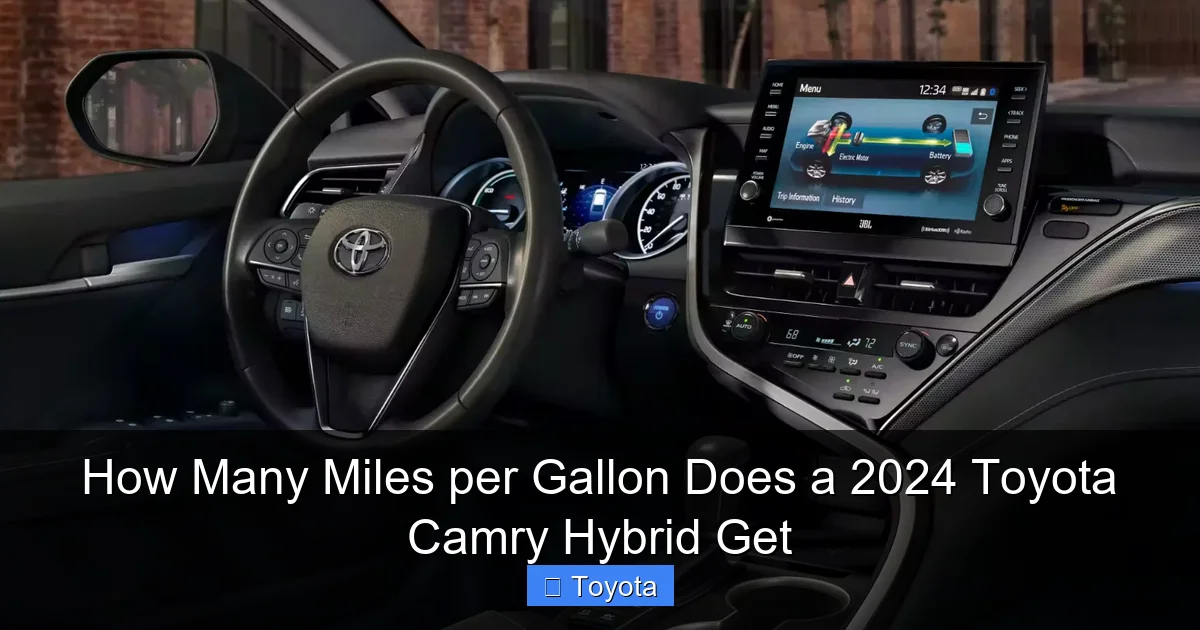
This system is always working to keep the gas engine in its most efficient RPM range. At low speeds and during light acceleration, it often runs on electric-only power (EV mode), using zero gasoline. When you demand more power, the system engages the gas engine in its sweet spot. During braking or coasting, it recaptures kinetic energy to recharge the battery. This constant optimization is why you see such astronomical city MPG numbers.
Aerodynamics and Lightweighting
Fuel economy isn’t just about the powertrain. The 2024 Camry Hybrid benefits from a carefully sculpted body with a low drag coefficient, helping it slice through the air on the highway. Additionally, the use of high-strength steel and other lightweight materials helps offset the weight of the hybrid battery, keeping the overall vehicle mass in check. The LE trim’s efficiency edge partly comes from its lack of premium features and potentially more aerodynamic wheel designs.
Real-World MPG: What Actual Owners Are Seeing
EPA numbers are a fantastic guide, but your personal “miles per gallon” will be your own. A myriad of factors influence real-world efficiency. Let’s break down the biggest ones and what you can realistically expect.
Visual guide about How Many Miles per Gallon Does a 2024 Toyota Camry Hybrid Get
Image source: sansonestoyota.com
The Dominant Factor: Your Driving Style and Environment
This is the single largest variable. The EPA tests are conducted in a controlled lab with a specific driving cycle. Your life is not a lab cycle.
- City vs. Highway Mix: If your commute is 80% city with stop-and-go traffic, you could very easily see 48-55 MPG, sometimes even higher in warm weather with gentle driving. The hybrid system thrives here. If your driving is 90% steady highway at 75 mph, your numbers will likely drop to the 42-46 MPG range. Aerodynamic drag increases exponentially with speed, and the engine runs more consistently.
- Climate Control: Using the air conditioner in summer or the heater in winter puts a significant load on the system. In extreme cold, the engine runs more to warm the cabin and the battery is less efficient, which can lower MPG by 3-6 MPG. Using seat heaters and ventilated seats (if equipped) instead of full cabin climate control can help mitigate this.
- Terrain: Hilly or mountainous roads will reduce efficiency. Regenerative braking on downhills helps, but constant uphill climbs demand more power from both the engine and motor.
- Driving Aggressiveness: Heavy acceleration and hard braking are the enemies of efficiency. Smooth, anticipatory driving—accelerating gradually and coasting to stops—can easily add 3-5 MPG to your average. The Camry Hybrid rewards patience.
The Importance of Maintenance and Tire Health
A well-maintained Camry Hybrid will perform as designed. Neglect will cost you at the pump.
- Proper Tire Inflation: This is the #1 maintenance item for MPG. Under-inflated tires increase rolling resistance dramatically. Check your tire pressure monthly and keep them at the manufacturer’s recommended PSI (found on the driver’s door jamb sticker, not the tire sidewall). You could lose 0.3% in fuel economy for every 1 PSI drop in pressure on all four tires.
- Regular Oil Changes: Using the correct, recommended 0W-16 synthetic oil (or the specified alternative) ensures the engine operates with minimal internal friction. Old, dirty oil increases drag.
- Air Filter: A clogged engine air filter makes the engine work harder to breathe. Replace it as scheduled.
- Wheel Alignment: Misalignment causes tires to drag, reducing MPG and wearing them out prematurely.
Based on owner forums, fuel tracking apps, and long-term reviews, a well-driven 2024 Camry Hybrid in a mixed-use environment (50/50 city/highway) will consistently deliver 45-50 MPG combined. Many report their best tank averages in the low 50s during warmer months with mostly city driving. Achieving the EPA’s 52 MPG combined is certainly possible with ideal conditions and gentle driving.
Comparing the Hybrid to the Gas-Only Camry and Other Models
Is the Hybrid worth the potential price premium? Let’s put the MPG into a practical context by comparing it to its siblings and a relevant competitor from the list.
Visual guide about How Many Miles per Gallon Does a 2024 Toyota Camry Hybrid Get
Image source: tffn.net
Camry Hybrid vs. Camry Gas: The Pure Math
The non-hybrid Camry with its 2.5L engine is no slouch, rated at 32 MPG combined. The Hybrid LE/SE’s 52 MPG combined is a 62.5% improvement. Over 12,000 miles, at a national average gas price of $3.50/gallon:
- Gas Camry: 12,000 miles / 32 MPG = 375 gallons. Cost: 375 * $3.50 = $1,312.50.
- Camry Hybrid LE: 12,000 miles / 52 MPG = 230.8 gallons. Cost: 230.8 * $3.50 = $807.80.
That’s an annual fuel savings of over $500. Over five years of ownership, that’s $2,500+ saved, which often covers a significant portion of the hybrid’s initial cost premium. Furthermore, the hybrid battery is warrantied for 10 years/150,000 miles in most states, providing long-term peace of mind. You can also learn more about the specific cost of a replacement Camry Hybrid battery for complete ownership context.
How It Compares to the Toyota Venza
You might also be cross-shopping with Toyota’s own Toyota Venza, a hybrid-only crossover SUV. The 2024 Venza is rated at 40 MPG combined (41 city / 37 highway). The Camry Hybrid LE’s 52 MPG combined is significantly higher. The trade-off is obvious: the Venza offers more cargo space, a higher seating position, and standard all-wheel drive (AWD), while the Camry Hybrid offers superior fuel economy, a slightly more engaging drive, and a traditional sedan feel. Your choice depends on whether MPG or utility is the higher priority.
How It Stacks Up Against a Nissan Rogue
Another popular choice in the family vehicle space is the Nissan Rogue. The standard gas Rogue is rated at 30 MPG combined (26 city / 34 highway). Even the Rogue’s hybrid variant (if available in your market) typically rates around 34 MPG combined. The Camry Hybrid’s advantage here is substantial, offering near-sedan efficiency in a package that’s still roomy and practical. It highlights how far ahead Toyota’s hybrid system is in extracting efficiency from a gasoline engine.
Maximizing Your Own Camry Hybrid MPG: Practical Tips
You now know the potential. Here’s how to unlock it in your daily driving.
Driving Techniques That Pay Off
- Embrace the “EV Mode” Indicator: When the dashboard icon shows you’re running on electric power alone, you’re getting infinite MPG! Gentle acceleration from a stop and maintaining momentum helps keep you in this mode as much as possible, especially in the city.
- Use the “Eco” Mode: This adjusts the throttle response and air conditioning to prioritize efficiency. It makes the car feel slightly more relaxed but can noticeably improve MPG in mixed driving.
- Coast When You Can: See a red light ahead? Take your foot off the accelerator early and coast. The regenerative braking system will still capture energy to recharge the battery, and you’ll use zero fuel.
- Plan Your Routes: If you have flexibility, choose routes with fewer stop signs and more steady-flow traffic. A 5-mile route with 20 stop signs will drink more gas than a 6-mile route with two traffic lights.
Maintenance is Non-Negotiable for Peak MPG
Stick to the factory maintenance schedule religiously. Beyond the tire pressure and oil changes mentioned earlier:
- Use Genuine Toyota Parts: When replacing spark plugs, air filters, or wiper blades, OEM or Toyota-approved parts are designed for the specific engine and hybrid system.
- Keep the Hybrid System Cool: Ensure the hybrid system’s dedicated cooling components (like the inverter coolant) are checked and serviced as per the manual. An overheating system will derate performance and efficiency.
- Choose the Right Tires: If you need to replace tires, opt for low-rolling-resistance (LRR) tires. They are specifically designed to improve fuel economy. The stock Michelin or Bridgestone tires on the Camry Hybrid are already chosen for this balance of grip and efficiency.
The Big Picture: Ownership Cost and Environmental Impact
Focusing solely on the MPG number can be shortsighted. The true value lies in the holistic ownership experience.
Fuel Savings as a Financial Benefit
As calculated earlier, the $500+ annual fuel savings is real and tangible. Over a typical 5-7 year ownership period, this can amount to thousands of dollars saved, which can be redirected towards payments, insurance, maintenance, or other goals. This makes the Camry Hybrid not just an efficient choice, but a financially smart one. For context on range, with its 15.8-gallon tank and 52 MPG, the LE model has a theoretical highway range of over 830 miles. You’ll be filling up less often, saving not just money but time.
Reduced Emissions and a Smaller Carbon Footprint
Every gallon of gasoline burned produces about 8.89 kg of CO2. By burning significantly fewer gallons, the Camry Hybrid directly reduces your tailpipe emissions. For the 12,000-mile/year example:
- Gas Camry: 375 gallons * 8.89 kg CO2 = ~3,334 kg CO2.
- Camry Hybrid LE: 231 gallons * 8.89 kg CO2 = ~2,052 kg CO2.
That’s a reduction of over 1,280 kg (nearly 1.5 tons) of CO2 emissions annually. For drivers concerned about their environmental impact, this is a meaningful contribution without sacrificing practicality or reliability.
Resale Value and Long-Term Reliability
History is a great predictor. Toyota hybrids consistently hold their value better than their gas-only counterparts. The proven reliability of the Hybrid Synergy Drive system, with its lack of a traditional transmission and the long warranty on the battery, inspires confidence in used car buyers. When it’s time to sell or trade, your 2024 Camry Hybrid is likely to command a higher percentage of its original value than a comparable gas Camry, further improving the total cost of ownership equation. The brand’s reputation for longevity, as seen in models like the Avalon, extends firmly to the hybrid lineup.
Frequently Asked Questions
Is the 2024 Toyota Camry Hybrid’s 52 MPG combined rating realistic for daily driving?
Yes, it is realistic as a target, especially in city-heavy driving with gentle acceleration. Many owners consistently achieve 48-52 MPG combined. Your actual MPG will vary based on your specific drive mix, use of climate control, and driving habits. Highway-centric driving at higher speeds will lower the average.
Does the hybrid battery need special maintenance or replacement often?
No special maintenance is required. The hybrid battery is designed to last the life of the car and is covered by an extensive warranty (typically 10 years/150,000 miles). Replacement before that is extremely rare. The system manages battery charge and temperature automatically.
How does cold winter weather affect the Camry Hybrid’s MPG?
Cold weather reduces MPG by 3-6 MPG on average. The engine runs more to warm up and maintain cabin heat, and the battery is less efficient. Using remote start to warm the car while connected to a charger (if equipped) or using seat heaters instead of full cabin heat can help minimize the drop.
Should I use regular or premium fuel in the Camry Hybrid?
Use regular unleaded gasoline with an octane rating of 87 (AKI). The engine is designed for this fuel, and using premium offers no benefit in power or fuel economy. Check your owner’s manual for the specific fuel requirements.
Does the Camry Hybrid have enough power for highway merging and passing?
Absolutely. The combined system output is 209 horsepower. The electric motor provides instant torque, making the Camry Hybrid feel surprisingly quick from a stop and confident for highway merges. It is more than adequate for safe and comfortable passing.
How much cargo space do I lose compared to a regular Camry due to the hybrid battery?
The hybrid battery pack sits in the trunk, reducing cargo capacity. A standard Camry offers about 15.1 cubic feet of trunk space. The Camry Hybrid offers about 10.8 cubic feet. You lose about 4 cubic feet, which is the space of a small carry-on suitcase. The rear seat folding function remains, so long items can still be accommodated.