
How to Reset the Check Engine Light on a 2014 Toyota Camry

Resetting the check engine light on your 2014 Toyota Camry is a simple process, but it’s critical to understand it doesn’t fix underlying problems. First, you must diagnose the issue with an OBD2 scanner, as the light indicates a specific emissions-related fault. You can reset it by disconnecting the battery or using a scan tool to clear codes. Never ignore a persistent light, and always ensure the problem is repaired before resetting to avoid damage or failed inspections.
That glowing amber triangle on your dashboard—the check engine light. For any 2014 Toyota Camry owner, it’s a moment of mixed frustration and anxiety. You know it means something isn’t quite right under the hood, but your mind races with questions. What’s wrong? Is it safe to drive? How much will it cost? And the immediate, practical question: how do I make that annoying light go away? This guide is your definitive, step-by-step companion for understanding and resetting the check engine light on your specific vehicle. We’ll walk through the why before the how, because resetting the light without addressing the cause is like turning off a smoke alarm while a fire burns—it doesn’t solve the problem and can lead to catastrophic results.
Your 2014 Camry’s On-Board Diagnostics II (OBD2) system is a sophisticated computer network constantly monitoring engine, transmission, and emissions components. When it detects a parameter outside of its accepted range, it stores a Diagnostic Trouble Code (DTC) and illuminates the check engine light to alert you. Resetting the light is simply the process of telling the car’s computer, “I’ve seen the message, you can stop warning me now.” But the message itself—the code—remains in the system’s memory until actively cleared, and more importantly, the faulty component or condition remains. This article will equip you with the knowledge to handle this situation correctly, safely, and effectively, saving you from unnecessary worry and potential costly mistakes.
Key Takeaways
- Reset ≠ Repair: Clearing the light only turns off the warning; it does not solve the mechanical or electronic issue that triggered it.
- Diagnosis is Mandatory: Always read and understand the stored trouble codes before clearing them to identify the root cause of the problem.
- Two Primary Methods: You can reset the light via battery disconnect (temporary) or by using an OBD2 scanner to clear codes (more effective).
- Drive Cycle May Be Needed: After a reset, the car must complete a specific drive cycle for all monitors to reset, which can take multiple trips.
- Light Will Return if Unfixed: If the original problem persists, the check engine light will illuminate again, often after a short drive.
- Safety First: A flashing check engine light indicates a severe problem (like a misfire). Stop driving and seek professional help immediately—do not just reset it.
- Inspection Readiness: A just-reset light will cause an immediate failure on an emissions test (smog check) until all diagnostic monitors are complete.
📑 Table of Contents
- Understanding Your 2014 Camry’s Check Engine Light
- Essential Preparation: The Non-Negotiable First Step
- Method 1: The Battery Disconnect Reset (The “Hard Reset”)
- Method 2: The OBD2 Scanner Reset (The Preferred Method)
- When Resetting is NOT the Answer: Serious Warning Signs
- After the Reset: Monitoring and Final Steps
- Conclusion: A Reset is a Tool, Not a Cure
Understanding Your 2014 Camry’s Check Engine Light
Before you touch a wrench or a scanner, you need to understand what that light truly represents. It’s not a single, simple “engine bad” indicator. It’s a gateway to a specific, coded message from your car’s brain.
The Difference Between Solid and Flashing
This is the most critical distinction. A solid, steady check engine light indicates a non-emergency fault that should be diagnosed and repaired soon. It could be something as minor as a loose gas cap or as significant as an oxygen sensor failure. A flashing or blinking light, however, is your Camry’s scream for immediate attention. It signifies a severe problem, most commonly a cylinder misfire that is raw, unburned fuel being dumped into the exhaust. This can quickly overheat and destroy the catalytic converter, a repair that can cost thousands. If your light is flashing, pull over safely, turn off the engine, and call for a tow. Do not attempt to drive or simply reset the light.
What Triggers the Light? Common 2014 Camry Culprits
While any number of issues can trigger the light, some are notoriously common on the 2014 model year Camry with its 2.5L 4-cylinder or 3.5L V6 engines:
- Loose or Faulty Gas Cap: A classic. A cap that doesn’t seal properly allows fuel vapors to escape, tripping the EVAP system monitor.
- Oxygen (O2) Sensor Failure: These sensors monitor exhaust gases. A failing sensor reduces fuel efficiency and increases emissions.
- Catalytic Converter Issues: The cat converts harmful gases. A failing one will trigger codes and eventually cause poor performance.
- Mass Airflow (MAF) Sensor: This sensor measures incoming air. Contamination or failure leads to poor running and codes like P0101/P0102.
- Spark Plugs/Ignition Coils: Worn plugs or failing coils cause misfires (codes P0300-P0304), which can lead to a flashing light.
- Exhaust Leaks: A leak before the O2 sensors can introduce false air, skewing sensor readings and setting codes.
Knowing these common issues helps you contextualize the code you’ll find. For other common Toyota lights, such as the maintenance required light, the process is different and less urgent—you can learn about that in our guide on how to reset the maintenance required light on a Toyota.
Essential Preparation: The Non-Negotiable First Step
You are now a detective. Your first job is to get the evidence—the Diagnostic Trouble Code (DTC). Resetting the light without this step is foolish and dangerous. You are metaphorically erasing the crime scene before the police arrive.

Visual guide about How to Reset the Check Engine Light on a 2014 Toyota Camry
Image source: static.cargurus.com
Acquire an OBD2 Scanner
Every 2014 Camry has an OBD2 port, a 16-pin trapezoidal connector usually located under the dashboard, to the left of the steering column. You need a tool to plug into it.
- Basic Code Reader ($20-$50): These inexpensive tools will read and clear generic OBD2 codes. Perfect for this job. Brands like Autel, Ancel, and Innova offer reliable options. They will give you a code like “P0420” but often little detail.
- Advanced Scan Tool ($100+): These, from brands like Launch, ThinkDiag, or professional-grade tools, provide manufacturer-specific codes (Toyota-specific codes start with “P1”), live data streaming, and more advanced functions. They are a great investment for any DIYer.
- Smartphone Adapters ($15-$30): Devices like the OBDLink LX or BAFX Bluetooth adapter pair with a free app (like Torque Pro) on your phone. They are highly convenient and capable.
Read and Document the Code(s)
1. Turn the ignition to the “ON” position (do not start the engine).
2. Plug your scanner into the OBD2 port.
3. Follow the scanner’s prompts to “Read Codes.”
4. Write down all codes displayed. Note if they are “Stored” or “Pending.”
5. This is your starting point. Search the code online (e.g., “P0171 Toyota Camry”) to understand the likely cause. This research tells you if you’re dealing with a simple fix or a complex problem. If multiple codes appear, they often point to a common cause (e.g., a major vacuum leak can cause both fuel trim and MAF codes).
If the thought of diagnosing feels overwhelming, this is your cue to seek a professional. A reputable shop will read the codes for a small fee or free if they do the repair. Remember, a reset is not a diagnosis.
Method 1: The Battery Disconnect Reset (The “Hard Reset”)
This is the old-school method, effective but with notable drawbacks. It works by temporarily removing power from the Engine Control Module (ECM), clearing its volatile memory where codes and learned fuel trims are stored.
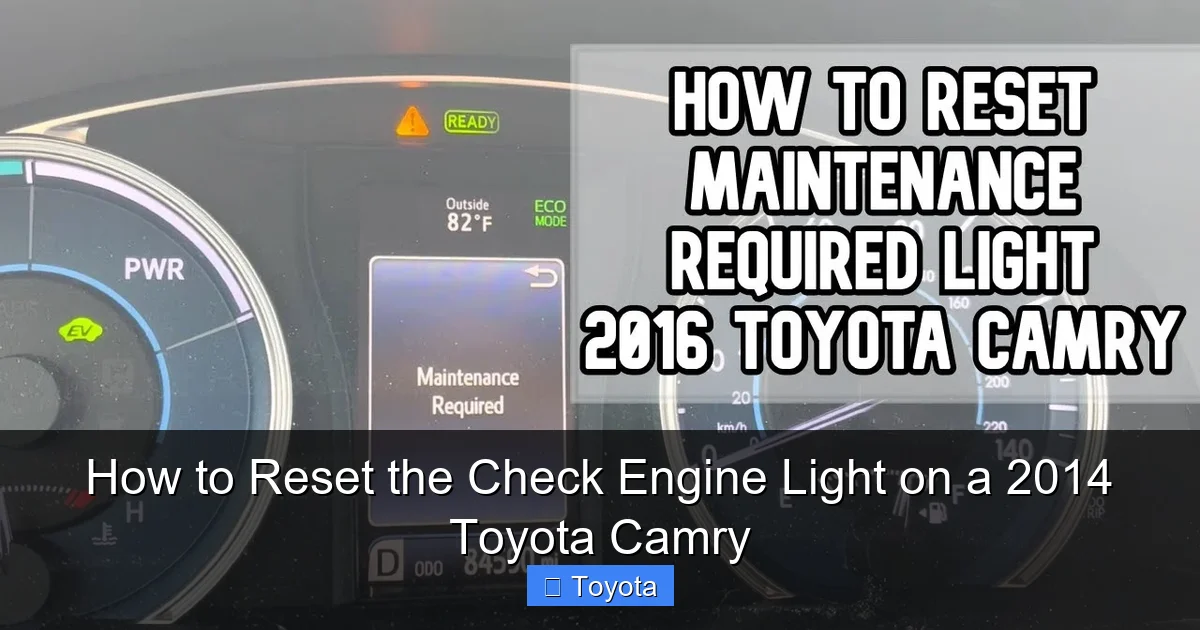
Visual guide about How to Reset the Check Engine Light on a 2014 Toyota Camry
Image source: i.ytimg.com
Step-by-Step Procedure
Warning: Disconnecting the battery will reset all electrical systems. You will lose radio presets, seat memory, and clock settings. On some vehicles, it may also require a sunroof or window re-initialization (less common on a 2014 Camry, but possible). Be prepared to reset these afterward.
- Park your Camry on a level surface, engage the parking brake, and turn off all accessories.
- Open the hood and locate the battery. The 2014 Camry typically has a standard top-post battery in the engine bay.
- Identify the terminals: The negative terminal is marked with a black cover and a “-” symbol. The positive is red with a “+”.
- Using a 10mm wrench (size varies, check yours), loosen the nut on the NEGATIVE (-) cable clamp. Always disconnect the negative first.
- Carefully lift the negative cable clamp off the battery post and tuck it safely away so it cannot contact the post.
- Wait. This is the crucial part. To ensure a full reset, you must wait at least 10-15 minutes. This allows all residual power (capacitors) in the ECM and modules to drain. Some sources recommend as long as 30 minutes for a complete clear. Patience is key.
- Reconnect the negative cable clamp, tightening the nut securely but not over-tightening (which can break the post).
- Close the hood.
What to Expect After Reconnection
When you turn the key to “ON,” the check engine light should be off. However, the car’s computer has also forgotten its “learned” fuel trims and idle adjustments. For the first few drive cycles, you may notice:
- A slightly rough or high idle for the first minute or two.
- Less than optimal fuel economy until the computer relearns.
- The light may come back on very quickly if the original problem is still present (like a bad O2 sensor).
This method is best for clearing codes after you’ve already repaired the issue (e.g., you replaced a faulty gas cap or tightened a loose connector) and just need to reset the light. It is less reliable for clearing complex or persistent codes compared to a scanner.
Method 2: The OBD2 Scanner Reset (The Preferred Method)
This is the professional, precise, and recommended way to reset your check engine light. It directly communicates with the ECM and tells it to clear its stored trouble codes and freeze frame data.

Visual guide about How to Reset the Check Engine Light on a 2014 Toyota Camry
Image source: i.ytimg.com
Step-by-Step Procedure
- Ensure your ignition is in the “ON” position (engine off).
- Plug your OBD2 scanner firmly into the port under the dash.
- Turn the scanner on if it’s a standalone unit. If using a phone app, ensure Bluetooth is on and connected.
- Navigate the scanner menu to find functions like “Erase Codes,” “Clear DTCs,” or “Reset MIL.” (MIL = Malfunction Indicator Lamp).
- Before you clear, double-check: Have you documented all codes? Have you addressed the potential cause? Once cleared, the specific code data is gone (though some scanners save it).
- Select the “Erase” or “Clear” function. The scanner will communicate with the car and send the clear command.
- You should see a confirmation message like “Codes Cleared” or ” MIL Off.”
- Disconnect the scanner.
- Turn the ignition off, wait a few seconds, then restart the engine. The check engine light should be extinguished.
The Critical Drive Cycle
This is the part most people miss. For your 2014 Camry to pass an emissions test (smog check), all of its onboard diagnostic monitors must be set to “Ready” or “Complete.” These monitors check systems like the EVAP system, oxygen sensors, and catalytic converter. Simply clearing the code resets all monitors to “Not Ready.”
To set the monitors, you must perform a specific drive cycle—a sequence of driving conditions (warm-up, steady cruise, deceleration, etc.) that allows the computer to run its self-tests. This can take 50-100 miles of varied driving and may not happen if you only do short trips. If you go for a smog test too soon after a reset, you will fail because the monitors aren’t ready. For specific Toyota drive cycle details, a service manual or a targeted online search for “2014 Camry OBD2 drive cycle” is necessary. This is why fixing the problem first, then resetting, and then driving normally for a week before testing is the best strategy.
When Resetting is NOT the Answer: Serious Warning Signs
Your check engine light is a messenger. Sometimes, the message is “Stop now.”
The Flashing Light: An Immediate Red Flag
As emphasized earlier, a flashing check engine light means a severe misfire. Unburned fuel is entering the exhaust, which can overheat and melt the catalytic converter’s internal substrate. This is a multi-thousand-dollar repair. The only correct action is to pull over safely, shut off the engine, and have the vehicle towed to a mechanic. Do not try to “reset it and see if it goes away.” You will cause immense damage.
Accompanying Symptoms
Even with a solid light, pay attention to how the car drives. If you experience any of these, do not reset. Have it towed or diagnosed immediately:
- Severe loss of power, shaking, or vibration.
- Strange noises (clunking, backfiring).
- Smoke from the exhaust (black, blue, or white).
- Overheating (temperature gauge in the red).
- Fluid leaks under the car.
- Inability to shift gears properly.
These symptoms indicate a problem that could strand you or cause safety issues. The light is the least of your worries.
After the Reset: Monitoring and Final Steps
You’ve cleared the codes. Now what?
The Test Drive
Take your Camry for a normal drive of at least 20-30 minutes, including highway speeds. Pay attention to:
- Does the check engine light return immediately or within a few miles?
- Does the car feel and sound normal? Is the idle smooth?
- Are there any new noises, smells, or performance issues?
If the light comes back, your repair was either incomplete or the diagnosis was incorrect. The code will likely be the same or a new, related one. You must revisit the diagnosis.
Preparing for Inspection
If your Camry is due for a registration renewal that requires a smog check:
- Do not reset the light immediately before the test. The monitors will not be ready, and you’ll fail.
- After a reset, drive the car normally for at least a week, covering a mix of city and highway miles. This maximizes the chance of completing all drive cycles.
- Before the test, you can use your OBD2 scanner to check the status of the monitors. They should all read “Ready” or “Complete.” If any show “Not Ready,” you need more driving.
- If the light is on, you will fail the visual and functional portion of the test automatically.
Conclusion: A Reset is a Tool, Not a Cure
Resetting the check engine light on your 2014 Toyota Camry is a straightforward procedure, whether you choose the battery disconnect method or the more precise OBD2 scanner method. However, this entire process hinges on one fundamental principle: the reset is the final step, not the first. The first and most important step is always diagnosis—finding out what the car is trying to tell you via its stored trouble codes. Treating the check engine light as a mere annoyance to be silenced, rather than a diagnostic tool, is a path to expensive repairs, failed inspections, and potentially dangerous breakdowns.
Your Camry is a reliable vehicle, and its OBD2 system is there to help you maintain that reliability. Use it. Read the codes. Research them. Address the root cause—whether it’s a $20 gas cap or a more involved repair. Only then, and only after confirming the repair was successful through a test drive, should you clear the light. By following this disciplined approach, you save money, keep your car running smoothly, and drive with confidence, not with a masked warning light. Remember, when in doubt, a professional diagnosis is always a wise investment. For other Toyota models, the principles are identical, though button sequences may vary slightly; you can find model-specific guides like our article on how to reset the check engine light on a Toyota Corolla.
Frequently Asked Questions
Will disconnecting the battery reset the check engine light on my 2014 Camry?
Yes, disconnecting the negative battery terminal for 10-15 minutes will clear the codes and turn off the light by resetting the ECM. However, it also resets all other memory (radio, idle settings) and is less reliable than using an OBD2 scanner.
How long does it take for the check engine light to reset after clearing codes?
The light will turn off immediately after you successfully clear the codes with a scanner or battery disconnect. However, for the car’s internal monitors to reset and be “ready” for an emissions test, it typically requires driving 50-100 miles over various conditions, which can take several days of normal driving.
Can I drive my 2014 Camry with the check engine light on?
If the light is solid and the car runs normally (no rough idling, loss of power, or smoke), a short trip to a repair shop is generally safe. If the light is flashing, or if you have severe performance issues, do not drive it. Have it towed to prevent catastrophic engine or catalytic converter damage.
Why did my check engine light come back on after I reset it?
The light returned because the original problem that triggered the code was not fixed. The car’s computer ran its self-test again, detected the same fault, and turned the warning light back on. Resetting only erases the symptom, not the disease.
Do I absolutely need an OBD2 scanner to reset the check engine light?
No, you can use the battery disconnect method. However, an OBD2 scanner is the preferred and professional method because it allows you to read and document the trouble codes first, which is essential for proper diagnosis. It also resets the system more cleanly without affecting other vehicle settings.
Is it safe to reset the check engine light before a smog test?
No, it is not safe and will cause an automatic failure. The emissions test requires all vehicle monitors to be in a “Ready” state. Resetting the light sets all monitors to “Not Ready.” You must drive the car for a complete drive cycle (often 50-100 miles) after a reset before all monitors will become ready again.
