How Many Miles Can a Toyota Sienna Go on a Full Tank?

Contents
- 1 Key Takeaways
- 2 📑 Table of Contents
- 3 Introduction: Planning Your Journey with Confidence
- 4 The Foundation: Fuel Tank Capacity
- 5 The Other Half of the Equation: Fuel Efficiency (MPG)
- 6 Real-World Factors That Reduce Your Range
- 7 The Gas Light: Your Final Reserve
- 8 Special Considerations: Towing and Extreme Duty
- 9 Conclusion: Know Your Minivan, Own Your Range
- 10 Frequently Asked Questions




The Toyota Sienna’s range on a full tank typically falls between 400 and 600 miles, depending heavily on the model year, drivetrain (FWD vs. AWD), and driving conditions. The standard gas tank holds about 18-20 gallons, and fuel economy ranges from 19 mpg (older V6 models) to 39 mpg (newer hybrids). Real-world range is almost always lower than EPA estimates due to factors like cargo load, driving style, and climate. Knowing your specific Sienna’s combined MPG and tank capacity is key to calculating its true maximum distance.
Key Takeaways
- Tank Size is Primary: The Toyota Sienna’s fuel tank capacity is typically 18.5 gallons for most recent models, directly setting the upper potential for your range.
- MPG Varies Significantly: Fuel efficiency is the other critical factor, ranging from ~19 mpg (pre-2021 V6 models) to an impressive 36-39 mpg (2021+ hybrid models), drastically changing the total miles possible.
- AWD Reduces Range: All-Wheel Drive models, while offering better traction, consistently achieve 1-3 mpg less than Front-Wheel Drive counterparts, resulting in a shorter distance per tank.
- Real-World vs. EPA: Expect 10-20% lower actual mileage than EPA estimates due to real driving conditions like city traffic, highway speed, and vehicle load.
- The Gas Light is Your Backup: Once the low fuel light illuminates, you generally have 30-50 miles remaining, a crucial reserve you should not rely on regularly.
📑 Table of Contents
- Introduction: Planning Your Journey with Confidence
- The Foundation: Fuel Tank Capacity
- The Other Half of the Equation: Fuel Efficiency (MPG)
- Real-World Factors That Reduce Your Range
- The Gas Light: Your Final Reserve
- Special Considerations: Towing and Extreme Duty
- Conclusion: Know Your Minivan, Own Your Range
Introduction: Planning Your Journey with Confidence
If you’re a Toyota Sienna owner—or considering becoming one—one of the most practical questions you’ll ask is, “How far can this thing really go before I need to stop for gas?” This isn’t just about avoiding the inconvenience of a fuel stop; it’s about trip planning, budgeting for family vacations, and understanding your vehicle’s true capabilities. The answer, while seemingly simple, is a classic “it depends” scenario. The maximum miles a Toyota Sienna can cover on a full tank is a calculation derived from two core numbers: the size of its fuel tank and its real-world fuel efficiency (miles per gallon, or MPG).
However, these numbers aren’t static. They shift based on whether your Sienna is a powerful pre-2021 V6 model or a modern, efficient hybrid. They change with the addition of all-wheel drive, the weight of seven or eight passengers plus luggage, and whether you’re cruising on a flat highway or navigating hilly terrain. In this comprehensive guide, we’ll break down every variable, provide model-specific estimates, and give you the tools to calculate your Sienna’s precise range. We’ll also debunk myths about running on “fumes” and explain why that little gas light is your friend, not a suggestion to push your luck.
The Foundation: Fuel Tank Capacity
Before we talk about miles, we must talk about gallons. The Toyota Sienna’s fuel tank is its fuel reservoir. A larger tank means more raw potential mileage, all else being equal. Over its production run, the tank size has remained relatively consistent but with key variations.
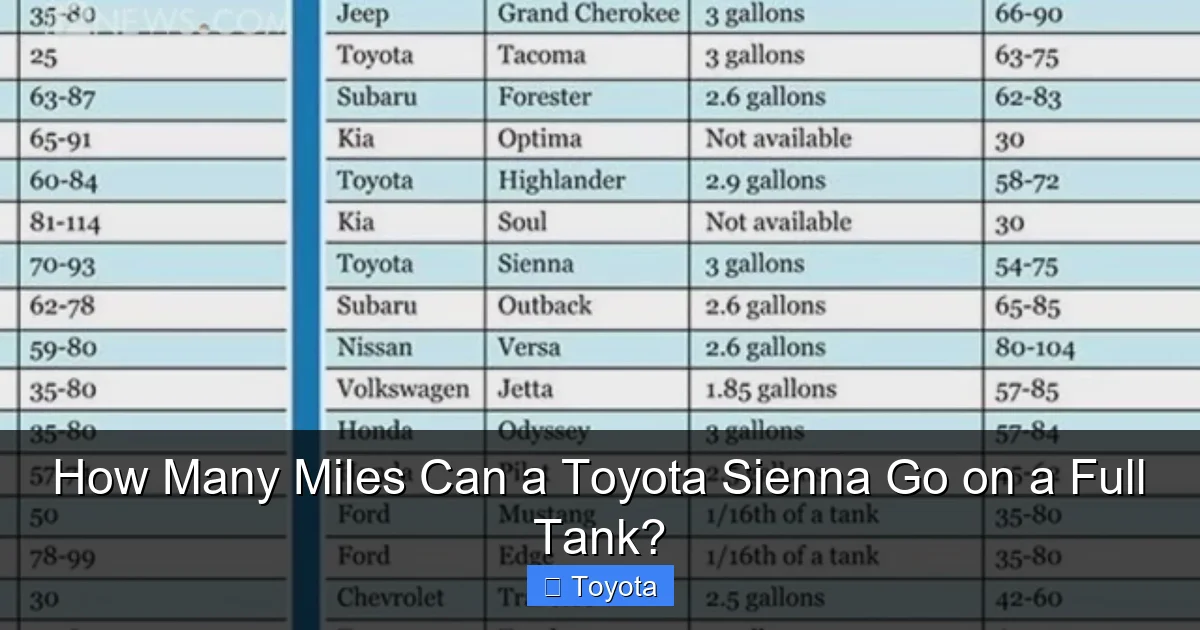
Visual guide about How Many Miles Can a Toyota Sienna Go on a Full Tank?
Image source: automotivian.com
Tank Size Across Generations
For the vast majority of model years from 2011 through 2020 (the fourth generation), the Toyota Sienna came equipped with an 18.5-gallon fuel tank. This was a reliable standard that provided a solid baseline for range calculations. The current, all-hybrid fifth generation (2021-present) also utilizes an 18.5-gallon tank. This consistency is helpful; you can generally use 18.5 gallons as your starting point for any recent Sienna.
There are minor exceptions. Some early 2004-2010 models (third generation) had a slightly larger 19.8-gallon tank. While this difference adds a small buffer, the more significant change is in the engine and its thirst for fuel. To find the exact capacity for your specific VIN, your owner’s manual is the ultimate source. You can also look for a sticker inside the fuel door, which often states “Capacity: XX gal.” Understanding your tank’s exact volume is the first, non-negotiable step in the range equation. For a deep dive specifically on this figure, we have a dedicated article explaining how many gallons a Toyota Sienna holds.
The Other Half of the Equation: Fuel Efficiency (MPG)
This is where the story diverges dramatically. The Toyota Sienna’s miles-per-gallon rating is not a single number. It’s a spectrum defined by engine type, drivetrain, and model year. Let’s separate the two major eras.

Visual guide about How Many Miles Can a Toyota Sienna Go on a Full Tank?
Image source: i.ytimg.com
The V6 Era (2011-2020): Power vs. Thirst
For a decade, the Sienna was powered by a 3.5-liter V6 engine paired with a 6-speed automatic transmission. This engine provided robust power for a heavy, loaded minivan, but it was not particularly fuel-thrifty by modern standards.
- FWD Models: EPA ratings typically landed at 18 mpg city / 24 mpg highway / 20 mpg combined.
- AWD Models: The all-wheel drive system introduced parasitic drag, reducing efficiency to about 17 mpg city / 23 mpg highway / 19 mpg combined.
Real-World V6 Expectation: In practice, many owners of these models report achieving closer to 17-19 mpg combined in mixed driving, especially with a full family and cargo. This is a critical reality check. Using the EPA combined number of 20 mpg and the 18.5-gallon tank, the theoretical maximum range is 370 miles (20 mpg * 18.5 gal). Using a more realistic 18 mpg, that drops to 333 miles. For the AWD model at 19 mpg combined, the real-world range often hovers around 318-340 miles on a full tank.
The Hybrid Revolution (2021-Present): Efficiency Redefined
The seismic shift came with the fifth-generation Sienna, which became a hybrid-only lineup. This fundamentally changed the range conversation. The 2.5-liter 4-cylinder engine works in concert with electric motors, delivering both strong acceleration and stellar fuel economy.
- FWD Models: EPA ratings are an impressive 36 mpg city / 37 mpg highway / 36 mpg combined.
- AWD Models: The hybrid AWD system uses a rear electric motor, which is more efficient than a mechanical driveshaft. Its penalty is minimal: 35 mpg city / 37 mpg highway / 36 mpg combined.
Real-World Hybrid Expectation: Hybrid systems often meet or exceed EPA estimates in gentle driving. Many owners consistently see 37-40 mpg on long highway trips. However, in aggressive city driving with lots of stop-and-go, it can dip toward 33-35 mpg. A very safe, realistic estimate for combined driving is 36 mpg. With the same 18.5-gallon tank, the math is transformative: 36 mpg * 18.5 gal = 666 miles. Even at a conservative 34 mpg, you’re still looking at 629 miles. This nearly doubles the potential range of the older V6 models.
Real-World Factors That Reduce Your Range
The EPA numbers and our calculations above are best-case scenarios in controlled environments. Your actual “miles to empty” on a full tank is a living number influenced by dozens of daily variables. Understanding these helps you manage expectations and drive more efficiently.

Visual guide about How Many Miles Can a Toyota Sienna Go on a Full Tank?
Image source: vehiclerides.com
Driving Style and Environment
This is the biggest wildcard. Aggressive acceleration, hard braking, and speeding are the enemies of efficiency. Every time you press the pedal to the floor, you’re dumping fuel. Hyper-miling techniques like gentle acceleration, anticipating traffic flow, and using cruise control on flat highways can add 10-15% to your range. Conversely, mountainous terrain, constant uphill climbs, and headwinds can drastically reduce MPG. Extreme temperatures play a role too: winter cold thickens oil and makes the engine work harder (and run richer), while summer A/C use places a significant load on the engine.
The Weight of Your Load
The Sienna is a people mover. A fully loaded van with 7-8 adults, luggage, and cargo can weigh 500-1,000 lbs more than a single occupant. This extra mass requires more energy (fuel) to accelerate and climb hills. The impact is most noticeable in city driving with frequent stops. A lightly loaded Sienna will always achieve better mileage than one packed for a cross-country family reunion.
Vehicle Maintenance and Health
A well-maintained Sienna is an efficient Sienna. Proper tire inflation is paramount; under-inflated tires increase rolling resistance, costing you 0.3% in MPG for every 1 PSI drop. Clean air filters ensure the engine breathes easily. Regular oil changes with the correct viscosity reduce internal friction. Worn spark plugs, a faulty oxygen sensor, or dragging brakes can silently sabotage your fuel economy. Following the recommended service schedule is a direct investment in maximizing your miles per tank. For guidance on upkeep, our article on how many miles for an oil change is a great resource.
The Gas Light: Your Final Reserve
Understanding your full-tank range is one thing; knowing what happens when you’re nearing empty is another. The moment your Toyota Sienna’s low fuel warning light (usually a yellow gas pump icon) illuminates on the dashboard, a specific internal process begins.
How Many Miles After the Light Comes On?
This is a critical safety and mechanical question. The light is triggered by a sensor in the fuel tank when the fuel level drops to a predetermined reserve, typically around 1.5 to 2.0 gallons remaining. The exact distance you can travel after this point depends entirely on your current MPG.
- V6 Model (18 mpg): 1.8 gal reserve * 18 mpg = ~32 miles.
- Hybrid Model (36 mpg): 1.8 gal reserve * 36 mpg = ~65 miles.
Manufacturers design this reserve as a safety margin, not an invitation to test limits. Consistently driving until the light is on (or worse, until you run out) can cause several problems: it overheats and wears the in-tank fuel pump (which is lubricated by gasoline), it can stir up sediment from the tank bottom that clogs fuel filters and injectors, and it leaves you vulnerable to stalling in dangerous locations. You should treat the gas light as a firm “refuel within the next 30-50 miles” alert. For a more detailed exploration of this specific scenario, check our piece on how many miles a Toyota Sienna can go on empty, which discusses the severe risks involved.
Why You Should Never “Test” It
Beyond the mechanical wear, there’s a simple logistical risk: your calculation might be wrong. If you get a flat tire, encounter unexpected traffic, or take a wrong turn, that 30-50 mile reserve can vanish quickly. Running out of gas is inconvenient, dangerous (you lose power steering and brakes), and can result in a costly tow. The smart strategy is to refuel when your gauge shows about 1/4 tank remaining, giving yourself a comfortable buffer for the unexpected.
Special Considerations: Towing and Extreme Duty
The Toyota Sienna is a surprisingly capable hauler, with a towing capacity of up to 3,500 lbs when properly equipped. However, towing is the single greatest fuel economy killer you can impose on your minivan.
The Towing Penalty
Pulling a trailer adds immense aerodynamic drag and weight. It forces the engine to work much harder, often reducing fuel economy by 25-50%. A hybrid Sienna that normally gets 36 mpg might drop to 22-27 mpg while towing a loaded trailer. Consequently, your range on a full tank plummets. Instead of 600+ miles, you might be looking at 370-500 miles, and you’ll be visiting gas stations far more frequently. This changes trip planning entirely, as you must factor in more frequent stops for both fuel and to let the powertrain cool. For a complete understanding of your Sienna’s capabilities in this area, our comprehensive guide on how much a Toyota Sienna can tow is essential reading.
High-Altitude and Cold-Weather Impact
If you live in the mountains or frequently drive in very cold weather, expect a further MPG hit. At high altitudes, air is thinner. While this can slightly reduce aerodynamic drag, the engine’s management system often enriches the fuel mixture to compensate, lowering efficiency. In extreme cold, the engine takes longer to reach optimal operating temperature, and the hybrid battery’s performance can be slightly reduced, causing the gasoline engine to run more often. These conditions can shave another 10-15% off your calculated range.
Conclusion: Know Your Minivan, Own Your Range
So, how many miles can a Toyota Sienna go on a full tank? For the modern hybrid owner, the answer is a game-changing 600-650 miles under ideal conditions. For the driver of a classic V6 model, the realistic expectation is a respectable 320-380 miles. These are not just guesses; they are the product of multiplying your specific tank capacity (almost always 18.5 gallons) by your real-world, observed fuel efficiency.
The true power lies in your own observation. Reset your trip odometer at each fill-up. Track how many gallons you put in. Calculate your actual MPG over several tanks. You’ll discover a pattern unique to your driving habits, your typical routes, and your specific Sienna’s health. This knowledge turns a vague question into a precise tool for stress-free travel. Remember to respect the gas light’s reserve, keep your vehicle well-maintained, and adjust expectations for heavy loads or challenging terrain. With this understanding, your Toyota Sienna transforms from just a people-mover into a predictable, reliable, and long-range companion for every adventure life throws your way.
Frequently Asked Questions
Does the Toyota Sienna have a reserve tank beyond the gas light?
No, there is no separate “reserve tank.” The gas light simply indicates you’ve reached a predetermined low level within the main 18.5-gallon tank, usually leaving about 1.5-2.0 gallons. The distance remaining depends entirely on your current MPG.
How does driving with the AWD system affect my Sienna’s range?
AWD consistently reduces fuel efficiency by 1-3 mpg compared to the FWD version of the same model year, due to the added mechanical resistance of powering all four wheels. On a hybrid, the penalty is minimal (often just 0-1 mpg). On a V6 model, it’s more noticeable, shaving roughly 10-15 miles off your total potential range per tank.
What is the single best thing I can do to improve my Sienna’s miles per gallon?
Beyond proper maintenance, the most effective habit is to drive more gently. This means avoiding rapid acceleration and hard braking, using cruise control on highways, and maintaining steady speeds. Reducing weight by removing unnecessary cargo and ensuring proper tire inflation are also highly effective, low-effort improvements.
If I frequently tow a trailer, how often will I need to refuel?
Towing can cut your fuel economy by up to half. If your hybrid Sienna normally gets 600 miles per tank, towing could reduce that to 300-400 miles. You should plan to refuel at least every 250-300 miles when towing, and always keep a larger buffer in mountainous areas.
Are the EPA fuel economy estimates accurate for the Toyota Sienna?
They are a standardized benchmark, not a guarantee. For hybrids, real-world mileage often meets or slightly exceeds EPA numbers on steady highway drives. For older V6 models, real-world combined MPG is frequently 1-2 mpg below the EPA estimate, especially in city driving. Use them for comparison, but track your own numbers for true accuracy.
How far can a 2023 Toyota Sienna hybrid go on a full tank?
A 2023 Sienna hybrid (FWD or AWD) has an 18.5-gallon tank and an EPA rating of 36 mpg combined. The theoretical maximum is 666 miles. In real-world mixed driving with a typical family load, most owners report a reliable range of 550-620 miles before the fuel gauge reaches empty.