
How Many Gallons Does a Toyota Sienna Hold?

The Toyota Sienna has a fuel tank capacity of 18.5 gallons across all recent model years, offering a driving range of up to 500 miles on a full tank thanks to its hybrid powertrain. This makes it one of the most fuel-efficient minivans on the market, perfect for families and long-distance travelers.
Key Takeaways
- Fuel tank capacity: The Toyota Sienna holds 18.5 gallons of gasoline, consistent across all trims and model years from 2021 to 2024.
- Hybrid efficiency: As a standard hybrid, the Sienna achieves up to 36 mpg combined, significantly outperforming non-hybrid minivans.
- Real-world range: With 18.5 gallons and 36 mpg, drivers can travel approximately 666 miles on a full tank under ideal conditions.
- Refueling frequency: Most drivers refuel every 7–10 days with typical family use, depending on driving habits and distance.
- Fuel type recommendation: Toyota recommends using regular unleaded gasoline (87 octane) for optimal performance and engine longevity.
- Eco-driving tips: Using Eco mode, maintaining proper tire pressure, and reducing cargo weight can extend your Sienna’s range.
- Comparison advantage: The Sienna’s hybrid system gives it a clear edge over competitors like the Honda Odyssey and Chrysler Pacifica in fuel economy and tank efficiency.
📑 Table of Contents
- How Many Gallons Does a Toyota Sienna Hold?
- Understanding the Toyota Sienna’s Fuel Tank Capacity
- The Hybrid Advantage: How the Sienna Maximizes Every Gallon
- Calculating Your Sienna’s Driving Range
- Comparing the Sienna to Other Minivans
- Practical Tips for Maximizing Fuel Efficiency
- Conclusion: The Sienna’s Fuel Capacity Makes It a Family Favorite
How Many Gallons Does a Toyota Sienna Hold?
If you’re considering buying a Toyota Sienna or you’re already a proud owner, one of the most practical questions you might have is: How many gallons does a Toyota Sienna hold? The answer is straightforward—the Toyota Sienna has a fuel tank capacity of 18.5 gallons. This capacity has remained consistent across all trims and model years since the full redesign in 2021, when Toyota made the bold move to offer the Sienna exclusively as a hybrid vehicle.
But knowing the tank size is just the beginning. What really matters is how far that 18.5 gallons can take you. Thanks to Toyota’s advanced hybrid technology, the Sienna doesn’t just hold fuel efficiently—it uses it wisely. With an EPA-estimated 36 miles per gallon combined (35 city / 36 highway), the Sienna delivers one of the best fuel economies in the minivan segment. That means you can go longer between fill-ups, save money at the pump, and reduce your environmental footprint—all while shuttling kids to soccer practice, heading out on a family road trip, or running weekend errands.
In this comprehensive guide, we’ll dive deep into the fuel capacity of the Toyota Sienna, explore how its hybrid system maximizes efficiency, compare it to other minivans, and share practical tips to get the most out of every gallon. Whether you’re a new owner or just doing your research, this article will give you everything you need to understand your Sienna’s fuel performance.
Understanding the Toyota Sienna’s Fuel Tank Capacity
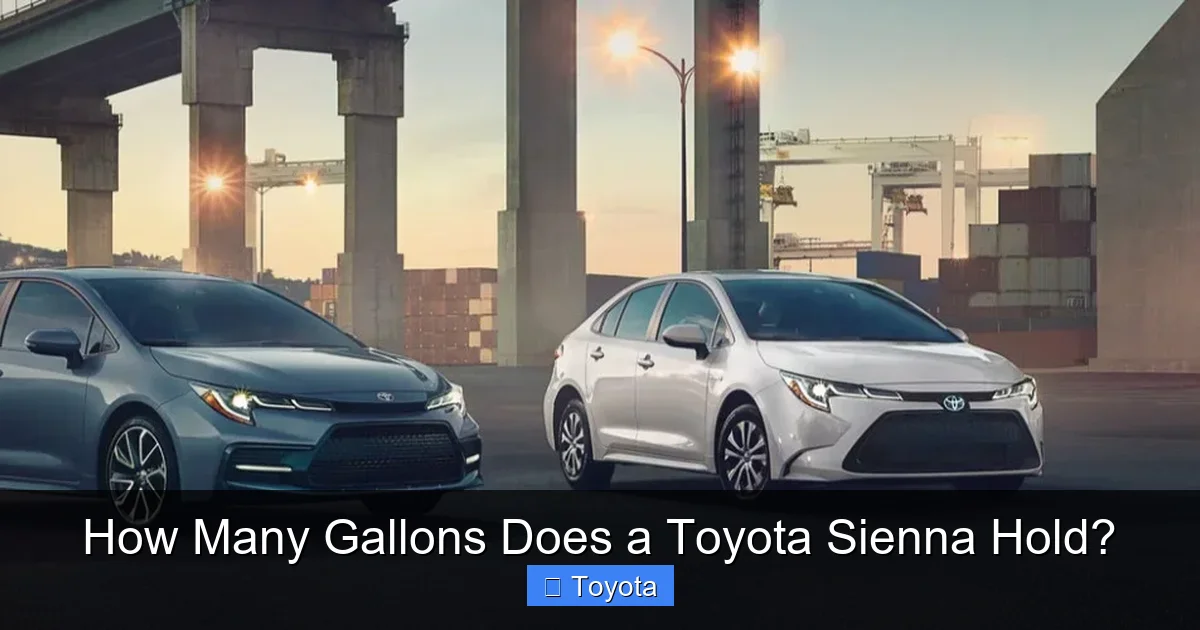
Visual guide about How Many Gallons Does a Toyota Sienna Hold?
Image source: thecarhow.com
The Toyota Sienna’s fuel tank holds exactly 18.5 gallons of gasoline. This number isn’t arbitrary—it’s the result of careful engineering to balance driving range, vehicle weight, and fuel efficiency. Unlike some older minivans that relied on large V6 engines and bigger tanks (sometimes up to 20 gallons), the Sienna’s hybrid design allows it to achieve impressive range without needing a massive fuel reservoir.
Why 18.5 Gallons?
Toyota chose the 18.5-gallon capacity to optimize the Sienna’s overall performance. A larger tank would add weight, reduce cargo space, and increase manufacturing costs. A smaller tank might require more frequent refueling, which could be inconvenient for families on long trips. The 18.5-gallon size strikes a perfect balance—offering enough range for most drivers while keeping the vehicle lightweight and efficient.
This capacity is consistent across all Sienna trims, from the base LE to the premium Limited and Platinum models. Whether you choose front-wheel drive or all-wheel drive, the fuel tank size remains the same. That means no matter which version you drive, you’re getting the same fuel-holding capability.
Fuel Type and Octane Recommendation
Toyota recommends using regular unleaded gasoline with an octane rating of 87 in the Sienna. You don’t need to spend extra on premium fuel—the hybrid engine is designed to run efficiently on standard gasoline. Using higher-octane fuel won’t improve performance or mileage, so stick with regular to save money.
It’s also important to use fuel from reputable stations to avoid contaminants that could affect engine performance. If you’re filling up in an area with questionable fuel quality, consider using a fuel system cleaner periodically to keep your engine running smoothly.
Fuel Door and Refueling Process
Refueling the Sienna is simple and user-friendly. The fuel door is located on the driver’s side, just behind the rear wheel. It opens with a gentle pull of the interior fuel door release lever, usually located near the driver’s seat or on the floor. The filler neck is wide and easy to access, making it convenient even for drivers with limited mobility.
The gas cap is tethered, so you won’t lose it while refueling—a small but appreciated detail. Once you’ve filled up, simply replace the cap and listen for the click to ensure it’s sealed properly. A loose or missing gas cap can trigger the check engine light and reduce fuel efficiency, so always double-check.
The Hybrid Advantage: How the Sienna Maximizes Every Gallon
Visual guide about How Many Gallons Does a Toyota Sienna Hold?
Image source: cti-ssi.com
The real magic behind the Sienna’s fuel efficiency isn’t just the tank size—it’s the hybrid powertrain. Since 2021, every Toyota Sienna comes standard with a hybrid system that combines a 2.5-liter four-cylinder gasoline engine with two electric motors. This setup delivers a total of 245 horsepower while achieving up to 36 mpg combined.
How the Hybrid System Works
The Sienna’s hybrid system uses intelligent energy management to switch seamlessly between gasoline and electric power. At low speeds—like in stop-and-go traffic or parking lots—the vehicle runs primarily on electric power, using energy stored in the battery. As speed increases or more power is needed, the gasoline engine kicks in to assist.
The system also uses regenerative braking to recharge the battery. Every time you slow down or brake, the electric motors act as generators, converting kinetic energy back into electricity. This means the Sienna is constantly recharging itself during normal driving, reducing reliance on the gas engine.
Real-World Fuel Economy
While the EPA estimates 36 mpg combined, real-world mileage can vary based on driving conditions, habits, and climate. In city driving, where the electric motor does most of the work, many owners report achieving 38–40 mpg. On the highway, where the gasoline engine is more active, mileage typically drops to around 34–36 mpg.
For example, a family driving 15,000 miles per year with an average of 36 mpg would use about 417 gallons of fuel annually. At $3.50 per gallon, that’s roughly $1,460 per year in fuel costs. Compare that to a non-hybrid minivan like the Honda Odyssey, which averages around 22 mpg—using about 682 gallons and costing over $2,380 annually. The Sienna saves over $900 per year in fuel alone.
Eco Mode and Driving Tips
The Sienna comes equipped with an Eco Mode button that adjusts throttle response, climate control, and other systems to maximize fuel efficiency. When activated, the vehicle prioritizes smooth acceleration and reduced power consumption.
To get the most out of your Sienna’s hybrid system, try these tips:
– Use Eco Mode during city driving or light traffic.
– Avoid aggressive acceleration and hard braking.
– Keep your speed steady on the highway—cruise control helps.
– Remove unnecessary cargo to reduce weight.
– Maintain proper tire pressure (check monthly).
These small changes can add up to significant fuel savings over time.
Calculating Your Sienna’s Driving Range
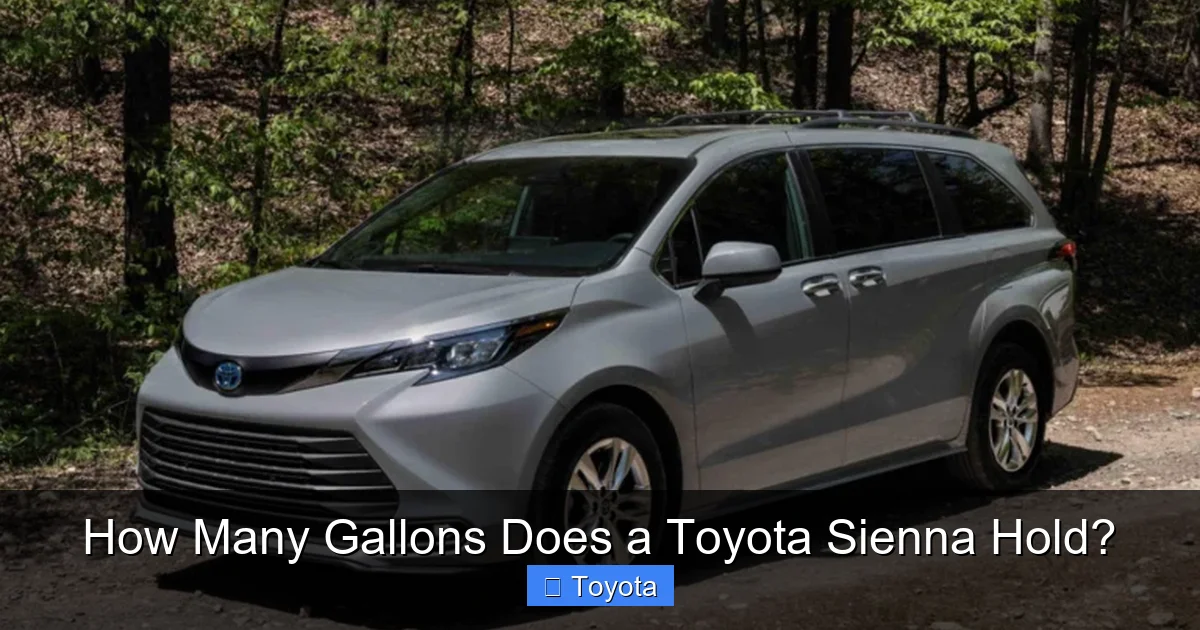
Visual guide about How Many Gallons Does a Toyota Sienna Hold?
Image source: 2025toyota.com
Now that we know the Sienna holds 18.5 gallons and gets up to 36 mpg combined, we can calculate its potential driving range. Simply multiply the tank capacity by the fuel economy:
18.5 gallons × 36 mpg = 666 miles on a full tank
That’s an impressive range for a minivan. In real-world conditions, most drivers will see between 600 and 650 miles, depending on driving style and conditions.
City vs. Highway Range
Because the Sienna is more efficient in city driving, your range will vary based on where you drive most often.
– City driving (35 mpg): 18.5 × 35 = 647 miles
– Highway driving (36 mpg): 18.5 × 36 = 666 miles
– Mixed driving (36 mpg): ~660 miles
For example, if you commute 50 miles round-trip daily in the city, you could go over 12 days without refueling. On a long road trip, you might be able to drive from Los Angeles to San Francisco (about 380 miles) and still have plenty of fuel left for sightseeing.
Factors That Affect Range
While the Sienna is highly efficient, several factors can reduce your actual range:
– Weather: Cold temperatures reduce battery efficiency and increase engine warm-up time, lowering mileage.
– HVAC use: Running the heater or air conditioning heavily can drain the battery and increase fuel consumption.
– Cargo and passengers: Extra weight reduces efficiency. A fully loaded Sienna with seven passengers and luggage may see a 5–10% drop in mpg.
– Driving habits: Rapid acceleration, speeding, and frequent braking lower fuel economy.
To maximize range, plan your trips efficiently, combine errands, and drive smoothly.
Comparing the Sienna to Other Minivans
When it comes to fuel efficiency, the Toyota Sienna stands out among its competitors. Let’s see how it stacks up against other popular minivans.
Toyota Sienna vs. Honda Odyssey
The Honda Odyssey uses a 3.5-liter V6 engine and an automatic transmission, achieving an EPA-estimated 19 mpg city / 28 mpg highway (22 mpg combined). With a 19.5-gallon tank, its range is about 429 miles.
Even though the Odyssey has a slightly larger tank, its lower fuel economy means it falls short of the Sienna’s range. The Sienna offers over 200 more miles per tank and saves hundreds in annual fuel costs.
Toyota Sienna vs. Chrysler Pacifica
The Chrysler Pacifica offers a hybrid version, but it’s a plug-in hybrid (PHEV), not a standard hybrid like the Sienna. The Pacifica Hybrid has a 16-gallon gas tank and an electric-only range of about 32 miles. Once the battery is depleted, it operates like a traditional hybrid, achieving around 30 mpg.
While the Pacifica Hybrid can run on electricity alone for short trips, it requires regular charging to maximize efficiency. The Sienna, on the other hand, never needs to be plugged in—it recharges automatically. For drivers who don’t want to worry about charging, the Sienna is a more convenient option.
Toyota Sienna vs. Kia Carnival
The Kia Carnival uses a 3.5-liter V6 engine with 19 mpg city / 26 mpg highway (22 mpg combined) and a 19.3-gallon tank. Its range is similar to the Odyssey—around 425 miles.
Again, the Sienna’s hybrid system gives it a clear advantage in fuel economy and range. The Carnival may offer more horsepower, but it can’t match the Sienna’s efficiency.
Why the Sienna Wins on Efficiency
The Sienna’s hybrid powertrain, combined with its 18.5-gallon tank, makes it the most fuel-efficient minivan on the market. It outperforms all non-hybrid competitors and offers greater convenience than plug-in hybrids. For families who prioritize fuel savings, low emissions, and long-range capability, the Sienna is the top choice.
Practical Tips for Maximizing Fuel Efficiency
Even with excellent factory efficiency, there are ways to get even more out of your Sienna’s fuel tank. Small changes in driving habits and maintenance can lead to big savings over time.
Drive Smoothly
Aggressive driving—speeding, rapid acceleration, and hard braking—can lower your fuel economy by 15–30%. Instead, accelerate gradually, maintain a steady speed, and anticipate stops to coast when possible. Use cruise control on the highway to avoid unnecessary speed fluctuations.
Use Eco Mode Wisely
Eco Mode reduces throttle sensitivity and adjusts the climate control system to save energy. It’s ideal for city driving, light traffic, or when you’re not in a hurry. However, if you need quick acceleration—like merging onto a highway—switch back to Normal mode for better responsiveness.
Keep Tires Properly Inflated
Underinflated tires increase rolling resistance, which reduces fuel economy. Check your tire pressure at least once a month and before long trips. The recommended pressure for the Sienna is usually 35 psi, but check the sticker on the driver’s door jamb for exact numbers.
Reduce Weight and Drag
Extra weight and aerodynamic drag hurt efficiency. Remove roof racks, cargo boxes, or bike carriers when not in use. Avoid carrying heavy items in the cabin unless necessary. Every 100 pounds of extra weight can reduce fuel economy by 1–2%.
Maintain Your Vehicle
Regular maintenance keeps your Sienna running efficiently. Follow the recommended service schedule, including oil changes, air filter replacements, and spark plug checks. A well-maintained engine burns fuel more cleanly and efficiently.
Plan Your Trips
Combine errands into one trip to avoid multiple cold starts, which are less efficient. Use GPS apps to find the shortest or least congested routes. Avoid driving during peak traffic hours when possible.
Conclusion: The Sienna’s Fuel Capacity Makes It a Family Favorite
So, how many gallons does a Toyota Sienna hold? The answer is 18.5 gallons—a well-balanced capacity that supports the minivan’s impressive fuel efficiency and long driving range. Thanks to its standard hybrid powertrain, the Sienna delivers up to 36 mpg combined, allowing drivers to travel over 600 miles on a single tank.
This combination of fuel capacity, efficiency, and practicality makes the Sienna a standout choice for families, road trippers, and anyone who values reliability and savings at the pump. Whether you’re navigating city streets or cruising down the highway, the Sienna ensures you’ll go farther with less fuel.
By understanding your Sienna’s fuel system and adopting smart driving habits, you can maximize every gallon and enjoy the full benefits of Toyota’s hybrid technology. With lower fuel costs, reduced emissions, and fewer stops at the gas station, the Sienna isn’t just a minivan—it’s a smart investment in your family’s future.
Frequently Asked Questions
How many gallons does a Toyota Sienna hold?
The Toyota Sienna has a fuel tank capacity of 18.5 gallons across all trims and model years from 2021 to 2024. This capacity supports its hybrid powertrain and contributes to its long driving range.
What type of fuel does the Toyota Sienna require?
The Toyota Sienna is designed to run on regular unleaded gasoline with an octane rating of 87. Premium fuel is not required and will not improve performance or efficiency.
How far can a Toyota Sienna go on a full tank?
With 18.5 gallons and an EPA-estimated 36 mpg combined, the Sienna can travel up to 666 miles on a full tank under ideal conditions. Real-world range typically falls between 600 and 650 miles.
Is the Toyota Sienna a hybrid?
Yes, every Toyota Sienna model since 2021 comes standard with a hybrid powertrain that combines a 2.5-liter four-cylinder engine with electric motors for improved fuel efficiency.
How often do I need to refuel my Toyota Sienna?
Most drivers refuel every 7 to 10 days, depending on driving habits and distance. With typical family use, you may only need to fill up once a week or less.
Can I improve my Sienna’s fuel economy?
Yes, you can improve fuel economy by using Eco Mode, maintaining proper tire pressure, driving smoothly, reducing cargo weight, and keeping up with regular maintenance.