How Many Miles Can a 2018 Toyota Camry Go on a Full Tank

Contents
- 1 Key Takeaways
- 2 📑 Table of Contents
- 3 Understanding the 2018 Camry’s Fuel Capacity
- 4 EPA Ratings vs. Real-World Driving: The Great Divide
- 5 Key Factors That Influence Your Actual Miles Per Tank
- 6 The Gas Light: Your Critical Reserve Buffer
- 7 Practical Tips to Maximize Your Camry’s Range
- 8 Comparing to the Competition and Other Toyotas
- 9 Frequently Asked Questions

Car Cup Holder Expander

Tire Pressure Monitoring System (TPMS)

Carburetor Cleaner

Microfiber Car Cleaning Cloth
The 2018 Toyota Camry, with its standard 15.8-gallon fuel tank, offers an estimated combined range of 448 to 588 miles on a full tank, depending on the engine and drivetrain. The EPA rates the base 2.5L 4-cylinder at 29 mpg combined (458 miles), while the more powerful 3.5L V6 gets 22 mpg combined (348 miles). However, real-world range can vary significantly based on driving habits, terrain, vehicle maintenance, and weather conditions. Understanding your specific Camry’s efficiency and the reserve fuel after the gas light comes on is key to avoiding an unexpected breakdown.
You’re on a long road trip, cruising down the highway in your trusty 2018 Toyota Camry. The fuel gauge is dipping towards that ominous “E,” and a familiar question pops into your head: “Just how far can I actually go before I need to stop?” It’s a practical worry for every driver, blending a desire for efficiency with the need to avoid the stress of running dry. The answer isn’t a single magic number, but a combination of your car’s hardware, your driving habits, and the environment. Let’s break down exactly how many miles you can expect from your 2018 Camry on a full tank, turning that guess into a confident, data-driven plan.
Key Takeaways
- Tank Size is Fixed: All 2018 Camry models (except hybrids) come with a 15.8-gallon fuel tank, which is the primary hardware determining maximum range.
- EPA Ratings are a Baseline: The official EPA estimates (22-32 mpg combined) provide a useful comparison but rarely match every driver’s exact real-world results.
- Driving Style is Everything: Aggressive acceleration, high speeds, and heavy city traffic can reduce your fuel economy by 15-30% compared to gentle, highway cruising.
- The Gas Light Means Reserve: When the low fuel light illuminates, you typically have 1.0 to 2.0 gallons left, offering a crucial 30-60 mile buffer to find a station.
- Maintenance Directly Impacts Efficiency: Under-inflated tires, dirty air filters, and overdue oil changes can silently drain your miles per gallon and shorten your total range per tank.
- Climate Control Drains Power: Using the air conditioning or heater, especially in extreme temperatures, increases engine load and can lower fuel economy by up to 10%.
- Model Matters: The 4-cylinder LE/XLE models are the most efficient; the V6 XSE/XLE and the now-discontinued SE 4-cylinder offer slightly different mpg figures, affecting total distance.
📑 Table of Contents
Understanding the 2018 Camry’s Fuel Capacity
Before we talk miles, we must talk gallons. The absolute maximum distance you can travel starts with the size of your fuel tank. For the 2018 model year, Toyota equipped nearly all non-hybrid Camry models with a single, unified fuel tank size. This standardization simplifies our calculations. To get the full picture, it’s helpful to understand the specifics of this component. For a deep dive into the exact dimensions and design, you can explore our detailed guide on how big the gas tank is on a Toyota Camry.
The Standard 15.8-Gallon Tank
Every 2018 Toyota Camry with a conventional gasoline engine—from the base LE to the top-tier V6 XSE—features a fuel tank with a nominal capacity of 15.8 gallons. This includes the popular 2.5L 4-cylinder and the optional 3.5L V6 engines. The tank is a single, molded plastic unit located under the rear seats and trunk floor. Its size was engineered to balance range, weight, packaging, and refueling convenience. This consistency means the primary variable in your total range isn’t the tank size, but what you put into it: the fuel itself, and how efficiently your engine burns it.
Hybrid Exception
It’s crucial to note that the 2018 Camry Hybrid LE and Hybrid XLE models use a different system. They have a smaller gasoline tank (approximately 13.2 gallons) because their powertrain relies on electric energy from a battery for a significant portion of city driving. Their total range on a full “tank” (gas + electric) is actually much higher, often exceeding 700 miles, but their gasoline-only range is different. Our focus here is on the traditional gasoline-only Camry models.
EPA Ratings vs. Real-World Driving: The Great Divide
The Environmental Protection Agency (EPA) provides fuel economy estimates that are the official, standardized numbers you see on the window sticker. They are derived from controlled laboratory tests and offer a fantastic baseline for comparing models. However, they are not a guarantee of what you’ll see in your daily life. For the 2018 Camry, the EPA ratings create a clear spectrum of expected range.
Decoding the Window Sticker Numbers
Here’s how the EPA ratings break down for the key 2018 Camry trims with the 15.8-gallon tank:
- Camry LE/XLE (2.5L 4-cylinder, FWD): 29 mpg combined (28 city / 39 highway). This yields a theoretical maximum range of 458 miles (15.8 gal * 29 mpg).
- Camry SE (2.5L 4-cylinder, FWD): Slightly different tuning/weight gives 28 mpg combined (27 city / 38 highway). Theoretical max range: 442 miles.
- Camry XSE/XLE (3.5L V6, FWD): The V6 prioritizes power. Rated at 22 mpg combined (21 city / 30 highway). Theoretical max range: 348 miles.
- Camry V6 (AWD models): All-wheel drive adds drivetrain loss. Rated at 21 mpg combined (20 city / 28 highway). Theoretical max range: 332 miles.
These are your starting points—the “best case” in ideal, laboratory-like conditions.
Why Your Odometer Will Tell a Different Story
So why do most drivers get fewer miles per tank? Real-world driving is a chaotic mix of variables the EPA tests can’t fully replicate. You might experience stop-and-go traffic with constant acceleration, drive on hilly terrain, use your climate control year-round, or carry a full load of passengers and cargo. All these factors increase the work your engine must do, burning more fuel per mile. A conservative, highway-focused driver might consistently hit or even slightly exceed EPA estimates. A city commuter with a heavy foot might see 20-25% lower fuel economy. Your actual range is a personal number, shaped by your unique driving life.
Key Factors That Influence Your Actual Miles Per Tank
To move from theory to practice, you need to audit your own driving conditions. Several major factors will either help you stretch that 15.8 gallons or cause it to vanish quicker than expected.
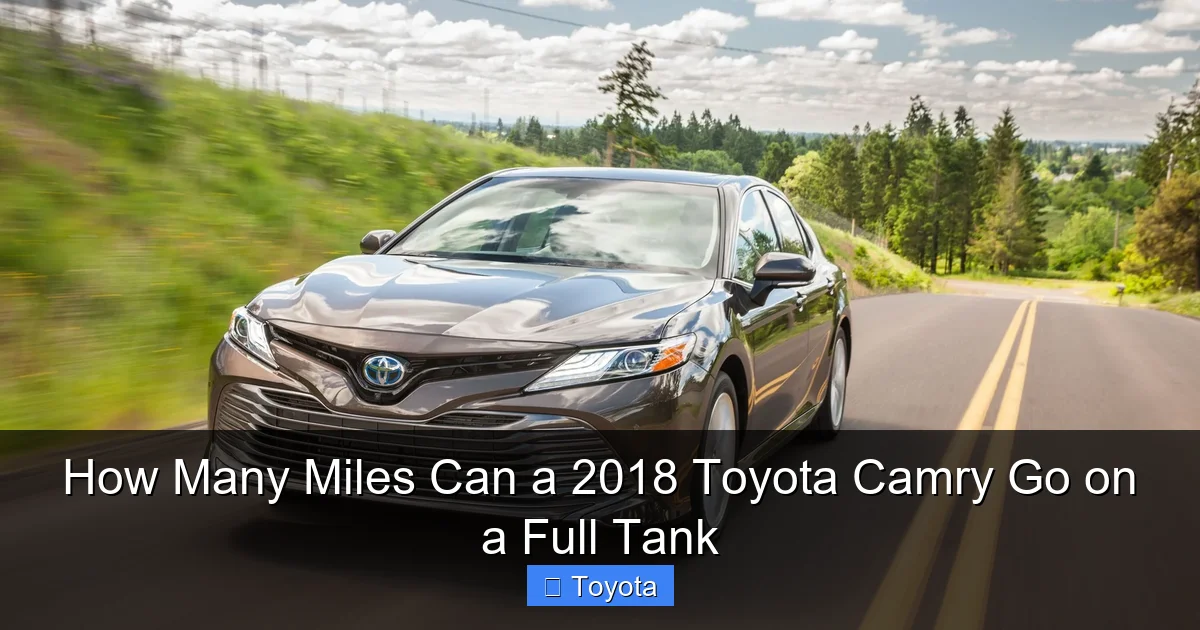
Visual guide about How Many Miles Can a 2018 Toyota Camry Go on a Full Tank
Image source: cimg1.ibsrv.net
Driving Environment: City vs. Highway
This is the single biggest influencer. The 2018 Camry’s 4-cylinder shows its strength on the open road, with an EPA highway rating of 38-39 mpg. At a steady 65-70 mph, you are in the efficiency sweet spot. Conversely, city driving, with its frequent stops, starts, and idling, is where fuel economy plummets. The EPA city rating for the 4-cylinder is only 27-28 mpg. If your commute is 80% city, your combined average will skew much lower, shaving 50-100 miles off your potential range.
Vehicle Load and Aerodynamics
Extra weight requires more energy to move. A fully loaded Camry with five adults and a roof rack full of luggage can see fuel economy drop by several mpg. Similarly, a roof rack or cargo carrier, even when empty, creates significant aerodynamic drag, especially at highway speeds, hurting your efficiency. Remove unnecessary cargo and racks when not in use to preserve your range.
Climate Control: The Silent Range Thief
Your air conditioning and heater are powered by the engine. The A/C compressor places a direct mechanical load on the engine, burning extra fuel. In extreme summer heat, running the A/C at max can reduce fuel economy by 5-10%. The heater uses engine waste heat (so less direct impact), but the fan motor still draws electrical power, which the alternator must generate using engine power. In very cold weather, the engine also runs richer until warm, further reducing initial mpg.
Tire Pressure and Maintenance
This is where owner responsibility meets fuel economy. Under-inflated tires increase rolling resistance, making your engine work harder. A drop of just 5 PSI below the recommended pressure (found on the driver’s door jamb sticker) can lower fuel economy by 2-3%. Regular maintenance is non-negotiable for peak range: clean air filters allow proper airflow, synthetic oil reduces internal friction, and properly functioning spark plugs ensure efficient combustion. A neglected Camry can lose 10% or more of its potential efficiency.
The Gas Light: Your Critical Reserve Buffer
Understanding your full-tank range is useless if you don’t know when the tank is *truly* empty. That’s where the low fuel warning light comes in. It’s not a panic button; it’s a calculated reminder. When that amber light glows on your 2018 Camry’s dashboard, you have a significant and safe reserve of fuel remaining. The exact amount varies by model year and tank design, but for the 2018 Camry, it’s a reliable figure.
How Much Fuel is Left When the Light Comes On?
Based on owner reports, technical service bulletins, and tank geometry, the 2018 Camry’s low fuel light typically illuminates when there are approximately 1.0 to 2.0 gallons of gasoline remaining in the 15.8-gallon tank. This translates to a reserve range of about 30 to 60 miles for the efficient 4-cylinder model, and 22 to 44 miles for the V6. This buffer is designed to give you ample time to locate a gas station without damaging the fuel pump (which relies on gasoline for cooling and lubrication) or causing sediment from the tank bottom to enter the fuel system.
Don’t Push Your Luck: The Dangers of “On Empty”
While the reserve is there for convenience, consistently driving until the light is on and beyond is a bad habit. It increases the risk of running out, which is dangerous and inconvenient. More subtly, it can cause your fuel pump to overheat (as it’s no longer submerged) and can suck up debris that has settled at the tank’s bottom, potentially clogging the fuel filter or injectors. For a detailed look at this specific warning in Camrys, our article on how many miles you can drive when the gas light comes on in a Toyota Camry provides model-specific insights and cautionary advice.
Practical Tips to Maximize Your Camry’s Range
Now for the empowering part: how to actively increase the miles you get from every fill-up. You don’t need to modify your car; you need to modify your approach. These are proven, driver-controlled strategies that can add 10-20% more range to your tank.
Adopt a Smooth, Anticipatory Driving Style
This is the golden rule. Look far ahead at traffic. If you see a red light or slowing cars, take your foot off the accelerator early and coast gently instead of braking at the last second. Accelerate slowly and smoothly from a stop. Use cruise control on flat, open highways to maintain a constant speed. These habits reduce the fuel-wasting cycles of hard acceleration and heavy braking. Imagine an egg under your foot—that’s the gentle touch that saves fuel.
Observe the Speed Limit (and Then Some)
Aerodynamic drag increases exponentially with speed. Driving 75 mph instead of 65 mph can increase fuel consumption by 10-15%. The most efficient speed for most cars is in the 45-55 mph range, but on highways, staying at or just below the speed limit is a practical and legal way to conserve fuel. Your range will thank you for the patience.
Reduce Idling and Excess Weight
If you’re stopped for more than 30-60 seconds (except in heavy traffic), turn the engine off. Modern starters are efficient, and idling wastes fuel at a rate of 0.5 to 1 gallon per hour. Also, do a regular trunk clean-out. Every 100 pounds of extra cargo reduces fuel economy by about 1%. Remove golf clubs, tools, or other non-essentials when not needed.
Stay on Top of Basic Maintenance
Create a checklist: Check tire pressure monthly with a good gauge and inflate to the door jamb spec. Use the recommended oil grade (0W-20 for 2018 Camry). Replace engine air filters as scheduled (usually every 30k miles). Ensure your alignment is correct. These simple, inexpensive tasks keep your engine running as efficiently as the engineers intended, directly translating to more miles per gallon and more miles per tank.
Comparing to the Competition and Other Toyotas
How does the Camry’s range stack up? It consistently leads its class. The 2018 Honda Accord, its primary rival, had similar EPA ratings and a 17.2-gallon tank, giving it a slightly longer theoretical highway range. The 2018 Hyundai Sonata had a 14.2-gallon tank, making its total range comparable or slightly less. Within the Toyota family, the larger Avalon shares the Camry’s platform but has a bigger 18.5-gallon tank, giving it a clear advantage in total distance. For families needing even more space, the Toyota Sienna minivan offers a massive 20-gallon tank, though with lower fuel economy, its total range is in a similar ballpark. The Camry’s sweet spot is its excellent balance of strong fuel economy and a reasonably sized tank, making it one of the most practical midsize sedans for long-distance travel without frequent stops.
Frequently Asked Questions
What is the absolute maximum range of a 2018 Camry 4-cylinder on the highway?
In perfect, steady-state highway conditions at 60-65 mph with a well-maintained vehicle and no excess weight, a driver could potentially see 40-42 mpg. With 15.8 gallons, that’s a theoretical peak of 630-665 miles. However, this is highly optimistic and not typical for most drivers.
Does using premium gasoline increase my Camry’s range?
No. The 2018 Camry’s 2.5L 4-cylinder and 3.5L V6 engines are designed to run on regular unleaded 87-octane fuel. Using premium offers no benefit in power, economy, or range, as the engine’s timing and compression are not tuned for it. It’s an unnecessary expense.
How much does using the air conditioner really affect my miles per gallon?
At low speeds in city driving, the A/C compressor load can reduce fuel economy by up to 10-15%. At steady highway speeds, the impact is less noticeable (around 3-5%) because the engine is already under load to overcome aerodynamic drag. The effect is most pronounced in stop-and-go traffic.
Is the gas light warning accurate for the remaining miles?
The light itself is not mileage-based; it’s a tank-level sensor. The “miles to empty” readout on your multi-information display is an estimate based on your recent driving history. It’s a good guide, but it’s not infallible. It’s safer to use the general rule of thumb: when the light comes on, plan to refuel within the next 40-50 miles for a 4-cylinder.
My Camry has an “E” on the gauge. How many miles is that?
>The “E” zone is not a precise measurement. It’s a red zone indicating you are on reserve fuel. The actual amount of fuel left varies. Relying on the low fuel light (which comes on before the needle hits “E”) is the more accurate warning. The needle hitting “E” means you are likely already into the last 0.5-1.0 gallon of reserve.
Does tire pressure really affect my fuel range that much?
Yes, significantly. Under-inflated tires increase rolling resistance. The EPA estimates that for every 1 PSI drop in average tire pressure, fuel economy decreases by about 0.2%. For a Camry getting 30 mpg, that’s a loss of 0.06 mpg per PSI. On a 15.8-gallon tank, 5 PSI low could cost you 2-3 miles per gallon, or 30-50 total miles of range. Check pressures monthly.