
How Many Miles Can a 2009 Toyota Corolla Go on Empty?

A 2009 Toyota Corolla typically has 30-50 miles of reserve fuel after the gas light illuminates. Driving on empty regularly can damage your fuel pump and engine. Knowing your car’s actual capacity helps prevent breakdowns and extends vehicle life.
Key Takeaways
- Reserve Fuel Exists: Most Corollas have 1-2 gallons left when the gas light comes on, designed as a safety buffer.
- Typical Range: Under normal conditions, expect 30-50 miles after the warning, but this varies significantly.
- Variables Matter: Driving style, terrain, traffic, and vehicle health directly impact your actual empty miles.
- Damage Risks: Running on empty overheats the fuel pump, sucks up sediment, and can cause engine stalling.
- Refuel Early: Filling up at 1/4 tank protects your fuel system and gives peace of mind.
- Gauge Inaccuracy: Fuel gauges are estimates; don’t push your luck based solely on the needle.
- Safety First: Running out in traffic is dangerous—plan refueling stops to avoid stranding.
📑 Table of Contents
- Introduction: That Scary Gas Light Moment
- How Fuel Gauges and Reserve Tanks Actually Work
- 2009 Toyota Corolla: What’s the Real Empty Range?
- What Factors Change Your Reserve Miles?
- The Hidden Dangers of Driving on Empty
- Smart Practices: Never Push Your Luck
- Conclusion: Your Corolla’s Longevity Depends on It
Introduction: That Scary Gas Light Moment
You’re on your daily commute, maybe on the highway, when a little yellow icon flickers to life on your dashboard. The gas light. For a 2009 Toyota Corolla owner, that glow can spark a familiar mix of panic and calculation. “How far can I actually go?” “Is there a gas station soon?” “Can I make it home?”
This moment is universal. But the answer isn’t as simple as a single number. While many drivers treat the gas light as a “start worrying” signal, it’s actually a “begin planning your next refuel” warning. Understanding the true empty range of your 2009 Corolla isn’t just about avoiding a tow truck—it’s about protecting your car’s vital systems and ensuring your safety. Pushing that limit regularly leads to expensive repairs.
This guide dives deep into the specifics of the 2009 model year. We’ll separate myth from fact, explore what really happens when you drive on fumes, and give you practical, actionable advice. By the end, you’ll know exactly how to manage your fuel with confidence, keeping your reliable Corolla running smoothly for years to come.
How Fuel Gauges and Reserve Tanks Actually Work
To understand “empty,” you first need to understand what your dashboard is telling you. That fuel gauge isn’t a precise measurement tool; it’s an estimate based on a simple but clever system.

Visual guide about How Many Miles Can a 2009 Toyota Corolla Go on Empty?
Image source: autozonic.com
The Float and Sensor System
Inside your Corolla’s gas tank is a float—like the one in a toilet tank—attached to a resistor arm. As fuel level drops, the float sinks, changing the electrical resistance sent to the gauge. The “E” or empty mark on your dial doesn’t mean the tank is bone dry. Manufacturers intentionally design a reserve fuel capacity. This hidden buffer ensures you have enough fuel to reach a gas station after the warning lights up, preventing you from being stranded immediately.
Why Your Gauge Lies (And That’s Okay)
Several factors make your gauge an approximation. Tank shape (often irregular to fit around the car’s structure) means the float’s movement isn’t linear. A gallon at the top of the tank might last longer than a gallon at the bottom. Gauge tolerances, sensor wear, and even the angle of your car on a hill can cause slight fluctuations. This is why you might see the needle bounce a bit when turning corners. For a broader look at how different vehicles handle this, our article on how far can a car go on empty explains the universal engineering principles behind reserve fuel.
The key takeaway? The gas light is your car’s way of saying, “I’m now using my reserve buffer.” It’s not a countdown to zero.
2009 Toyota Corolla: What’s the Real Empty Range?
Now, for the number you’ve been waiting for. For the 2009 Toyota Corolla, we combine factory specs with real-world owner data.

Visual guide about How Many Miles Can a 2009 Toyota Corolla Go on Empty?
Image source: platform.cstatic-images.com
Manufacturer Specifications and Design
The 2009 Corolla came with a fuel tank capacity of approximately 13.2 gallons (for most trims). Automotive engineers typically set the fuel light to illuminate when there’s about 1.0 to 1.5 gallons remaining. This creates a reserve of roughly 7-10% of the tank’s total volume. Using the Corolla’s EPA-rated fuel economy (around 27 mpg city / 35 mpg highway for the 1.8L 4-cylinder), a simple calculation gives a baseline estimate.
Low Estimate: 1.0 gallon * 27 mpg (city) = ~27 miles
High Estimate: 1.5 gallons * 35 mpg (highway) = ~52 miles
So, from a pure numbers perspective, you’re looking at a theoretical range of 25-50 miles once the light comes on.
Real-World Owner Reports and Tests
Owner forums and anecdotal tests paint a more nuanced picture. Most 2009 Corolla owners report a consistent range of 30 to 45 miles after the light first illuminates. Some hypermilers in ideal conditions (flat highway, no AC, gentle acceleration) have squeezed out 50+ miles. Conversely, aggressive city driving with stop-and-go traffic and the air conditioner on max can drop that number closer to 25 miles.
It’s useful to compare with other Toyotas. For instance, a larger vehicle like the Toyota Sienna minivan has a bigger tank and may offer a slightly longer absolute distance on reserve, but the percentage buffer is often similar. Your Corolla’s compact size means its reserve is smaller in gallons but can still deliver comparable miles due to superior fuel efficiency.
What Factors Change Your Reserve Miles?
The 30-50 mile figure is a ballpark. Your actual result depends on a dynamic mix of conditions. Think of it as your car’s “empty range score” that changes with every drive.
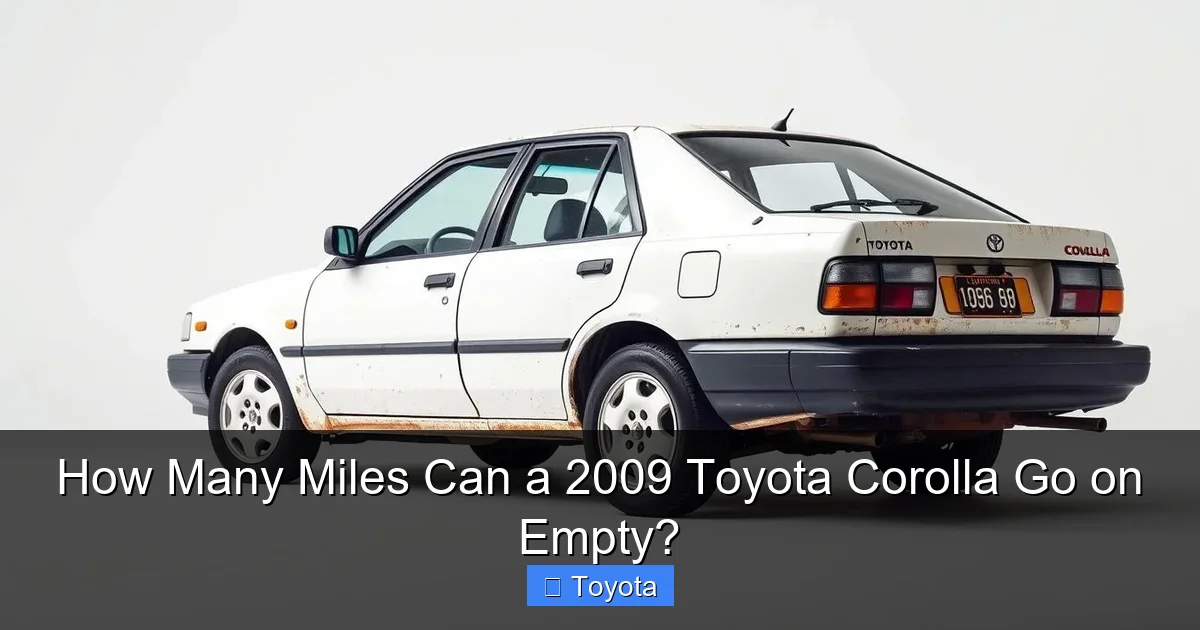
Visual guide about How Many Miles Can a 2009 Toyota Corolla Go on Empty?
Image source: vehiclerides.com
Driving Conditions: Highway vs. City
This is the biggest variable. Steady highway cruising at 60-70 mph is the most fuel-efficient scenario for the Corolla’s 1ZZ-FE or 2ZR-FE engine. You’ll maximize those reserve miles. In contrast, dense city traffic with constant acceleration and braking can reduce fuel economy by 20-30%. That same 1.2 gallons of reserve might only get you 30 miles in the city versus 45 on the highway.
Vehicle Health and Maintenance
A well-maintained Corolla performs as designed. Neglect can shrink your range:
- Clogged Air Filter: Reduces efficiency, burning more fuel.
- Under-inflated Tires: Increase rolling resistance.
- Worn Spark Plugs: Cause incomplete combustion.
- Dirty Fuel Filter: Restricts fuel flow, making the pump work harder and potentially starving the engine earlier.
Regular maintenance keeps your estimated miles accurate.
Fuel Quality, Additives, and Weather
Lower-quality fuel with fewer detergents can lead to carbon buildup, reducing efficiency. Extreme weather plays a role too: cold starts and winter blend fuel slightly decrease mpg. Using the air conditioner can increase fuel consumption by up to 10-15%, directly eating into your reserve. Carrying extra weight (roof racks, heavy cargo) also has a negative effect.
The Hidden Dangers of Driving on Empty
So you made it home on that last drop. No harm, no foul, right? Wrong. Making a habit of running your 2009 Corolla to empty is a silent killer for two critical components.
Fuel Pump Overheating and Premature Failure
This is the #1 reason not to run on empty. Your electric fuel pump is located inside the gas tank. Fuel acts as both a lubricant and a coolant for the pump. When fuel levels are low, the pump can suck in air, causing it to run hot and dry. Over time, this excessive heat and lack of lubrication wears out the pump’s bearings and internal components, leading to failure. A failed fuel pump means your car won’t start, and replacing it often requires dropping the gas tank—a costly $500-$1000 repair. For more on what happens when the fuel system is compromised, see our guide on driving after the gas light comes on in a Toyota Corolla.
Sediment and Debris ingestion
Over years of use, tiny rust particles, dirt, and debris settle at the bottom of your fuel tank. This sediment is normally kept away from the fuel pickup by the weight of the fuel itself. When levels get very low, the pickup starts sucking this gunk into your fuel system. It can clog the fuel filter, dirty the injectors, and in worst cases, damage the pump itself. This leads to rough idling, misfires, and poor performance.
Engine Stalling and Safety Risks
The most immediate danger is the car simply stalling—often at the worst possible moment, like merging onto a highway or in an intersection. This creates a major safety hazard. Additionally, modern fuel-injected engines can suffer damage from sudden fuel starvation, though this is less common than pump wear. The risk of being stranded in an unsafe area is also very real.
Smart Practices: Never Push Your Luck
Knowledge is power, but good habits are everything. Here’s how to manage your 2009 Corolla’s fuel like a pro.
Refuel at the 1/4 Tank Mark
Forget the gas light as your trigger. Make it a habit to fill up when your gauge reads about 1/4 full. This gives you a comfortable buffer, ensures the fuel pump is always submerged and cooled, and allows you to take advantage of potentially better gas prices without rushing. It also gives you time to find a station you like rather than panicking and overpaying at the first one you see.
Use the “Distance to Empty” Display Wisely
Your 2009 Corolla likely has a trip computer that shows “Distance to Empty” (DTE). This is a helpful but flawed tool. It calculates based on recent average mpg, not your current driving conditions. If you’ve been on the highway, it might show 80 miles, but if you then hit city traffic, that number will plummet rapidly. Use DTE as a rough guide, but always pair it with your fuel gauge and your knowledge of the area. Never let DTE drop below 20 miles before seeking fuel.
Emergency Planning and Awareness
If the light does come on, don’t ignore it. Immediately:
- Turn off non-essential electrical loads (AC, heater, stereo).
- Drive calmly, avoiding rapid acceleration.
- Use cruise control on the highway to maintain steady speed.
- Know the location of gas stations along your route.
If you do run out, safely move to the shoulder, turn on hazard lights, and call for roadside assistance. Keeping an emergency kit with water and a phone charger is always smart. For specific steps on refueling safely if you’re stranded, knowing how to open the gas tank on a Toyota Corolla can be useful information, though in an empty situation you’ll likely need a fuel delivery service first.
Conclusion: Your Corolla’s Longevity Depends on It
The 2009 Toyota Corolla is renowned for its longevity and reliability. It’s not uncommon to see these cars surpass 300,000 miles with proper care. A huge part of that reputation is due to simple, consistent maintenance—and fuel management is a critical, often overlooked piece.
So, how many miles can it go on empty? The honest answer is: enough to get you to a gas station if you act immediately, but not enough to make it a habit. Plan for 30-45 miles as your realistic, safe buffer. Treat that gas light not as a challenge, but as your car’s polite reminder to top off the tank. By refueling early, you protect your fuel pump from premature death, keep sediment out of your engine, and eliminate the stress and danger of being stranded. This small habit costs you nothing but a few extra minutes at the pump, and it pays dividends in reliability, repair savings, and peace of mind. Treat your Corolla well, and it will return the favor for hundreds of thousands of miles.
Frequently Asked Questions
How many miles can a 2009 Toyota Corolla go after the gas light comes on?
Under normal driving conditions, most 2009 Corollas can travel between 30 and 50 miles after the gas light illuminates. This depends on your driving style, terrain, and vehicle health. Always treat this as an emergency reserve, not regular range.
Is it damaging to drive with the gas light on?
Yes, occasionally driving with the gas light on is generally fine, but making a habit of it is damaging. It causes the fuel pump to overheat and suck up sediment from the bottom of the tank, leading to premature pump failure and clogged filters. Aim to refuel before the light comes on.
Why is my fuel gauge or “miles to empty” reading inaccurate?
Fuel gauges are estimates based on a float sensor and tank shape. The “Distance to Empty” calculation uses your recent average MPG, so it changes with driving conditions. Hills, fuel sloshing, and sensor wear can also cause minor inaccuracies. Never rely solely on these numbers; use them as guides alongside your gas light.
What should I do if I actually run out of gas?
If your engine stalls, safely move to the shoulder, turn on hazard lights, and stay in the car if you’re on a busy road. Call for roadside assistance or a friend with fuel. Do not try to walk on a highway. Once refueled, drive immediately to a gas station to fill the tank completely.
How often should I refuel to best protect my Corolla?
The best practice is to refuel when your fuel gauge reaches the 1/4 tank mark. This keeps your fuel pump adequately submerged and cooled, prevents sediment ingestion, and gives you a comfortable buffer. It’s the simplest way to extend the life of your fuel system.
Does the 2009 Corolla have a fuel reset button or special procedure after running out?
No, the 2009 Corolla does not have a specific “fuel reset” button. After running out of gas and refueling, you may need to cycle the ignition a few times or crank the engine for 10-15 seconds to allow the fuel pump to prime and build pressure. If it doesn’t start, check the fuel pump fuse. For other Toyota-specific reset procedures, you can refer to guides like how to reset the battery light on a Toyota Corolla, though fuel system resets are typically automatic.