

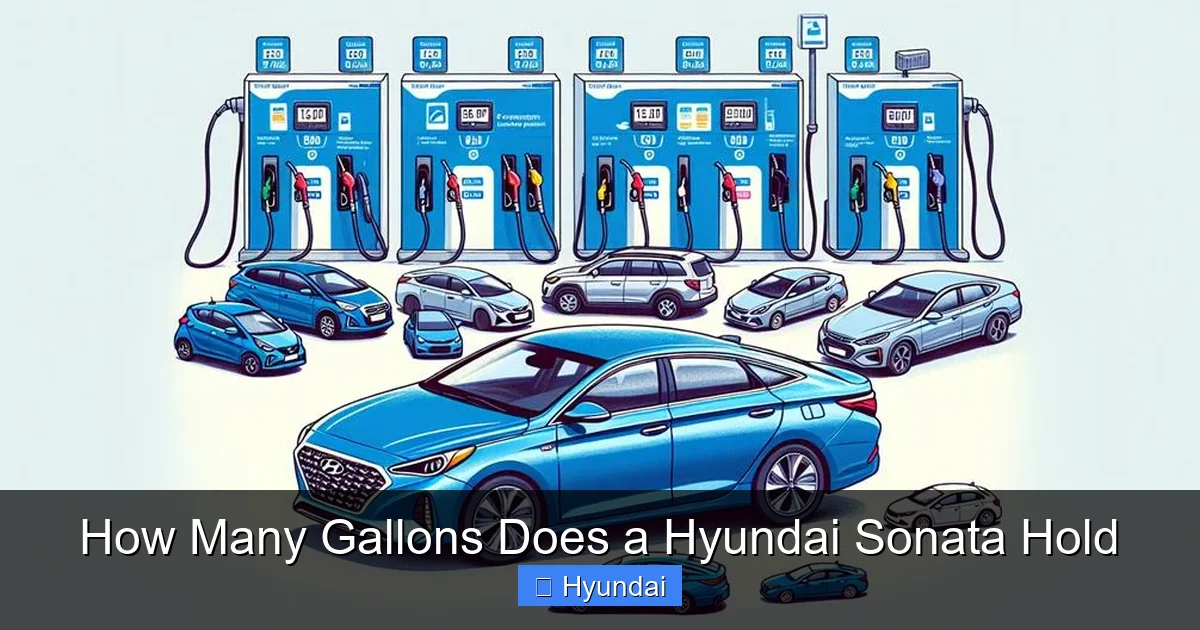
How Many Gallons Does a Hyundai Sonata Hold

Contents
- 1 Key Takeaways
- 2 📑 Table of Contents
- 3 Hyundai Sonata Fuel Tank Capacity: A Detailed Year-by-Year Breakdown
- 4 From Gallons to Miles: Calculating Your Sonata’s Real-World Driving Range
- 5 How the Sonata’s Fuel Tank Stacks Up Against Key Competitors
- 6 Factors That Influence Your Sonata’s Actual Fuel Efficiency (Beyond the Tank)
- 7 Practical Tips to Maximize Every Gallon in Your Hyundai Sonata
- 8 Conclusion: Fueling Your Sonata with Confidence and Efficiency
- 9 Frequently Asked Questions

Diesel Fuel Additive

Car Wireless Charger Mount

Reflective Stickers

Car Fog Light Bulb
The Hyundai Sonata typically holds between 14.5 and 15.2 gallons of fuel, with most recent model years (2020-2024) featuring a 15.2-gallon tank. This generous capacity, paired with its efficient engine options, often delivers a driving range exceeding 500 miles on highways. Understanding your specific model’s exact tank size is crucial for accurate trip planning, fuel budgeting, and comparing it to midsize sedan competitors like the Toyota Camry and Honda Civic.
Ever found yourself wondering, “How many miles can I really go before I need to find a gas station?” If you own or are considering a Hyundai Sonata, that question is more than just casual curiosity—it’s about practicality, budgeting, and peace of mind on the road. The Hyundai Sonata has long been a favorite in the midsize sedan segment, praised for its comfort, features, and especially its fuel efficiency. But efficiency alone doesn’t tell the whole story. The size of its fuel tank is the other critical piece of the puzzle, determining just how far that efficiency can take you between fill-ups.
So, how many gallons does a Hyundai Sonata hold? The answer isn’t a single number for every single Sonata ever made. It has evolved slightly over the years and can even differ between the standard gasoline and hybrid versions. Generally, for the last several model years, you’re looking at a capacity that sits comfortably in the 14.5 to 15.2 gallon range. This article will dive deep into the specifics, breaking down the numbers by generation, explaining why it matters for your daily drive and long trips, and showing you exactly how to leverage that tank size to your advantage. We’ll also compare it directly to key competitors so you can see where the Sonata stands in the real world of fuel and range.
Key Takeaways
- Tank capacity varies by model year: Recent Hyundai Sonatas (2020+) hold 15.2 gallons, while earlier models (2017-2019) typically hold 14.5 gallons.
- Hybrid models may differ: The Sonata Hybrid often has a slightly smaller fuel tank, usually around 12.4 gallons, due to battery packaging.
- Range depends on MPG, not just tank size: A larger tank only extends range if paired with good fuel efficiency; driving habits and maintenance are equally important.
- Sonata’s tank is competitive: Its 15.2-gallon capacity is slightly larger than the Honda Civic (12.1 gal) but smaller than some rivals like the Nissan Altima (15.9 gal).
- Never rely on “Empty” gauge: Modern vehicles have a fuel reserve; you should refuel when the gauge reaches the last quarter to avoid strain on the fuel pump.
- Useful for trip planning: Knowing your tank capacity allows you to calculate precise fuel stops and avoid running low in remote areas.
- Check your owner’s manual: For the most accurate specification, always refer to the manual for your specific model year and trim.
📑 Table of Contents
- Hyundai Sonata Fuel Tank Capacity: A Detailed Year-by-Year Breakdown
- From Gallons to Miles: Calculating Your Sonata’s Real-World Driving Range
- How the Sonata’s Fuel Tank Stacks Up Against Key Competitors
- Factors That Influence Your Sonata’s Actual Fuel Efficiency (Beyond the Tank)
- Practical Tips to Maximize Every Gallon in Your Hyundai Sonata
- Conclusion: Fueling Your Sonata with Confidence and Efficiency
Hyundai Sonata Fuel Tank Capacity: A Detailed Year-by-Year Breakdown
Understanding the exact fuel tank capacity for your specific Hyundai Sonata requires looking at its model year. Hyundai has made subtle adjustments to the tank size across generations, often in response to packaging changes, safety requirements, or to accommodate new technology like hybrid batteries. Let’s break it down.
2017-2019 Model Years (Seventh Generation)
For the seventh-generation Sonata, which spanned from the 2017 model year through a significant refresh in 2018 and into 2019, the standard gasoline-engine models were equipped with a fuel tank that holds 14.5 gallons (approximately 54.8 liters). This was a proven, reliable capacity that offered a solid balance between range and vehicle packaging. The hybrid variant for these years, however, featured a smaller tank. The 2017-2019 Sonata Hybrid held about 12.4 gallons (roughly 47 liters). The reduction was necessary to make space for the hybrid battery pack without compromising trunk space or interior room.
2020-Present Model Years (Eighth Generation)
With the complete redesign for the 2020 model year, Hyundai slightly increased the fuel tank capacity for the standard gasoline models. The eighth-generation Sonata (2020, 2021, 2022, 2023, 2024) now boasts a 15.2-gallon (57.5-liter) tank. This increase of 0.7 gallons might seem small, but in the world of fuel efficiency, it translates directly to more miles between gas stations, especially on long highway cruises where these cars excel. For the current Sonata Hybrid (2020+), the tank capacity remains at 12.4 gallons, consistent with the previous generation’s hybrid packaging constraints.
It’s worth noting that within a single model year, the fuel tank capacity is typically the same across all trims (SE, SEL, Limited, etc.) for the gasoline models. The primary differentiator is the powertrain: gasoline vs. hybrid. Always double-check your vehicle’s door jamb sticker or owner’s manual for the definitive specification for your exact VIN, as there can be rare exceptions for specific markets or fleet vehicles.
From Gallons to Miles: Calculating Your Sonata’s Real-World Driving Range
Knowing the tank’s gallon capacity is only half the equation. The magic number you really care about is range—how many miles you can drive before the low fuel light comes on. Calculating this is straightforward but requires an honest look at your driving style and conditions.
Visual guide about How Many Gallons Does a Hyundai Sonata Hold
Image source: hyundaimaintenance.com
The Basic Formula
The simplest formula is: Fuel Tank Capacity (gallons) x Average MPG = Estimated Range (miles). For example, take a 2023 Hyundai Sonata with a 15.2-gallon tank. The EPA estimates its combined fuel economy at around 33 MPG for the 2.5L engine. Doing the math: 15.2 gallons x 33 MPG = approximately 502 miles on a theoretical full tank. However, this is a best-case, combined estimate.
Highway vs. City Reality
The Sonata shines on the highway. The same 2023 model might achieve 38 MPG or more on steady highway drives. Using that number: 15.2 x 38 = about 578 miles. That’s a serious road-tripping range. Conversely, in heavy stop-and-go city traffic, MPG can drop to the mid-20s. At 25 MPG: 15.2 x 25 = just 380 miles. This variance is why your personal range will fluctuate so much. Pro Tip: Use your Sonata’s trip computer after a fill-up to track your actual miles per gallon for different driving conditions. It’s the most accurate way to personalize your range calculation.
The “Reserve” Factor
Here’s a crucial piece of knowledge: your 15.2-gallon tank is not entirely usable. Automakers build in a fuel reserve—typically 1 to 2 gallons—that the fuel gauge doesn’t account for. This protects the fuel pump (which is cooled by submerged fuel) and gives you a safety buffer. When your Sonata’s gauge shows “E” or the low fuel light illuminates, you likely still have 1-2 gallons left. Therefore, your practical, safe range is based on about 13-14 usable gallons, not the full 15.2. Planning your refueling for when you have a quarter-tank left is the smartest habit to avoid stress and potential damage.
How the Sonata’s Fuel Tank Stacks Up Against Key Competitors
A number in isolation is meaningless. To truly appreciate the Sonata’s fuel tank capacity, we must compare it to its arch-rivals in the competitive midsize sedan arena. How does it fare against the Toyota Camry, Honda Civic, and Nissan Altima?

Visual guide about How Many Gallons Does a Hyundai Sonata Hold
Image source: hyundaimaintenance.com
Head-to-Head with the Toyota Camry
The perennial leader, the Toyota Camry, is a direct competitor. For its latest gasoline models, the Camry holds 15.8 gallons. That’s 0.6 gallons more than the Sonata’s 15.2. On paper, this gives the Camry a slight theoretical range advantage, assuming identical MPG. However, the Sonata often matches or exceeds the Camry’s real-world highway MPG in many driving conditions, which can neutralize or even overcome that tank-size difference. For a detailed look at the Camry’s capacity, you can read our comparison of how many gallons a Toyota Camry holds. In practice, the range difference between a well-driven Sonata and Camry is often negligible for most owners.
Compared to the Honda Civic
The Honda Civic, while often classified as a compact, is frequently cross-shopped with the Sonata due to its spacious interior and excellent efficiency. The current Civic sedan holds about 12.1 gallons. This is a significant 3.1-gallon difference compared to the Sonata. Even if the Civic achieves a higher MPG (which it sometimes does in specific trims), the Sonata’s much larger tank gives it a decisive edge in maximum highway range. A driver doing long road trips will find the Sonata’s fewer required fuel stops a tangible benefit over the Civic. For specifics on the Civic’s tank, see our article on how many gallons of gas a Honda Civic holds.
Measuring Up to the Nissan Altima
The Nissan Altima is another core rival. The current Altima’s fuel tank capacity is 15.9 gallons. This makes it the largest in this direct comparison group, edging out the Sonata by 0.7 gallons. Like the Camry comparison, the Altima’s advantage is marginal and can be offset by the Sonata’s potential for better real-world MPG. The Altima’s extra capacity is most beneficial on ultra-long, uninterrupted highway stretches. You can explore the Altima’s specs further in our guide to how many gallons a Nissan Altima holds.
Within the Hyundai Family: The Sonata vs. Elantra
Even within Hyundai’s own sedan lineup, there’s a clear capacity hierarchy. The smaller, compact Hyundai Elantra has a fuel tank that holds approximately 12.4 gallons. This is identical to the Sonata Hybrid’s tank size and makes perfect sense given the Elantra’s smaller footprint. The Sonata, as the midsize offering, logically provides more fuel capacity for longer journeys. This step-up from Elantra to Sonata is a key selling point for families and commuters who prioritize fewer stops. For a full breakdown, check out how much gas a Hyundai Elantra holds.
Factors That Influence Your Sonata’s Actual Fuel Efficiency (Beyond the Tank)
You could have the largest fuel tank in the world, but if your car is drinking gasoline like a thirsty giant, you’ll still be visiting the pump constantly. The tank capacity sets the upper limit of your range, but fuel efficiency (MPG) is the multiplier that makes it meaningful. Many factors affect how many miles you actually get per gallon from your Sonata.

Visual guide about How Many Gallons Does a Hyundai Sonata Hold
Image source: hyundaimaintenance.com
Driving Style and Environment
This is the biggest variable. Aggressive acceleration, hard braking, and speeding all drastically reduce MPG. The Sonata’s efficient engine is designed to reward smooth, steady driving. Highway cruising at 65-70 mph will yield its best numbers. City traffic with constant stops is its kryptonite. Additionally, extreme temperatures play a role. Using the heater or air conditioning puts extra load on the engine. In very cold weather, the engine takes longer to reach optimal operating temperature, burning more fuel initially. Hilly terrain also increases consumption compared to flat roads.
Vehicle Maintenance and Health
A well-maintained Sonata will deliver its rated MPG. Key maintenance items include:
- Tire Pressure: Under-inflated tires increase rolling resistance, hurting MPG by 3% or more. Check monthly.
- Motor Oil: Using the correct viscosity oil as specified in your owner’s manual is critical. Thicker oil can increase engine friction.
- Air Filter: A clogged air filter restricts airflow to the engine, forcing it to work harder and burn more fuel.
- Spark Plugs: Worn plugs cause misfires and poor combustion, wasting fuel.
A tune-up or addressing a check engine light (like a faulty oxygen sensor) can restore lost efficiency.
Vehicle Load and Aerodynamics
Extra weight means more energy to move. A fully loaded Sonata with passengers and cargo will get lower MPG than a solo driver. Similarly, roof racks, even empty, create significant aerodynamic drag, especially at highway speeds, reducing efficiency. Remove them when not in use. Keeping your vehicle clean and waxed can also slightly improve aerodynamics.
Practical Tips to Maximize Every Gallon in Your Hyundai Sonata
Armed with the knowledge of your tank size and the factors affecting efficiency, you can adopt simple habits to stretch every drop of fuel. These practices complement the Sonata’s inherent efficiency and can add meaningful miles to your range.
Master the Art of Highway Cruising
The Sonata is a highway star. To capitalize on this:
- Use Cruise Control: On flat, open highways, maintaining a constant speed is far more efficient than manual throttle adjustments.
- Observe Speed Limits: MPG typically peaks around 50-60 mph and drops off significantly above 70 mph due to aerodynamic drag. Driving 65 vs 75 can save a surprising amount of fuel.
- Plan Trips Efficiently: Use navigation apps that suggest fuel-efficient routes, avoiding unnecessary idling in traffic or excessive detours.
Smart City Driving Techniques
In stop-and-go traffic:
- Look Ahead and Coast: Anticipate traffic lights and stop signs. Ease off the accelerator early to coast, reducing the need for hard braking.
- Minimize Idling: If you’re stopped for more than 60 seconds (except in traffic), turning the engine off saves fuel. Modern Sonatas have start-stop systems that do this automatically.
- Combine Errands: Multiple short trips with a cold engine are inefficient. Group your chores into one longer, warmer-engine trip.
Routine Care is Non-Negotiable
Stick to your maintenance schedule without exception. A clean fuel system, properly functioning emissions controls (like oxygen sensors), and correctly aligned wheels all contribute to optimal MPG. Consider using Hyundai-recommended fuel, usually regular unleaded (87 octane) for most Sonata models, as higher octane offers no benefit unless specified for your specific engine.
Conclusion: Fueling Your Sonata with Confidence and Efficiency
So, how many gallons does a Hyundai Sonata hold? For the vast majority of drivers looking at model years from 2020 onward, the answer is a solid and practical 15.2 gallons. For the previous generation (2017-2019), it’s 14.5 gallons. This capacity, when married to the Sonata’s impressive EPA ratings—often in the 30+ MPG range—results in a real-world driving range that can comfortably exceed 500 miles on a single tank under optimal conditions. This places it squarely in the leaderboard for its class, offering a blend of efficiency and range that makes long road trips and daily commutes equally manageable.
Remember, the number on the pump is just the starting point. Your actual range is a dynamic figure shaped by your driving habits, your car’s health, and the environment. By understanding your specific tank capacity, calculating your personal MPG, and adopting fuel-smart driving techniques, you can extract every possible mile from each fill-up. Whether you’re comparing it to the larger-tanked Toyota Camry, the more efficient but smaller-tanked Honda Civic, or even Hyundai’s own Elantra, the Sonata holds its own as a practical, long-legged sedan built for the modern driver who values both comfort and cost-effective ownership. The next time you pull up to the pump, you’ll know exactly what that “15.2” means for your journey ahead.
Frequently Asked Questions
What is the fuel tank capacity of a 2023 Hyundai Sonata?
The 2023 Hyundai Sonata with the standard 2.5L gasoline engine holds 15.2 gallons. The Sonata Hybrid for the same year has a smaller tank, holding 12.4 gallons.
How does the Sonata’s fuel tank size compare to the Toyota Camry and Honda Civic?
The Sonata’s 15.2-gallon tank is smaller than the Toyota Camry’s 15.8 gallons but significantly larger than the Honda Civic’s 12.1 gallons. This gives the Sonata a potential range advantage over the Civic, while being very close to the Camry.
Do all Hyundai Sonata model years have the same tank size?
No. Model years 2017-2019 have a 14.5-gallon tank (gasoline models), while 2020 and newer models increased to 15.2 gallons. Hybrid models across these years consistently have a 12.4-gallon tank.
How far can a Hyundai Sonata go on a full tank of gas?
With a 15.2-gallon tank and an EPA combined rating of ~33 MPG, the theoretical range is about 500 miles. On pure highway driving (38+ MPG), it can approach 580 miles. In heavy city driving (25 MPG), it may be as low as 380 miles. Always plan to refuel with 1-2 gallons remaining.
Why is my Hyundai Sonata’s actual fuel range different from the EPA estimates?
EPA estimates are based on controlled lab conditions. Your real-world MPG depends heavily on driving style, terrain, weather, vehicle load, and maintenance. Aggressive driving, cold weather, and under-inflated tires can all reduce your actual range significantly below the sticker estimate.
Is it bad to let my Sonata’s fuel gauge go all the way to ‘E’?
Yes, it’s not recommended. While there is a reserve, running the tank completely empty can overheat and damage the fuel pump, which is cooled by gasoline. It’s best practice to refuel when your gauge reaches the last quarter to maintain fuel pump health and avoid being stranded.


