How Many Batteries Does a Jeep Compass Have?

Contents
- 1 Key Takeaways
- 2 📑 Table of Contents
- 3 Understanding Your Jeep Compass’s Electrical Heart
- 4 The Standard Single-Battery Setup: The Most Common Answer
- 5 The Start-Stop System and Its Auxiliary Battery
- 6 The Plug-in Hybrid Jeep Compass 4xe: A Three-Battery Reality
- 7 How to Identify Your Specific Battery Configuration
- 8 Battery Maintenance, Replacement, and Common Pitfalls
- 9 Practical Tips and Troubleshooting Scenarios
- 10 Conclusion
- 11 Frequently Asked Questions

Trunk Organizer

Car Window Tint Film

Car LED Headlight Bulb

Battery Terminal Cleaner
Most Jeep Compass models have a single 12-volt battery located in the engine bay. However, certain trim levels with automatic start-stop systems or hybrid powertrains may include an auxiliary or high-voltage battery pack. The exact configuration depends on your specific model year and engine type. Always consult your owner’s manual for definitive information about your vehicle’s battery setup.
Key Takeaways
- Understanding How Many Batteries Does a Jeep Compass Have?: Provides essential knowledge
📑 Table of Contents
- Understanding Your Jeep Compass’s Electrical Heart
- The Standard Single-Battery Setup: The Most Common Answer
- The Start-Stop System and Its Auxiliary Battery
- The Plug-in Hybrid Jeep Compass 4xe: A Three-Battery Reality
- How to Identify Your Specific Battery Configuration
- Battery Maintenance, Replacement, and Common Pitfalls
- Practical Tips and Troubleshooting Scenarios
- Conclusion
Understanding Your Jeep Compass’s Electrical Heart
So, you’re standing in your driveway, hood popped, staring at the engine bay of your trusty Jeep Compass. A simple question pops into your head: “How many batteries does this thing actually have?” It’s a fair question! While most cars operate on a single battery, modern vehicles, especially those packed with tech, can have more complex electrical systems. The answer for your Compass isn’t always a straightforward “one.” It depends heavily on the model year, engine type, and optional features you have. Let’s pop the hood and dig into the details, clearing up the confusion once and for all.
For the vast majority of Jeep Compass owners, the answer is one. A single, robust 12-volt battery sits under the hood, working tirelessly to start your engine and power everything from your headlights to your touchscreen. This is the classic setup that has powered vehicles for decades. However, as automotive technology evolved to meet stricter fuel economy and emissions standards, manufacturers like Jeep introduced systems that put a greater strain on the standard battery. This is where the story gets interesting and the answer to “how many” can change.
We’re going to break this down into clear categories. We’ll start with the standard single-battery setup you’re most likely familiar with. Then, we’ll explore the scenarios where a second battery comes into play—specifically with start-stop technology. Finally, we’ll tackle the unique case of the plug-in hybrid Jeep Compass 4xe, which introduces a completely different type of battery into the mix. By the end, you’ll know exactly what’s powering your specific Compass, where to find it, and what it means for maintenance and replacement. Think of this as your ultimate owner’s guide to the electrical system of your SUV.
The Standard Single-Battery Setup: The Most Common Answer
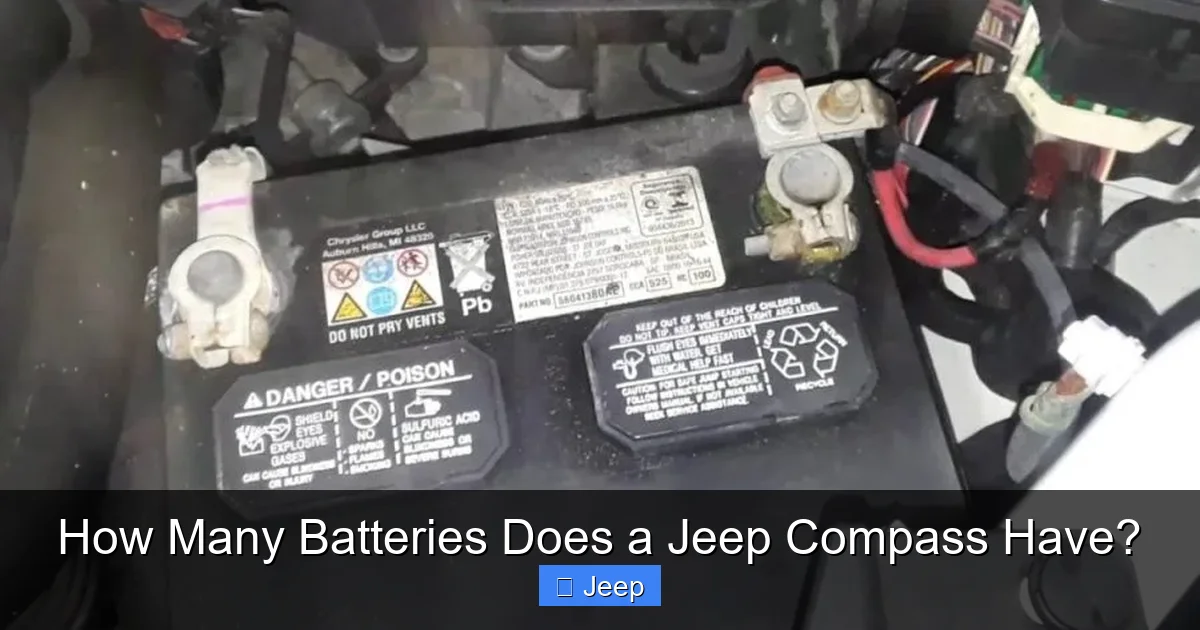
If you own a Jeep Compass with a gasoline engine (like the 2.4L Tigershark or the turbocharged 2.0L) and it doesn’t have the automatic engine start-stop feature, you almost certainly have one battery. This is the baseline, no-frills configuration that has been the norm for years. This single battery is a 12-volt lead-acid or, in more recent models, an absorbed glass mat (AGM) battery. Its job is huge: it provides the massive burst of power needed to crank the engine over, and then it stabilizes the voltage for the entire vehicle’s electrical system once the engine is running and the alternator takes over.

Visual guide about How Many Batteries Does a Jeep Compass Have?
Image source: koala.sh
Location and Physical Characteristics
Finding this battery is usually the easy part. In almost all Jeep Compass models, regardless of generation, the primary 12V battery is located in the engine bay. You’ll find it tucked away in a corner, often on the driver’s side (left side for US models), secured in a plastic tray. It’s a rectangular box, typically about 10 inches long, 7 inches wide, and 8-9 inches tall. The positive (+) terminal is usually red and marked, while the negative (-) terminal is black. Look for the large, heavy-duty cables connected to it—one going to the starter motor and another to the engine block or chassis for grounding.
The exact specifications—like its cold cranking amps (CCA) and reserve capacity (RC)—are printed on a label on the top of the battery. These numbers are critical when buying a replacement. For example, a 2022 Jeep Compass with a 2.4L engine might call for a battery with around 600 CCA and 120 RC, while a model with the 2.0L turbo might require slightly different specs. Always match the manufacturer’s recommendation. You can find this information in your owner’s manual or on the old battery’s label. If you’re curious about how this component contributes to your vehicle’s overall mass, checking resources on how much a Jeep Compass weighs can provide interesting context, as the battery adds a solid 30-50 pounds to that total.
Battery Type Evolution: From Flooded to AGM
Older Jeep Compass models (pre-2017 or so) typically used a traditional flooded lead-acid battery. These have liquid electrolyte and require occasional checking and topping up with distilled water. Newer models, especially those with more electrical demands (even without start-stop), have moved to AGM batteries. AGM batteries are sealed, maintenance-free, and better at handling deep discharges and vibrations. They also charge faster and have longer lifespans. They are more expensive but are increasingly the standard. A quick visual check can often tell you which type you have: flooded batteries usually have filler caps, while AGM batteries are completely sealed with no access ports.
Understanding your battery type is the first step in proper care. AGM batteries have specific charging requirements; using a standard charger meant for flooded batteries can damage them. If you ever need to charge your Compass’s battery, make sure to use a charger with an AGM setting or a smart charger that automatically adjusts. This small detail can significantly extend your battery’s life and prevent premature failure.
The Start-Stop System and Its Auxiliary Battery
Here’s where the “one battery” answer starts to change. To improve fuel economy and reduce emissions, many modern Jeep Compass models—especially those from the 2017 model year onward and in certain markets—are equipped with an automatic engine start-stop system. This clever tech shuts off the engine when you come to a complete stop, like at a red light, and automatically restarts it when you take your foot off the brake. It’s great for saving gas in traffic, but it creates a problem: the constant stopping and starting puts a huge drain on the standard 12V battery because it has to power all the accessories (radio, lights, HVAC) even when the engine is off.
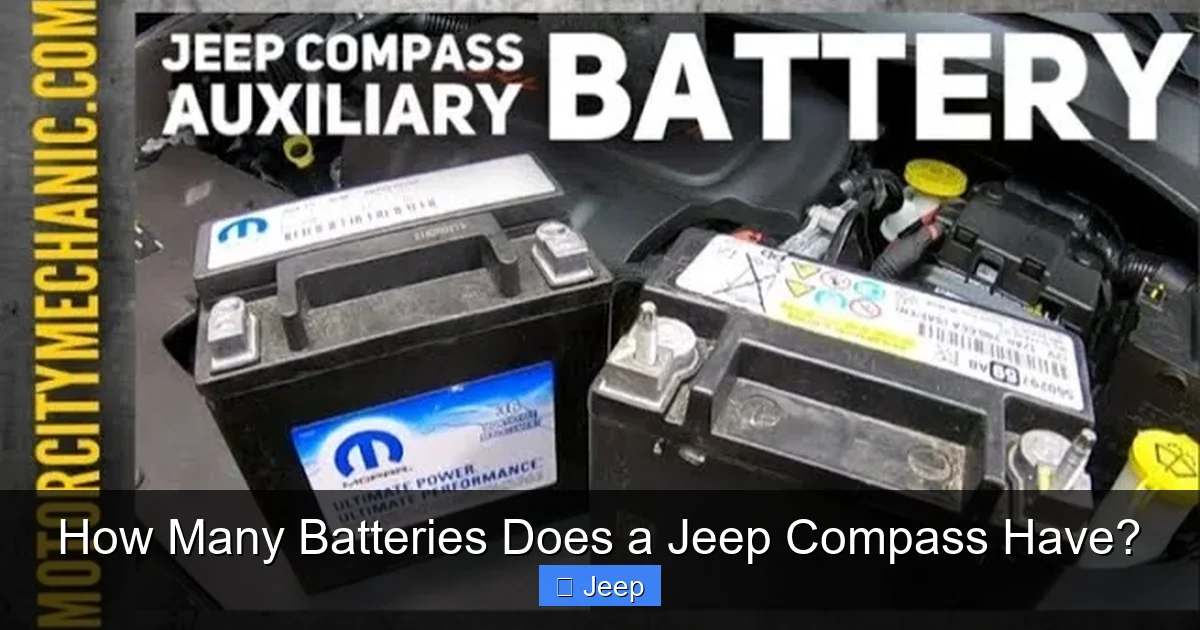
Visual guide about How Many Batteries Does a Jeep Compass Have?
Image source: i.ytimg.com
Why a Second Battery is Needed
To handle this extra load without draining the primary battery to the point where it can’t restart the engine, engineers add a second, smaller battery. This is often called an auxiliary battery or a start-stop support battery. It’s usually a smaller AGM battery, sometimes mounted in a different location—like under the trunk floor, in the rear wheel well, or even near the primary battery in the engine bay. Its sole job is to maintain power to the vehicle’s essential electronics and infotainment system when the engine is off, allowing the primary battery to stay charged and ready to crank the engine.
If your Compass has a start-stop system, you’ll likely see a dashboard indicator (a letter “A” with an arrow in a circle) that illuminates when the system is active. You might also notice the engine shutting off more frequently during your commute. To confirm you have the auxiliary battery, the best place to look is your owner’s manual. It will have a dedicated section explaining the start-stop system and often includes a diagram showing the location of both batteries. A visual inspection might reveal two separate battery units. The auxiliary battery is crucial; if it fails, your start-stop system will disable itself, and you might experience electrical glitches or difficulty with the primary battery holding a charge.
Diagnosing Issues in a Dual-Battery System
Having two batteries complicates diagnostics slightly. If your Compass won’t start, it’s not always as simple as “the battery is dead.” It could be the primary battery, the auxiliary battery, or even the system that manages them. A common scenario is a failed auxiliary battery. Since it’s designed to take the load during stop-start cycles, it can wear out faster than the primary battery. When it fails, the vehicle’s computer may disable the start-stop function to prevent a total electrical shutdown, but it might also put extra strain on the primary battery, leading to its premature failure. Always check both batteries if you have a start-stop equipped model. The electrical system in these vehicles is more complex, which is why some owners find it helpful to understand related components, such as those discussed in articles about oxygen sensors, which also rely on stable voltage from the battery system.
The Plug-in Hybrid Jeep Compass 4xe: A Three-Battery Reality
Now we enter the most complex territory: the Jeep Compass 4xe. This is the plug-in hybrid electric vehicle (PHEV) version of the Compass. It combines a gasoline engine with an electric motor powered by a high-voltage battery pack, offering significant electric-only range. In this configuration, your vehicle actually has three batteries, but two of them are part of the hybrid system. Let’s clarify the count, as it can be confusing.

Visual guide about How Many Batteries Does a Jeep Compass Have?
Image source: interstatebatteries.com
The Three-Battery Breakdown
First, there is the standard 12V battery. Yes, even the 4xe has a conventional 12-volt battery. Its job is identical to the one in a standard Compass: it powers all the low-voltage accessories, the starter motor (for the gasoline engine), and the vehicle’s computers when the high-voltage system is off. It’s usually located in the engine bay.
Second, there is the high-voltage traction battery pack. This is the heart of the hybrid system. It’s a large, lithium-ion battery pack typically located under the floor of the vehicle, often in the center tunnel or beneath the rear seats. This battery stores the energy you get from plugging in and provides power to the electric drive motor. It operates at several hundred volts (usually around 300-400V) and is absolutely not serviceable or replaceable by the average owner or mechanic. It’s managed by a sophisticated battery management system (BMS) and is designed to last the life of the vehicle.
Third, some hybrid systems, including certain 4xe models, may incorporate a smaller, third 12V battery specifically for the hybrid control modules or as a backup. However, this is less common and often integrated. For the Jeep Compass 4xe, the standard count is two distinct batteries: one 12V and one high-voltage pack. But when people ask “how many batteries,” they are usually referring to the accessible, serviceable 12V type. The high-voltage pack is in a different category entirely. Its capacity is measured in kilowatt-hours (kWh), not amp-hours, and it requires specialized training and equipment for any service.
Implications for Owners and Service
If you own a Compass 4xe, your maintenance routine regarding batteries is different. The 12V battery still needs to be checked and replaced like in any car. However, a dead 12V battery in a hybrid can be particularly problematic because it may prevent the vehicle from even turning on the systems needed to charge the high-voltage battery or start the gasoline engine. You might find yourself with a car that won’t move at all, even if the high-voltage battery is fully charged. Always ensure your 12V battery is in good health. Regarding the high-voltage pack, there’s little you can do besides ensuring it’s charged correctly and avoiding physical damage. Its longevity is generally excellent, with warranties often covering it for 8 years/100,000 miles. For those interested in the technical specs of high-capacity batteries, exploring articles on amp-hour ratings can provide a foundation, though hybrid traction batteries are a different beast altogether.
How to Identify Your Specific Battery Configuration
So, you’ve read the categories, but you’re still not 100% sure what’s under your own hood. Don’t worry; identifying your Jeep Compass’s battery setup is a straightforward process. You don’t need to be a mechanic. Here are the most reliable methods, in order of preference.
Consult Your Owner’s Manual: The Final Authority
This is your number one resource. The owner’s manual has a dedicated section for “Battery” or “Specifications.” It will list the battery type, group size (like H8 or 49), cold cranking amps (CCA), and reserve capacity (RC). More importantly, it will often include a diagram of the engine compartment or underbody, clearly labeling the battery location(s). If your vehicle has a start-stop system or is a hybrid, the manual will explain it in detail, including the location of any auxiliary batteries. It might even have a separate section titled “Start-Stop System” or “Hybrid System.” Take the time to flip through the index; you’ll find the answers there.
Perform a Visual Inspection
Open the hood and look for the large black battery box. This is your primary 12V battery. Now, ask yourself: is there a second, smaller battery nearby? Check the corners of the engine bay, the firewall behind the battery, and even the fender wells. If you have a hybrid, you won’t see the high-voltage pack from the engine bay—it’s under the car. But you might see additional 12V batteries or large, sealed electrical modules. Look for labels. A battery will have its specs printed on top. If you see two distinct units with terminals, you have a dual-12V system (likely start-stop).
Look for Telltale Signs of Start-Stop
Start your Compass and come to a stop. Does the engine shut off automatically? Does a dashboard light (often an “A” in a circle) illuminate? If yes, you have the start-stop system, which almost certainly means you have an auxiliary battery to support it. Also, check your vehicle’s settings menu on the infotainment screen. There is usually an option to turn the start-stop system on or off. If that option exists, you have the system and the associated extra battery.
Check the Vehicle Identification Number (VIN)
Your VIN is a goldmine of information. You can decode it using online VIN decoders or by providing it to a Jeep dealership parts department. The VIN will specify the exact engine, transmission, and installed packages. It will confirm if your vehicle was built with the start-stop system or is a 4xe hybrid. This is the most definitive way to know from a code what your vehicle originally came with.
Once you’ve identified your setup, you’ll be better equipped for any battery-related task, from jump-starting to replacement. Remember, the weight of your vehicle, including all its batteries, plays a role in its performance and efficiency. For a deeper dive into that aspect, you can always look up detailed weight specifications for your specific model year and trim.
Battery Maintenance, Replacement, and Common Pitfalls
Knowing how many batteries you have is only half the battle. Keeping them healthy is what ensures your Jeep Compass starts reliably and all its electrical systems function properly. Maintenance needs differ slightly between a single-battery setup and a dual-battery system, but the core principles are the same.
Routine Maintenance for All Batteries
Whether you have one battery or three, visual inspection is key. Every few months, pop the hood and look at the primary 12V battery (and auxiliary if you have one). Check for:
- Corrosion: A white, blue, or green powdery substance on the terminals. This is caused by electrolyte leakage and can impede electrical flow. Clean it with a mixture of baking soda and water and a wire brush. Always disconnect the negative terminal first for safety.
- Physical Damage: Look for cracks in the battery case, bulging sides, or leaks. Any of these mean the battery is unsafe and must be replaced immediately.
- Connector Tightness: Ensure the terminal clamps are snug. A loose connection can cause intermittent starting problems.
For traditional flooded batteries (if yours has filler caps), check the electrolyte level every few months and top up with distilled water if it’s low. Never overfill. For AGM batteries, there are no serviceable fluids—they are sealed and maintenance-free in that regard. However, they still need to be kept clean and secure.
When and How to Replace
A typical car battery lasts 3-5 years. Signs of failure include slow engine cranking, dimming headlights, the check engine light coming on, or needing frequent jump-starts. For a single-battery system, replacement is simple: remove the old battery (always disconnect negative first!) and install the new one in the same orientation, connecting the positive terminal first. It’s a great DIY project for the handy owner.
For a dual-battery system (start-stop), the process is similar, but you must identify which battery is faulty. Sometimes, a failure of the auxiliary battery will trigger a warning message. Replacing it is just as straightforward, but you must ensure the new auxiliary battery is the correct type (usually a smaller AGM) and that it’s properly paired with the primary battery. Some vehicles require a registration or coding process after replacement to tell the car’s computer about the new battery’s specifications (like its capacity and type). This is common on European makes but is becoming more frequent on American vehicles too. If your Compass requires this, you’ll need a scan tool or to visit a dealer/shop.
For the 4xe, the 12V battery replacement is standard. Never, under any circumstances, attempt to service, disconnect, or replace the high-voltage traction battery yourself. It contains potentially lethal voltages and must only be handled by technicians with specific high-voltage safety training and equipment. Tampering with it can cause severe injury, death, or catastrophic damage to the vehicle’s hybrid system.
Choosing the Right Replacement
When buying a new battery, don’t just grab the cheapest one. You need the correct group size (physical dimensions), the right terminal configuration (post type and location), and the recommended CCA and RC ratings. The easiest way is to look at your old battery’s label or consult your manual. You can also use the battery finder tool at any major auto parts store—just input your vehicle’s year, make, model, and engine. Stick to reputable brands. For AGM batteries, ensure the replacement is also AGM. Mixing types can lead to poor performance and early failure. Finally, consider the warranty. A good battery will come with a free-replacement warranty for several years.
Practical Tips and Troubleshooting Scenarios
Let’s bring this all together with some real-world advice. Knowing the theory is great, but what do you do when you’re actually faced with a battery problem?
Jump-Starting a Jeep Compass
If your Compass won’t start, a jump-start is often the first step. For a single-battery system, it’s simple: connect the red clamp to the positive (+) terminal, the black clamp to a bare metal ground point on the engine block or chassis (away from the battery), start the donor car, then try starting your Compass. For a dual-battery system (start-stop), you still connect to the primary 12V battery’s terminals. The auxiliary battery is managed by the vehicle’s systems and doesn’t need direct connection. However, if the primary battery is severely discharged, the car might not even allow the jump-start process to engage the starter. In that case, you might need to let the donor car charge the primary battery for 5-10 minutes before attempting to start. Always follow the exact procedure in your owner’s manual, as some modern vehicles have specific jump-start terminals in the engine bay.
What to Do If Your Car Won’t Start After a Battery Replacement
You just installed a new, correct-spec battery, but your Compass still acts dead—no lights, no crank. First, double-check that the terminals are clean and tight, and that the connections are correct (positive to positive). If that’s all good, the issue might not be the battery itself. It could be a faulty main fuse, a problem with the battery cable connections to the chassis/engine block (a bad ground), or a failed starter motor. Since the battery is new, the problem lies elsewhere in the starting/charging circuit. This is when it’s time to call for professional help. Diagnosing a “no-start” can involve checking voltage at the starter solenoid, which is more advanced.
Dealing with Parasitic Drain
Parasitic drain is when something in your vehicle draws power from the battery even when the car is off and parked. A small, normal drain (for clock, computer memory) is expected. But a large drain can kill a battery overnight. This is a common issue in modern vehicles with many always-on modules. If your battery dies repeatedly and you’ve ruled out a bad battery, a parasitic drain test is needed. This involves using an ammeter to measure current draw with everything off. Finding the culprit can be tricky and often requires a professional. Common causes include aftermarket accessories (stereos, alarms), faulty modules, or even a trunk or hood light that won’t turn off. For Jeep owners who add electrical accessories, this is a known risk.
By understanding your specific battery configuration, you’re already ahead of the game. You’ll make smarter decisions about maintenance, avoid costly mistakes during replacement, and know when a problem is simple and when it needs a pro. Your Jeep Compass’s battery system is its electrical foundation—treat it well, and it will start your adventures for years to come.
Conclusion
So, to circle back to the original question: “How many batteries does a Jeep Compass have?” The most common and simple answer is one. That’s what you’ll find under the hood of the vast majority of gasoline-powered Compass models on the road today. It’s a single, 12-volt unit responsible for all the heavy lifting of starting the engine and powering the basics. However, as we’ve explored, the rise of efficiency-focused technology like automatic start-stop systems introduced a second, smaller auxiliary battery in many newer models to handle the increased electrical demand. And for the environmentally conscious driver who opted for the plug-in hybrid Jeep Compass 4xe, the answer becomes more complex, involving the standard 12V battery plus a large, high-voltage traction battery pack.
The key takeaway is this: your specific model year, engine type, and optional packages determine your battery count. Never assume. The surefire way to know is to consult your owner’s manual or perform a simple visual inspection. Knowing whether you have one battery or two (or three, in the hybrid sense) is crucial for proper maintenance, accurate troubleshooting, and correct replacement. It saves you time, money, and the frustration of buying the wrong part or misdiagnosing a problem. Your vehicle’s electrical system is a network, and the battery (or batteries) is its heart. Keep it healthy, choose the right replacements, and your Jeep Compass will remain ready for any journey.
Frequently Asked Questions
Does a standard Jeep Compass have one or two batteries?
Most standard gasoline Jeep Compass models have one 12-volt battery. However, models equipped with the automatic start-stop system typically have a second, smaller auxiliary battery to support the increased electrical load.
Where is the battery located in a Jeep Compass?
The primary 12-volt battery is almost always located in the engine compartment, usually on the driver’s side corner, secured in a plastic tray. If your vehicle has an auxiliary battery for the start-stop system, it may be located in the trunk, under the rear floor, or in a different compartment of the engine bay.
What type of battery does a Jeep Compass use?
Newer Jeep Compass models typically use a maintenance-free absorbed glass mat (AGM) battery. Older models may use a traditional flooded lead-acid battery with filler caps. The exact type and specifications (like group size and cold cranking amps) are listed in your owner’s manual and on the battery label itself.
How long does a Jeep Compass battery last?
On average, a car battery lasts 3 to 5 years. Factors like extreme temperatures, short trips that don’t fully recharge the battery, and high electrical accessory use can shorten its lifespan. Batteries in start-stop systems may wear out slightly faster due to the increased cycling.
Can I jump-start a Jeep Compass with a start-stop system?
Yes, you jump-start it the same way as a standard vehicle: connect the red clamp to the positive (+) terminal of the primary 12V battery and the black clamp to a solid metal ground point on the engine or chassis. Always refer to your owner’s manual for the exact procedure and any specific warnings.
Does the Jeep Compass 4xe have a regular car battery?
Yes, the Jeep Compass 4xe plug-in hybrid has a standard 12-volt battery in the engine bay, just like a regular gasoline car. It powers all the normal accessories and the starter for the gasoline engine. In addition, it has a separate, large high-voltage lithium-ion battery pack under the vehicle that powers the electric motor.