
How Long Does It Take to Charge a Jeep 4xe?

The time it takes to charge a Jeep 4xe depends entirely on the charging method you use. Using a standard 120V outlet (Level 1), a full charge can take 10-12 hours. With a 240V home charger (Level 2), that drops to about 2-3 hours for a full charge. For the fastest possible top-up, DC Fast Charging (Level 3) can add significant range in under 30 minutes. Your specific model year, battery state, and even outside temperature will also influence these times.
Key Takeaways
- Charging method is the #1 factor: Level 1 (120V) is slowest, Level 2 (240V) is ideal for home, and Level 3 (DC Fast) is fastest for public top-ups.
- Model matters: The Grand Cherokee 4xe has a larger battery than the Wrangler 4xe, so it takes slightly longer to charge on the same equipment.
- Temperature impacts speed: Cold weather can increase charging time by 20-30% as the battery management system works to warm the pack.
- You rarely need a full charge: For daily driving, charging to 80% is faster and better for long-term battery health than charging to 100%.
- Home charging is cheapest: While Level 2 charging at home is faster than Level 1, it’s also far more cost-effective than frequent public DC Fast Charging.
- DC Fast Charging is for road trips: Use Level 3 charging to add 100+ miles of range in about 30 minutes, but it’s not meant for daily charging.
- Your charger’s power rating is key: Not all Level 2 chargers are equal; a 7.2kW charger is nearly twice as fast as a 3.6kW unit.
📑 Table of Contents
- So, You’re Thinking About a Jeep 4xe?
- The Three Levels of Charging: Your Hose Options
- Real-World Times for Your Specific 4xe Model
- What Else Affects Your Charging Time? (It’s Not Just the Plug)
- Smart Charging Strategies: Getting the Most From Your 4xe
- The Cost-Time Tradeoff: Electricity vs. Convenience
- Conclusion: Charging Your 4xe is Easier Than You Think
So, You’re Thinking About a Jeep 4xe?
You’ve probably seen them on the road—the quiet, capable Jeep Wrangler 4xe or the luxurious yet efficient Grand Cherokee 4xe. They offer the best of both worlds: legendary Jeep capability with a plug-in hybrid twist. But if you’re considering making one your own, one big question likely tops your list: “How long does it take to charge a Jeep 4xe?” It’s a practical question that gets to the heart of plug-in hybrid ownership.
The answer isn’t a single number. It’s a spectrum. Think of it like filling a bathtub. The size of the tub (the battery) and the size of the hose (your charger) determine how long it takes. A trickle from a tiny hose (a standard wall outlet) will take all night. A powerful, dedicated hose (a home 240V charger) will fill it in a couple of hours. And a firehose at a fire station (a public DC Fast Charger) can get you enough “water” to get going again in under 30 minutes. Let’s break down exactly what that means for your Jeep 4xe.
The Three Levels of Charging: Your Hose Options
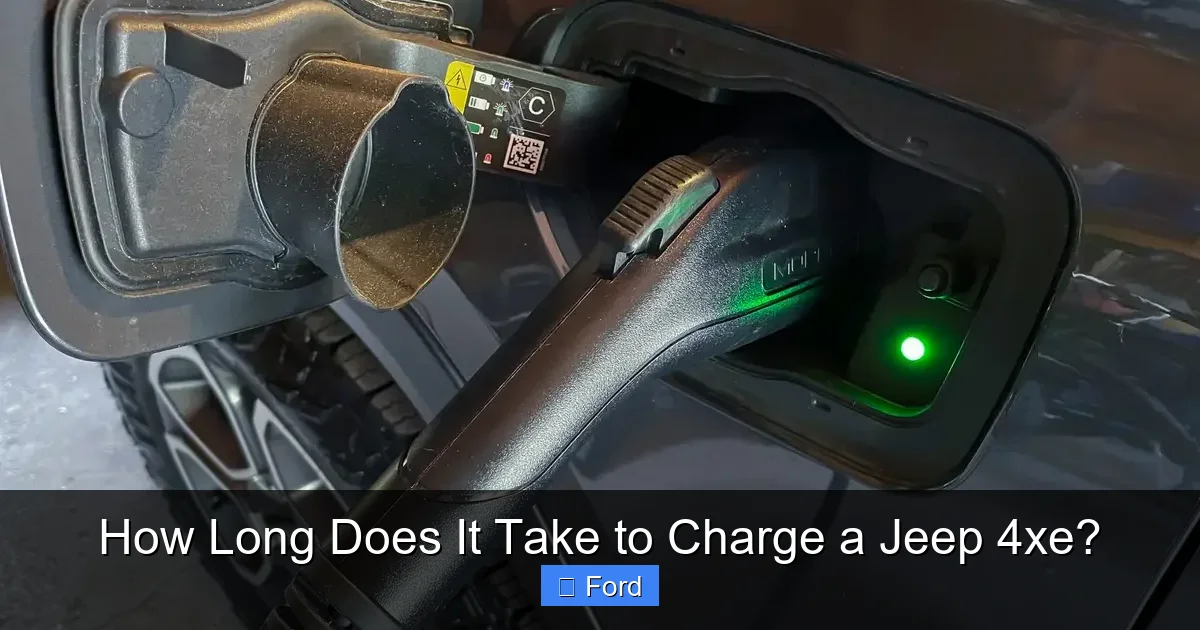
Charging infrastructure is categorized into three levels. Understanding these is crucial to knowing your charging time. The “4xe” system uses a standard J1772 plug for AC charging (Levels 1 and 2) and a CCS port for DC Fast Charging (Level 3).

Visual guide about How Long Does It Take to Charge a Jeep 4xe?
Image source: jeepxpert.com
Level 1: The Trusty Wall Outlet (120V)
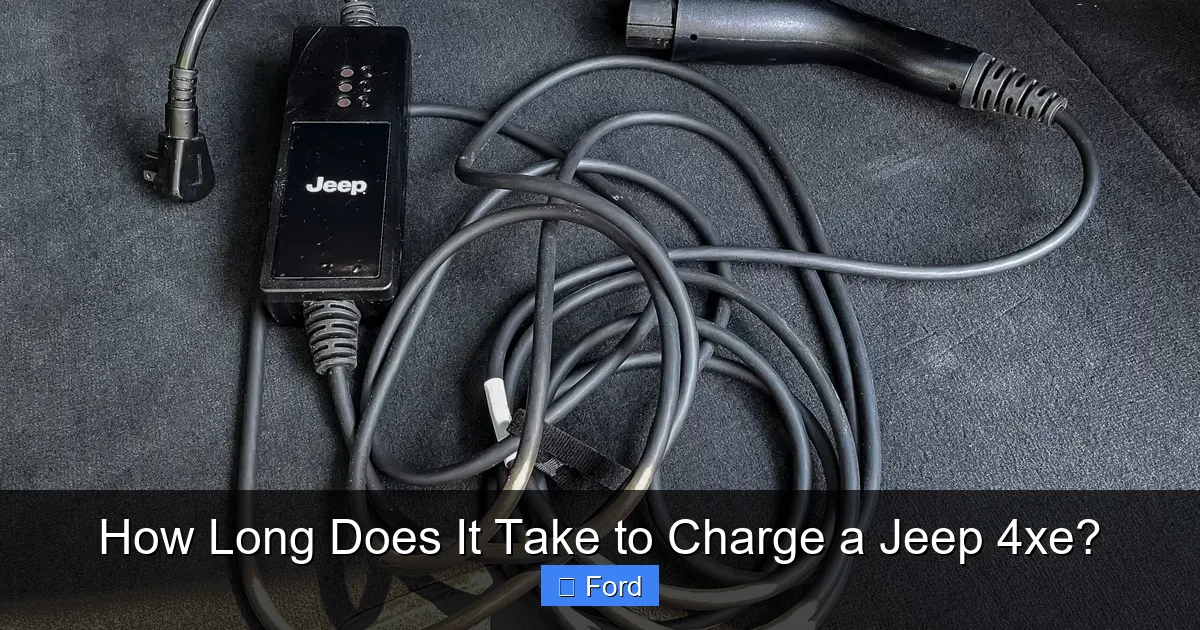
This is the slowest method, but also the most universally available. Every Jeep 4xe comes with a portable charging cord that plugs into any standard 120V household outlet. It’s your safety net—you can charge anywhere there’s an outlet, from your garage to a friend’s house or even a hotel room (with permission!).
How fast is it? It delivers about 3-4 miles of electric range per hour of charging. For a completely depleted battery, you’re looking at a full charge time of approximately 10 to 12 hours. This is perfectly adequate if you plug in overnight and your daily drive is within the 20-26 miles of electric range (depending on model). It’s not ideal for a quick turnaround, but for a nightly “top-off,” it gets the job done reliably. If you’re considering the logistics of home charging, you might also wonder about the cost to charge a Jeep 4xe, which is very low on Level 1.
Level 2: The Home & Public Workhorse (240V)
This is the sweet spot for most 4xe owners. Level 2 charging uses a 240V circuit, similar to what your clothes dryer or electric range uses. You can install a dedicated home charging station (often called an EVSE), or you’ll find these at many workplaces, shopping centers, and public parking garages.
How fast is it? It typically adds 10-25 miles of range per hour. The exact speed depends on the charger’s power rating (in kW) and your vehicle’s onboard charger capacity. The Jeep 4xe’s onboard charger can accept up to 7.2kW. Using a 7.2kW Level 2 charger:
- Jeep Wrangler 4xe (17.4 kWh battery): A full charge from 0% takes about 2 to 2.5 hours.
- Jeep Grand Cherokee 4xe (25 kWh battery): A full charge from 0% takes about 2.5 to 3 hours.
For the vast majority of daily use—coming home with some battery left and plugging in—you’ll achieve a full charge well within a typical 8-hour sleep period. Installing a Level 2 charger at home is the most recommended upgrade for seamless 4xe ownership.
Level 3: DC Fast Charging (Public Network)
This is the “emergency” or “road trip” option. Level 3 charging, often called DC Fast Charging, bypasses the vehicle’s onboard charger and pumps direct current (DC) power directly into the battery. It requires special, expensive public stations and uses the CCS plug (the larger, two-part plug on your driver’s side front fender).
How fast is it? This is where the numbers get impressive but nuanced. The Jeep 4xe is not designed for the absolute fastest DC charging speeds (like some pure EVs), but it can still accept a meaningful charge. At a 50kW or higher DC Fast Charger:
- You can add approximately 10-12 miles of electric range every 10 minutes.
- Going from 20% to 80% state of charge typically takes 25 to 45 minutes, depending on the station’s output and battery temperature.
Important Note: DC Fast Charging is best used for topping up during long trips to extend your electric-only miles. It’s not recommended for daily charging, as frequent high-power DC charging can generate more heat and may slightly accelerate long-term battery degradation. For comparison, a pure EV like the Cadillac Lyriq can accept much higher DC power rates, leading to even faster charge times.
Real-World Times for Your Specific 4xe Model
While the general rules above hold true, let’s look at the specifics for each current 4xe model. Battery size is the primary differentiator.
Visual guide about How Long Does It Take to Charge a Jeep 4xe?
Image source: images.cars.com
Jeep Wrangler 4xe
The iconic Wrangler 4xe comes with a 17.4 kWh battery (of which about 14.9 kWh is usable). Its official electric-only range is up to 21 miles (EPA) when combined with the hybrid system, though many owners report achieving more in gentle, electric-only driving.
- Level 1 (120V): ~10-11 hours for a full charge.
- Level 2 (7.2kW): ~2.0-2.5 hours for a full charge.
- DC Fast Charging: 20-80% in ~30 minutes.
For a Wrangler owner who might do a short, electric-only commute to the trailhead, Level 1 charging overnight is often sufficient. For those wanting a full battery for a full day of errands, a Level 2 charger is a game-changer.
Jeep Grand Cherokee 4xe
The Grand Cherokee 4xe features a larger 25 kWh battery (with about 21.1 kWh usable), giving it an EPA-rated electric-only range of up to 26 miles. This extra capacity naturally requires a bit more time to fill.
- Level 1 (120V): ~11-12 hours for a full charge.
- Level 2 (7.2kW): ~2.5-3.0 hours for a full charge.
- DC Fast Charging: 20-80% in ~35-45 minutes.
The Grand Cherokee 4xe is often used for family hauls and commutes where that extra 5 miles of electric range can make a difference between using gas or not. The charging times are very similar to the Wrangler, but that extra battery capacity adds about 30 minutes on Level 1 and 30+ minutes on Level 2 for a true 0-100% fill.
What Else Affects Your Charging Time? (It’s Not Just the Plug)
You’ve got the charger, you know your model. But five other factors can slide that charge time needle left or right.
Visual guide about How Long Does It Take to Charge a Jeep 4xe?
Image source: images.cars.com
1. The State of Charge (How “Empty” is the Battery?)
Charging is not linear. It’s fastest when the battery is very low (like 10-20%) and slows down considerably as it approaches 80-100%. This is a battery protection feature. So, a “full charge” from 0% takes the longest. Topping up from 50% to 80% is much, much faster. This is why experts recommend charging to 80% for daily use and only going to 100% when you need the maximum range for a long trip.
2. The Temperature (It’s a Battery Thing)
Batteries are like us—they don’t work as efficiently when they’re cold. In freezing temperatures, the chemical reactions inside slow down, and the battery’s internal heater may kick in to bring it up to an optimal temperature, using some of the charging energy. The result? Charging times can increase by 20-30% in very cold weather. Conversely, extreme heat can also trigger cooling systems that slightly reduce charge speed. The ideal charging temperature is a mild 60-80°F (15-27°C).
3. Your Home Charger’s Actual Power Rating
Not all Level 2 chargers are created equal. They are rated in kilowatts (kW). A basic, portable 240V cord might only deliver 3.6kW. A popular, hardwired home station like the ChargePoint Home Flex can be set to deliver up to 7.2kW (the max for the 4xe). A 7.2kW charger will charge your Grand Cherokee 4xe nearly twice as fast as a 3.6kW charger. Always check the specs of the charger you’re using or planning to buy.
4. The Health of the Battery
As batteries age, their maximum capacity slowly degrades. A brand-new 4xe battery might accept a charge at its peak rate. A battery with 100,000 miles might have lost 10-15% of its original capacity and may also have slightly different charge acceptance characteristics, potentially adding a few minutes to a full charge. This is normal and negligible for most owners.
5. The Charger You’re Actually Using
Public chargers vary wildly. A 6kW Level 2 charger at a city parking garage will be slower than a 9.6kW charger at your office. For DC Fast Charging, a 50kW station is standard, but you’ll increasingly find 150kW and 350kW stations. The 4xe will only draw what its onboard system allows (up to ~50kW for DC), but a underpowered or malfunctioning station will give you slower speeds. Using a reputable network like Electrify America or EVgo is your best bet for consistent speeds.
Smart Charging Strategies: Getting the Most From Your 4xe
Knowing the times is one thing. Using that knowledge to your advantage is another. Here’s how to make charging effortless and efficient.
Schedule Your Charge for Off-Peak Rates
This is the #1 pro tip for saving money. Most electric utilities offer significantly lower “off-peak” or “time-of-use” electricity rates at night (e.g., 10 PM – 6 AM). Use the timer function in your Jeep’s Uconnect system or on your home charger to automatically start charging at 10 PM. You’ll wake up to a full battery for a fraction of the daytime cost. This applies whether you’re on Level 1 or 2.
Embrace the 80% Rule for Daily Driving
Charging to 100% is only necessary for a long road trip. For your daily 20-mile commute, charging to 80% is:
- Faster: The last 20% can take as long as the first 80%.
- Better for the battery: Keeping a lithium-ion battery at a high state of charge for extended periods stresses it.
- Sufficient: 80% of a full Grand Cherokee 4xe battery gives you over 20 miles of electric range—plenty for most daily trips.
Set your daily charge limit to 80% in the vehicle settings. You can always override it for a weekend trip.
Plan DC Fast Charging Stops on Road Trips
When your electric range is depleted and the hybrid system kicks in, you’re essentially driving a very efficient hybrid. For a long trip, you can run on gas and then use a DC Fast Charger at a rest stop to “refill” your electric buffer for the next leg. Use an app like PlugShare or the built-in Uconnect navigation to find stations along your route. A 25-minute charge can give you enough electric-only miles to zip through the next town or scenic stretch silently.
Know When Level 1 is Actually Enough
If your daily drive is 10-15 miles and you plug in every night, Level 1 charging is a perfectly viable, zero-cost-upfront solution. The 3-4 miles of range added per hour means 8 hours overnight gives you 24-32 miles—more than enough to replenish what you used. Don’t feel pressured to buy a Level 2 charger if your usage pattern fits Level 1. Many 4xe owners are perfectly happy with the included cord.
The Cost-Time Tradeoff: Electricity vs. Convenience
Charging time has a direct relationship with cost, but not in the way you might think. The slower the charge (Level 1), the cheaper the electricity per mile. The fastest, most convenient charge (public DC Fast Charging) is the most expensive per mile.
- Home Level 1/2: This is your “utility” rate. Charging a Grand Cherokee 4xe from empty at home might cost $2-$4, depending on your local kWh price. It’s incredibly cheap.
- Public Level 2: Often free at malls/workplaces, or a small fee ($0.15-$0.30/kWh). Still very affordable.
- Public DC Fast Charging: This is the premium service. Rates are higher, often $0.40-$0.60/kWh, plus sometimes a per-minute fee. A 25-minute session to add 15 kWh could cost $6-$10+. It’s comparable to filling up a small gas tank, but you’re doing it for the convenience of a quick stop on a long drive.
The lesson? Use cheap, slow home charging for your daily base. Use expensive, fast public charging for strategic top-ups when you need them. For a deeper dive into the financials, check out our article on how much it costs to charge a Jeep 4xe.
Conclusion: Charging Your 4xe is Easier Than You Think
So, how long does it take to charge a Jeep 4xe? The simple answer is: as long as you have.
If you have all night, a standard outlet is fine. If you want a full battery before your morning coffee, install a Level 2 charger at home. If you’re on a cross-country adventure and need a boost, a DC Fast Charger will get you back on the road in the time it takes to grab a snack and use the restroom.
The beauty of the 4xe system is its flexibility. It doesn’t force you into one charging lifestyle. You can be a “plug-in casual” using Level 1, a “dedicated EV commuter” with Level 2, or a “road-tripping adventurer” who mixes gas, hybrid, and fast charging. Your charging time is simply a function of the tools you choose to use and your personal driving needs. The first step is understanding the options, which you now do. The next step is enjoying the silent, efficient, and incredibly capable drive that comes with your electrified Jeep.
Frequently Asked Questions
What is the fastest way to charge a Jeep 4xe at home?
The fastest way is to install a dedicated 240V Level 2 charging station rated for 7.2kW or higher. This will provide a full charge in about 2-3 hours, compared to 10-12 hours on a standard 120V outlet.
Can I charge a Jeep 4xe with a Tesla charger?
No. The Jeep 4xe uses the standard J1772 plug for Level 1/2 charging and the CCS plug for DC Fast Charging. Tesla’s connectors are proprietary. You would need a Tesla-to-J1772 adapter for AC charging, but these are not recommended for DC Fast Charging and won’t work with Tesla’s Supercharger network.
Does charging a Jeep 4xe damage the battery?
No. The vehicle’s sophisticated battery management system protects the battery from overcharging, overheating, and excessive stress. However, for long-term battery health, it’s best to avoid constantly charging to 100% and to minimize the use of DC Fast Charging for daily use.
How long does the battery last before it needs replacing?
Jeep warranties the 4xe hybrid battery for 8 years or 100,000 miles. With proper care and charging habits (like avoiding extreme states of charge and heat), the battery is expected to last well beyond the warranty period, typically 10-15 years or more for most drivers.
Can I leave my Jeep 4xe plugged in all the time?
Yes, absolutely. The vehicle’s charging system is designed to stop automatically when the battery is full (or at your set limit, like 80%). Leaving it plugged in is actually recommended, as it keeps the battery at an optimal temperature and allows for scheduled charging during off-peak hours.
Is it bad to only ever use Level 1 charging?
No, it’s not bad. Level 1 charging is perfectly safe and will not harm the battery. The main drawback is speed. If your daily electric-only driving is low (under 15 miles) and you plug in every night, Level 1 is a simple, zero-hardware-cost solution that works perfectly fine.
