
How Long Does It Take to Charge a Bmw I4?

The time it takes to charge a BMW i4 depends almost entirely on your charging method. Using a standard 120V outlet (Level 1) is extremely slow, taking over 24 hours for a full charge. A dedicated 240V home charger (Level 2) is the sweet spot for daily use, adding about 30-40 miles of range per hour and fully charging overnight. For rapid on-the-go charging, DC Fast Charging can add up to 200 miles in roughly 30 minutes, but speeds taper as the battery fills. Your specific i4 model (eDrive40 vs. M50) and the charger’s power output are the primary variables.
Key Takeaways
- DC Fast Charging is fastest: At a high-power public station (150kW+), you can add ~200 miles of range in about 30 minutes, but the final 20% is much slower.
- Battery State Matters: Charging from 10% to 80% is significantly faster than topping up from 80% to 100% due to battery management systems.
- Temperature is a Factor: Extreme cold or heat can reduce charging efficiency and increase time, especially for fast charging.
- Your Onboard Charger has Limits: The i4’s onboard AC charger maxes at 11kW (or 22kW in some markets), capping Level 2 speed regardless of the station’s capability.
- Home Charging is for Daily Refueling: Level 2 (240V) is ideal for overnight charging, turning your garage into a gas station and is typically the most cost-effective method.
- Model Differences Exist: The i4 eDrive40 (RWD) generally charges slightly faster at peak rates than the dual-motor M50 (xDrive) due to battery and powertrain differences.
- Charger Power Varies Widely: Not all public DC fast chargers are equal; a 50kW station will be much slower than a 350kW station, even if both are “CCS.”
📑 Table of Contents
- So, How Long Does It Actually Take to Charge a BMW i4?
- Understanding the Charging Levels: AC vs. DC
- BMW i4 Battery & Charging Hardware Specs
- Real-World Charging Times for the BMW i4
- Maximizing Your Charging Efficiency: Practical Tips
- The Future of BMW Charging: MyBMi & Network Expansion
- Conclusion: Charging Time is About Lifestyle, Not Just Numbers
So, How Long Does It Actually Take to Charge a BMW i4?
Welcome to the world of electric vehicle ownership! One of the first questions on every new or prospective EV driver’s mind is the charging time conundrum. It’s a different mindset from the 5-minute gas station fill-up. For the sleek, powerful, and efficient BMW i4, understanding its charging profile is key to stress-free ownership. The short answer is: it depends completely on how you charge it. There is no single number. Instead, we have a spectrum of times, from “overnight” to “lunch break.”
Let’s break it down. Charging an EV is governed by two main things: the power source (the charger) and the car’s ability to accept that power (its onboard charger and battery management system). Think of it like filling a bathtub. The faucet (the public or home charger) has a maximum flow rate. The drain (the car’s systems) can only open so wide. The slower of the two determines the total fill time. In this guide, we’ll explore every faucet you might use, from the humble wall outlet to the most powerful DC fast chargers, and give you realistic, real-world expectations for your BMW i4.
Understanding the Charging Levels: AC vs. DC
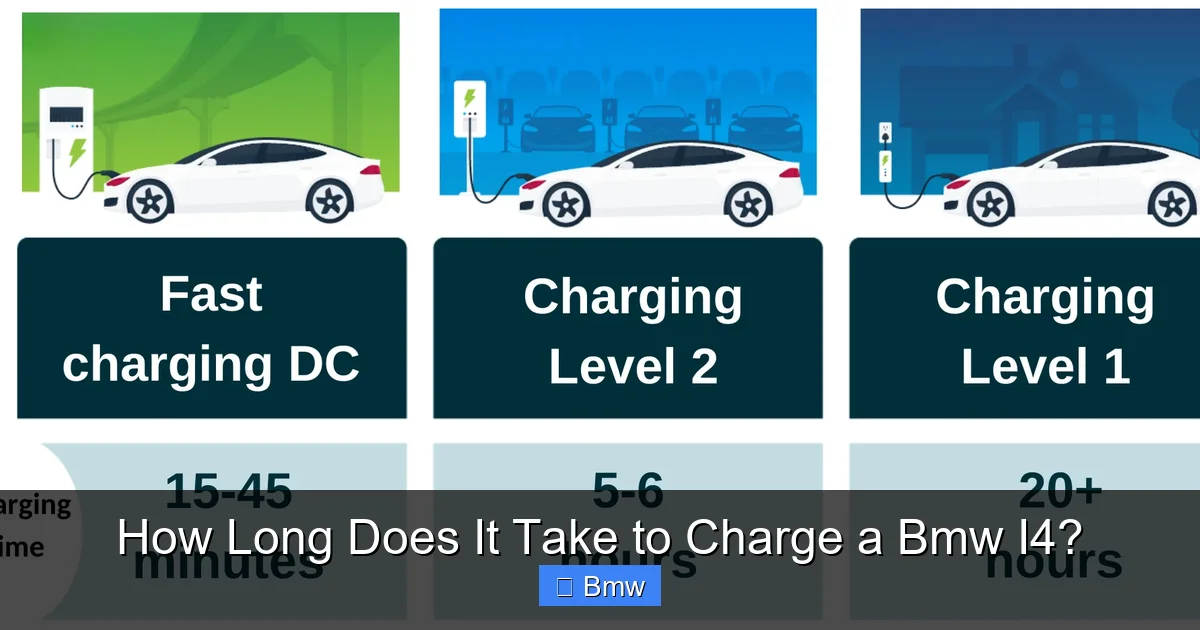
Before diving into i4-specific numbers, we need a quick primer on the two fundamental types of electricity that charge your car: Alternating Current (AC) and Direct Current (DC). This distinction is the root of all charging time confusion.
Visual guide about How Long Does It Take to Charge a Bmw I4?
Image source: octa.energy
AC Charging: The Slow and Steady Home & Public Method
Your home outlets and most public charging stations provide AC power. However, the battery in your BMW i4 can only store DC power. So, the car must convert AC to DC using its onboard charger. This conversion process is inherently slower and is limited by the size and capability of the car’s onboard charger hardware. This is what we call Level 1 and Level 2 charging.
DC Fast Charging: The Rapid Public Top-Up
DC Fast Charging stations (like Electrify America, EVgo, or Tesla’s Superchargers with an adapter) bypass the car’s small onboard charger. They feed massive amounts of raw DC power directly into the battery. This allows for vastly higher power transfer (measured in kilowatts, kW) and dramatically faster charging times. However, this high power can only be sustained until the battery reaches about an 80% state of charge. After that, the charging curve tapers off significantly to protect battery health.
BMW i4 Battery & Charging Hardware Specs
To calculate times, we need to know the tools we’re working with. The BMW i4 comes primarily in two powertrain configurations in the U.S., each with a different usable battery capacity.
Visual guide about How Long Does It Take to Charge a Bmw I4?
Image source: androidauthority.com
- BMW i4 eDrive40: Features a single rear motor and a usable battery capacity of approximately 80.7 kWh.
- BMW i4 M50 xDrive: Features dual motors (AWD) and a usable battery capacity of approximately 83.9 kWh.
The charging hardware is largely the same for both models in North America:
- Onboard AC Charger: Max input of 11.5 kW (single-phase) or 11 kW (three-phase). This means a Level 2 home charger will never charge the i4 faster than about 11 kW, adding roughly 30-40 miles of range per hour.
- DC Fast Charging Port: Supports a peak rate of up to 200 kW (in ideal conditions with a compatible 350kW+ charger). BMW states the i4 can charge from 10% to 80% in about 31 minutes at a 200kW charger. Real-world results are often very close to this, especially with newer, higher-power stations.
Pro Tip: If you’re comparing EVs, you’ll often see a higher “peak” DC charging rate (like 350kW for a Hyundai Ioniq 5). The i4’s 200kW limit is still very fast and will get you back on the road quickly, but it’s helpful to understand where it stands. For a deep dive into how different EVs handle fast charging, you can read about the Cadillac Lyriq’s fast charging explained to see a contrasting approach.
Real-World Charging Times for the BMW i4
Now, let’s get to the numbers you actually care about. These are estimated, real-world times based on starting from a low battery state (around 10-20%) and factoring in typical charging curve tapering. “Full charge” times are less practical than “10% to 80%” times for daily use.
Visual guide about How Long Does It Take to Charge a Bmw I4?
Image source: decortweaks.com
Level 1 Charging: The Emergency Backup (120V)
This is plugging your i4 into a standard North American household outlet with the included mobile cord.
- Power Output: ~1.4 kW (12A @ 120V)
- Range Added Per Hour: 3-5 miles
- Time for Full Charge (eDrive40, 80.7 kWh): Roughly 60+ hours from empty.
- Practical Verdict: This is not for daily use. It’s purely for getting a few miles of emergency range when you have no other option. You should not rely on this for regular ownership. It’s the equivalent of refueling your gas car with a teaspoon.
Level 2 Charging: The Daily Workhorse (240V)
This is what you’ll install in your garage or use at many workplaces and public Level 2 stations. A 48-amp (11.5 kW) home charger is ideal to max out the i4’s onboard capacity.
- Power Output: Up to 11.5 kW
- Range Added Per Hour: 30-40 miles
- Time for 80% Charge (from 20%): Approximately 6-7 hours.
- Time for Full Charge (from empty): Roughly 8-9 hours.
- Practical Verdict: This is your bread and butter. Plug in when you get home, and you’ll be ready for a full day of driving by morning. It’s quiet, convenient, and cheap (especially if you use off-peak electricity rates). For most owners, a Level 2 charger is the only home charging equipment they’ll ever need. The installation process for a 240V outlet is similar to what’s discussed for a Tesla 220V outlet, with costs varying based on your home’s electrical panel distance.
DC Fast Charging: The Road Trip Savior
This is for when you’re traveling beyond the i4’s excellent EPA-rated range (up to 307 miles for eDrive40, 289 for M50) and need a rapid top-up.
- Power Output: 50 kW to 350 kW (i4 maxes at ~200 kW)
- Time for 10% to 80% Charge: ~25-35 minutes at a 150-200 kW charger.
- Time for 80% to 100% Charge: Can take another 30-45 minutes due to taper. Most drivers stop at 80% for efficiency.
- Practical Verdict: Perfect for highway rest stops. Grab a snack, stretch your legs, and you’ll have plenty of range to reach your destination. Remember, not all DC chargers are equal. A 50kW station will take nearly twice as long as a 200kW station. Apps like PlugShare are essential for finding high-power chargers.
Maximizing Your Charging Efficiency: Practical Tips
You can’t change the fundamental laws of electricity, but you can optimize your i4’s charging experience with these smart practices.
1. Precondition the Battery for Fast Charging
Your i4’s battery operates best in a specific temperature range (roughly 60-80°F / 15-27°C). In very cold weather, the battery is “cold-soaked” and accepts charge much slower. Use the BMW i4’s preconditioning feature (set via the app or infotainment) to warm up the battery *while still plugged in* before you start your DC fast charging session. This uses grid power to heat the battery, allowing it to accept the fastest possible charge rate immediately when you plug into the DC station. This can save 10-15 minutes on a cold winter fast-charge session.
2. Embrace the 80% Rule for Daily Use & Fast Charging
Charging to 100% on a regular basis, especially using DC fast charging, adds unnecessary stress and time to the battery’s lifecycle. For daily driving, 80% is more than enough for most people and is much faster to achieve. Plan your fast-charging stops to get to ~80%, not 100%. The last 20% can take as long as the first 60%. This is a universal EV best practice.
3. Optimize Your Home Charging Schedule
If your utility offers time-of-use (TOU) electricity rates, schedule your Level 2 charging to start during off-peak hours (usually late night). This saves you money and helps balance the grid. The i4’s built-in timer or your smart charger’s app can handle this automatically. This also ensures your car is fully charged by morning without you having to think about it.
4. Understand Your Actual Needs
The average American drives about 30 miles per day. Even a modest Level 1 charge overnight (8 hours) can add 40+ miles. Don’t feel pressured to get a “full” charge every night if you don’t need it. Charging to 50-60% daily is perfectly fine and is actually better for long-term battery health than constantly cycling from 10% to 100%. It’s all about matching your charging to your real driving pattern.
The Future of BMW Charging: MyBMi & Network Expansion
BMW is continuously improving the charging ecosystem for i4 owners. The MyBMW App is your central hub. It allows you to locate public chargers (including filtering by plug type and speed), start/stop charging sessions, and monitor status remotely. BMW is also expanding its partnerships and direct investments in charging networks to improve reliability and access for its customers. While the i4 uses the universal CCS1 plug in North America (a huge advantage over Tesla’s proprietary plug), the experience of finding a working, high-power charger is still a shared industry challenge. Always have a backup plan and check station status in your app before a long trip. The infrastructure is growing rapidly, but it’s not yet as ubiquitous as a gas station.
Conclusion: Charging Time is About Lifestyle, Not Just Numbers
So, how long does it take to charge a BMW i4? The final answer is a personal one. If your lifestyle involves a predictable daily commute and a place to park and plug in overnight, the answer is effectively “overnight, while you sleep.” Your Level 2 charger becomes an invisible utility, just like your water heater. If you’re planning cross-country road trips, you’ll build stops into your journey around 30-minute DC fast charging breaks, turning rest periods into productive or relaxing moments. The i4’s 200kW+ fast charging capability means you’ll spend minimal time waiting. The key is shifting your mental model from “refueling stops” to “opportunistic energy replenishment.” With a bit of planning and the right home setup, charging your BMW i4 becomes a seamless, non-disruptive part of your routine, freeing you from the gas station forever.
Frequently Asked Questions
What is the fastest way to charge a BMW i4?
The absolute fastest method is using a 150-350 kW DC Fast Charging station. These public chargers can replenish 80% of the battery in about 25-35 minutes. You must use a compatible CCS1 adapter, which is built into the i4.
Is it bad to charge the BMW i4 to 100% every time?
Regularly charging to 100%, especially on DC fast chargers, can accelerate long-term battery degradation. For daily driving, aim to charge to 80-90%. Reserve a full 100% charge only for when you need the absolute maximum range for a long trip.
Can I charge my BMW i4 with a Tesla charger?
Not directly. The i4 uses a CCS1 plug, while Tesla uses a proprietary plug in North America. You would need a separate, third-party CCS1 to Tesla adapter, but these are not officially supported by BMW and can be unreliable or unsafe. It’s best to use Electrify America, EVgo, or other CCS networks.
How much does it cost to charge a BMW i4 at home vs. publicly?
At home, it costs about $10-$15 for a full charge (80.7 kWh battery) based on average U.S. electricity rates (~$0.15/kWh). Public DC fast charging typically costs $0.40-$0.60 per kWh, so a similar 80% charge could cost $25-$35. Home charging is always significantly cheaper.
Does cold weather affect BMW i4 charging time?
Yes, significantly. Cold temperatures reduce battery efficiency and chemical reaction speeds. A cold-soaked battery can take 30-50% longer to charge on DC fast charging. Always use the preconditioning feature before a fast-charge session in cold weather to warm the battery first.
How often should I charge my BMW i4?
Charge it as often as needed based on your driving. Unlike older nickel-based batteries, the i4’s lithium-ion pack has no “memory effect.” It’s perfectly fine to plug in every night, even if you only used 20 miles that day. Frequent, shallow charging is actually easier on the battery than deep cycles.
