
How Long Does a Jeep Wrangler Last?

Jeep Wranglers are celebrated for their off-road prowess and can endure well beyond 200,000 miles with diligent care. Longevity hinges on consistent maintenance, rust prevention, and driving habits, with many owners reporting 300,000+ mile examples. By addressing model-specific issues and following service schedules, your Wrangler can provide decades of reliable adventure.
When you think of a Jeep Wrangler, images of rocky trails, sandy dunes, and endless adventure likely come to mind. But behind that rugged exterior lies a practical question for many owners and prospective buyers: just how long does a Jeep Wrangler last? Unlike some vehicles that fade after a decade, the Wrangler has earned a reputation for being one of the most durable SUVs on the market. However, its lifespan isn’t solely determined by its iconic design—it’s a complex interplay of engineering, maintenance, and owner habits. In this deep dive, we’ll explore every facet of Wrangler longevity, from engine resilience to rust battles, and equip you with actionable insights to keep your Jeep rolling for generations.
First, let’s set the stage. Jeep Wranglers aren’t just daily drivers; they’re tools for exploration. This dual role means they endure both highway commutes and extreme off-road conditions, which can take a toll over time. Yet, anecdotal evidence and owner forums consistently highlight Wranglers clocking 200,000, 300,000, and even 400,000 miles. But is that the norm or the exception? We’ll break down the realities, backed by data and expert opinions, so you understand what it truly takes to maximize your Wrangler’s life. Whether you’re a new owner or a seasoned off-roader, this guide will answer your burning questions and debunk myths along the way.
Key Takeaways
- Maintenance is non-negotiable: Regular oil changes, inspections, and timely repairs are critical for extending Wrangler life, especially for powertrain components.
- Rust is the biggest enemy: Frame and body corrosion, particularly in older models or snowy regions, requires proactive treatment like undercoating and frequent cleaning.
- Engine durability varies by model: The 3.6L Pentastar V6 is robust, but the 2.0L turbo may need more attention; transmissions can last long with proper servicing.
- Model year matters: Newer Wranglers (JL and later) have improved rust resistance and reliability over earlier JK and TJ models, but all can last with care.
- Off-road use accelerates wear: While designed for trails, aggressive off-roading demands more frequent checks of drivetrain, suspension, and seals to prevent premature failures.
- High-mileage success stories are real: Numerous Wranglers surpass 300,000 miles, proving that with owner commitment, these vehicles are built for the long haul.
- Cost of ownership is manageable: Expect higher maintenance costs than sedans, but budgeting for key services like fluid changes and brake inspections pays off in longevity.
📑 Table of Contents
What Makes the Jeep Wrangler Built to Last?
The Jeep Wrangler’s longevity starts with its fundamental design philosophy. Since the original CJ models, Jeeps have been engineered for simplicity and strength, prioritizing durability over luxury. This ethos continues in modern Wranglers, which feature body-on-frame construction—a traditional setup known for robustness compared to unibody designs. The body-on-frame layout isolates the cabin from twists and bends, reducing stress on components during off-road excursions. Additionally, solid axles front and rear (in most models) are simpler and more repairable than independent suspensions, contributing to long-term reliability.
Engineering for Adventure
Jeep engineers test Wranglers in extreme conditions, from Moab’s rocks to Arctic cold, ensuring they can handle abuse. The powertrain options, like the stalwart 3.6L Pentastar V6 engine, are derived from Chrysler’s proven lineup and built with heavy-duty internals. Even the newer 2.0L turbocharged four-cylinder, while more complex, incorporates upgrades for efficiency without sacrificing core durability. Transmissions—both the manual Aisin AX15 and automatic ZF 8-speed—are industry-standard units known for longevity when maintained. This focus on proven components means fewer electronic gremlins that can plague modern cars.
However, “built to last” doesn’t mean “indestructible.” The Wrangler’s simplicity is a double-edged sword; basic systems require more frequent attention than sealed units in luxury SUVs. For instance, the manual transmission needs clutch replacements around 100,000 miles, and the automatic’s fluid should be changed regularly. But overall, the engineering provides a solid foundation. When comparing to other long-lived vehicles, such as the Nissan Maxima, which also boasts high mileage potential, the Wrangler’s off-road readiness sets it apart. Both share a commitment to powertrain strength, but the Wrangler’s chassis is uniquely tailored for terrain that would cripple most sedans.
Key Factors Affecting Your Wrangler’s Lifespan
Not all Wranglers are created equal when it comes to longevity. Several variables dictate whether your Jeep will see 150,000 miles or 400,000. Understanding these factors helps you make informed decisions as an owner and tailor your maintenance approach.
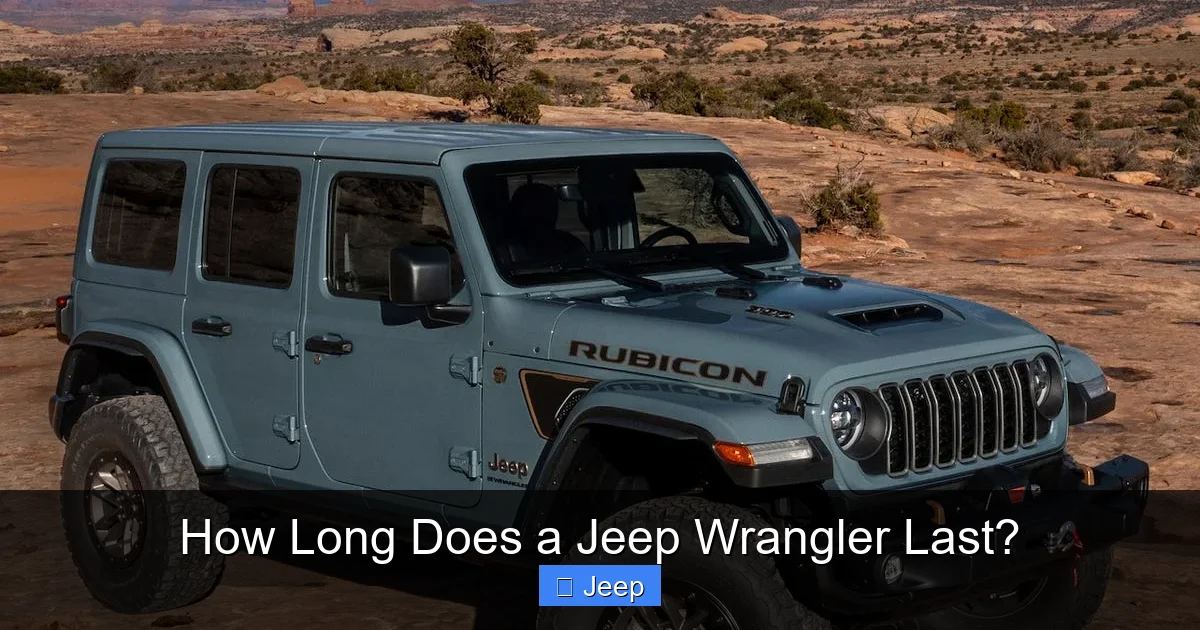
Visual guide about How Long Does a Jeep Wrangler Last?
Image source: adventurejeep.com
Model Year and Generation
The Wrangler has evolved through generations: YJ (1987-1995), TJ (1997-2006), JK (2007-2018), and JL (2018-present). Earlier models like the TJ are beloved for their simplicity but suffer from notorious rust issues and less refined engines. The JK introduced more power and comfort but had its own rust challenges, especially in the frame. The current JL represents a significant leap with improved corrosion protection, better sealing, and more efficient engines. If longevity is the goal, a well-maintained JL is your best bet, but a cared-for TJ or JK can still surprise you. For example, many TJs with the 4.0L inline-six engine are hitting 300,000 miles thanks to their bulletproof nature, despite rust concerns.
Driving Conditions and Usage
How you drive your Wrangler matters immensely. Highway miles are gentle on components, while constant stop-and-go traffic strains the transmission and engine. Off-roading, while fun, subjects the drivetrain, suspension, and seals to extreme stress. Water fording can lead to differential and transfer case leaks if not serviced promptly. Sandy or muddy environments infiltrate bearings and joints, accelerating wear. Owners who primarily use their Wranglers for light trails and daily driving will generally see longer component life than those who rock-crawl regularly. That said, with rigorous after-trail inspections and cleaning, even hardcore off-roaders can achieve high mileage. It’s about balancing adventure with upkeep.
Climate and Environment
Where you live plays a huge role. In snowy states, road salt is a silent killer, promoting rust on frames, brake lines, and body panels. Coastal areas with salty air have similar effects. Conversely, dry climates like Arizona minimize corrosion but can degrade rubber seals and hoses faster due to UV exposure. If you’re in a harsh climate, proactive measures like annual undercoating and washing the undercarriage are non-negotiable. Interestingly, some owners in rust-prone regions report better longevity by storing their Wranglers in garages and avoiding winter driving altogether—but that defeats the purpose of a Jeep! Adapting your maintenance to your environment is key.
Engine and Transmission: The Heart of the Wrangler
Powertrain longevity is often the make-or-break factor for any vehicle, and the Wrangler is no exception. Let’s examine the engines and transmissions that have powered these SUVs through the years, highlighting strengths, weaknesses, and care tips.
Visual guide about How Long Does a Jeep Wrangler Last?
Image source: vehicleanswers.com
Engine Options Through the Years
The Wrangler’s engine lineup has shifted from carbureted inline-sixes to modern fuel-injected V6s and turbo-fours. The legendary 4.0L inline-six in TJ and early JK models is revered for its simplicity and durability, often surpassing 300,000 miles with basic upkeep. However, it’s underpowered by today’s standards. The 3.6L Pentastar V6, introduced in 2012, balances power and reliability; it’s a workhorse with few major issues if oil changes are done on time (every 5,000-7,500 miles). The 2.0L turbo, found in four-door JLs, offers great fuel economy but introduces complexity with turbochargers and direct injection. These engines can last long, but they require strict adherence to service intervals—neglecting oil changes or using low-quality fuel can lead to carbon buildup or turbo failure.
For diesel enthusiasts, the 3.0L EcoDiesel in some JL models provides torque and efficiency, but it’s a newer engine with limited long-term data. Early reports suggest it’s robust, but emissions systems like DEF require maintenance. Regardless of engine, watch for common issues: the 3.6L can experience coolant leaks and ticking noises (often harmless), while the 2.0L may have occasional turbo actuator faults. Regular diagnostic scans and addressing check engine lights promptly prevent small problems from escalating. Compared to transmissions in other brands, like the Honda Civic transmission, which is known for reliability but can fail with neglect, Wrangler powertrains are tougher but not immune to abuse.
Transmission Longevity: Manual vs Automatic
Wranglers offer both manual and automatic transmissions, each with distinct longevity profiles. The manual Aisin AX15 (in TJ/JK) and Aisin AL6 (in JL) are incredibly durable when driven properly. Clutch replacement is the main wear item, typically needed around 80,000-120,000 miles depending on driving style. Manuals require fluid changes every 30,000-60,000 miles to keep synchronizers happy. Many owners report manual transmissions lasting 300,000+ miles with minimal issues.
Automatics, particularly the ZF 8-speed in JL models, are smooth and efficient but more complex. The older 42RLE 4-speed in JK models had a reputation for slipping if not serviced, while the 8-speed is generally robust but can suffer from solenoid or torque converter problems if fluid is neglected. Automatic transmission fluid (ATF) should be changed every 60,000-100,000 miles; skipping this leads to overheating and wear. Towing heavy loads or aggressive off-roading increases heat, so consider auxiliary coolers for heavy use. In summary, both types can last long, but automatics demand stricter fluid maintenance. Think of it like caring for a Honda Civic’s oil life system—regular intervals are crucial, but Wrangler transmissions are built tougher for abuse.
Rust and Frame Integrity: A Common Challenge
If there’s one Achilles’ heel for Jeep Wranglers, it’s rust. Especially in pre-2015 models, frame corrosion can compromise structural integrity and lead to costly repairs. Understanding rust patterns and prevention is essential for maximizing lifespan.
Visual guide about How Long Does a Jeep Wrangler Last?
Image source: vehicleriding.com
Why Wranglers Rust: The Design Trade-off
Wranglers are designed for water fording up to 30 inches, which means water inevitably enters frame rails and crevices. Combined with road salt, this creates a perfect storm for internal rust. Early JK frames (2007-2012) are particularly susceptible, with rust often starting at the rear axle mounts and spreading. Body panels, like the fender flares and rocker panels, also trap moisture. Jeep addressed this in later JK and JL models with better coatings and drainage holes, but no Wrangler is rust-proof. Owners in snowy states often report frame rust within 5-10 years if not treated.
Prevention and Treatment Strategies
An ounce of prevention is worth a pound of cure. Start with regular washing: after driving in snow or off-road, rinse the undercarriage thoroughly to remove salt and mud. Apply an undercoating product like Fluid Film or POR-15 annually; these create barriers against moisture. For existing rust, grind it down to bare metal, treat with a rust converter, and repaint with a durable coating. Many shops offer frame repairs, but severe rust can be expensive—sometimes exceeding the vehicle’s value. Therefore, early intervention is key. When buying a used Wrangler, always inspect the frame, especially near the rear axle and front control arms. A rust-free frame is a green flag for longevity.
Additionally, consider aftermarket modifications like fender liners and splash guards to keep debris off critical areas. While these won’t stop internal frame rust, they reduce surface contaminants. Remember, rust isn’t just cosmetic; it can weaken mounting points for suspension and engine, leading to safety issues. By staying vigilant, you can add decades to your Wrangler’s life.
Real-World High-Mileage Wranglers: Proof of Concept
Theories are nice, but real-world examples cement the Wrangler’s reputation. Across forums and dealerships, stories of high-mileage Wranglers abound, offering valuable lessons for owners.
Case Studies from Owner Forums
Take “TJ Tom” from Colorado, who logged 380,000 miles on his 1999 TJ with the 4.0L engine. His secret? religious oil changes every 4,000 miles, annual undercoating, and replacing wear items like water pumps and radiators preemptively. Or “JK Jill” from Texas, whose 2012 JK Unlimited reached 250,000 miles with the 3.6L V6; she attributes it to using synthetic oil, rotating tires every 5,000 miles, and addressing transmission fluid at 60,000 miles. These aren’t flukes; they reflect disciplined ownership.
Dealerships also see high-mileage Wranglers. A mechanic in Ohio noted that his shop regularly services JLs with 200,000+ miles, mostly for routine items like brakes and fluids, not major engine failures. This contrasts with some crossovers that start needing engine rebuilds at 150,000 miles. The consistency across generations suggests that, barring rust, Wrangler powertrains are overbuilt for their intended use. However, high-mileage examples often have replaced components like starters, alternators, and transfer cases—normal wear items that don’t spell doom but require budgeting.
Lessons from the Mileage Leaders
What do these high-mileage heroes teach us? First, consistency trumps intensity. Small, regular maintenance tasks compound over time. Second, address symptoms early: a small coolant leak or transmission slip ignored can lead to catastrophic failure. Third, invest in quality parts; cheap alternators or brake pads might save money upfront but cost more in labor and repeat repairs. Finally, keep records. Detailed service histories not only help with resale but also guide future maintenance. By emulating these practices, your Wrangler can join the high-mileage club.
Essential Maintenance Practices for Longevity
Now that we’ve covered the “what” and “why,” let’s dive into the “how.” A structured maintenance regimen is the cornerstone of Wrangler longevity. Here’s a practical checklist, tailored to different model years and usage.
The Basic Service Schedule
Every Wrangler needs these core services, typically based on mileage or time:
- Oil and filter: Every 5,000-7,500 miles (or 6 months) with synthetic oil. The 3.6L and 2.0L engines benefit from high-quality oil to prevent sludge.
- Transmission fluid: Manual: every 30,000-60,000 miles; Automatic: every 60,000-100,000 miles. Use Mopar ATF+4 for older automatics or ZF Lifeguard for 8-speeds.
- Differential fluid: Every 30,000-50,000 miles, especially if off-roading. Use GL-5 gear oil.
- Transfer case fluid: Every 30,000 miles; neglect leads to whining and failure.
- Coolant: Replace every 100,000 miles or 10 years; watch for leaks around the water pump and thermostat.
- Brakes: Inspect pads and rotors every 15,000 miles; replace as needed. Brake fluid should be flushed every 2 years.
- Battery: Test annually; replace every 3-5 years. Wranglers with extra accessories (lights, winches) strain batteries more.
Sticking to this schedule prevents most major failures. For example, skipping transmission fluid changes is a common cause of premature automatic transmission death—a problem that can cost $3,000+ to fix. By contrast, a fluid change costs $200-$300. It’s a no-brainer. Also, consider your driving: if you tow or off-road frequently, shorten intervals by 20-30%.
Seasonal and Pre-Adventure Checks
Before hitting trails or winter, perform these quick checks:
- Tires and pressure: Ensure proper inflation; off-road pressures differ from street.
- Fluid levels: Check engine oil, coolant, brake fluid, and washer fluid.
- Undercarriage inspection: Look for leaks, damage, or loose bolts after off-roading.
- Seals and boots: Inspect axle and CV boots for tears; replace immediately to prevent dirt ingress.
- Battery terminals: Clean corrosion and tighten connections.
These habits catch small issues before they become big ones. For instance, a torn CV boot leads to joint failure within weeks, costing hundreds in repairs. A quick visual check can save thousands. Additionally, store your Wrangler in a garage if possible to reduce weather-related wear. While not everyone can do this, even a car cover helps.
When to Seek Professional Help
Some tasks are best left to experts, especially with modern Wranglers’ complexity. Diagnostic scans for engine codes, transmission servicing, and frame rust repairs require specialized tools and knowledge. Don’t DIY critical systems unless you’re experienced—mistakes can be costly. Build a relationship with a trusted Jeep specialist; they know the common pitfalls and can offer model-specific advice. For example, a mechanic familiar with JL models might catch early turbo issues that a general shop would miss. Investing in professional service for major items pays off in longevity.
Incorporating these practices transforms your Wrangler from a mere vehicle into a lifelong companion. Remember, the goal isn’t just to avoid breakdowns but to build a history of reliable adventures. Every mile maintained is a story added to your Jeep’s legacy.
Conclusion
So, how long does a Jeep Wrangler last? The answer isn’t a single number but a spectrum: with neglect, you might see 150,000 miles before major issues; with obsessive care, 400,000+ is achievable. The Wrangler’s robust design provides a strong foundation, but its longevity ultimately depends on you—the owner. By understanding the factors at play, from model year nuances to rust prevention, and committing to a rigorous maintenance schedule, you can defy expectations and keep your Jeep thriving for decades. The high-mileage examples out there aren’t luck; they’re the result of informed, proactive ownership. Whether you’re cruising highways or conquering trails, treat your Wrangler with respect, and it will reward you with countless adventures. In the end, a Wrangler’s true lifespan is measured not just in miles, but in the memories made along the way.
Frequently Asked Questions
How many miles can a Jeep Wrangler last?
With proper maintenance, a Jeep Wrangler can easily last 200,000 to 300,000 miles. Many owners report even higher mileage, especially with well-cared-for models from the 1990s and 2000s, though rust and model-specific issues can affect this.
What are the most common issues that affect Wrangler longevity?
Rust, especially on frames and body panels, is the top concern. Powertrain issues like transmission slips (in older automatics) and engine coolant leaks also arise if maintenance is skipped. Electrical gremlins and seal failures from off-roading are other frequent problems.
How does off-roading impact Wrangler lifespan?
Off-roading accelerates wear on drivetrain components, suspension, and seals. Water fording can lead to leaks, and rocky terrain stresses axles and joints. However, with post-trail inspections and cleaning, these impacts can be mitigated, and many Wranglers endure heavy off-road use for years.
Which Jeep Wrangler model year is the most reliable?
The current JL generation (2018+) is generally the most reliable due to improved rust protection and refined engines. Among older models, the TJ (1997-2006) with the 4.0L engine is famed for durability but watch for rust; the JK (2007-2018) is a middle ground with some rust issues in early years.
How much does it cost to maintain a high-mileage Wrangler?
Expect higher costs than average SUVs, with annual maintenance ranging from $500 to $1,500 depending on usage. Major services like transmission fluid changes or rust repairs can spike costs, but budgeting for routine items prevents expensive breakdowns.
Can a Jeep Wrangler last 300,000 miles?
Yes, absolutely. Numerous Wranglers surpass 300,000 miles, particularly TJs with the 4.0L engine and well-maintained JKs and JLs. Achieving this requires consistent oil changes, rust prevention, and addressing wear items promptly, but it’s a proven milestone for dedicated owners.
