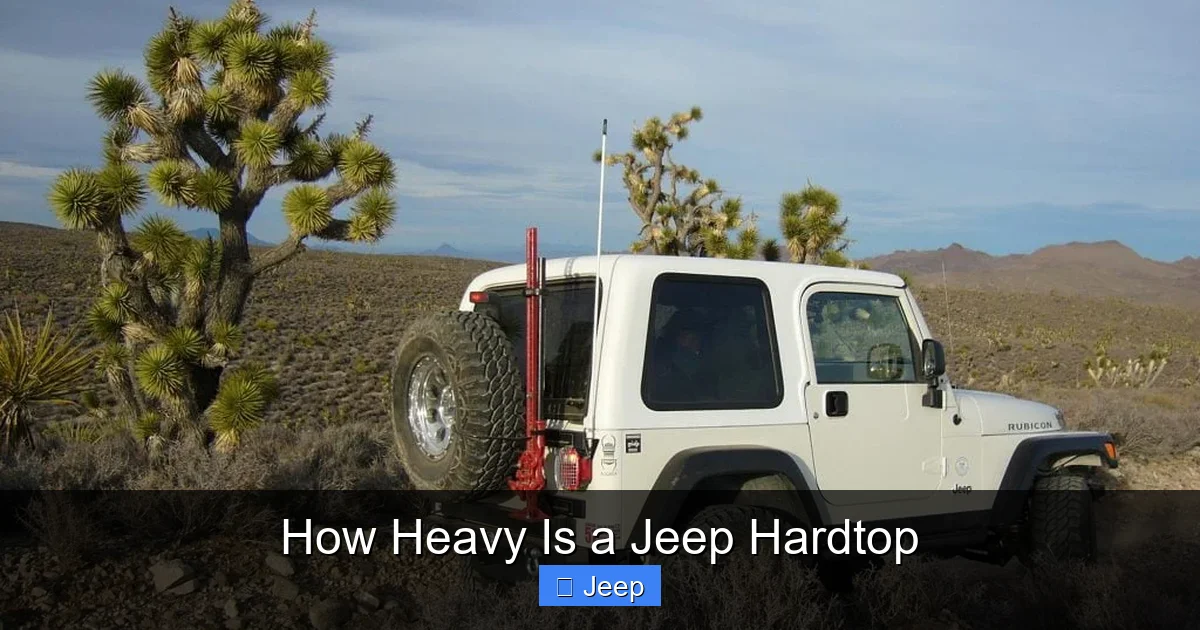
How Heavy Is a Jeep Hardtop

Contents
- 1 Key Takeaways
- 2 📑 Table of Contents
- 3 The Official Numbers: Weight by Generation and Model
- 4 Beyond Factory: Aftermarket and Specialized Hardtops
- 5 The Critical Question: Why Does Weight Matter So Much?
- 6 How to Determine Your Specific Hardtop’s Weight
- 7 Essential Tools and Techniques for Safe Handling
- 8 Frequently Asked Questions


The weight of a Jeep hardtop varies significantly by model, material, and year, typically ranging from 90 to 140 pounds for factory hardtops. A full-size 2-door Wrangler (JK/JL) steel hardtop usually weighs 120-140 lbs, while a lightweight aluminum or composite top can be as light as 90-110 lbs. 4-door Wrangler Unlimited hardtops are heavier, often 140-170 lbs due to the larger size. Knowing the exact weight is crucial for safe removal, storage, and potential aftermarket modifications.
So, you’re staring at your Jeep Wrangler, wondering about that massive slab of metal or composite sitting on top. You know you want to take it off for the summer, but a nagging question keeps popping up: just how heavy is this thing, really? It’s not just idle curiosity. Knowing the weight of your Jeep hardtop is the first, most critical step in planning a safe, successful removal and storage process. Get it wrong, and you could be looking at a strained back, a dented fender, or a cracked windshield. Get it right, and you’ll be enjoying open-air freedom in no time. Let’s break down the numbers, the variables, and the real-world implications of that weight.
The short answer is: it depends. But we’re not leaving you hanging. We’ll dive into the specifics for every major Wrangler generation and configuration. Whether you have a classic TJ, a modern JL, a 2-door or a 4-door, a steel or an aluminum top, we’ve got the data you need. We’ll also talk about why that number matters—for your body, your garage, and your driving experience. This isn’t just a specs sheet; it’s your operational manual for one of the Jeep’s most iconic features.
Key Takeaways
- Weight Varies by Model & Material: A 2-door Jeep Wrangler (JK/JL) steel hardtop averages 120-140 lbs, while aluminum/composite options are 90-110 lbs. 4-door models add 20-30 lbs.
- Year Matters: TJ (1997-2006) hardtops are generally lighter (90-120 lbs) than modern JK/JL (2007+) steel tops due to size and safety features.
- Removal Requires Planning: You’ll need at least two people, proper tools (Torx bits), and a clear, safe workspace. Never attempt solo removal.
- Storage Solutions Impact Usability: A dedicated hardtop hoist or wall rack is the safest storage method, preventing damage and making re-installation easier.
- Aftermarket Tops Have Different Weights: Aftermarket fiberglass or polycarbonate tops can be significantly lighter or heavier than OEM; always check manufacturer specs.
- Weight Affects Vehicle Dynamics: Removing the hardtop reduces overall vehicle weight, slightly improving fuel economy and acceleration but raising the center of gravity.
- Safety First: The awkward shape and weight distribution make dropping a hardtop a common cause of back injury and vehicle damage if done incorrectly.
[FEATURED_IMAGE_PLACEHOLDER]
📑 Table of Contents
The Official Numbers: Weight by Generation and Model
Jeep has used several hardtop designs over the decades, and the weight can change dramatically from one generation to the next. The biggest factors are the overall size of the vehicle (2-door vs. 4-door), the primary material used (steel vs. aluminum/composite), and the inclusion of features like a rear window or sound deadening. Here’s a detailed, model-by-model breakdown.
Jeep Wrangler TJ (1997-2006)
The TJ era is beloved for its relatively compact size and simpler design. Hardtop weights here are on the lighter end of the spectrum for factory units.
- 2-Door TJ Steel Hardtop: Typically weighs between 95 and 120 pounds. The exact weight depends on whether it has the factory-installed rear slider window (adds a few pounds) and sound deadening material.
- 2-Door TJ “Half-Top” or Safari Top: This is the removable front section only. It’s much lighter, usually in the 40-60 pound range.
- 4-Door TJ (LJ) Hardtop: The long-wheelbase LJ is rare but did exist. Its hardtop is significantly longer, weighing in the 130-150 pound range.
Practical Note: TJ owners often report that their steel tops feel surprisingly manageable with two people, thanks to the smaller overall footprint. A common tip is to use a simple blanket or towel as a sling to get a better grip during the lift.
Jeep Wrangler JK & JKU (2007-2018)
The JK generation brought a major size increase, especially with the introduction of the 4-door Unlimited (JKU). This is where hardtop weights start to climb noticeably.
- 2-Door JK Steel Hardtop: The standard for this generation. Weight ranges from 125 to 145 pounds. The inclusion of the rear window and more complex seals adds weight over the TJ.
- 4-Door JKU Steel Hardtop: This is the heaviest common factory hardtop. Expect a weight of 150 to 170 pounds. The extra length and larger rear window contribute to the heft.
- JK/JKU Aluminum Hardtop (Optional): Available as a premium option, this top is a game-changer for weight. It typically weighs 90 to 110 pounds for the 2-door and 110 to 130 pounds for the 4-door. The weight savings are substantial and make solo handling (with a hoist) much more feasible.
Real-World Example: A 2015 Jeep Wrangler Unlimited Sahara with the steel hardtop is one of the heaviest common combinations. Owners consistently report needing three strong people to safely maneuver it off without a hoist. If you have this setup, investing in a hardtop lift is not a luxury—it’s a necessity. For more on Jeep costs, you might look at how much is a Jeep Compass lease, but the weight considerations are entirely different for a unibody SUV.
Jeep Wrangler JL & JLU (2018-Present)
The current JL generation refined the design but didn’t drastically reduce the weight of the steel hardtop. However, material improvements and the continued availability of the aluminum top provide options.
- 2-Door JL Steel Hardtop: Very similar to the JK, weighing 120 to 140 pounds. Slight tweaks in construction may shave a pound or two here and there.
- 4-Door JLU Steel Hardtop: Again, the king of weight, typically 145 to 165 pounds.
- JL/JLU Aluminum Hardtop: Still the lightweight champion. Weights are comparable to the JK aluminum: 95-115 lbs (2-door) and 115-135 lbs (4-door).
- JL “Freedom Top” (Modular): This is the standard 3-piece top (front, mid, rear). The full assembly weight is the same as the standard steel top above, but the modularity means you can remove just the front section (weighing ~50-60 lbs) for a sunroof effect.
Key JL Difference: The JL uses a different, often more secure, latch system. While this is great for keeping the top tight, it can mean the latches are tighter and require more torque to release, which can be a factor when the top is already overhead.
Beyond Factory: Aftermarket and Specialized Hardtops
Your weight can change dramatically if you’ve swapped the OEM top for an aftermarket unit. Here are common scenarios:

Visual guide about How Heavy Is a Jeep Hardtop
Image source: hardtopdepot.com
Fiberglass Hardtops
Popular for their custom color-matching and often integrated spoilers. Weight varies wildly by manufacturer and construction.
- Lightweight Fiberglass: Can be as light as 80-100 pounds for a 2-door, using thinner gel coat and minimal reinforcement.
- Heavy-Duty Fiberglass: Built for extreme durability or with added sound deadening can easily hit 130-150 pounds or more.
Tip: Always contact the aftermarket manufacturer for the exact weight. Don’t assume it’s lighter than OEM.
Polycarbonate / Plastic Hardtops
Brands like Treeline or some European manufacturers use advanced plastics. These can be surprisingly light.
- Typical Weight: Often in the 70-95 pound range for a 2-door. They offer excellent UV resistance and are dent-proof but can scratch more easily than paint.
Steel Hardtop Modifications
Some owners add roof racks, swing-out tire carriers, or aftermarket lights directly to the hardtop. Each of these additions adds weight, often 10-30 pounds, and critically changes the center of gravity. A top that was balanced when empty can become dangerously front- or rear-heavy with a loaded rack. If you’ve modified your top, you must account for that extra weight during removal.
The Critical Question: Why Does Weight Matter So Much?
Knowing it’s 130 pounds is one thing. Understanding what that means for your body and your Jeep is another. This is the most important section of the article.
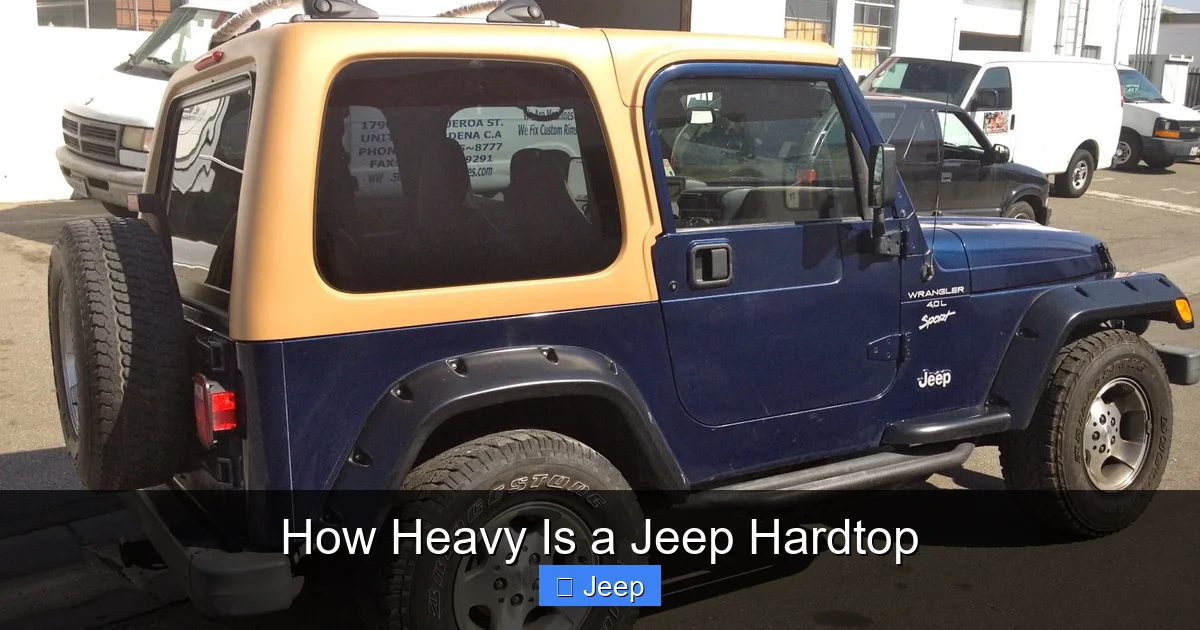
Visual guide about How Heavy Is a Jeep Hardtop
Image source: hardtopdepot.com
Safety and Injury Prevention
A 130-pound object that is 5 feet wide, 4 feet deep, and awkwardly shaped is a biomechanical nightmare. It doesn’t have convenient handles. Your grip points are on the edges, which forces you into an awkward, arms-outstretched posture. This places immense strain on your lower back, shoulders, and knees. The risk of a muscle tear, slipped disc, or dropped top (on yourself or your Jeep) is extremely high if you try to do it alone or without a clear plan. The weight itself is only part of the danger; the awkward leverage is the real killer. A proper hardtop hoist system converts this dangerous, full-body lift into a simple, controlled pull on a rope or winch.
Storage and Your Garage Space
Where will this 120-170 pound, 5’x4’ object live for half the year? You need a dedicated, secure spot.
- Floor Stand: The simplest. It takes up significant floor space (~5’x4’). You’ll need to maneuver the heavy top onto it, which is a two-person, back-breaking job. It’s stable but inefficient.
- Wall-Mounted Rack: The space-saving champion. Gets the top off the floor. Requires strong wall studs and a very solid, purpose-built rack. Lifting the top vertically onto the rack is difficult and risky without assistance or a pulley system.
- Ceiling-Mounted Hoist: The gold standard. Uses a pulley system (often a hand-crank or electric winch) to lift the top straight up and store it against the ceiling. This is by far the safest and most user-friendly method, especially for heavy 4-door tops. The initial installation effort pays off every single time you remove or reinstall the top.
Consider your physical space. If your garage is crowded, a floor stand might not be an option. A ceiling hoist might be your only viable solution. Don’t just think about *having* a place to put it; think about *getting* it there safely.
Impact on Driving Dynamics
Removing the hardtop isn’t just about looks; it changes how the Jeep drives.
- Weight Reduction: Removing a 130 lb top is like taking a small passenger out of the car. You’ll notice a very slight improvement in acceleration and braking. The effect is most noticeable in a smaller-engine Jeep (like a 2.0L turbo or 3.6L V6).
- Fuel Economy: Less weight means the engine works less. You might see a 0.5 to 1.5 MPG improvement, especially in city driving with lots of stops. It’s not huge, but it’s real.
- Center of Gravity: This is the big one. The hardtop’s mass is high up. Removing it lowers the overall center of gravity of the vehicle, which can slightly improve handling stability and reduce body roll in corners. It’s a modest but positive change.
- Noise: Expect significantly more wind and road noise with the soft top or no top. The steel hardtop is a superb sound insulator.
These dynamics are a fun bonus of going topless, but they don’t outweigh the primary reasons for knowing the weight: safety and logistics.
How to Determine Your Specific Hardtop’s Weight
So you want the exact number for your specific Jeep. Here’s how to find it.

Visual guide about How Heavy Is a Jeep Hardtop
Image source: hardtopdepot.com
1. The VIN is Your Best Friend
The most accurate method is to decode your Vehicle Identification Number (VIN). The 10th character is the model year. The 4th-8th characters (the vehicle descriptor section) will indicate body style, engine, and sometimes even the type of top. You can use a free VIN decoder online (like from the NHTSA) or a paid service for more detail. Look for codes indicating “Hard Top” or “Aluminum Hard Top.” Then, cross-reference with factory specification sheets for that specific year and model, which are often found on Jeep enthusiast forums or technical document archives.
2. Weigh It Yourself (The Direct Approach)
If you have access to a public scale (like at a truck stop or recycling center), this is the only way to get a 100% certain number for your modified or aftermarket top.
- Process: Drive your Jeep with the hardtop on to the scale. Get the total vehicle weight. Carefully remove the hardtop (with help!). Drive the empty Jeep back on the scale. Subtract the empty weight from the full weight. The difference is your hardtop’s weight, including any racks or accessories currently attached.
- Caution: This is a heavy, awkward job. Only attempt if you have a safe, level place to store the top immediately after removal and at least one helper. This method is best for those who are already planning to remove it and have their storage solution ready.
3. Community Knowledge (The Jeep Forums)
Forums like JeepForum.com, WranglerForum.com, and specific model-year subforums are treasure troves of real-world data. Search for threads like “Hardtop weight poll [Your Model Year].” You’ll find hundreds of posts where owners have weighed their tops on bathroom scales (by carefully lifting sections) or at scales. This gives you a fantastic average and a feel for the variance. You’ll also find invaluable tips on removal tricks specific to your generation. For instance, you might learn that a certain year’s latch is notoriously sticky, which doesn’t change the weight but makes the process more difficult.
Essential Tools and Techniques for Safe Handling
You know the weight. Now you need the plan. Here’s the essential toolkit for the job, categorized by necessity.
The Absolute Minimum (For the Lightest Tops Only)
If you have a lightweight aluminum or early TJ top and are in excellent shape, you *might* get away with this. But we still advise against it.
- Two (or more) able-bodied adults. Not just two people, but two people who can lift, twist, and carry 70-100 lbs each (the weight is distributed, but each person still handles a significant portion).
- An assistant with a plan. You must agree on commands (“Lift on 3,” “Pivot,” “Set down”).
- A clear, flat, padded area. The ground where you set the top should be soft grass or have moving blankets. Never set it on concrete or gravel.
- Proper footwear. Closed-toe shoes with good grip.
The Recommended Setup (For Most Owners)
This is what we advocate for anyone with a steel hardtop over 100 lbs.
- A Dedicated Hardtop Hoist. This is non-negotiable for 4-door steel tops and highly recommended for 2-door steel tops. A basic ceiling-mounted hoist with four straps costs $150-$300 and is the best safety investment you can make. Brands like TopLift and Smittybilt make excellent systems. It turns a dangerous two-person lift into a simple one-person operation.
- Torx Bit Set (T40, T45, T50 usually). Your hardtop latches and bolts are almost certainly Torx-headed. Have the correct, high-quality bits. Stripping one means you’re stuck.
- Penetrating Oil (e.g., PB Blaster). Spray the latch mechanisms and bolts a few hours before you plan to remove the top. Rust and grime make them incredibly tight.
- Soft straps or a dedicated hardtop sling. If using a hoist, you need straps that won’t scratch the paint. Many hoists come with them. If lifting manually, a wide nylon strap looped under the front and rear provides a better grip than grabbing the thin lip.
- Gloves. Protect your hands from sharp metal edges and pinch points.
The Step-by-Step Mental Checklist
- Prep: Park on level ground. Remove everything from the roof (antenna, lights, racks). Open all doors and the tailgate. Clean the top’s seal from the windshield frame.
- Unlatch: Starting at the front, release the two main latches (usually Torx). Then go to the rear and release the latch(es) there. On some models, you must also release the locking mechanism at the base of the windshield.
- Disconnect: Unplug the rear window defroster and any wiring for roof-mounted accessories. This is a critical step; forgetting this can destroy connectors.
- Lift: If using a hoist, hook the straps, engage the winch, and lift just 1-2 inches. Give the top a gentle front-to-back and side-to-side wiggle to ensure it’s free from the seal. Then lift it straight up until clear of the windshield and roll bar.
- Carry/Store: If carrying manually, one person at the front, one at the rear, lift in unison. Keep the top as vertical as possible. Carry it directly to its storage spot. If using a hoist, guide it to the ceiling rack and lower it into place.
Pro Tip: Always have a third person to guide and watch for obstacles. They can also manage the hoist lines or open garage doors. This is not a two-person job for a 4-door steel top.
Frequently Asked Questions
Can one person remove a Jeep hardtop?
For a 2-door with a lightweight aluminum top, it’s *possible* with a very good hoist system and careful planning. For any steel hardtop, especially on a 4-door, it is strongly discouraged. The weight and awkward size create a high risk of personal injury and vehicle damage. Always use at least two people for steel tops, and a hoist is highly recommended for 4-doors.
Do I need special tools to take off a Jeep hardtop?
Yes, the primary tool is a set of Torx bits (sizes typically T40, T45, and T50). These are required to release the main latches and bolts. A ratchet with a long extension helps reach the rear latches. Penetrating oil is also essential if the top hasn’t been removed in a while to prevent stuck bolts.
Where is the best place to store a Jeep hardtop?
The best place is on a dedicated ceiling-mounted hoist system in your garage. This keeps it off the floor, out of the way, and makes raising/lowering it safe and easy. The second-best option is a sturdy, wall-mounted rack against a strong stud wall. A floor stand is the simplest but uses valuable space and makes lifting the heavy top onto it a difficult task.
Will removing my hardtop affect my Jeep’s warranty?
No. Removing and reinstalling the factory hardtop as intended is a normal user operation and will not affect your vehicle’s warranty. However, if you damage the windshield frame, roof, or paint during removal due to negligence, that specific damage would not be covered.
How much does a Jeep Wrangler 4-door hardtop weigh compared to a 2-door?
A 4-door (Unlimited) hardtop is consistently 20 to 30 pounds heavier than its 2-door counterpart. This is due to the increased length, larger rear window, and additional structural support. A 2-door steel top is ~120-140 lbs, while a 4-door steel top is ~150-170 lbs. The difference is significant enough to impact your removal strategy and storage requirements.
Can I leave my Jeep hardtop on a hoist all summer?
Yes, that is the intended use. A properly installed ceiling hoist is designed to hold the static weight of the hardtop indefinitely. Ensure the hoist is rated for your specific hardtop’s weight (add a safety margin) and that it is securely anchored into ceiling joists or structural beams. Regularly inspect the straps for wear and the hardware for tightness.