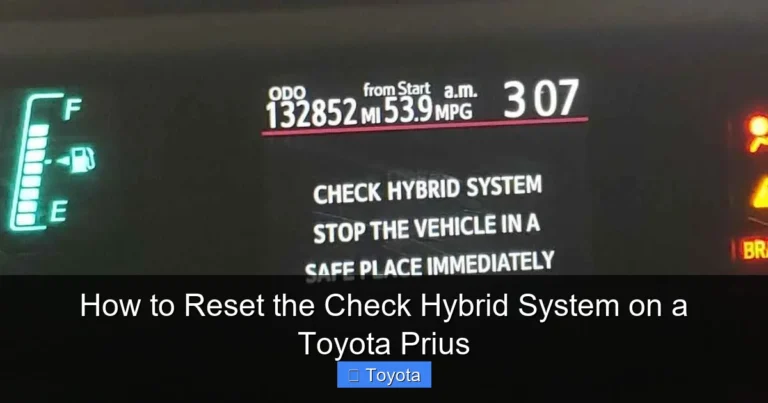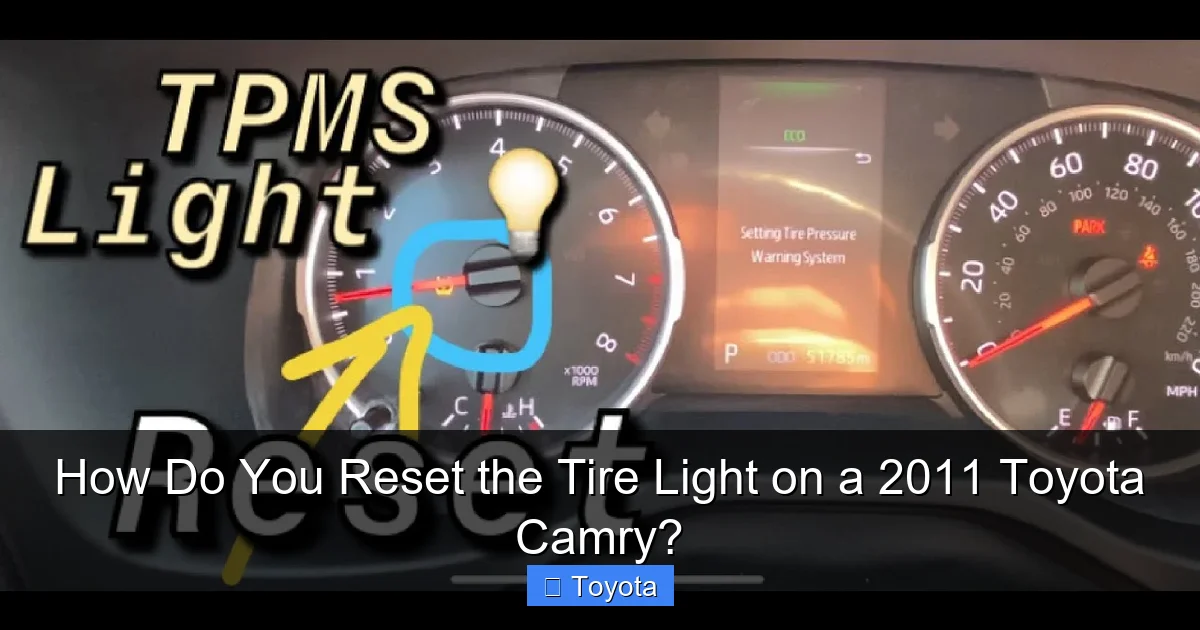
How Do You Reset the Tire Light on a 2011 Toyota Camry?

Contents
- 1 Key Takeaways
- 2 📑 Table of Contents
- 3 Understanding Your 2011 Toyota Camry’s Tire Pressure Monitoring System (TPMS)
- 4 Why Is the Tire Pressure Light On? Common Causes Explained
- 5 Preparing to Reset: Safety First and Tools Needed
- 6 Step-by-Step: How to Reset the Tire Light on Your 2011 Camry
- 7 Troubleshooting: When the Tire Light Won’t Turn Off
- 8 Maintaining Your TPMS and Tires for Long-Term Health
- 9 Conclusion: Safety Over Convenience
- 10 Frequently Asked Questions

LED Emergency Road Flares

Bluetooth FM Transmitter

Car Neck Pillow

Battery Terminal Cleaner
The tire pressure light on your 2011 Toyota Camry illuminates when the Tire Pressure Monitoring System (TPMS) detects a significant drop in one or more tires. Resetting it requires first addressing the cause—usually underinflation—by inflating tires to the correct PSI found on your door jamb sticker. If the light persists after proper inflation, a manual reset via the vehicle’s settings menu or a drive cycle is typically needed. Always prioritize safety; a recurring light may indicate a faulty sensor needing professional attention.
Key Takeaways
- Address the Root Cause First: Never simply reset the light without checking and adjusting tire pressure. The system warns of a real safety issue.
- 2011 Camry Uses an Indirect TPMS: This model relies on wheel speed sensors from the ABS system, not direct pressure sensors in each tire, affecting reset procedures.
- The Reset is a “Relearn” Process: After inflating tires, you must drive the car above 50 mph for 10-15 minutes for the system to automatically recalibrate and turn off the light.
- No Dedicated Reset Button Exists: Unlike some models, the 2011 Camry does not have a physical TPMS reset button; the process is automatic or menu-driven.
- A Scan Tool is a Last Resort: If the light won’t turn off, a professional scan tool may be needed to force a relearn or diagnose a faulty sensor.
- Cold Weather is a Common Trigger: Temperature drops can cause a 1-3 PSI loss per tire, triggering the light even if tires are fine.
- Regular Checks Prevent Issues: Manually check tire pressure monthly with a gauge, as TPMS is a warning system, not a maintenance tool.
📑 Table of Contents
- Understanding Your 2011 Toyota Camry’s Tire Pressure Monitoring System (TPMS)
- Why Is the Tire Pressure Light On? Common Causes Explained
- Preparing to Reset: Safety First and Tools Needed
- Step-by-Step: How to Reset the Tire Light on Your 2011 Camry
- Troubleshooting: When the Tire Light Won’t Turn Off
- Maintaining Your TPMS and Tires for Long-Term Health
- Conclusion: Safety Over Convenience
Understanding Your 2011 Toyota Camry’s Tire Pressure Monitoring System (TPMS)
Before we dive into the “how-to,” it’s crucial to understand what that little yellow tire pressure warning light on your dashboard actually represents. It’s not just an annoying little bulb; it’s a vital safety feature mandated by the TREAD Act following concerns over underinflated tires and their role in accidents. Your 2011 Toyota Camry is equipped with a Tire Pressure Monitoring System, or TPMS. Its primary job is to monitor the air pressure inside your tires and alert you when it falls significantly below the recommended level.
It’s important to know that your 2011 Camry uses what’s called an indirect TPMS. This is a key detail that changes how we approach the reset. Unlike newer models or other brands that have physical pressure sensors mounted inside each wheel (direct TPMS), your Camry’s system is cleverly integrated with the existing Anti-lock Braking System (ABS) wheel speed sensors. The car’s computer (ECU) constantly compares the rotational speed of each wheel. An underinflated tire has a slightly smaller diameter and therefore rotates faster than a properly inflated one. By detecting this minute difference in speed, the system can infer which tire is low and trigger the warning light on your dash. This means there are no battery-powered sensors in the wheels to replace, but it also means the reset process is tied to the car’s ability to “learn” the new rolling characteristics of your properly inflated tires.
This distinction is why the reset process for your Camry is different from, say, a Honda Civic with a direct system. If you own a Honda, you might be familiar with a dedicated reset button behind the steering wheel. Your Camry doesn’t have that. The reset is essentially a relearn cycle. Once the issue is fixed, the system needs to verify that all four tires now have matching rotational speeds, which indicates they are all properly inflated. This verification happens automatically under specific driving conditions.
Why Knowing Your TPMS Type Matters
Understanding that your vehicle uses an indirect system is the foundation for successful troubleshooting. It explains why:
- Rotating tires can sometimes trigger the light: If you swap tires front-to-rear without a subsequent relearn, the system may detect different tread depths or wear patterns as a “difference” and illuminate the light.
- Uneven tire wear can cause false warnings: If your alignment is out or tires are worn unevenly, the system might get confused over the long term.
- The reset is not instantaneous: You can’t just press a button and be done. The car needs to physically drive and collect data.
This knowledge also helps you communicate effectively with a mechanic. If you say, “My TPMS light is on,” they’ll immediately think about sensors. But if you say, “My 2011 Camry’s indirect TPMS light is on after I rotated my tires,” they’ll understand the context is likely a relearn issue, not a sensor failure.
Why Is the Tire Pressure Light On? Common Causes Explained
Okay, so the light is on. Before you try to turn it off, you must figure out why it’s on. This is non-negotiable for safety and to ensure the reset actually sticks. The light is a messenger, not the problem itself. Ignoring it is like ignoring your smoke alarm; you don’t silence the alarm, you find the fire.
Visual guide about How Do You Reset the Tire Light on a 2011 Toyota Camry?
Image source: corwheels.com
1. Underinflated Tires (The #1 Culprit)
This is, by far, the most common reason. Air naturally seeps out of tires over time—about 1 PSI per month is normal. A slow leak from a nail or puncture will cause a more rapid drop. Cold weather is a major trigger; for every 10°F drop in temperature, tire pressure decreases by about 1-2 PSI. So, that light coming on in the morning after a cold snap is often just nature at work. The solution is to check your pressure with a reliable handheld gauge (don’t trust the gas station pump’s accuracy) and inflate to the exact PSI listed on the sticker inside your driver’s side door jamb. This number is your target, not the “max” number on the tire sidewall.
2. Recent Tire Service or Rotation
If you’ve recently had your tires rotated, balanced, or repaired, the TPMS may have lost its “memory” of which wheel is which. The indirect system uses the unique speed signature of each wheel position. After a rotation, the system needs to relearn these new positions. This is a classic scenario where you’ll fix the pressure (which is likely still correct) but the light will stay on until you perform the reset/drive cycle.
3. Faulty or Damaged TPMS Component
While less common in an indirect system (since there are no internal sensors), components can fail. This could be a damaged wheel speed sensor, a problem with the wiring to the sensor, or a fault in the vehicle’s main computer module. If the light is flashing or stays on persistently despite perfect pressure and multiple drive cycles, this is a possibility. Diagnosing this requires a professional scan tool that can read the specific TPMS fault codes.
4. Spare Tire Issues
Some TPMS systems also monitor the spare tire if it’s a full-size, same-size spare mounted on the vehicle. If your spare is low, it could trigger the warning. Check it along with your other tires.
5. Aftermarket Wheires and Tires
If you’ve installed aftermarket wheels or significantly different tires (in size or type), the system’s calibration may be off. The wheel speed sensors might not be reading correctly, or the new tire’s rolling diameter is different enough to cause a persistent false reading.
Internal Link Integration: For those experiencing other common dashboard warnings, our guide on how to reset the airbag light on a Toyota Camry provides a parallel process for a different critical safety system. Both lights require immediate attention to underlying causes.
Preparing to Reset: Safety First and Tools Needed
You’ve diagnosed the likely cause—probably underinflation. Now, let’s get ready for the reset. This phase is all about preparation and safety. Rushing into a “reset” without confirming tire pressure is the #1 reason people have to repeat the process or get frustrated.
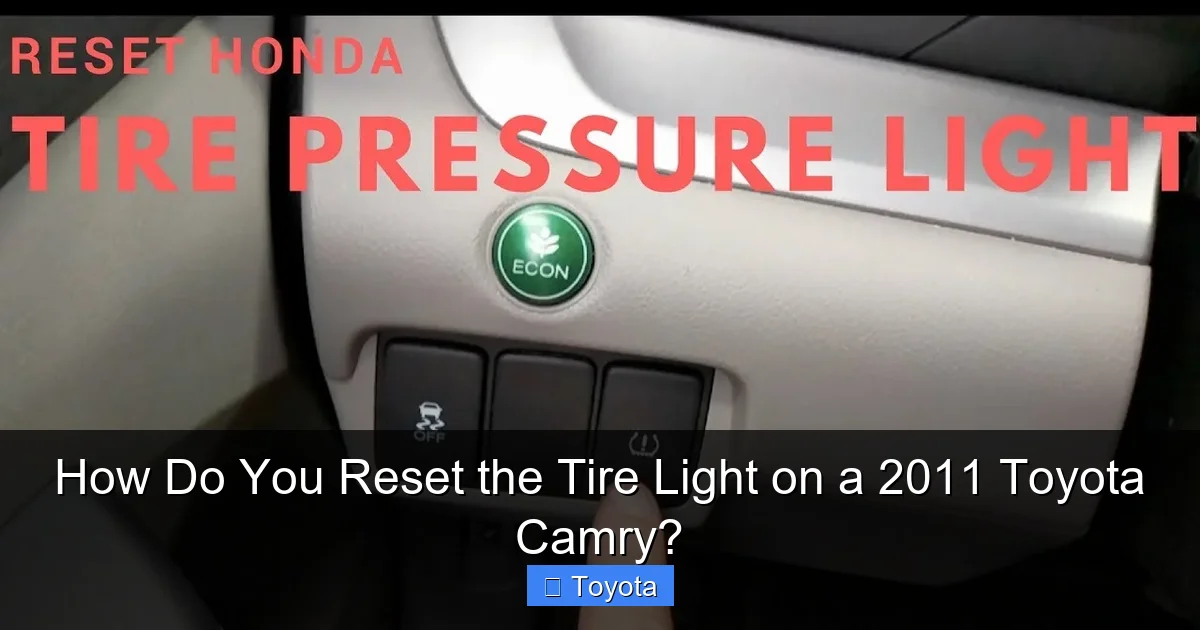
Visual guide about How Do You Reset the Tire Light on a 2011 Toyota Camry?
Image source: i.ytimg.com
Essential Tools & Materials
- A reliable tire pressure gauge: Digital is best for accuracy, but a good quality pencil gauge works. Avoid the ones at gas stations; they are often inaccurate.
- An air compressor: This could be a home floor pump, a portable 12V pump, or access to a quality air hose at a gas station.
- Your vehicle’s owner’s manual: While we’ll cover the steps, your manual has the definitive procedure and the correct PSI for your specific trim level.
- A safe, open driving area: For the drive cycle portion, you’ll need a stretch of road where you can safely maintain 50+ mph.
The Golden Rule: Inflate to the Door Jamb Sticker, Not the Tire Sidewall
This cannot be stressed enough. Look at the tire on your car. On the sidewall, you’ll see something like “MAX PRESSURE 44 PSI.” That is the maximum pressure that tire can safely hold. It is NOT the recommended pressure for your Camry. The correct pressure is on a small sticker or plate attached to the driver’s side door jamb when you open the door. It will say something like “TIRE PLACARD” and list pressures for front and rear tires, often at different loads (e.g., “32 PSI” for normal load). Always use this number. Overinflating based on the tire’s max rating leads to a harsh ride, poor traction, and uneven wear. Underinflating is the danger that triggers your light.
Step 1: Manual Pressure Check and Adjustment
1. Check Pressure When Cold: “Cold” means the car hasn’t been driven for at least three hours or has been driven less than a mile. Driving heats tires and increases pressure, giving a false high reading.
2. Remove the valve stem cap and firmly press your gauge onto the valve stem. Listen for a hiss—that means a poor seal.
3. Record the reading. Do this for all four tires and the spare if it’s a full-size.
4. Compare to the door jamb spec. Note which tires are low.
5. Inflate as needed. Add air in short bursts, rechecking the pressure each time to avoid overinflation.
6. Don’t forget the spare! If it’s a full-size, inflate it to the same pressure as the other tires.
Once all tires are at the exact specified pressure (and you’ve visually inspected for obvious nails or damage), you are ready for the reset procedure. If you found a puncture or a tire that won’t hold air, you must repair or replace it first. The reset will not work or will quickly return if the underlying issue persists.
Step-by-Step: How to Reset the Tire Light on Your 2011 Camry
Now for the main event. Since your 2011 Camry uses an indirect TPMS, there is no button to press under the dash or in the glovebox. The reset is performed by the car’s computer after it verifies the tire pressure is correct via the wheel speed sensors. There are two primary methods: the Automatic Drive Cycle (the standard method) and, if that fails, using an OBD-II Scan Tool (the professional method).

Visual guide about How Do You Reset the Tire Light on a 2011 Toyota Camry?
Image source: tiregrades.com
Method 1: The Standard Automatic Drive Cycle (The Most Common Solution)
This is the procedure Toyota intended for owners. After you have inflated all tires to the correct cold pressure, follow these steps precisely:
- Turn the Ignition On: Insert your key and turn it to the “ON” position (the position right before starting the engine, where all dashboard lights come on). Do not start the engine yet.
- Locate the TPMS Reset Button (If Equipped): Some 2011 Camry models, particularly higher trims, may have a dedicated TPMS reset button. It is typically located under the dash, to the left of the steering column, or sometimes in the glovebox. If you find a small button labeled “TPMS” or with a tire symbol, you can press and hold it for about 3 seconds until the TPMS indicator blinks three times. However, many base and mid-level trims do not have this button. If you cannot find a button, proceed to step 3. The drive cycle is the primary reset method regardless.
- Start the Engine and Drive: This is the critical part. You must drive the vehicle at a steady speed above 50 mph (80 km/h) for at least 10-15 minutes. The system needs time to “listen” to the wheel speed sensors and confirm that all four tires are now rotating at the same rate, indicating equal pressure. During this drive:
- Avoid heavy acceleration or braking.
- Maintain a constant highway speed if possible.
- Do not turn the ignition off during this cycle.
- Check the Light: After completing the drive cycle, turn the car off and restart it. The tire pressure light should be off. If it remains illuminated, repeat the drive cycle once more. If it is still on after two attempts, move to troubleshooting.
Pro Tip: Some owners report better success by first driving for a few minutes at lower speeds (30-40 mph) to warm the tires and sensors slightly before the high-speed segment. The system calibrates best when the tires are at operating temperature.
Method 2: Using an OBD-II Scan Tool (For Persistent Lights)
If the light refuses to turn off after multiple correct drive cycles, the system may need a manual “wake-up” call or there is a deeper fault. This requires a scan tool that can communicate with the TPMS module. This is typically a job for a tire shop, dealership, or a well-equipped DIYer with a high-end scanner like a Launch, Autel, or Snap-on tool.
- Connect the Scanner: Plug the OBD-II scan tool into the port under your dashboard (usually to the left of the steering column).
- Select TPMS Service: Navigate the scanner’s menu to the TPMS or Tire Pressure Reset function. The exact wording varies by brand.
- Choose “Relearn” or “Reset”: The tool will guide you. For an indirect system, it may simply command the ECU to begin a new relearn cycle.
- Follow On-Screen Prompts: You may be asked to confirm tire pressures are correct or to drive the vehicle again. The tool will often indicate success or failure.
Important: A basic “code reader” from an auto parts store will not be able to reset the TPMS. It can only read and clear engine/transmission codes. You need a dedicated TPMS-capable tool.
Troubleshooting: When the Tire Light Won’t Turn Off
You’ve inflated the tires to the perfect PSI. You’ve driven the 50+ mph cycle twice. The light is still glaring at you. Now what? Don’t panic. Let’s systematically eliminate possibilities.
1. Double-Check for Accuracy
This seems simple, but it’s the most common oversight. Use a known-good, high-quality digital gauge. Check pressure when the tires are stone-cold. Compare your reading to the door jamb sticker again. Is the spare tire (if full-size) also at spec? Even one tire being 2-3 PSI low will keep the light on.
2. Inspect for Damage and Slow Leaks
Visually inspect all tires for nails, screws, sidewall bubbles, or punctures. Feel the tread for any foreign objects. If you suspect a slow leak, you can perform a simple “soap test”: apply a soapy water solution to the valve stem and the tread area. If bubbles form, you have a leak that must be repaired before the system will reset.
3. Consider Temperature Effects
Did you set the pressure on a warm day, and now it’s freezing? A 30-degree temperature swing can cause a 3-6 PSI drop. Recheck pressure when it’s cold outside and adjust accordingly. The system is designed to account for minor changes, but a large drop will trigger it.
4. The Reset Button Myth
As mentioned, most 2011 Camrys lack a physical TPMS reset button. Searching frantically for a non-existent button will waste time. The drive cycle is your primary tool. If you do have a button (check your manual or look meticulously under the dash/glovebox), using it after correct inflation may expedite the process, but the drive cycle is still usually required.
5. It Might Be a Different Light
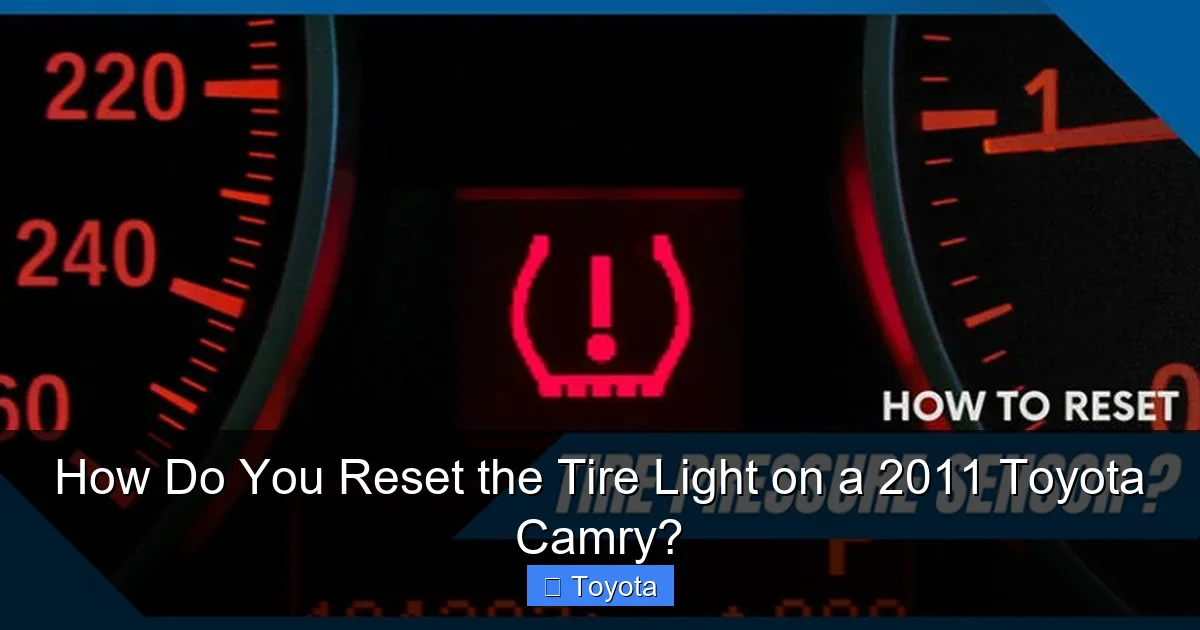
Is the symbol a cross-section of a tire with an exclamation point? That’s the TPMS light. Is it a wrench or “MAINT REQD”? That’s your maintenance reminder, which is entirely different and reset via a different procedure (usually involving the odometer button and ignition). Make sure you’re resetting the correct light. For other Toyota maintenance lights, our general guide on how to reset the maintenance required light on a Toyota covers the common steps for various models.
6. Faulty Sensor or Module (Indirect System)
In an indirect system, the “sensor” is the ABS wheel speed sensor. If one is dirty, damaged, or has a bad connection, it can send erroneous data, making the computer think one wheel is spinning faster. This is less common but possible. A professional scan tool can read the data from each wheel sensor and identify if one is reporting an outlier value. Repairing this involves cleaning the sensor, checking the wiring, or replacing the sensor.
Maintaining Your TPMS and Tires for Long-Term Health
Resetting the light is a reactive task. True car care is proactive. Here’s how to keep your TPMS and tires happy so the light only comes on when it truly should.
Make Manual Pressure Checks a Monthly Habit
Do not rely on the TPMS as your primary check. It’s a warning system, designed to alert you when pressure is already dangerously low (typically 25% below spec). By the time the light comes on, you’ve already lost fuel efficiency, handling, and tire tread life. Use your own gauge once a month and before long trips. This simple habit saves money on tires and gas, and more importantly, keeps you safe.
Understand How Temperature Affects Your Tires
Be proactive with seasonal changes. When fall arrives and temperatures start to drop, check and adjust your pressures. A 10°F drop equals about 1-2 PSI loss. It’s normal to add air in the fall/winter and potentially release a little in the spring/summer. Keeping pressure correct year-round is key.
After Tire Services, Verify the Light
Whenever you get new tires, a rotation, a flat repair, or an alignment, do a quick pressure check and then take the car for a 15-minute highway drive. Verify the TPMS light is off before leaving the shop. If it comes on, ask them to perform the relearn procedure. Reputable shops should do this as part of the service, but it’s good to confirm.
Don’t Ignore a Flashing Light
A solid, steady TPMS light means low pressure. A flashing TPMS light (usually for 60 seconds then solid) often indicates a system malfunction or a sensor failure (more common in direct systems, but possible). If your light flashes upon startup and then stays solid, treat it as a serious issue and have it scanned immediately.
The Spare Tire is Part of the System
If you have a full-size spare mounted on the car, it’s part of the TPMS equation. A low spare will trigger the light. Make it a point to check the spare’s pressure along with your other tires during your monthly check. If it’s a temporary “donut” spare, it’s usually not monitored by the TPMS, but it still needs to be inflated to its own specified pressure (found on the spare itself or in the manual).
Internal Link Integration: For owners of other Toyota models, reset procedures can vary. Our specific guide for how to reset the oil light on a 2011 Toyota Highlander demonstrates another common maintenance reset on a different Toyota platform.
Conclusion: Safety Over Convenience
Resetting the tire pressure light on your 2011 Toyota Camry is a straightforward process, but it’s a process built on a foundation of responsibility. The light exists for one reason: to warn you of a condition that compromises your safety, your tire’s longevity, and your fuel economy. The correct sequence is always: Diagnose → Correct → Reset → Verify.
Start by manually checking and adjusting all tires to the precise PSI on your door jamb sticker. Then, perform the essential drive cycle above 50 mph for 10-15 minutes to allow the indirect TPMS to recalibrate. If the light persists, re-inspect for leaks or damage. If all else fails, a professional scan tool may be required to diagnose a potential fault in the wheel speed sensor circuit.
Remember, a tire pressure warning is not a suggestion. Underinflated tires are a leading cause of tire failure, blowouts, poor handling, and increased stopping distances. By understanding your Camry’s system and following these steps diligently, you ensure that warning light is a reliable guardian, not a nuisance. Keep those tires properly inflated, and your Camry will continue to deliver the safe, reliable ride it’s known for.
Frequently Asked Questions
Can I just press a button to reset the tire light on my 2011 Camry?
Most 2011 Camrys do not have a dedicated physical TPMS reset button. The primary reset method is a drive cycle after correcting tire pressure. Some higher trims may have a button, but the drive is still usually required for the system to learn the new pressures.
How long do I need to drive to reset the tire pressure light?
You must drive at a steady speed above 50 mph (80 km/h) for approximately 10-15 minutes. The system needs this time to compare wheel speed sensor data from all four wheels and confirm they are matching, indicating equal tire pressure.
Why does my tire light keep coming back on after I reset it?
This almost always means the underlying issue wasn’t fixed. Common reasons include: a persistent slow leak (nail, puncture), a faulty valve stem, a damaged wheel speed sensor, or significant temperature changes causing pressure to drop again. You must identify and repair the root cause.
Is it safe to drive with the tire pressure light on?
It is not safe to ignore it. Driving on significantly underinflated tires causes excessive heat buildup, premature tire wear, poor fuel economy, and severely compromised handling and braking. Address the issue immediately by checking your pressures.
Do I need a special tool to reset the TPMS on a 2011 Camry?
For the standard procedure, no. You only need to inflate your tires correctly and complete the drive cycle. A special scan tool is only necessary if the light refuses to turn off after correct inflation and multiple drive cycles, indicating a possible system fault that needs professional diagnosis.
Will rotating my tires trigger the TPMS light?
Yes, it can. Rotating tires changes the position of each wheel and tire assembly. The indirect TPMS needs to “relearn” the new rotational characteristics of each wheel position. After a rotation, check all pressures, then perform the drive cycle to reset the light.