
Can I Put 88 Octane in My Car?

Whether you can put 88 octane in your car depends entirely on your vehicle’s manufacturer specifications. Most modern cars are designed for regular 87 octane fuel and will not benefit from higher octane. However, some high-performance, turbocharged, or luxury vehicles require or recommend premium fuel (often 91 octane or higher). Using a lower octane than required can cause damaging engine knock. Always check your owner’s manual or gas cap for the minimum recommended octane. If your car calls for regular, 88 octane is perfectly safe but offers no performance advantage.
You’re at the pump, finger hovering over the nozzle. The signs read 87, 89, 91, and sometimes an odd 88. Your mind races. “My car runs fine on regular, but is 88 better? Is it safe? What does it even mean?” You’re not alone. The question “Can I put 88 octane in my car?” is a common puzzle for drivers who see that mid-grade option and wonder if it’s a secret upgrade or a potential pitfall. Let’s clear the fog. The short, blunt answer is: it depends on what your car’s manufacturer built it to expect. For about 90% of vehicles on the road, the answer is “Yes, you can, but you shouldn’t because it’s a complete waste of money.” For the other 10%, the answer might be “No, you must use a higher octane.” This guide will walk you through everything you need to know to make a smart, confident choice at the pump, protecting your engine and your wallet.
Key Takeaways
- Octane measures knock resistance, not energy content: Higher octane fuels resist premature combustion (knock) under high pressure, which is critical for high-compression engines.
- Most cars are designed for 87 octane: The vast majority of standard economy and commuter vehicles run optimally on regular unleaded. Using higher octane is a waste of money.
- Using lower octane than required risks engine damage: If your manual specifies “Premium Required,” consistently using regular can cause sustained knock, leading to piston or rod bearing damage over time.
- 88 octane is a mid-grade fuel: It’s less common than 87 (regular) and 91/93 (premium). Its value is only relevant if your manufacturer recommends it specifically, which is rare.
- Your car’s requirement is non-negotiable: The “Recommended” or “Required” fuel type in your manual is an engineering specification, not a suggestion. Follow it exactly.
- Knock sensors provide a safety net, not a license: Modern cars can adjust timing to prevent damage from low octane, but you’ll suffer severe power and fuel economy loss.
- When in doubt, consult the manual or a dealer: Never guess. A quick call to your dealership’s service department can give you a definitive answer for your specific VIN.
📑 Table of Contents
- Understanding Octane Ratings: What Does 88 Octane Mean?
- Your Car’s Fuel Requirement: What Does the Manufacturer Say?
- The Risks of Using Lower Octane Than Required
- When Higher Octane (Like 88) Might Be Beneficial
- 88 Octane vs. Other Grades: 87, 89, 91, and 93
- Practical Tips: How to Choose the Right Gas for Your Car
- Conclusion: The Bottom Line on 88 Octane
Understanding Octane Ratings: What Does 88 Octane Mean?
First, let’s demystify the number. Octane is not a measure of power, energy, or “quality” in the way we often think. It is purely a measure of a fuel’s resistance to knocking. Also known as “pinging” or “pre-ignition,” engine knock is a metallic rattling sound that occurs when the air-fuel mixture in a cylinder ignites prematurely due to heat and pressure, before the spark plug fires. This collision of two flame fronts creates a shockwave that can be incredibly destructive to pistons, rings, and rod bearings over time.
The Science in Simple Terms
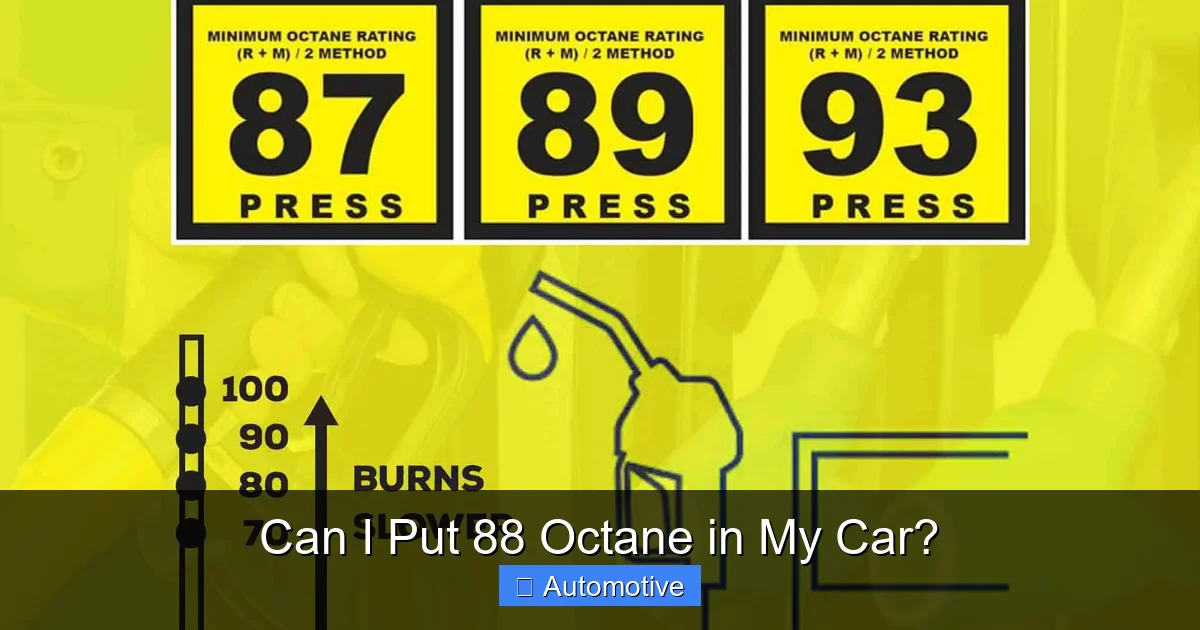
Think of an engine like a giant, incredibly precise air pump. On the power stroke, the piston is forced down by the controlled explosion of the compressed air-fuel mixture. High-compression engines (like those in sports cars or turbocharged vehicles) squeeze this mixture much tighter, creating more heat and pressure. This environment makes the mixture more likely to ignite on its own. Higher octane fuel has a higher threshold for this spontaneous ignition. It can withstand more pressure before knocking. Regular 87 octane fuel is formulated for standard compression ratios. Mid-grade 88 or 89 octane sits in the middle. Premium 91-93 octane is for the highest compression engines.
Why You See 88 and Not Just 87/89
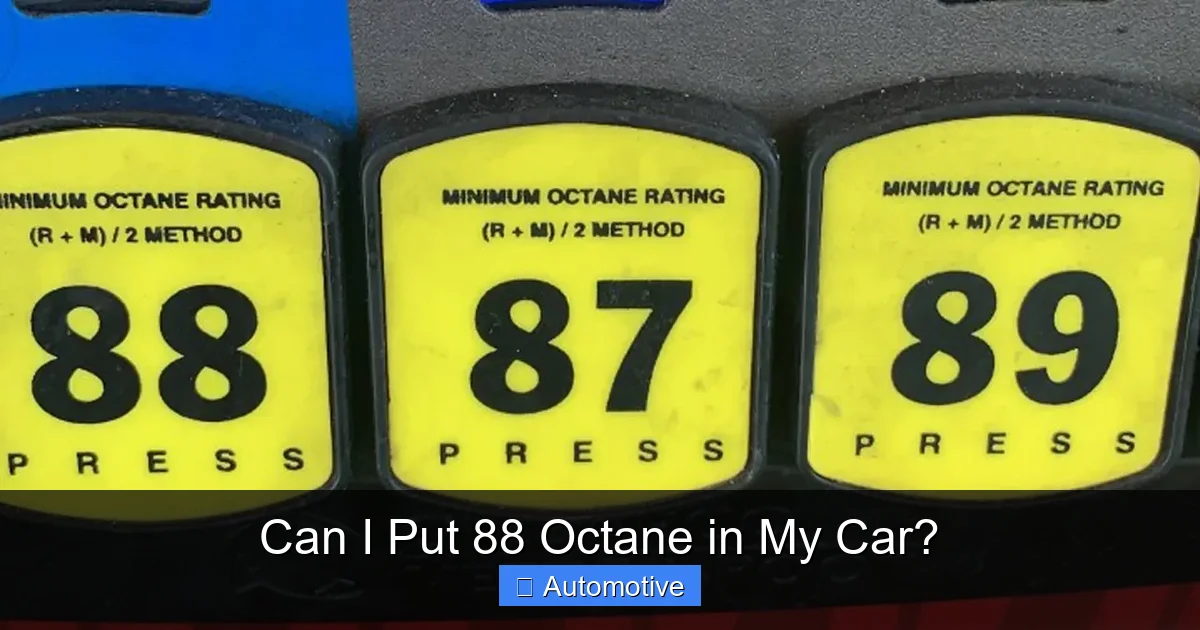
Fuel formulations vary by region and refinery process. In many parts of the United States, the standard grades are 87 (regular), 89 (mid-grade), and 91 or 93 (premium). However, some states or specific gas station chains offer an 88 octane mid-grade. This is often simply a blending of 87 and 89 or 91. It has no special magic. Its existence is a logistical and marketing choice, not an engineering one. There is no universal “88 is better” rule. Its value is defined solely by your car’s manual.
Your Car’s Fuel Requirement: What Does the Manufacturer Say?
This is the only section that matters. Your car’s engine was engineered with a specific compression ratio, boost pressure (for turbos), and combustion chamber design. The engineers calculated the exact minimum octane rating needed to prevent knock under all normal operating conditions. They documented this in your owner’s manual. This is your single source of truth.
Visual guide about Can I Put 88 Octane in My Car?
Image source: myfox8.com
Where to Find Your Car’s Requirement
You have three easy places to check:
- The Owner’s Manual: Look in the “Fuel” or “Specifications” chapter. It will state “Regular Unleaded,” “Premium Unleaded Required,” or “Premium Unleaded Recommended.”
- The Gas Cap or Fuel Filler Door: Many cars have a label right on the fuel door or cap that states the required octane. It might say “87 Octane” or “Premium Fuel Only.”
- The Dealer: Call your local dealership’s service department. Give them your Vehicle Identification Number (VIN), and they can tell you definitively.
For example, a base model 2022 Toyota Camry will almost certainly list “87 Octane Recommended.” A 2022 BMW 330i will list “91 Octane Required.” A 2022 Ford F-150 with the EcoBoost turbo engine might list “87 Octane Recommended, but 91 Octane Recommended for best performance.” The nuance is critical.
“Recommended” vs. “Required”
This distinction is everything. “Required” means you must use that octane or higher. Using a lower grade risks engine damage and will likely trigger the check engine light for knock detection. “Recommended” means the manufacturer suggests that octane for optimal performance, fuel economy, and emissions. You can use a lower octane in an emergency, but you will experience noticeable power loss and poor fuel economy as the engine’s computer retards timing to prevent knock. For a “Recommended” vehicle, 88 octane is perfectly acceptable if it meets or exceeds the minimum (e.g., if minimum is 87).
The Risks of Using Lower Octane Than Required
Let’s be clear: if your car requires premium (91+), and you put in 88 octane, you are playing with fire—literally. The engine’s knock sensors will detect the early combustion and try to compensate by pulling ignition timing. This makes the engine run inefficiently, hotter, and with significantly less power. You’ll feel it as sluggish acceleration and a “soggy” throttle response. Your fuel economy might drop by 10-15% or more, erasing any cost savings from using cheaper gas.

Visual guide about Can I Put 88 Octane in My Car?
Image source: cdn.thedailyautomotive.com
The Knock Event and Long-Term Damage
Under heavy load—like merging onto a highway, climbing a steep hill, or towing—the engine is under maximum stress. If the low-octane fuel still knocks despite the computer’s adjustments, you get sustained, destructive knock. This isn’t just an annoying noise; it’s a mechanical hammer blow inside your engine. Over time, this can:
- Wear piston skirts and cylinder walls.
- Damage piston rings, leading to oil consumption.
- Crack or melt pistons.
- Damage connecting rod bearings.
Repairing this kind of damage means a complete engine rebuild or replacement—a cost of thousands of dollars. It’s the ultimate false economy.
The “Check Engine Light” Warning
Your car’s computer is smart. When it detects persistent knock, it will store a diagnostic trouble code (often P0300-P0304 for misfire or specific knock codes) and illuminate your check engine light. This is your final, unambiguous warning to switch to higher octane immediately. Ignoring it guarantees progressive damage.
When Higher Octane (Like 88) Might Be Beneficial
Now, let’s flip the scenario. Are there cases where 88 octane is a good idea, even if 87 is the minimum? Yes, but they are specific.
Visual guide about Can I Put 88 Octane in My Car?
Image source: partsavatar.ca
For Vehicles that “Recommend” Premium
Many modern cars with advanced technology (like direct injection, variable valve timing, or mild hybrids) have engines that are efficient on 87 but produce more power and efficiency on 91+. The manufacturer states 87 is “acceptable” for daily driving, but 91+ is “recommended” for max performance. If you drive a car like this (some newer Honda 2.0T engines, certain Subaru models), using 88 octane would be a step up from 87, but not the full step to 91. You might see a tiny, likely imperceptible, improvement. The real benefit comes from using the recommended 91 octane. 88 is a half-measure that doesn’t fully unlock the engine’s design potential.
For High-Altitude or Extreme Heat Situations
Octane needs can change with environment. At high altitudes (like in Denver), air is thinner, which slightly reduces cylinder pressure and the tendency to knock. You might get away with a lower octane. Conversely, in extreme heat (Arizona summers), air is less dense for the intake but engine bay temperatures are higher, potentially increasing knock tendency. If you’re in a borderline situation (car “recommends” premium), using 88 in very hot conditions might be safer than using 87, but the proper solution is still to use the recommended 91.
For Cleaning Additives (A Minor Point)
Some premium fuels contain higher levels of detergent additives to help keep intake valves clean, especially in direct-injection engines. If 88 octane at a particular station is their “mid-grade” that is simply blended from lower-detergent regular and higher-detergent premium, it might have average detergent levels. This is not a reliable reason to choose 88. For intake cleaning, use a dedicated fuel additive or choose a top-tier premium brand known for strong detergents.
88 Octane vs. Other Grades: 87, 89, 91, and 93
Let’s do a direct comparison to put 88 in context.
The Standard Ladder (87-89-91/93)
- 87 (Regular): The baseline. For engines with compression ratios typically up to 10:1 or naturally aspirated engines without forced induction.
- 88/89 (Mid-Grade): An intermediate step. Historically used for some older “high-compression” engines of the 80s and 90s that needed more than 87 but before 91 became the standard premium. Today, it’s largely a filler grade. Very few modern production cars list 88 or 89 as the minimum requirement.
- 91/93 (Premium): For high-compression (often 11:1+), turbocharged, or supercharged engines. “Required” for many luxury and performance vehicles. 93 is common on the East Coast; 91 is standard on the West Coast. They are functionally similar for most purposes.
Is 88 a “Sweet Spot”?
No. There is a myth that mid-grade fuels offer the best balance of price and performance. This is not based on modern engineering. If your car needs 91, 88 is too low. If your car is fine on 87, 88 is overkill. The only scenario where 88 is the exact target is if your owner’s manual, gas cap, or dealer explicitly states “88 Octane Minimum.” This is exceptionally rare for post-2000 vehicles but was more common in the 1990s for certain models like some Chrysler LH platform cars (Intrepid, Concorde) or older GM V6s. Do not assume this. Verify for your specific model and year.
Practical Tips: How to Choose the Right Gas for Your Car
Armed with knowledge, here is your actionable checklist.
Step 1: Identify Your Requirement (The Non-Negotiable)
Find that manual or gas cap label. Is it “87,” “87 Recommended,” “Premium Required,” or “91 Octane Minimum”? This is your baseline. If it says “Premium Required,” your minimum is 91 (or 89 in some regions). 88 is insufficient. If it says “87 Recommended,” your minimum is 87. 88 is acceptable but not beneficial.
Step 2: Consider Your Driving Style (The Nuance)
If you have a car that “recommends” premium (e.g., some turbocharged engines), and you frequently drive hard—rapid acceleration, high speeds, mountain roads—using the recommended premium (91+) will give you the performance and fuel economy you paid for. If your driving is all gentle commute miles, 87 will suffice with a small penalty. 88 sits in an awkward middle ground that doesn’t fully solve either need.
Step 3: Listen to Your Engine (The Diagnostic)
If you’re unsure and have been using a lower grade, listen for pinging or knocking under acceleration, especially when warm or under load. If you hear it, immediately switch to a higher octane. If you don’t hear it, and your car has no check engine light, you are likely on the safe side for now, but you should still confirm the manual requirement.
Step 4: Don’t Be Fooled by Brand or “Detergent” Claims
All major brands in the US must meet federal minimum detergent standards. “Top Tier” gasoline (a voluntary standard adopted by most major brands) has higher detergent levels. This is good for engine cleanliness, but it is separate from octane. A Top Tier 87 is better for your engine than a non-Top Tier 91. Choose a Top Tier brand, then choose the octane your car needs. This is where understanding your oil is also crucial. Using the correct fuel is just one part of engine care; using the correct oil is equally vital. You can learn more about selecting the right oil for your vehicle in our detailed guide on what kind of oil to use.
Step 5: Regional Availability and “What If” Scenarios
If you’re traveling and 88 is the only mid-grade available, and your car requires 89, you might be in a tight spot. For a short period, you can use 88 but drive gently. If your car requires 91, 88 is a definite no-go. You must find 91 or use an octane booster additive (a temporary fix, not a solution). If your car runs on 87, any higher octane is fine but unnecessary.
Conclusion: The Bottom Line on 88 Octane
The pump dilemma is simple once you know your car’s requirement. For the overwhelming majority of drivers, the answer to “Can I put 88 octane in my car?” is “Yes, but don’t bother.” If your manual calls for regular 87, stick with 87. It’s cheaper and your engine is optimized for it. Pouring 88 into a Honda Civic is like filling a water bottle with sports drink—it works, but you’re not getting any extra benefit for the extra cost.
For the minority with cars that require or strongly recommend premium (91+), 88 octane is not a suitable substitute. It is below the threshold your high-performance engine needs to run safely and efficiently. Using it risks knock, poor performance, and long-term damage. If your car’s requirement is a specific 88 or 89 octane (rare in modern cars), then yes, 88 is your minimum. But verify this from an authoritative source, not from a gas station sign.
Ultimately, the power is in your owner’s manual. Respect the engineering that went into your vehicle. Use the fuel it was designed for. Your engine will run smoothly, efficiently, and last longer. And your wallet will thank you for not pouring unnecessary money down the filler neck. When it comes to fuel, there is no “better safe than sorry” with higher octane—there is only “correct” or “incorrect.” Know the difference.
Frequently Asked Questions
Is 88 octane gasoline the same as 89?
No. Octane ratings are precise measurements. 88 octane has a slightly lower knock resistance than 89 octane. While the difference is small, for an engine with a specific requirement, it can be the difference between smooth operation and damaging knock. Always use the minimum octane stated in your manual.
Will using 88 octane instead of 87 clean my engine better?
Not necessarily. Detergent additives are not directly tied to octane level. A Top Tier 87 octane fuel has as many or more cleaning additives as a mid-grade 88. Engine cleanliness depends on the brand’s Top Tier status, not the octane number. For cleaning, choose a Top Tier brand of the correct octane for your car.
My car says “Premium Recommended.” Can I use 88 octane?
You can, but it’s not ideal. “Premium Recommended” means your minimum is 87, but for best performance and fuel economy, use 91+ (premium). Using 88 is better than 87 but worse than 91. You’ll likely see a minor improvement over 87 but will not achieve the engine’s designed performance. The cost savings vs. performance trade-off usually favors using the recommended 91.
What happens if I accidentally put 88 octane in a car that requires 91?
If you only fill the tank once, the car will likely run on it without immediate catastrophic damage due to knock sensors adjusting timing. However, you will experience severe power loss, poor fuel economy, and a possible check engine light. Do not continue to use it. Once you’ve used a quarter-tank, refill with the correct 91+ octane as soon as possible. Repeated use will cause damage.
Is there any benefit to using 88 octane in a car that only needs 87?
No. There is zero performance, power, or fuel economy benefit. The engine’s computer is calibrated for 87. Using a higher octane does not advance the timing or increase power. It simply burns differently in an engine not designed to take advantage of it. You are only spending more money per gallon for no return.
How can I be 100% sure my car needs 88 octane?
You can’t rely on gas station signs. The only way to be sure is to check your official owner’s manual or the label on your fuel filler door. If it specifies “88 Octane Minimum” or lists a specific octane number, follow it. If it says “87” or “Regular,” you do not need 88. For absolute certainty, call your dealer with your VIN. Never guess based on model year or car type alone.