
How Do You Manually Open the Trunk of a Toyota Highlander?

If your Toyota Highlander’s power trunk or key fob fails, you can still access your cargo area manually. Most models have a hidden interior release handle behind the trunk lid or inside the cargo area. For older models, a physical key in the door lock often works too. Always check your owner’s manual for your specific model year’s exact location, as designs changed over time.
Picture this: you’re standing in a crowded parking lot, groceries in hand, your key fob’s battery is dead, and your Toyota Highlander’s fancy power liftgate just clicks and refuses to budge. Panic sets in for a second. But what if we told you there’s a secret, low-tech way back into your cargo space that doesn’t require calling a locksmith or breaking a window? That’s right. Your Highlander has a built-in manual trunk opening system, designed specifically for moments like these. It’s a feature that’s easy to forget exists until you need it most. This guide will walk you through every possible method, from the simple to the less obvious, ensuring you’re never locked out of your trunk again. We’ll cover all generations, from the early 2000s models to the latest 2024 Highlander, because the location and method have evolved.
Key Takeaways
- Two Primary Manual Methods: You can typically open the trunk either via an interior release handle (often hidden behind a trim panel) or, on older models, by using the physical key in the driver’s door lock which may trigger the trunk release.
- Location Varies by Model Year: The exact position of the manual release cable or handle changed between generations. A 2014-2020 Highlander differs from a 2021+ model, so your owner’s manual is the final authority.
- Safety First: Never attempt to force the trunk lid or pry panels if you’re unsure. You can damage the latch mechanism, wiring, or exterior paint, leading to costly repairs.
- Dead Battery Protocol: A completely dead 12V battery often disables all electronic releases. The manual interior release is your primary backup in this scenario, as it operates via a mechanical cable.
- Lost Key Fob Solution: If your key fob is lost inside the car, the manual interior release is your only way to retrieve it without breaking a window. This is a critical feature to know.
- Preventative Tip: Periodically locate and test your manual trunk release (with the trunk open) to ensure you know its position and that the cable isn’t seized.
- Not All Trunks Are Equal: The power liftgate on newer Highlanders adds complexity. The manual override is specifically for when that power system fails; it does not bypass a completely locked mechanical latch.
📑 Table of Contents
- Understanding Your Highlander’s Trunk System: Power vs. Manual
- The Primary Method: Locating and Using the Interior Manual Release
- Alternative & Older Methods: The Key Fob and Door Lock
- Troubleshooting: What to Do When the Manual Release Seems to Fail
- Prevention and Maintenance: Never Get Caught Off Guard
- When Manual Methods Aren’t Enough: Professional Solutions
- Conclusion: Empowerment Through Knowledge
Understanding Your Highlander’s Trunk System: Power vs. Manual
Before we dive into the “how-to,” it helps to understand the “why.” Modern vehicles like the Toyota Highlander prioritize convenience with power-operated liftgates. A button on the key fob, a switch on the door, or a foot-sensor under the bumper activates an electric motor that unlatches and raises the heavy trunk lid. This system relies entirely on your vehicle’s 12-volt battery and electronic circuitry. When that system fails—due to a dead battery, a blown fuse, a faulty latch motor, or a lost key fob—the manual override becomes your best friend. This override is a purely mechanical connection, usually a steel cable, that runs from a hidden lever or handle inside the vehicle directly to the trunk latch mechanism. Pulling it physically moves the latch, just like the power motor would. Think of it as a failsafe, a direct line to the mechanism that bypasses all the electronics. It’s important to know that this manual system is for *opening* the trunk from the *inside* of the vehicle. It is not a method for locking or unlocking the trunk lid from the outside when the key fob is dead (though some models have a keyhole on the trunk lid itself).
Generational Differences: Why Your Year Matters
The Toyota Highlander has gone through several major redesigns since its 2000 debut. The location and design of the manual trunk release reflect the interior styling of each generation.
- First Generation (2000-2007): These models often have a simple, visible trunk release lever on the driver’s side interior panel, near the floor. It might be a bright red or yellow T-handle. On some, you use the physical key in the driver’s door lock, turning it to the left or right to pop the trunk.
- Second Generation (2008-2013): The interior became more integrated. The manual release was frequently hidden behind a small plastic trim panel on the driver’s side cargo wall, near the tailgate. It was a small, unmarked flap you’d pull to reveal a cable handle.
- Third Generation (2014-2020): With the introduction of the standard power liftgate on most trims, the manual release became even more discreet. It’s commonly located behind a rectangular or square access panel on the *left-hand side* (driver’s side in US models) of the cargo area, near the top where the trim meets the glass. The panel might have a small groove to pry it off with a fingernail or a flat tool.
- Fourth Generation (2021-Present): The current Highlander continued the trend. The manual trunk release cable is typically behind a similar access panel on the driver’s side cargo wall. However, the panel’s design and clip type may vary. Some models also feature a secondary emergency release *inside* the trunk compartment itself, designed for child safety (to prevent accidental locking), which is a different mechanism.
This variation is why consulting your owner’s manual is the golden rule. It will have a diagram and exact instructions for your specific vehicle identification number (VIN). If you don’t have the manual, a quick online search for “[Your Year] Toyota Highlander trunk manual release location” will often yield forum posts with photos from other owners.
The Primary Method: Locating and Using the Interior Manual Release
This is the method you’ll use 90% of the time when the power is out. It requires you to have access to the vehicle’s cabin, which you should if you have the keys (even if the fob is dead) or if you’re locked out but can get in via another door (if you have the physical key hidden somewhere).
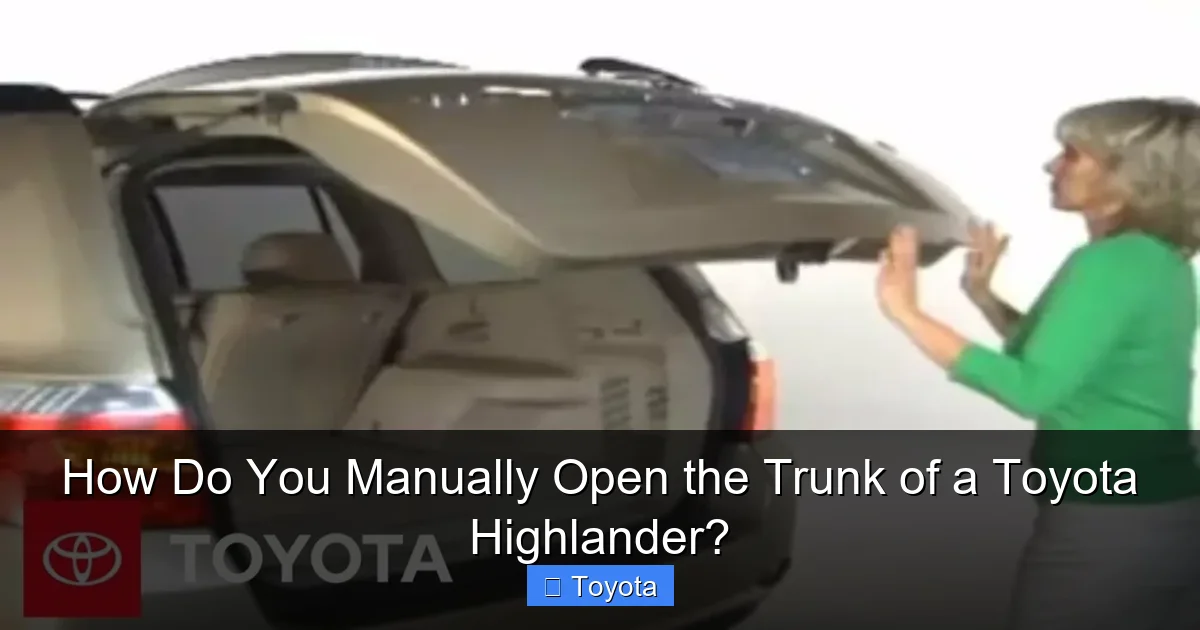
Visual guide about How Do You Manually Open the Trunk of a Toyota Highlander?
Image source: diycarexpert.com
Step-by-Step: Finding the Access Panel
First, you need to get into the cargo area. If the power liftgate is stuck closed, you’ll need to fold down the rear seats. In most Highlanders, the rear seatbacks have a release lever or button on the top edge. Pull it and fold the seat forward. Now crawl into the trunk space. You’ll be looking at the interior side of the closed trunk lid and the side panels.
For 2014-2024 models, focus on the driver’s side (left side) panel. Run your fingers along the trim about halfway up, near where the rear window meets the body. You’re feeling for a small, rectangular plastic panel, roughly 2×3 inches, that is slightly recessed and may have a tiny notch or seam. It’s often the same color and texture as the surrounding carpeted or plastic trim, making it blend in.
Prying the Panel Open Safely
Do not use a metal tool like a screwdriver, as you risk scratching the paint on the inside of the trunk lid or cracking the plastic. Your fingernail might work if it’s strong. The best tool is a plastic trim removal tool, a old credit card, or even a plastic spudger from a phone repair kit. Gently insert the tool into the seam or notch and pry outward. The panel is held by 2-4 plastic clips. You’ll hear them pop. Work your way around the edges. Once free, set the panel aside carefully. You should now see a hole with a metal cable ending in a plastic T-handle or loop.
Pulling the Cable: The Critical Action
This is the moment of truth. Grasp the handle firmly. You will need to pull it *firmly and decisively* in the direction that the cable runs (usually towards the rear of the vehicle, but sometimes to the side). You should feel a solid resistance followed by a distinct clunk or click as the latch mechanism disengages. Do not just tug lightly; a half-hearted pull often won’t overcome the spring tension in the latch. If you pull and feel nothing but constant tension, you may have the wrong handle (some vehicles have multiple cables for seat releases) or the cable could be broken/disconnected. If you hear/feel the click, immediately go to the rear of the vehicle. The trunk lid should now be unlatched and you can lift it manually. It will not have hydraulic support, so be prepared for the full weight of the lid. Use your free hand to guide and lift it.
Alternative & Older Methods: The Key Fob and Door Lock
Before you go crawling into the trunk, always try these simpler methods first, as they don’t require any disassembly.

Visual guide about How Do You Manually Open the Trunk of a Toyota Highlander?
Image source: wonder007.com.tw
Using the Physical Key Hidden in Your Fob
Most Toyota Highlander key fobs from the 2010s onward have a hidden mechanical key inside. Press the button on the fob to release the emergency key. This key is not for starting the car (in most modern models), but it can operate the driver’s door lock and, in many cases, the trunk. On many Highlanders, inserting this key into the driver’s door lock and turning it to the unlock position twice in quick succession will activate the trunk release solenoid. This is a common feature in Toyota vehicles. Try it: insert key, turn to unlock (counter-clockwise in US), remove, then immediately insert and turn again. Listen for a faint “thump” from the trunk area. If you hear it, the trunk is now unlatched. This method works even with a completely dead battery because it’s a direct mechanical link to the door lock cylinder, which then triggers a separate, low-power circuit for the trunk release.
The Classic “Driver’s Door Lock” Trick (Pre-2014)
For first and second-generation Highlanders (2000-2013), the process was often even more direct. These models frequently had a trunk release button on the driver’s door panel. If the power was out, you could use the physical key in the door lock itself. Inserting the key and turning it to the unlock position and holding it for a second or two would often directly pop the trunk. This was a mechanical linkage, not electronic. If your older Highlander has a separate trunk lock cylinder on the lid itself (rare but possible on base models), the physical key will work there too.
What About the External Trunk Button?
The button on the trunk lid itself (if equipped) is almost always powered. A dead battery means this button will do nothing. Do not waste time pressing it if you know the battery is dead or the liftgate is inoperative. Your efforts are better spent finding the interior manual release.
Troubleshooting: What to Do When the Manual Release Seems to Fail
So you found the cable, pulled it hard, heard the click, but the trunk still won’t open? Don’t panic. There are a few logical steps.
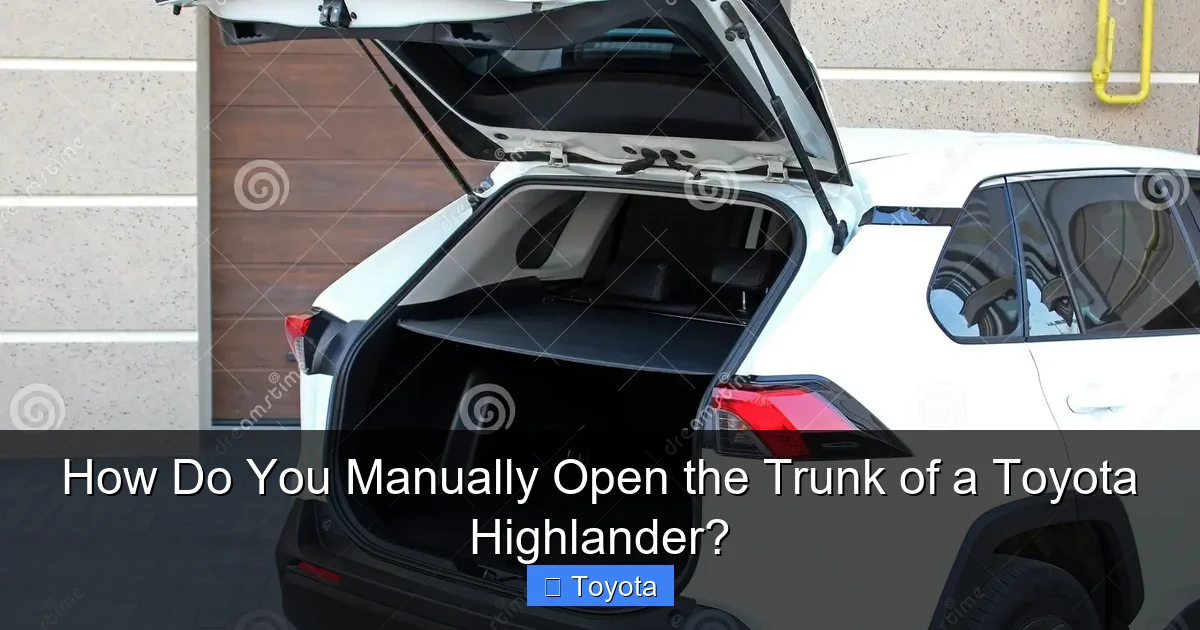
Visual guide about How Do You Manually Open the Trunk of a Toyota Highlander?
Image source: thumbs.dreamstime.com
The “Double-Check” Procedure
First, ensure you pulled the correct cable. In some cargo areas, there might be a cable for folding the rear seats or releasing the rear window. The trunk release cable is usually the only one with a T-handle or a loop large enough to grip firmly. Second, go to the trunk and try lifting the lid *immediately* after pulling. Sometimes the latch spring is weak and the lid can stick if you wait too long. Place both hands on the lid, near the latch, and push up firmly while pulling the cable with your other hand. Third, have someone inside pull the cable while you try to lift from the outside. The combined force can sometimes free a sticky latch.
Inspecting for Physical Damage
If the cable pulls with no resistance (like it’s detached) or excessive resistance (like it’s broken inside the sheath), the failure is mechanical. You may have a broken cable or a latch that is physically jammed (e.g., by ice, snow, or debris). In this case, your options are limited. You may need to call a locksmith or a tow truck. A professional might access the latch from the outside by removing the trim on the trunk lid itself, but this is complex and risks damage. If the cable is simply seized from lack of use, a penetrating lubricant like PB Blaster sprayed into the cable sheath at the latch end (you’d need to access that from underneath or by removing the inner trunk panel) might help, but this is an advanced repair.
The Ultimate Last Resort: Folding the Seats and Accessing from Inside
Remember, the manual release is designed to be used from inside the cargo area. If you can get into the cargo area by folding the rear seats (even if the trunk lid is latched), you can then use the manual release to open the lid from the inside. This is the standard procedure. If your rear seats are locked in the upright position and won’t fold, you have a bigger problem. You’d need to access the seat release mechanisms from the trunk side, which is often possible by peeling back a small piece of trim on the side of the seatback. This is getting into advanced territory, and at this point, professional help is strongly recommended to avoid damaging interior components.
Prevention and Maintenance: Never Get Caught Off Guard
The best strategy is to be prepared. Knowledge is your primary tool, but a little maintenance goes a long way.
Locate and Test Your Release Annually
Once a year, with the trunk open and the car running (to keep the battery charged), have a friend hold the trunk lid up while you go inside. Find the access panel and the cable. Pull it firmly. Does it release the latch smoothly? Does it feel stiff or gritty? This simple test ensures the cable isn’t corroded or seized and confirms you know exactly where it is in an emergency. Doing this in the daylight is much easier than fumbling in the dark during a crisis.
Keep a Spare Key Fob Battery
The most common cause of a “dead” trunk is a dead key fob battery. These are cheap (usually a CR2032) and easy to replace. Keep a spare in your glove compartment. Replacing the battery in your primary fob takes two minutes and solves the problem instantly. This is the simplest, most effective preventative measure.
Understand Your Vehicle’s Specifics
Spend 10 minutes with your owner’s manual’s “Trunk” or “Liftgate” section. Find the diagram. Is there a keyhole on the trunk lid? Is there a secondary release inside the trunk for child safety locks? Knowing these details removes all guesswork. You can also check online forums specific to your Highlander model year (e.g., “2018 Highlander manual trunk release”) where owners share photos and exact locations. For instance, owners of certain trims might discover their release is behind a different panel than the base model.
When Manual Methods Aren’t Enough: Professional Solutions
There are rare scenarios where even the manual cable won’t work: a broken cable, a severely corroded latch mechanism, or a latch that is physically locked due to an accident or impact. In these cases:
- Roadside Assistance: If you have a Toyota Safety Connect subscription, a Toyota roadside assistance call might be your fastest route. They have master keys and tools for many models.
- Locksmith: A reputable automotive locksmith can often manipulate the latch from the outside or create a new key if you’ve lost all keys. This is usually less expensive than a tow to a dealer.
- Dealership: The dealer will have the exact diagrams and master keys. They can diagnose if the latch motor needs replacement or if the cable is broken. This is the most expensive option but guarantees a factory-correct repair.
- Tow Truck: If you need to get the vehicle to a shop, a flatbed tow is the only safe way. Do not try to drive with a trunk that won’t open if you need to secure cargo inside.
It’s also worth noting that if your Highlander’s battery is completely dead, you may not be able to unlock the doors with the key fob either. The physical key in the door lock is your gateway to the cabin and, subsequently, to the manual trunk release. Always ensure you can access the cabin first.
Conclusion: Empowerment Through Knowledge
Your Toyota Highlander is a robust, well-engineered vehicle, and its manual trunk release is a testament to thoughtful design—a simple, reliable backup for when high-tech fails. The core takeaway is this: find it, test it, and know it. Spend a few minutes now to locate that small access panel on the driver’s side cargo wall. Familiarize yourself with the feel of the cable and the sound of the latch releasing. This small investment of time provides immense peace of mind and saves you from the stress, expense, and inconvenience of being locked out of your own vehicle’s cargo space. Remember, a dead battery is the most common culprit, so keep that spare key fob battery handy. And when in doubt, your owner’s manual is your most reliable co-pilot. Now, go forth with the confidence that no stuck trunk can keep your Highlander’s cargo from you.
Frequently Asked Questions
Can I manually open the trunk if the Highlander’s battery is completely dead?
Yes, absolutely. The manual interior release operates via a mechanical cable, not electricity. As long as you can get into the cabin (using the physical key in the door lock if the fob is dead), you can fold the seats and pull the manual release cable to open the trunk. This is its primary purpose.
Where exactly is the manual trunk release on a 2020 Toyota Highlander?
On a 2020 Highlander, look on the driver’s side (left side) interior cargo wall, near the top where the rear window meets the body. There is a small, rectangular black plastic access panel, about 2×3 inches, with a tiny notch. Pry this panel off with a plastic tool to reveal the metal cable with a T-handle. Pull it firmly towards the rear of the vehicle.
What if I don’t hear a click when I pull the manual release cable?
If there’s no click and the trunk doesn’t open, first ensure you pulled the correct, sturdy cable (the trunk release is usually the only one with a T-handle). Pull it very firmly and decisively. If it still doesn’t work, the cable may be broken/disconnected, or the latch mechanism itself may be seized or mechanically broken. In this case, you’ll need a professional locksmith or technician.
Does using the physical key in the driver’s door lock open the trunk on all Highlanders?
It works on most models from the 2000s through the 2010s. For many 2014+ models with power liftgates, inserting the key and turning it to the unlock position twice quickly *should* trigger the trunk solenoid. However, this electronic circuit also requires some battery power. If the 12V battery is utterly dead, this method may fail, making the interior manual cable your only option.
Can I lock the trunk manually from the inside?
No. The manual release cable is a one-way mechanical system for *opening* the latch. It does not engage the locking mechanism. The trunk locks automatically when you lock the vehicle with the key fob or door switch, or manually via the key fob’s trunk button. There is no manual lock lever inside the trunk.
Is there a way to open the trunk from the outside without a key fob or battery?
On most Highlanders, no. There is typically no external keyhole on the trunk lid for security reasons. The external button is electronic. Your only manual access points are: 1) using the physical key in the driver’s door lock to trigger the electronic release (if there’s residual battery power), or 2) gaining access to the cabin and using the interior manual release cable. Some very old base-model Highlanders might have had a trunk keyhole, but it’s extremely rare on models from the last 15 years.