How Do I Know If My Jeep Has Vari-lok?

Contents
- 1 Key Takeaways
- 2 📑 Table of Contents
- 3 Understanding Vari-Lok: What Exactly Is It?
- 4 Method 1: The Build Sheet (Your Jeep’s Birth Certificate)
- 5 Method 2: The Axle Tag (The Physical Clue)
- 6 Method 3: The Visual Inspection (What’s Inside?)
- 7 Method 4: The Test Drive (The “Feel” Test)
- 8 Vari-Lok vs. Open Differential: A Quick Comparison
- 9 What If I Don’t Have Vari-Lok? Your Next Steps
- 10 Conclusion: Knowledge is Traction
- 11 Frequently Asked Questions



To definitively determine if your Jeep has Vari-Lok, locate and decode the RPO codes on your vehicle’s data plate or door jamb sticker; look specifically for codes “G80” (for older models) or “G96” (for newer models) which indicate a limited-slip differential, with Vari-Lok being Chrysler’s specific term for this feature. Alternatively, you can visually inspect the rear axle—Vari-Lok axles often have a distinct, thicker cover without a drain plug and may have a small tag or casting number on the differential housing. For absolute certainty, use your VIN to retrieve a build sheet from a dealership or online service, which will list the exact axle and differential type installed at the factory.
So, you’re standing in your driveway, looking at your trusty Jeep. Maybe you’re about to hit the trails, or perhaps you’re just doing some routine maintenance. A question pops into your head: “Does my baby have Vari-Lok?” If you’re not sure what that even means, don’t worry, you’re not alone. Many Jeep owners know their rig inside and out but get fuzzy on the specifics of their differential. Figuring this out isn’t about being a gearhead; it’s about understanding what your Jeep is truly capable of, especially when the pavement ends or the snow starts flying. Let’s be honest, knowing if you have that extra bit of traction magic under there can be the difference between a fun day exploring and a frustrating day stuck.
Vari-Lok is Jeep’s name for its clutch-type limited-slip differential (LSD). It’s a brilliant piece of engineering designed to send power to the wheel with the most grip when one wheel starts to spin. It’s not as aggressive as a locker, but it’s a massive upgrade over a standard open differential. But here’s the catch: Jeep didn’t always make it obvious. They didn’t put a big, shiny “VARI-LOK” badge on the axle. You have to do a little detective work. This guide is your investigation toolkit. We’ll walk through every single method, from the easiest paperwork check to the classic “feel it out” test drive. By the end, you’ll know your Jeep’s differential personality better than you know your own.
Key Takeaways
- Check the Axle Tag First: Find the metal tag on the axle housing for “D74” or “D78” codes.
- Perform a Tire Spin Test: On loose dirt, a wheel with Vari-Lok will show slight resistance and spin slower.
- Look for Visual Badges: Some Jeeps have a “Vari-Lok” decal or badge on the rear axle housing.
- Know Common Model Years: Vari-Lok was common in 2002-2006 TJs and 2007+ JK/JLU models.
- Consult Your VIN or Dealer: A dealership can decode your VIN to confirm the factory-installed differential.
📑 Table of Contents
- Understanding Vari-Lok: What Exactly Is It?
- Method 1: The Build Sheet (Your Jeep’s Birth Certificate)
- Method 2: The Axle Tag (The Physical Clue)
- Method 3: The Visual Inspection (What’s Inside?)
- Method 4: The Test Drive (The “Feel” Test)
- Vari-Lok vs. Open Differential: A Quick Comparison
- What If I Don’t Have Vari-Lok? Your Next Steps
- Conclusion: Knowledge is Traction
Understanding Vari-Lok: What Exactly Is It?
Before we start hunting for clues, let’s make sure we’re on the same page about what we’re looking for. Think of your Jeep’s differential as a traffic cop for power. In a standard open differential, if one wheel loses traction (like on ice or mud), that wheel spins freely, and all the power goes to it. The wheel with grip gets nothing. It’s why a two-wheel-drive car gets stuck so easily.
A limited-slip differential, like Vari-Lok, is a smarter cop. It uses clutch packs inside the differential case. When it senses one wheel spinning faster than the other, it applies pressure to these clutches, physically linking the two axle shafts together. This forces both wheels to turn, sending power to the one that has traction. It’s not perfect—if one wheel is completely off the ground, it will still spin a bit—but for loose surfaces, wet roads, and light off-roading, it’s a game-changer. Chrysler/Jeep has used a few names over the years (Trac-Lok is another common one, often used on Ram trucks and some Jeeps), but for our classic Jeeps like the Cherokee XJ and Grand Cherokee ZJ/WJ, “Vari-Lok” is the specific term.
The Benefits You’re Actually Getting
If you discover your Jeep does have Vari-Lok, what does that mean for you? It means:
- Better traction in snow and rain: You’ll notice less wheel spin when accelerating on slick roads.
- Improved performance on loose trails: It handles gravel, dirt, and mild mud far better than an open diff.
- Reduced wheel hop: On hard acceleration, the inside tire is less likely to spin uselessly.
- It’s a subtle, always-on system: No buttons to press or levers to pull. It just works.
What It’s NOT
It’s equally important to know what Vari-Lok is not. It is not a locking differential. A true locker (like an ARB air locker or a Detroit locker) mechanically locks both wheels together 100% of the time, making them spin at the exact same rate. This is supreme traction for rock crawling but can make turning on pavement difficult and cause tire scrub. Vari-Lok is a compromise—a great one—for daily-driven Jeeps that see occasional off-road use. If you’re doing serious rock crawling, you’d likely want a locker in addition to or instead of the Vari-Lok.
Method 1: The Build Sheet (Your Jeep’s Birth Certificate)
This is, by far, the most accurate and definitive method. Every Jeep rolls off the assembly line with a detailed build sheet (also called a dealer invoice or window sticker). This document lists every single option your specific vehicle was built with, coded by a series of letters and numbers. The differential type is always on there.
Visual guide about How Do I Know If My Jeep Has Vari-lok?
Image source: adventurejeep.com
How to Find Your Build Sheet
This is the tricky part. The original paper copy is usually long gone. But you have digital options:
- Contact a Dealer: A service department at a Jeep dealership can look up your VIN in their system (the STAR system) and print out the original build sheet. Be polite; sometimes they charge a small fee or do it for free if you’re a customer.
- Online VIN Decoders: Websites like Jeep’s official owner’s portal, or third-party sites like JeepForum’s VIN decoder, can sometimes provide option details. However, they are often incomplete for older vehicles and may not list the axle code specifically.
- The glovebox door: On many XJs and ZJs, there’s a sticker on the glovebox door with the VIN and a “build sheet” code. You can cross-reference this code online with enthusiast forums to decode it.
Reading the Code: What to Look For
When you have the build sheet, look for lines referencing the “Axle,” “Rear Axle,” or “Differential.” You’re hunting for specific codes. While codes vary by year and model, here are common ones for Vari-Lok:
- For XJ Cherokees (1984-2001): Look for axle code “D” or “D2” on the build sheet. This typically indicates a Dana 35 rear axle with Vari-Lok. “A” or “A1” is usually an open Dana 35.
- For ZJ/WJ Grand Cherokees (1993-2004): Codes get more complex. You might see “DSA” for a Dana 44 with Vari-Lok, or specific option codes like “DSA” or “DSB.” A “D” code alone might mean open Dana 44. The build sheet is crucial here.
Pro Tip: Once you have your axle code (e.g., “D2”), search for “[Your Year Model] axle code D2 meaning” on Jeep forums. You’ll find decades of collective knowledge that will confirm it.
Method 2: The Axle Tag (The Physical Clue)
If you’re comfortable getting a little dirty, this is the next best thing to the build sheet. Most Jeep axles have a metal tag bolted to the differential cover or the axle tube. This tag has a series of numbers and letters stamped on it.
Visual guide about How Do I Know If My Jeep Has Vari-lok?
Image source: thecarhow.com
Finding the Tag
You’ll need to look at the rear axle. For most Jeeps, you’ll need to crawl underneath. Safety first: use jack stands on solid ground, never just a jack. Locate the differential (the round pumpkin-shaped housing in the center of the axle). Look on the front, side, or back of this housing for a small, silver or rusty metal tag. On some Dana 35 axles (common in XJs), the tag might be on the left-side axle tube, near the differential.
Decoding the Tag
The tag will have something like: “D35 3.07 L” or “D44 3.73 G”. The first part is the axle model (Dana 35 or Dana 44). The last number is the gear ratio (3.07, 3.73, etc.). The letter in the middle is the crucial clue. For Dana axles from this era:
- “G” or “L” = Limited-Slip (Vari-Lok/Trac-Lok).
- “A” or “1” = Open differential.
- “B” = Open with a Trac-Lok option? (Context matters, but “G” is the safe LSD bet).
So, if you see “D35 3.55 G”, you have a limited-slip rear end. If it says “D44 3.73 A”, you have an open differential. Note: Some later models or different manufacturers (like AMC) may use different codes. This is most reliable for the popular Dana 35 and Dana 44 axles in 1984-2004 Jeeps.
Method 3: The Visual Inspection (What’s Inside?)
This is the “last resort” method because it involves opening up the differential. You should only do this if you’re already planning a fluid change or rebuild. But it’s 100% conclusive.
Visual guide about How Do I Know If My Jeep Has Vari-lok?
Image source: adventurejeep.com
What to Look For
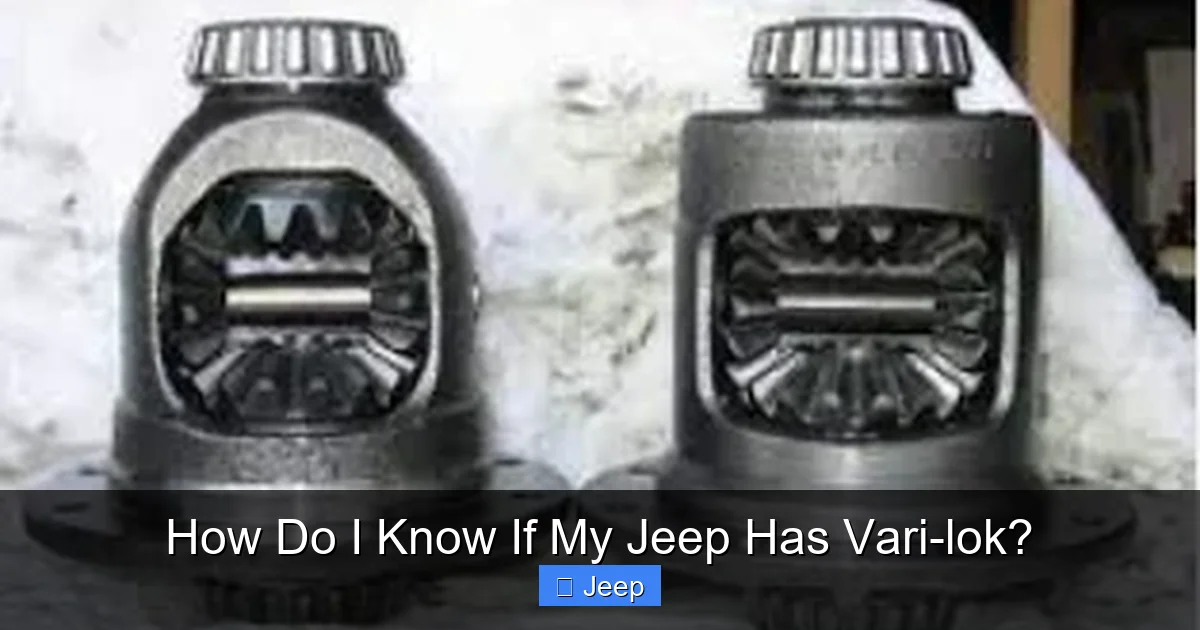
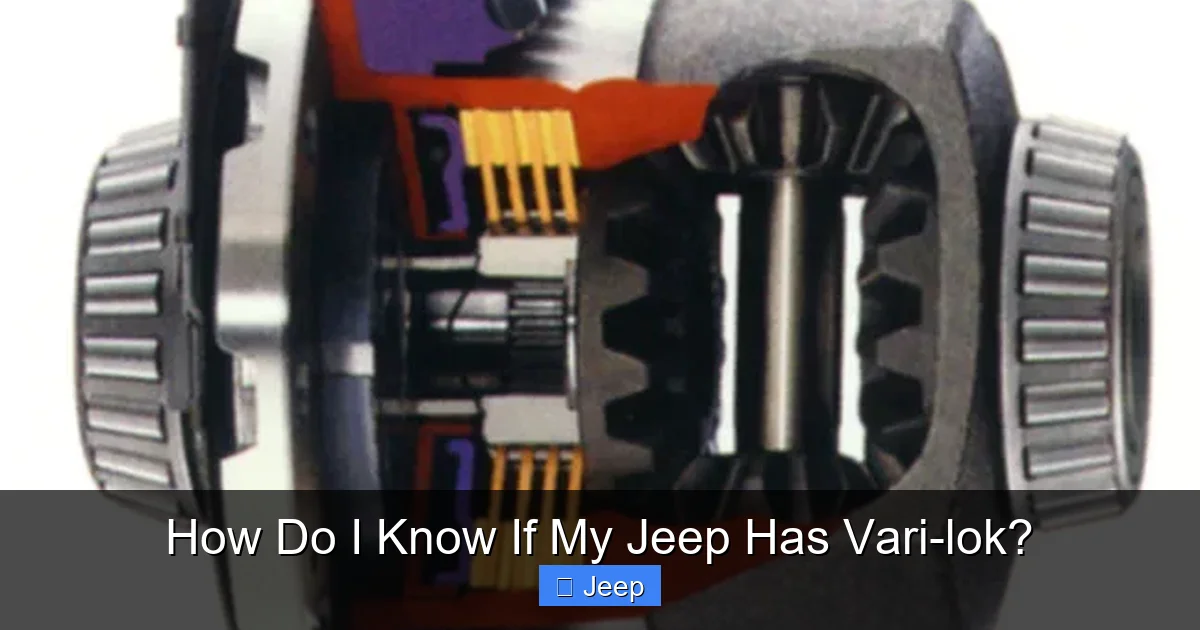
Once you have the differential cover off (drain the fluid first!), you’ll see the ring and pinion gears and the carrier. In an open differential, the carrier is a simple cross-shaped piece holding the side gears. In a Vari-Lok unit, the carrier will have clutch packs. You’ll see a series of thin, circular steel plates and friction plates stacked together on either side of the carrier. They look like a multi-layer sandwich. If you see these clutch packs, you have a limited-slip differential.
The “Friction Modifier” Clue
Another hint is the type of fluid used. Vari-Lok differentials require a specific gear oil that contains a friction modifier. The oil will often be labeled “GL-5” with “Limited Slip” or “Friction Modified” on the bottle. If you drain your differential and the old fluid smells burnt or looks like metallic sludge, it could be a sign the clutch packs were worn or the wrong fluid was used. While not a positive ID, finding the correct friction-modified fluid in your differential is a strong supporting piece of evidence.
Method 4: The Test Drive (The “Feel” Test)
This is the fun, practical method. It won’t give you a parts number, but it will tell you how the system behaves. You need a safe, empty, wet or loose-surface area (like a large, empty wet parking lot after rain, or a gravel driveway).
The One-Wheel Spin Test
Find a spot where one wheel can be on a low-traction surface (ice, mud, gravel) and the other is on solid pavement or dry ground. Get a little rolling start (2-5 mph), then gently apply the gas. Watch and feel:
- If you have an open differential: The wheel on the low-traction surface will spin wildly (smoke and noise), while the wheel on solid ground does nothing. You’ll feel a complete lack of pull forward.
- If you have Vari-Lok: You might see a brief spin of the loose wheel, but then the differential will clutch in. You’ll feel the Jeep lurch forward as power is sent to the gripping wheel. The spinning will be much shorter and less violent. It will feel like the Jeep is “finding” traction.
The “No-Spin” Burnout Test (Advanced)
On a very loose surface (deep gravel or wet grass), try a very light, controlled burnout (just enough to make the rear wheels spin). With an open diff, one wheel will spin furiously while the other barely moves. With Vari-Lok, both wheels will spin at a more similar rate, kicking up a more even rooster tail of debris. It’s a clear visual difference.
Caution: Don’t abuse this test. Spinning tires damages trails and can overheat your differential. A quick, gentle test is all you need.
Vari-Lok vs. Open Differential: A Quick Comparison
To solidify your understanding, here’s a simple breakdown of what each system means for your driving experience.
| Feature | Open Differential | Vari-Lok (Limited-Slip) |
|---|---|---|
| Traction on Loose Surfaces | Poor. One wheel spins, power is lost. | Good. Automatically sends power to the wheel with grip. |
| Snow & Rain Performance | Adequate, but wheel spin is common. | Better. Reduced wheel spin, more confident acceleration. |
| Daily Driving Feel | Neutral. No unusual behavior. | Slight, occasional clutch “chatter” on tight turns in dry conditions (normal). |
| Maintenance | Simple. Standard gear oil. | Critical. Must use friction-modified GL-5 gear oil. Wrong oil destroys clutches. |
| Off-Road Capability | Limited. Gets stuck easily. | Moderate. Handles most trails, but not extreme rock crawling. |
| Cost to Repair/Rebuild | Lower. Simple ring & pinion. | Higher. Clutch packs, springs, and special shims required. |
What If I Don’t Have Vari-Lok? Your Next Steps
So you did the detective work and confirmed you have a standard open differential. Don’t despair! This is very common, especially on base-model XJs and Grand Cherokees. An open diff is perfectly fine for 95% of daily driving and light-duty trails. But if you want more confidence, you have options:
- The Simple Fix: Traction Aids. Keep a bag of sand, kitty litter, or traction mats in your Jeep. When you get stuck, put them under the spinning tire. This is cheap, effective, and works with any differential.
- The Mechanical Upgrade: Add a Locker. For serious off-roading, you can install an aftermarket air or electronic locker in your open differential housing. This requires a new carrier and ring & pinion installation—a job for a professional or an advanced DIYer. Important: If you do this, you must remove the Vari-Lok clutch packs if they were ever present; you cannot mix parts.
- The Practical Compromise: Good Tires. A set of all-terrain or mud-terrain tires will dramatically improve traction on an open differential. Sometimes, the right rubber makes a bigger difference than any LSD.
- Check Your Maintenance: If you have an open diff, now is the time to ensure you’re using the correct, non-friction-modified gear oil. Using the wrong oil in an open diff is harmless, but if you ever upgrade, you’ll want to flush it out properly.
Also, while you’re under there checking differentials, it’s a great time to assess your overall driveteline health. Knowing how much lift your Jeep has can affect driveline angles, and understanding your maintenance schedule is key. For instance, if you’re unsure about your fluid change intervals, a quick check on whether your car uses synthetic oil (for the engine) can extend your service intervals, but remember, differential fluid is a separate, critical service. And while we’re talking about maintenance, poor alignment can cause uneven tire wear, which is even more noticeable on a vehicle with an open differential. If you’re experiencing strange wear patterns, you might need to learn how to know if you need a tire alignment.
Conclusion: Knowledge is Traction
There you have it. You are now a certified Vari-Lok detective. The easiest path is almost always the build sheet or the axle tag. If those fail, the test drive on a slippery surface will give you a definitive, real-world answer. Remember, having Vari-Lok is a fantastic feature for a daily-driven Jeep, offering that sweet spot of improved traction without the complications of a full locker.
But here’s the real takeaway, friend: your Jeep is an amazing machine regardless of what’s bolted to the rear axle. The most important thing is that you understand it. That understanding leads to better decisions—about maintenance, about driving, and about upgrades. Whether you’re rocking a clattering Dana 35 with an open diff or a quiet Dana 44 with a smooth-clutching Vari-Lok, get out there and enjoy your Jeep. The best trail is the one you’re on, and now you know a little more about the machine that’s taking you there.
Frequently Asked Questions
How can I visually identify a Vari-Lok differential on my Jeep?
The easiest visual check is to look at the differential cover. A Vari-Lok unit (often on Dana 35 or Dana 44 axles) typically has a large, round, ribbed aluminum cover with 10 bolts, unlike the smoother, flat covers on open differentials. You may also see a small sensor or wiring harness plugged into the differential housing.
Can my Jeep’s VIN or window sticker tell me if it has Vari-Lok?
Yes, your vehicle’s build sheet or window sticker (Monroney label) is a reliable source. Look for codes like “DLD” (Dana Limited Slip Differential) or specific axle codes (e.g., “D44 LSD”) in the axle or options section. You can also decode your VIN online using a Jeep-specific service to find factory-installed options.
What’s the difference between Vari-Lok and Trac-Lok in a Jeep?
For many Jeep models, “Vari-Lok” and “Trac-Lok” are essentially the same clutch-type limited-slip differential system; Chrysler used both names over the years. The key difference is that “Vari-Lok” was the common term for earlier models (like XJ and TJ), while “Trac-Lok” became the standard name for later JK and JL models, but the function is identical.
Which Jeep models and years commonly came with Vari-Lok from the factory?
Vari-Lok was a popular factory option on many Jeep Wrangler TJ (1997-2006) and Cherokee XJ (1984-2001) models, especially those with the 4.0L engine and automatic transmission. It was also available on some Grand Cherokee ZJ/WJ models and Jeepster Commando C101s. It was never standard but was a frequent optional upgrade for off-road packages.
Will my Jeep’s driving behavior indicate if it has Vari-Lok?
Yes, you might notice it during slippery conditions. With Vari-Lok, if one rear wheel loses traction, the other wheel will continue to apply power, often causing a “chirping” or slight slip sound as the clutch pack engages. In contrast, an open differential would simply spin the loose wheel freely with no power to the other wheel.
Could my Jeep have an aftermarket Vari-Lok or limited-slip differential?
Absolutely. Many Jeep owners install aftermarket limited-slip differentials (like from ARB, Ox Lockers, or Yukon) that function similarly to the factory Vari-Lok. To confirm, you would need to physically inspect the differential or ask the previous owner about modifications, as a VIN check would not reveal aftermarket parts.