How Do I Know If My Bmw Has Launch Control?

Contents
- 1 Key Takeaways
- 2 📑 Table of Contents
- 3 What Exactly is Launch Control? (And Why It’s Not Just “Floor It”)
- 4 Which BMW Models Actually Have Factory Launch Control?
- 5 How to Check Your BMW: Three Reliable Methods
- 6 How to Activate BMW Launch Control: The General Sequence
- 7 Safety, Limitations, and Why You Should Be Cautious
- 8 Common Misconceptions and FAQ Basics
- 9 Frequently Asked Questions



Launch control is a performance feature that manages engine RPM and traction for explosive, consistent starts. It’s primarily found in high-performance BMW M models and some newer plug-in hybrids. You can check for it by consulting your owner’s manual, exploring the iDrive drive mode menus, or decoding your BMW’s VIN. Activating it typically requires specific conditions like a cold start and Sport/Manual mode. Always use it responsibly on a track or safe location to avoid excessive wear.
So you’ve heard the rumors. That deep, thunderous roar of a BMW M3 at the starting line, the way it seems to catapult itself forward with barely a hint of wheelspin. That’s often the magic of launch control in action. But is it tucked away inside your own BMW? Maybe you’ve felt a quirky hesitation when you floored it from a stop, or perhaps your friend’s M car has a secret button combination. Figuring out if your specific BMW has this coveted performance feature isn’t always obvious. It’s not like a sunroof switch you can just see. This guide will walk you through everything, from what launch control actually is, to which BMW models get it, and the exact, step-by-step methods to discover if your car is hiding this acceleration trick.
First, let’s be clear. We’re talking about factory-installed, computer-managed launch control. This is not the same as a driver manually revving and dumping the clutch—that’s a recipe for a burnt clutch and a trip to the repair shop. True BMW launch control is a sophisticated piece of software that orchestrates engine power, transmission behavior, and traction systems to give you the fastest, most consistent zero-to-sixty time possible, every single time. It’s the difference between a skilled driver’s perfect launch and a robot’s perfect launch. Knowing if you have it changes how you can responsibly enjoy your car’s full potential.
Key Takeaways
- Launch control is a computer-managed system for perfect starts: It holds engine RPM at an optimal limit and manages clutch/brake release to maximize acceleration without wheelspin.
- It’s mostly an M model feature: Factory-installed launch control is standard on most modern BMW M cars (M3, M5, X5 M, etc.) and some high-output plug-in hybrids like the i4 M50.
- You can check via your iDrive system: Look for a “Launch Control” or “Roll-Out” option in the drive mode settings (usually under “Sport” or “M” modes) when the car is in Park/Neutral and stationary.
- VIN decoding is a definitive method: Using BMW’s official website or a third-party decoder, your VIN will specify included packages and features, confirming if launch control is factory-programmed.
- It has strict activation requirements: Typically requires the engine to be at operating temperature, the car on level ground, stability control partially on, and specific pedal/brake sequences.
- It’s not for daily driving: Frequent use causes extreme stress on the drivetrain, clutch, and brakes. It’s designed for track use or controlled drag-strip scenarios.
- Aftermarket tunes can add it: Some tuning companies can enable or emulate launch control on non-M models, but this may void warranty and increase component wear.
📑 Table of Contents
- What Exactly is Launch Control? (And Why It’s Not Just “Floor It”)
- Which BMW Models Actually Have Factory Launch Control?
- How to Check Your BMW: Three Reliable Methods
- How to Activate BMW Launch Control: The General Sequence
- Safety, Limitations, and Why You Should Be Cautious
- Common Misconceptions and FAQ Basics
What Exactly is Launch Control? (And Why It’s Not Just “Floor It”)
To understand if you have it, you need to understand what it is. Launch control is a software function, primarily found in dual-clutch (DCT) and automated manual transmissions, though some torque-converter automatics have it too. Its job is to manage two critical things at the start of a drag run: engine RPM and wheel slip.
The Science of the Perfect Start
When you press the brake and accelerator simultaneously in a car with launch control (the typical activation method), the system takes over. It will hold your engine at a pre-determined, optimal RPM—often between 3,500 and 5,000 RPM depending on the model and conditions. This is the “launch RPM.” It’s not the redline; it’s the sweet spot where the engine makes massive torque but the tires are less likely to break loose. You hold the brake with your left foot (or hold the brake pedal), press the gas with your right, and the engine note will settle into a steady, menacing drone. The car is coiled like a spring.
The second part is the release. When you lift off the brake, the system doesn’t just let the clutch engage brutally. It modulates the clutch engagement and throttle application with millisecond precision. It aims for just a tiny, controlled amount of wheelspin—usually around 5-15%—which is actually ideal for traction. Too little spin means you’re not using all your power; too much means you’re wasting it in smoke. The computer finds that perfect balance. The result is a shockingly consistent, violent, and efficient launch that’s nearly impossible to replicate perfectly by human instinct alone.
Launch Control vs. Launch Mode vs. Roll-Out
BMW uses different terminology across its model range, which can cause confusion. Launch Control is the most common term, especially in M cars. You might also see Launch Mode or Roll-Out (common in newer BMWs with xDrive all-wheel drive). The principle is identical: computer-optimized standing start. The naming sometimes depends on the transmission type or model year. An M3 with a DCT will have “Launch Control.” An X5 M with an automatic might list it as “Roll-Out” in the menus. They perform the same core function.
Which BMW Models Actually Have Factory Launch Control?
This is the million-dollar question. The short answer is: almost all modern BMW M cars and select high-performance plug-in hybrids. But there are important nuances by model year and region.

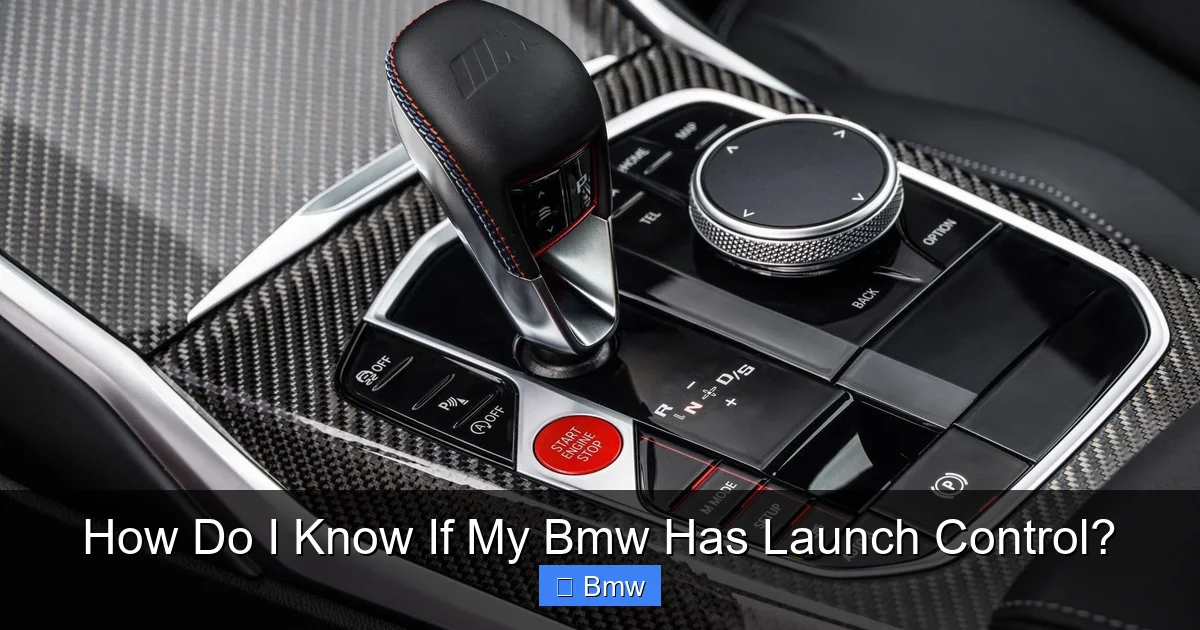
Visual guide about How Do I Know If My Bmw Has Launch Control?
Image source: thecarhow.com
The M Car Lineup (Most Likely Candidates)
If you own a vehicle with an “M” badge from BMW’s performance division (not to be confused with M Sport packages), there’s an extremely high probability you have launch control, provided it’s from the last 15 years or so.
- M3 & M4: All generations from the E90/E92 (V8) onward have it. The current G80/G82 models have a very aggressive, user-adjustable launch control via the M Laptimer app.
- M5 & M6: The E60 M5 (V10) famously had a “Launch Control” button. All subsequent F10/F90 M5s and F06/F12 M6s have it, often with adjustable RPM limiter settings.
- X5 M & X6 M: These SUVs are shockingly quick off the line thanks to launch control, present in both the E70/E71 and current F95/F96 generations.
- M2, M8, M5 Competition, etc.: Virtually every modern M model includes it as a standard track feature.
Even some older, special M models like the 1 Series M Coupe (E82) have a form of it. The key is the presence of an M-specific transmission (like the 7-speed DCT) or a highly tuned automatic with M-specific software.
Non-M But High-Performance: The “M Performance” Line
This is where it gets trickier. Models like the M340i, M440i, X3 M40i, and Z4 M40i are not full M cars but have potent engines and sportier tuning. Their inclusion of launch control varies significantly by generation and market.
- G20/G21 Generation (2019+ 3 Series): The M340i with the ZF 8-speed automatic does have a form of launch control, often called “Launch Control” or accessible via a special drive mode sequence. It’s less aggressive than an M3’s but present.
- G22/G23 Generation (4 Series): Similar story for the M440i.
- F-Body M Performance (2016-2019): Many of these earlier models did not have a factory-enabled launch control function, though the hardware might be capable. It was often reserved for the full M models.
Plug-in Hybrids: The i4 M50 and the older i8 (though not a traditional BMW) have launch control-like functions. The i4’s “Sport Boost” mode provides a similar, if not identical, aggressive start. The i8 had a “Race Start” mode.
The M Sport Package is NOT a Guarantee
This is a critical and common point of confusion. A car with an “M Sport” steering wheel, bumper, and wheels is not an M car. It’s a cosmetic and mild suspension package. A 330i with M Sport does not have factory launch control. The software, transmission tuning, and drivetrain cooling are not up to the task. Always check the model designation (330i vs. M3) first.
How to Check Your BMW: Three Reliable Methods
Now for the practical part. How do you find out for sure? Don’t just guess based on your badge. Use these methods.
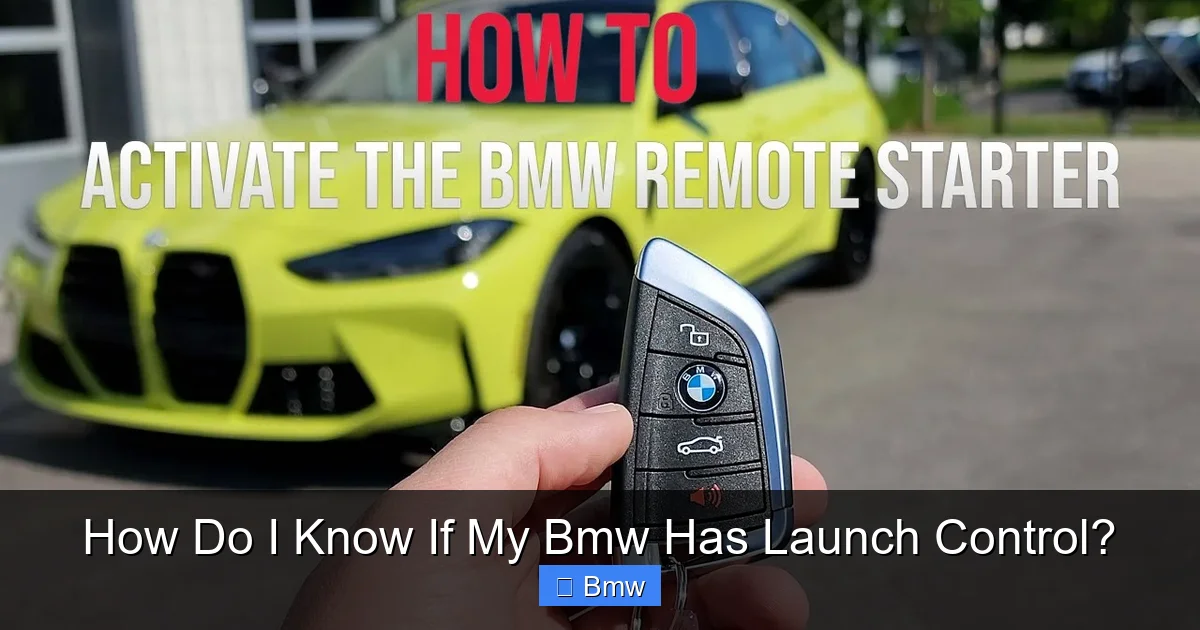
Visual guide about How Do I Know If My Bmw Has Launch Control?
Image source: i.ytimg.com
Method 1: The Owner’s Manual & iDrive Menu Detective Work
This is your first and easiest stop. Grab your physical owner’s manual or find the digital PDF for your specific model year on BMW’s website. Search for “launch control,” “launch mode,” “roll-out,” or “starting off.”
- In the car, with the engine running and the car in Park (or Neutral for manuals), go into your iDrive menu.
- Navigate to the “Driving” or “Vehicle” settings, then “Drive Modes” or “M” menu (if applicable).
- Look for an option that says “Launch Control,” “Roll-Out,” or sometimes “Launch Assistant.”
- Important: The option will often be greyed out or inaccessible until you meet specific conditions: engine at full operating temperature, car on level ground, traction control partially enabled (not fully off), and sometimes a specific drive mode selected (like Sport or Sport+).
If you find the menu option, you have the feature. The manual will detail the exact activation sequence (e.g., “Press and hold the brake pedal, then press the accelerator pedal to the kick-down point, the engine speed will stabilize…”).
Method 2: The VIN Decoder (The Definitive Answer)
Your Vehicle Identification Number (VIN) is a 17-digit code that contains your car’s entire spec sheet. This is the most accurate way to confirm factory-installed software and hardware packages.
- Find your VIN on the driver’s side dashboard (visible through the windshield), the driver’s side door jamb sticker, or your registration/insurance documents.
- Use a reputable BMW-specific VIN decoder. The official BMW VIN Lookup (for US models) is excellent. Third-party sites like bmwfans.info or realoem.com (using the chassis number from your VIN) are also incredibly detailed.
- Enter your VIN and look for codes related to transmission, engine management, or specific option packages. Terms like “SA6DC” (for DCT with Launch Control in older models) or listings under “Engine & Transmission” that specify “Launch Control” are giveaways.
This method tells you what the car was built with from the factory, regardless of any aftermarket changes or deletions.
Method 3: The “Paper Test” & Owner Community Research
Sometimes, you just need to ask people who know. Find the specific model year and chassis code (e.g., F80 for 2017-2023 M3, G80 for 2024+) of your car.
- Search forums like BimmerPost or BMW Blog for “[Your Chassis Code] launch control.” You’ll find countless threads where owners discuss its presence, activation quirks, and even share video evidence.
- Look for a definitive “Yes” or “No” from the community. Often, the first few pages of a forum thread for a new model will have a sticky post listing all its performance features.
- As a last resort, if you know someone with the exact same model year and trim, ask them to show you their iDrive menu. This is a foolproof visual check.
Combining the VIN decode with forum consensus gives you near-absolute certainty.
How to Activate BMW Launch Control: The General Sequence
So you’ve confirmed you have it. Now, how do you actually use it without messing up? The sequence is generally consistent across models but always consult your manual first.
Visual guide about How Do I Know If My Bmw Has Launch Control?
Image source: i.ytimg.com
The Standard Activation Ritual
1. Warm Up: Drive the car until the engine reaches full operating temperature (oil temp around 230°F/110°C). Cold engines will often block launch control to protect them.
2. Find a Safe Location: A long, straight, empty stretch of road or a racetrack. Never on public streets with traffic.
3. Select the Right Mode: Set your drive mode to Sport or Sport+ (or the dedicated “M” mode on M cars). Traction Control (DSC) must be ON, but often in its “sport” or “dynamic” mode—fully OFF might disable launch control as a safety measure. Experiment.
4. Come to a Complete Stop: Hold the brake pedal firmly with your left foot.
5. Press the Gas: With the brake held, press the accelerator pedal firmly to the floor (kick-down). You’ll feel a distinct point where the pedal stops pushing further.
6. Wait for the RPM to Stabilize: The engine RPM will rise and then hold steady at the launch RPM (e.g., 4,500 RPM). This is the key indicator that launch control is engaged. The digital tachometer may change color or a message may appear on the screen saying “Launch Control Ready” or similar.
7. Release the Brake: Quickly but smoothly lift your left foot off the brake pedal. The car will launch forward with maximum traction.
8. Let it Shift: Keep your foot flat on the gas. The transmission will shift automatically at the redline or a pre-set point.
Model-Specific Quirks
– M DCT Cars (E9X, F8X, etc.): The sequence above is classic. The RPM hold is very obvious.
– ZF 8-Speed Automatics (G80 M3, F90 M5): It works similarly, but the activation might require the car to be in “Manual” mode using the paddle shifters or the gear lever.
– xDrive Models (X5 M, M5 xDrive): Often called “Roll-Out.” The activation is the same, but the all-wheel-drive system makes the launch even more brutally efficient with almost zero wheelspin.
– i4 M50: Accessed via “Sport Boost” mode in the iDrive menu. It’s a single-pedal activation (press brake, then gas, then release brake) and feels more like an instant torque surge than a traditional RPM hold due to the electric motor’s immediate response.
Safety, Limitations, and Why You Should Be Cautious
Launch control is a tool, not a toy. Using it ignorantly can lead to damage and danger.
Drivetrain Stress: The Clutch and Transmission Take a Beating
Even with perfect computer management, a launch from a standstill is the single most stressful event for a clutch pack (in a DCT) or a torque converter (in an automatic). The violent engagement of power generates immense heat and wear. One or two launches on a cold day will cause negligible damage. But doing ten in a row? You’re significantly shortening the life of your clutch or transmission fluid. This is why BMW often limits how many consecutive launches you can attempt—the system may go into a “cool-down” period or refuse to engage until the transmission temperature drops. If you track your car regularly, budget for a more frequent brake pad and fluid change schedule; aggressive launching also heats the brakes rapidly.
Warranty and Liability Concerns
BMW’s warranty will cover defects in materials and workmanship. However, if a component fails and it’s determined that the failure was caused by “abuse” or “competition use,” and launch control is considered a competition feature, they could deny the claim. Document everything. Use it sparingly and on track days where the risk is accepted. Never use it in a way that endangers others.
Traction is Still King
Launch control is not a magic “no-spin” button. Its goal is optimal slip. On wet, icy, or even dusty surfaces, it will still spin the tires, possibly even more than a gentle manual start. The system assumes a certain amount of grip. If the surface is poor, it will adjust its target RPM down, but you’ll get a much slower launch. Always assess conditions.
Common Misconceptions and FAQ Basics
Let’s clear up some frequent points of confusion.
“My BMW Has an ‘M’ Button/Button with a Checkered Flag. That’s Launch Control, Right?”
Not necessarily. That button is almost always your M Laptimer or M Mode activation. It starts a lap timer and changes your display to a sporty layout. On some models (like the F80 M3), pressing it while moving activates a more aggressive shift program, but it is not the same as the stationary launch control sequence. Launch control is activated with the brake and gas pedals while stopped.
“Can I Install Launch Control on My Non-M BMW?”
Technically, yes, through aftermarket engine control unit (ECU) tunes. Companies like MHD, Bootmod3, or Cary offer software modifications that can add a “launch control” function to many BMW models, including 335i, 435i, etc. However, this is a significant modification. It will likely void your power-train warranty. It also puts extreme stress on a stock clutch or transmission that may not have been designed for it, leading to premature failure. It’s a popular mod for the tuner crowd, but it comes with major risks and responsibilities.
“Is it the Same as a ‘Line Lock’ or ‘Staging Brake’?”
No. A line lock is a system that holds the front brakes while you rev the engine and release the rear brakes, pre-heating your tires. It’s common in drag racing. BMW’s launch control does not pre-hold the brakes separately; you hold the brake pedal yourself, and the system manages the engine and clutch/transmission. It’s an all-in-one package.
Frequently Asked Questions
Will using launch control damage my BMW’s clutch or transmission?
Yes, but in a calculated way that BMW engineers accounted for. Occasional, proper use on a warm car and a prepared surface causes minimal accelerated wear. However, frequent or aggressive use, especially when cold or on poor surfaces, significantly shortens the lifespan of clutch packs in DCTs or stresses automatic transmissions. It’s a wear item designed for occasional track use, not daily driving.
Can I use launch control in any BMW with the M Sport package?
No. The M Sport package is primarily cosmetic and includes sport seats, steering wheel, and exterior styling. It does not include the high-performance engine, specialized transmission software, or drivetrain cooling required for launch control. You need a full M model (M3, M5, etc.) or a specific high-output model like the M340i with the correct transmission.
Why does my launch control sometimes not engage even though I have the feature?
The system has multiple safety interlocks. Common reasons include: engine oil temperature not at operating level, car not on a perfectly level surface, traction control (DSC) turned completely off, vehicle speed not at zero, or the transmission fluid being too hot from previous use. Consult your owner’s manual for the exact, model-specific prerequisites.
Is launch control the same as “Sport Plus” or “Sport” drive mode?
No. Sport and Sport+ modes sharpen throttle response, firm up the steering, and hold gears longer. They prepare the car for aggressive driving but do not manage the stationary start. Launch control is a separate, discrete function that overrides normal start-off behavior and is only active under very specific conditions (car stopped, pedals pressed).
My VIN decoder didn’t explicitly say “Launch Control.” How can I be sure?
Look for transmission codes. For example, a code like “SA6DC” (for a 7-speed DCT) or “SA8FA” (for an 8-speed sport automatic) in a BMW VIN decoder strongly implies the car has the software for launch control, as these transmissions are paired with M engines that include the feature. Cross-reference this with your model year’s known specifications on enthusiast forums.
Can I use launch control if my BMW is all-wheel drive (xDrive)?
Yes, absolutely. In fact, it’s often even more effective. BMW calls it “Roll-Out” on many xDrive models like the X5 M and M5 xDrive. The all-wheel-drive system allows the car to put power down more efficiently, resulting in almost no wheelspin and extremely consistent 0-60 times. The activation sequence is the same: brake, gas to the floor, RPM hold, release brake.