
Hail Damage Through Cover: Can Hail Still Dent Your Car?

Quick Answer
Yes, hail can damage a car through a cover. A normal outdoor cover mainly protects against dirt, sun, moisture, and light debris, while even padded hail covers have limits when stones become large or wind-driven. The safest option remains sturdy covered parking, which is also recommended in Kelley Blue Book’s hail-protection guidance.
Why damage can happen through a cover
- Thin material: A standard fabric layer cannot absorb much impact energy.
- Large hail: Bigger stones can compress padding and transfer force into the body panel.
- Wind-driven impacts: Strong winds can make hail strike exposed panels from sharper angles.
- Weak protection: Roofs, hoods, trunk lids, and glass remain vulnerable beneath light covers.
- Cover movement: Wind can shift a loose cover and allow trapped grit to rub against paint.
What to do now
- Wait until the storm is completely over, remove the cover carefully, and inspect the vehicle in bright, angled light for dents, chipped paint, and cracked glass.
If you removed a car cover after a storm and found dents underneath, the cover didn’t necessarily fail. Most covers simply aren’t designed to stop the concentrated force of severe hail.
As of 2026, I treat a car cover as one layer of protection rather than a substitute for a garage. This guide explains why hail gets through, what damage to check for, and what to do next.
In This Guide
Can Hail Damage a Car Through a Cover?
Yes. Hail can dent body panels or damage glass even when the vehicle is completely covered.
A cover reduces exposure, but the result depends heavily on its thickness, padding, fit, hail size, wind, and the vehicle underneath.
Hail damage through a cover means impact damage reaches the vehicle even though fabric or padding separates the hailstone from the exterior surface.
- Standard outdoor covers provide little impact cushioning because they’re designed mainly for environmental exposure.
- Multilayer covers may absorb more energy but aren’t automatically hail-resistant.
- Padded hail covers offer better cushioning but still have a maximum practical limit.
- Inflatable systems create a larger buffer between falling hail and the vehicle but still require correct setup and anchoring.
The physics are straightforward. Padding spreads and absorbs some impact energy, but a hard hailstone can compress that padding until significant force reaches the sheet metal underneath.
Horizontal panels are especially exposed. The hood, roof, trunk lid, and glass receive more direct impacts than many vertical surfaces.
Wind complicates the picture. Strong crosswinds can drive hail into doors, quarter panels, mirrors, and side glass that would otherwise receive fewer direct hits.
The NOAA National Severe Storms Laboratory explains that hailstones can vary dramatically in size within the same storm. That variation is one reason no fabric cover can promise complete protection.
Section Takeaway: A cover can reduce impact severity, but it cannot make an exposed vehicle hail-proof. Direct shelter provides a much stronger barrier.
Which Car Covers Protect Against Hail?
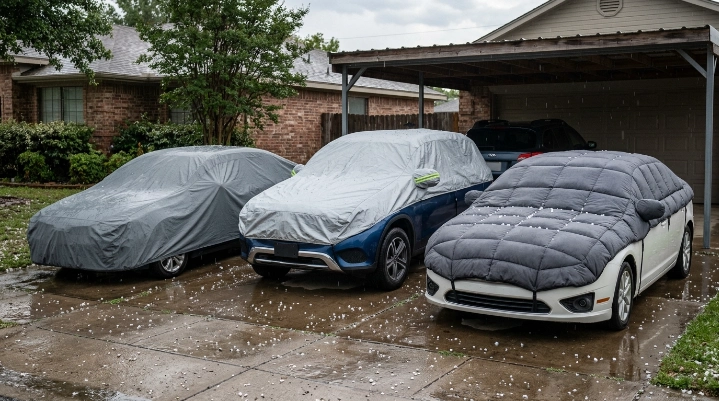
A dedicated padded hail cover provides more protection than an ordinary weather cover. Construction matters much more than marketing phrases such as “all-weather.”
When I’m judging whether a cover is suitable for hail, I look first at the actual cushioning over the roof, hood, and trunk. A thin waterproof shell doesn’t become impact protection simply because it has several fabric layers.
Regular outdoor car covers
These covers are useful for sun, dust, bird droppings, tree debris, and general weather exposure. Their impact protection is usually limited.
- Thin fabric compresses quickly under impact.
- Soft lining may protect paint but adds little impact absorption.
- Loose fit can allow wind movement.
- Water resistance does not indicate hail resistance.
Padded hail covers
Hail-specific covers add thicker foam or impact-absorbing layers over exposed body panels. That extra distance helps spread a hailstone’s force over a larger area.
Protection still isn’t absolute. Large stones can overwhelm the padding, especially when strong thunderstorm winds increase the impact angle or speed.
Inflatable hail protection
Inflatable systems place an air-filled barrier around much of the vehicle. The larger separation can absorb more impact than a thin fitted cover.
They also require power, inflation time, secure anchoring, and enough warning before the storm. They’re therefore more specialized than a cover you simply pull from the trunk.
| Protection Type | Impact Cushioning | Best Use | Main Limitation |
|---|---|---|---|
| Thin outdoor cover | Low | Dust, sun, light debris | Minimal hail absorption |
| Multilayer weather cover | Low to moderate | General outdoor storage | Layers may be thin |
| Padded hail cover | Higher | Forecast hail exposure | Large hail may overwhelm padding |
| Garage or sturdy carport | Direct-impact barrier | Severe storms | Requires available shelter |
Section Takeaway: Buy for cushioning, not just weather resistance. A thick hail-specific barrier is preferable when your vehicle regularly sits outside in hail-prone weather.
How Does Hail Size Change the Damage Risk?
Larger hail generally creates a greater damage threat, but there is no universal stone size that guarantees a dent. Vehicle materials, storm winds, impact angle, and hail density all change the outcome.
The National Weather Service hail-size guide identifies quarter-size hail as about 1 inch and golf-ball hail as about 1.75 inches.
| Common Description | Approx. Diameter | What It Means for a Covered Car |
|---|---|---|
| Pea | 0.25 inch | Lower impact energy, though conditions still vary |
| Dime/Penny | 0.75 inch | Padding becomes more useful, but protection isn’t guaranteed |
| Quarter | 1.00 inch | Meaningful dent risk exists on exposed vehicles |
| Golf ball | 1.75 inches | A normal cover should not be trusted as primary protection |
| Tennis ball | 2.50 inches | Severe body and glass damage is a serious concern |
| Baseball | 2.75 inches | Seek sturdy shelter rather than relying on a fabric cover |
Don’t read that table as a guaranteed damage threshold. A smaller stone driven hard by wind may damage one vehicle while another vehicle escapes noticeable dents.
Panel construction also matters. Steel, aluminum, composite panels, glass, and plastic trim don’t react identically to the same impact.
Section Takeaway: Hail size is useful for judging storm severity, not predicting an exact dent threshold for your particular vehicle.
How Should You Inspect a Covered Car After Hail?
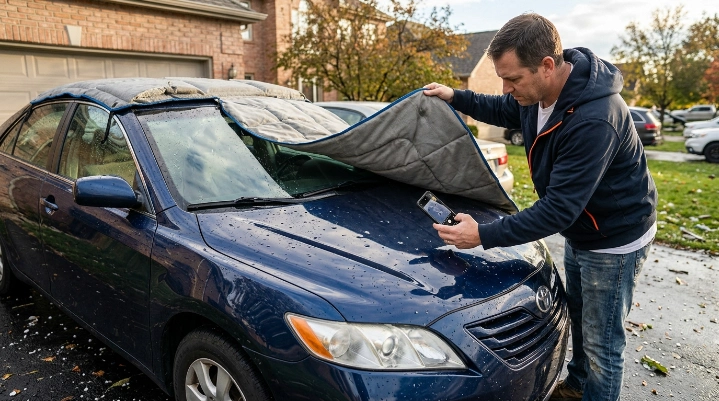
Remove the cover only after the storm has passed and conditions are safe. Then inspect the vehicle under bright daylight or strong angled lighting.
Small hail dents hide surprisingly well under flat lighting. Looking across the panel rather than straight at it makes shallow distortions easier to spot.
- Photograph the covered vehicle first. Record the cover’s position and any visible storm debris before moving anything.
- Remove the cover gently. Lift rather than drag it so grit doesn’t scrape the paint.
- Check the roof and hood. These horizontal panels usually deserve your closest inspection.
- Inspect the trunk or hatch. Look for shallow circular dents and paint chips.
- Check all glass. Look for chips, star-shaped cracks, edge cracks, and damaged panoramic roof panels.
- Inspect lights and trim. Mirrors, lamp lenses, moldings, and plastic parts can also take impact damage.
- Check the cover itself. Compressed padding, torn fabric, stretched seams, and punctures reveal where impacts were strongest.
Don’t forget paint damage
A dent with intact paint may be primarily cosmetic. A chip that exposes metal deserves faster attention because corrosion can begin at the damaged area.
The same inspection is useful even when no dents are obvious. Photographing the vehicle immediately gives you a clear record if damage becomes easier to see later.
Consumer Reports also recommends choosing covers with paint-friendly materials and avoiding conditions that encourage scratching, especially when a vehicle lives outdoors. See its street-parking vehicle protection guidance for broader outdoor-parking considerations.
Section Takeaway: Use bright angled light, document everything, and inspect both impact damage and paint condition before arranging repairs.
Should You Repair the Damage or File an Insurance Claim?
Start with a professional damage estimate if the dents are widespread, paint is chipped, or glass is damaged. Then compare the estimate with your deductible and policy coverage.
Paintless dent repair, commonly called PDR, reshapes certain dents without repainting the panel. It’s commonly considered when the paint remains intact and technicians can work the affected metal successfully.
Traditional body repair may be needed when paint has cracked, panels are badly stretched, body lines are damaged, or the metal cannot be restored acceptably with PDR.
Mechanic Alert: Extensive dent repair, glass replacement, and structural or electrical work should be handled by a qualified repair professional rather than attempted as a first-time DIY project.
Does insurance cover hail damage through a cover?
Having a cover on the car doesn’t automatically prevent an insurance claim. What matters is your policy and the cause of the damage.
Hail commonly falls under optional comprehensive coverage rather than liability-only coverage. The Insurance Information Institute identifies hail among the types of non-collision losses generally associated with comprehensive auto insurance.
- Photograph every damaged panel.
- Keep photos of the cover and surrounding storm debris.
- Record the date and approximate time of the storm.
- Review your comprehensive deductible.
- Get repair estimates before assuming a claim is worthwhile.
- Follow your own insurer’s reporting requirements.
Don’t assume every small dent deserves a claim. A repair estimate below or only slightly above your deductible may change the financial calculation.
Section Takeaway: Document first, estimate second, and review your own policy before deciding whether to pay for repairs yourself or submit a claim.
How Can You Prevent Hail Damage Next Time?
The most effective strategy is getting the vehicle beneath sturdy overhead protection before hail starts. A garage, parking structure, or suitable carport prevents direct hail from reaching the vehicle.
If permanent covered parking isn’t available, preparation matters. Keep your hail solution somewhere you can reach quickly instead of burying it in a storage closet.
Use multiple protective layers carefully
When purpose-built hail protection isn’t available, thick padded blankets can add temporary cushioning beneath a secured outer layer. Never use hard objects directly against painted surfaces.
- Cover the roof, hood, trunk, and major glass areas first.
- Use clean materials so grit isn’t trapped against the paint.
- Secure padding without placing hard buckles on body panels.
- Don’t create loose material that can whip against the vehicle.
- Never risk personal safety by installing protection once severe hail has begun.
Watch weather alerts early
A few extra minutes can make the difference between moving a car into shelter and trying to protect it outdoors. Severe-weather warnings should be treated as a signal to act before hail arrives.
If you’re already driving, prioritize your safety over the vehicle. Don’t stop in an active traffic lane or put yourself in danger just to prevent cosmetic damage.
The safest principle is simple: the stronger the hail threat becomes, the less confidence you should place in a soft cover alone.
Section Takeaway: Treat padded covers as backup protection. When severe hail is forecast, sturdy covered parking should be your first choice whenever it is safely available.
Frequently Asked Questions About Hail Damage Through a Cover
Can small hail damage a car through a cover?
It can, although smaller hail generally presents less impact energy than large hail. Damage also depends on wind, vehicle panel material, impact angle, and cover padding, so there isn’t one hail diameter below which every covered vehicle is guaranteed to remain dent-free.
Will a regular waterproof car cover protect against hail?
A regular waterproof cover shouldn’t be treated as hail protection unless the manufacturer specifically designs it for impact cushioning. Waterproofing describes resistance to water penetration, while hail protection depends heavily on thickness, padding, construction, and how much energy the cover can absorb.
Can golf-ball-size hail damage a car under a cover?
Yes. The National Weather Service lists golf-ball hail at about 1.75 inches in diameter. At that size, relying on a normal fabric cover is risky, and even specialized padding shouldn’t be viewed as a guarantee against dents or glass damage.
Should I remove the cover immediately after a hailstorm?
Wait until the severe weather has passed and it is safe to go outside. Photograph the vehicle while it is still covered, then lift the cover carefully rather than dragging it across dirty paint. Inspect the cover and vehicle separately.
Can a car cover itself scratch the paint during a hailstorm?
Yes, especially if wind moves a loose cover while dust or grit sits between the fabric and paint. A clean vehicle, soft inner material, proper fit, and secure fastening reduce that risk, although they cannot eliminate every possibility during severe weather.
Does comprehensive insurance cover hail damage if I used a car cover?
Comprehensive auto coverage commonly includes hail damage, but exact coverage, deductibles, exclusions, and claim procedures depend on your policy. Using a cover generally does not change the weather event that caused the loss, but you should confirm the details directly with your insurer.
Is a hail cover worth buying if my car stays outside?
A dedicated padded hail cover can be a useful extra layer when garage parking isn’t available. I would choose one based on actual cushioning, vehicle fit, fastening, setup time, and manufacturer instructions rather than assuming an “all-weather” label means meaningful hail protection.
If you’ve just discovered hail damage through a cover, don’t panic and don’t start pushing dents out from underneath. Document the vehicle, get a professional estimate, and decide on repairs after reviewing your insurance deductible.
For the next storm, upgrade the weakest part of your protection plan. A better padded cover can help, but moving the vehicle beneath sturdy shelter remains the strongest option.
“`
