
Generator Vs Solar for Rv

Choosing between a generator and solar power for your RV can feel overwhelming, but it doesn’t have to be. Both options offer unique benefits—generators provide instant, high-output power, while solar delivers quiet, eco-friendly energy with minimal maintenance. Your ideal choice depends on your travel style, budget, and how often you go off-grid.
Key Takeaways
- Generators deliver reliable, high-power output ideal for running heavy appliances like air conditioners and microwaves, especially during short trips or cloudy weather.
- Solar power is silent, eco-friendly, and low-maintenance, making it perfect for long-term boondocking and eco-conscious RVers who value peace and sustainability.
- Initial costs differ significantly: generators are cheaper upfront, while solar systems require a higher initial investment but save money over time.
- Fuel availability and storage matter—generators need gasoline, propane, or diesel, which may be hard to find in remote areas.
- Solar performance depends on sunlight, so cloudy days or shaded campsites can reduce charging efficiency unless you have a large battery bank.
- Hybrid systems combine the best of both, offering solar for daily use and a generator as backup during high-demand or low-sun periods.
- Noise and emissions are key considerations: generators are loud and produce fumes, while solar is completely silent and emission-free.
📑 Table of Contents
- Introduction: Powering Your RV Adventures
- Understanding Your RV Power Needs
- Generators: The Classic RV Power Source
- Solar Power: The Quiet Revolution
- Cost Comparison: Upfront and Long-Term
- Performance and Reliability: Which Delivers When You Need It?
- Environmental Impact and Lifestyle Fit
- Hybrid Systems: The Best of Both Worlds
- Installation and Maintenance: What to Expect
- Conclusion: Making the Right Choice for Your RV
Introduction: Powering Your RV Adventures
So, you’ve got your RV packed, the map is out, and you’re ready to hit the open road. But before you roll out, there’s one critical decision that can make or break your trip: how will you power your home on wheels?
Whether you’re a weekend warrior heading to a campground with full hookups or a full-time boondocker exploring remote deserts and mountain trails, your power source is the heartbeat of your RV. And when it comes to choosing between a generator and solar power, the debate is as old as the RV lifestyle itself. Each has its champions, its drawbacks, and its ideal use cases. The good news? You don’t have to pick just one—many RVers are now combining both for maximum flexibility.
In this guide, we’ll break down the generator vs solar for RV debate in plain, practical terms. We’ll look at cost, performance, convenience, environmental impact, and real-world usability so you can make an informed choice that fits your lifestyle. Whether you’re powering a laptop, running an air conditioner, or just keeping the lights on, we’ve got you covered.
Understanding Your RV Power Needs
Before diving into generators and solar panels, it’s essential to understand what you’re actually powering. RVs use electricity for everything from lighting and refrigeration to air conditioning, microwaves, and entertainment systems. But not all appliances draw the same amount of power.
Visual guide about Generator Vs Solar for Rv
Image source: campergrid.com
How Much Power Do You Really Need?
Start by listing the devices you use regularly and their wattage. For example:
- LED lights: 5–10 watts each
- Refrigerator (12V or 120V): 100–800 watts
- Laptop: 50–100 watts
- Microwave: 1,000–1,500 watts
- Air conditioner: 1,200–3,500 watts
- Water pump: 300–500 watts
Add up the total wattage of everything you might run at once. This is your “peak load.” Then consider your “daily usage” in watt-hours (Wh), which is how much energy you consume over 24 hours. For instance, running a 100-watt fridge for 8 hours uses 800Wh.
AC vs DC Power in RVs
RVs use two types of electricity: 12-volt DC (direct current) and 120-volt AC (alternating current). Your RV’s battery powers DC devices like lights, water pumps, and some fridges. But most household appliances—like microwaves, TVs, and air conditioners—run on AC power.
This is where inverters come in. An inverter converts DC power from your batteries into AC power. Solar systems and generators both can charge your batteries or power AC devices directly, but they do it differently.
Battery Bank: The Unsung Hero
No matter which power source you choose, your RV’s battery bank is crucial. Deep-cycle batteries (like lithium or AGM) store energy for later use. A larger battery bank means more stored power, which is especially important for solar setups or when running a generator intermittently.
For example, a 200Ah lithium battery bank can store about 2,400Wh of energy—enough to run a few lights, a fridge, and a laptop for a day. But if you want to run an air conditioner, you’ll need either a powerful generator or a massive solar array with a huge battery bank.
Generators: The Classic RV Power Source
Generators have been the go-to power solution for RVers for decades. They’re reliable, powerful, and easy to use—just flip a switch and you’ve got electricity. But they’re not without their downsides.
Visual guide about Generator Vs Solar for Rv
Image source: shutterstock.com
How Generators Work in RVs
An RV generator burns fuel—gasoline, diesel, or propane—to produce electricity. Most are built into the RV (like Onan or Generac models) or are portable units you carry in a storage compartment. They can power your entire RV, including high-draw appliances like air conditioners and microwaves.
When the generator runs, it either powers your RV directly or charges your house batteries through a converter. Some models even have automatic start features that kick in when battery levels drop too low.
Pros of Using a Generator
- High power output: Can easily run multiple appliances at once, including air conditioning.
- Instant power: No waiting for sunlight or battery charging—just turn it on.
- Reliable in all weather: Works rain or shine, day or night.
- Lower upfront cost: A basic portable generator can cost $500–$1,500, much less than a full solar setup.
- Widely available fuel: Gas stations and propane refills are common, even in rural areas.
Cons of Using a Generator
- Noise: Most generators are loud—often 60–70 decibels, like a vacuum cleaner. This can disturb you and your neighbors.
- Emissions: They produce carbon monoxide and other pollutants, requiring proper ventilation and safety precautions.
- Fuel dependency: You need to carry and store fuel, which adds weight and takes up space.
- Maintenance: Generators need regular oil changes, air filter replacements, and tune-ups.
- Campground restrictions: Many parks limit generator use to certain hours (e.g., 8 AM–8 PM) due to noise.
Real-World Example: Weekend Camping Trip
Imagine you’re spending a long weekend at a state park with no hookups. You want to run your air conditioner during the day and charge your phones at night. A 3,000-watt portable generator can handle this easily. Just start it up, plug in your RV, and enjoy cool air and hot meals. But you’ll need to refuel every few hours and endure the noise.
Solar Power: The Quiet Revolution
Solar power has exploded in popularity among RVers, especially those who love boondocking—camping off-grid without hookups. It’s clean, quiet, and increasingly affordable. But it’s not a one-size-fits-all solution.
Visual guide about Generator Vs Solar for Rv
Image source: shutterstock.com
How Solar Works in RVs
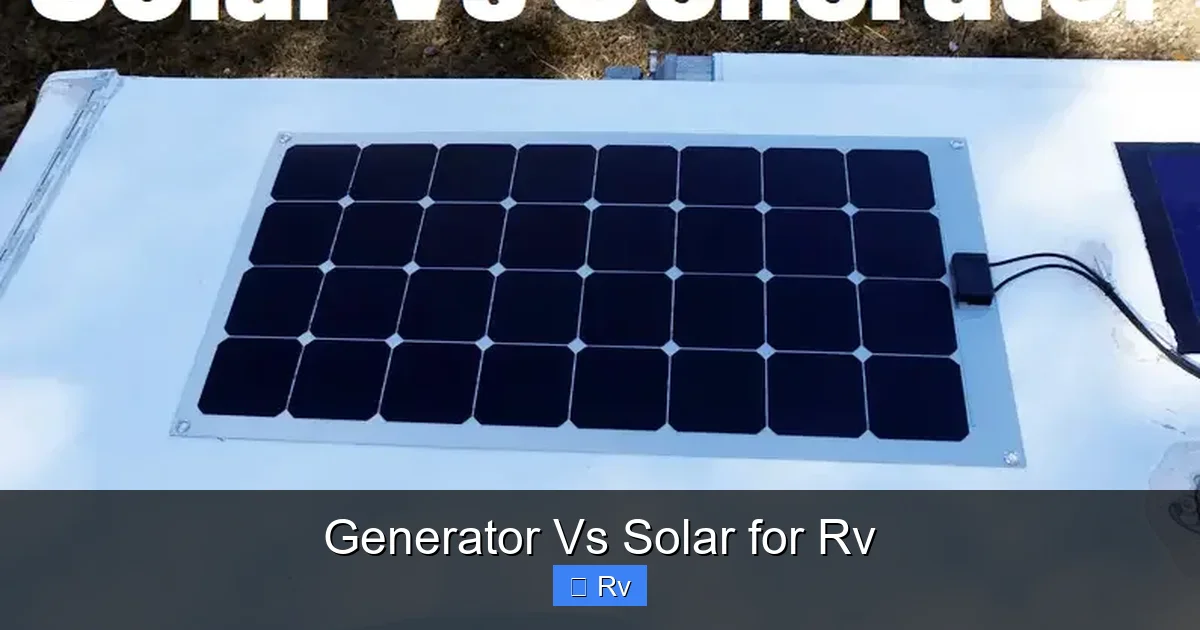
Solar panels on your RV’s roof capture sunlight and convert it into DC electricity. This power charges your house batteries through a charge controller. An inverter then converts the stored DC power into AC for your appliances.
A typical solar setup includes:
- Solar panels: Usually 100W to 400W each, mounted on the roof.
- Charge controller: Regulates the voltage and current from the panels to prevent overcharging.
- Battery bank: Stores the energy for use at night or on cloudy days.
- Inverter: Converts DC to AC power.
Pros of Using Solar Power
- Silent operation: No noise—perfect for peaceful campsites and wildlife areas.
- Eco-friendly: Zero emissions and renewable energy source.
- Low maintenance: Once installed, solar panels require little upkeep—just occasional cleaning.
- Fuel-free: No need to carry or store gasoline or propane.
- Unlimited runtime (in sunlight): As long as the sun shines, you can generate power.
- Campground freedom: No noise restrictions—use your appliances anytime.
Cons of Using Solar Power
- Weather dependent: Cloudy days, shade, or short winter days reduce output.
- High upfront cost: A quality 400W solar kit with batteries and inverter can cost $2,000–$5,000.
- Limited power output: Hard to run high-draw appliances like air conditioners without a massive system.
- Roof space limitations: RVs have limited roof area, restricting how many panels you can install.
- Slow charging: Batteries charge gradually, so you can’t instantly power heavy loads.
Real-World Example: Boondocking in the Desert
Say you’re spending a week in Joshua Tree National Park, far from any power sources. You’ve installed four 100W solar panels (400W total) and a 200Ah lithium battery bank. On sunny days, your panels generate about 1,600Wh—enough to run lights, a fridge, a laptop, and charge phones. But on a cloudy day, output drops to 400Wh, forcing you to conserve power. You can’t run the air conditioner, but you’re comfortable and quiet.
Cost Comparison: Upfront and Long-Term
Money matters, especially when outfitting an RV. Let’s break down the costs of generators and solar systems.
Generator Costs
A portable generator ranges from $500 to $2,000, depending on size and features. Built-in RV generators cost $2,000–$5,000 installed. Add in fuel costs—about $3–$5 per hour for gasoline—and maintenance (oil, filters, spark plugs), and you’re looking at ongoing expenses.
For example, running a 3,000W generator for 4 hours a day over a 2-week trip could cost $150–$200 in fuel alone.
Solar System Costs
A basic 200W solar kit with a charge controller and cables costs $300–$600. But to be truly off-grid capable, you’ll need more:
- 400W solar panels: $600–$1,000
- 200Ah lithium battery: $1,000–$2,000
- 300W–2,000W inverter: $200–$800
- Charge controller, wiring, mounts: $200–$400
Total: $2,000–$4,500 for a robust system. However, once installed, there are no fuel costs. Over 5 years, a solar system can save you $1,000–$2,000 in fuel and generator maintenance.
Which Is More Cost-Effective?
If you camp mostly at parks with hookups, a generator may be cheaper upfront and sufficient. But if you boondock frequently, solar pays for itself over time. Plus, solar increases your RV’s resale value and reduces reliance on fossil fuels.
Performance and Reliability: Which Delivers When You Need It?
Power isn’t just about cost—it’s about performance. Can your system handle your needs when it matters most?
Generator Performance
Generators excel in high-demand situations. Need to run your air conditioner while cooking dinner? A 3,500W generator can handle both. They’re also reliable in bad weather—rain, snow, or overcast skies don’t affect them.
But they’re not perfect. Fuel can run out, engines can fail, and noise can be a dealbreaker in quiet zones. Also, frequent short runs (like 15 minutes to charge batteries) can cause carbon buildup and reduce engine life.
Solar Performance
Solar is consistent on sunny days but unpredictable in shade or bad weather. A 400W system might generate 1,600Wh on a clear day but only 400Wh on a cloudy one. That’s why battery capacity is critical—you need enough storage to cover low-production days.
Modern MPPT charge controllers help maximize efficiency, and lithium batteries charge faster and last longer than lead-acid. But even the best solar setup can’t power a 15,000 BTU air conditioner without a massive investment.
Reliability in Extreme Conditions
In winter, shorter days and snow-covered panels reduce solar output. In summer, heat can slightly reduce panel efficiency. Generators, meanwhile, may struggle in extreme cold if not winterized.
For full-time RVers in harsh climates, a hybrid approach—solar for daily use, generator for backup—is often the most reliable.
Environmental Impact and Lifestyle Fit
Your power choice isn’t just practical—it’s personal. It reflects your values and travel style.
Eco-Friendliness
Solar is the clear winner here. It produces no emissions, uses renewable energy, and has a minimal carbon footprint. Generators, by contrast, burn fossil fuels and contribute to air and noise pollution.
If you’re passionate about sustainability, solar aligns with a low-impact lifestyle. Many national parks and eco-campsites even encourage or require quiet, emission-free power sources.
Noise and Comfort
Imagine waking up to birdsong instead of a roaring generator. Solar offers peace and quiet, enhancing your connection to nature. Generators, while powerful, can be disruptive—especially at 5 AM when you’re trying to charge batteries before work.
For RVers who value tranquility, solar is a game-changer.
Lifestyle Considerations
- Weekend campers: A generator may be sufficient for short trips with occasional use.
- Full-time RVers: Solar (or hybrid) offers independence and lower long-term costs.
- Boondockers: Solar is ideal for remote, off-grid adventures.
- Resort campers: If you’re always hooked up, you may not need either—but solar can still supplement shore power.
Hybrid Systems: The Best of Both Worlds
Why choose one when you can have both? Hybrid systems combine solar panels with a generator for maximum flexibility.
How Hybrid Systems Work
Your solar panels charge your batteries during the day. When the sun goes down or demand spikes, the generator automatically starts to recharge the batteries or power high-draw appliances. Some systems even use smart controllers to optimize when the generator runs—only when necessary.
Benefits of Going Hybrid
- Reduced generator runtime: Solar handles daily loads, so the generator runs less—saving fuel and reducing wear.
- Backup power: If your batteries die on a cloudy week, the generator saves the day.
- Quiet operation most of the time: Solar runs silently; the generator only kicks in when needed.
- Scalability: Start with solar and add a generator later, or vice versa.
Real-World Example: Full-Time Traveler
Meet Sarah, a full-time RVer who travels the country in her 5th wheel. She has a 600W solar array and a 300Ah lithium battery bank. On sunny days, she rarely uses her generator. But during a week of rain in the Pacific Northwest, her solar output dropped. Her 2,000W propane generator automatically started each evening to top off the batteries. She stayed powered, quiet, and stress-free.
Installation and Maintenance: What to Expect
Both systems require setup and upkeep, but the effort differs.
Generator Installation
Built-in generators are installed by dealers and wired into your RV’s electrical system. Portable units just need to be stored securely and connected via a power cord. Maintenance includes oil changes every 50–100 hours, air filter checks, and fuel stabilizer use.
Solar Installation
Solar can be DIY or professionally installed. Panels are mounted on the roof with brackets and sealed to prevent leaks. Wiring runs to the charge controller and batteries. It’s important to use proper fuses and disconnects for safety.
Maintenance is minimal: clean panels monthly, check connections, and monitor battery health. Lithium batteries last 5–10 years; lead-acid may need replacement every 2–3 years.
Conclusion: Making the Right Choice for Your RV
So, generator vs solar for RV—which is better? The truth is, there’s no single answer. It depends on your travel habits, budget, and priorities.
If you need high power, quick charging, and don’t mind noise and fuel, a generator is a solid choice. But if you value silence, sustainability, and long-term savings, solar is the way to go. And for many RVers, the smartest solution is a hybrid system that gives you the best of both worlds.
Take time to assess your power needs, consider your camping style, and don’t be afraid to start small. You can always expand your solar setup or add a generator later. The goal is freedom—freedom to go where you want, when you want, and power your adventures on your terms.
Frequently Asked Questions
Can I run my RV air conditioner with solar power?
Yes, but it requires a large solar array and battery bank—typically 1,000W+ of panels and 400Ah+ of lithium batteries. Most RVers use a generator or hybrid system for air conditioning due to the high power demand.
How long does it take to charge RV batteries with solar?
It depends on sunlight and system size. A 400W solar array can charge a 200Ah battery in 4–6 hours of full sun. Cloudy days or partial shading will slow charging significantly.
Are portable generators safe to use in RVs?
Yes, if used properly. Always operate them outside the RV, away from windows and vents, to prevent carbon monoxide poisoning. Use a CO detector and follow manufacturer guidelines.
Do I need a special inverter for solar?
Yes, you need a pure sine wave inverter for sensitive electronics like laptops and medical devices. Modified sine wave inverters are cheaper but can damage some equipment.
Can I install solar panels myself?
Yes, many RVers DIY their solar installations. Just ensure proper sealing to prevent leaks and use correct wiring and fuses for safety. If unsure, hire a professional.
What’s the lifespan of RV solar panels?
Most solar panels last 25–30 years with minimal degradation. However, the charge controller, inverter, and batteries may need replacement every 5–10 years depending on usage and quality.
