Does Toyota Care Cover Windshields?

Contents
- 1 Key Takeaways
- 2 📑 Table of Contents
- 3 Understanding Toyota Care: What It Is and What It Covers
- 4 Does Toyota Care Cover Windshields? The Straight Answer
- 5 What Actually Covers Windshield Damage?
- 6 Optional Toyota Protection Plans That May Include Glass Coverage
- 7 Dealer-Added Windshield Protection: Is It Worth It?
- 8 How to Handle Windshield Damage: Practical Tips
- 9 Real-Life Example: A Toyota Owner’s Windshield Story
- 10 Conclusion: Plan Ahead for Windshield Protection
- 11 Frequently Asked Questions

Car LED Headlight Bulb

Torque Wrench Set

Battery Terminal Cleaner

Tire Shine Spray
Does Toyota Care cover windshields? The short answer is no — Toyota Care doesn’t typically cover windshield repairs or replacements unless they’re part of a covered mechanical failure. However, certain circumstances and add-on plans may offer protection. Read on to learn the details.
Key Takeaways
- Toyota Care is a complimentary maintenance plan that covers routine services like oil changes and tire rotations, but not glass damage.
- Windshield repairs or replacements are not included in the standard Toyota Care program unless caused by a covered mechanical issue.
- Comprehensive auto insurance often covers windshields with little or no deductible, especially for chips and cracks.
- Toyota offers optional protection plans like Toyota Extra Care Vehicle Protection that may include glass coverage.
- Some dealerships offer add-on windshield protection at the time of purchase, which can be worth considering in high-risk areas.
- Act quickly on small chips — early repair can prevent costly full replacements and may be covered by insurance.
- Always check your specific plan details — coverage can vary by model, year, and region.
📑 Table of Contents
- Understanding Toyota Care: What It Is and What It Covers
- Does Toyota Care Cover Windshields? The Straight Answer
- What Actually Covers Windshield Damage?
- Optional Toyota Protection Plans That May Include Glass Coverage
- Dealer-Added Windshield Protection: Is It Worth It?
- How to Handle Windshield Damage: Practical Tips
- Real-Life Example: A Toyota Owner’s Windshield Story
- Conclusion: Plan Ahead for Windshield Protection
Understanding Toyota Care: What It Is and What It Covers
If you’ve recently bought or leased a new Toyota, you might have heard about Toyota Care — the brand’s complimentary maintenance program. It’s one of the perks that makes owning a Toyota feel extra rewarding. But when it comes to something as common and frustrating as a cracked windshield, many owners wonder: does Toyota Care cover windshields?
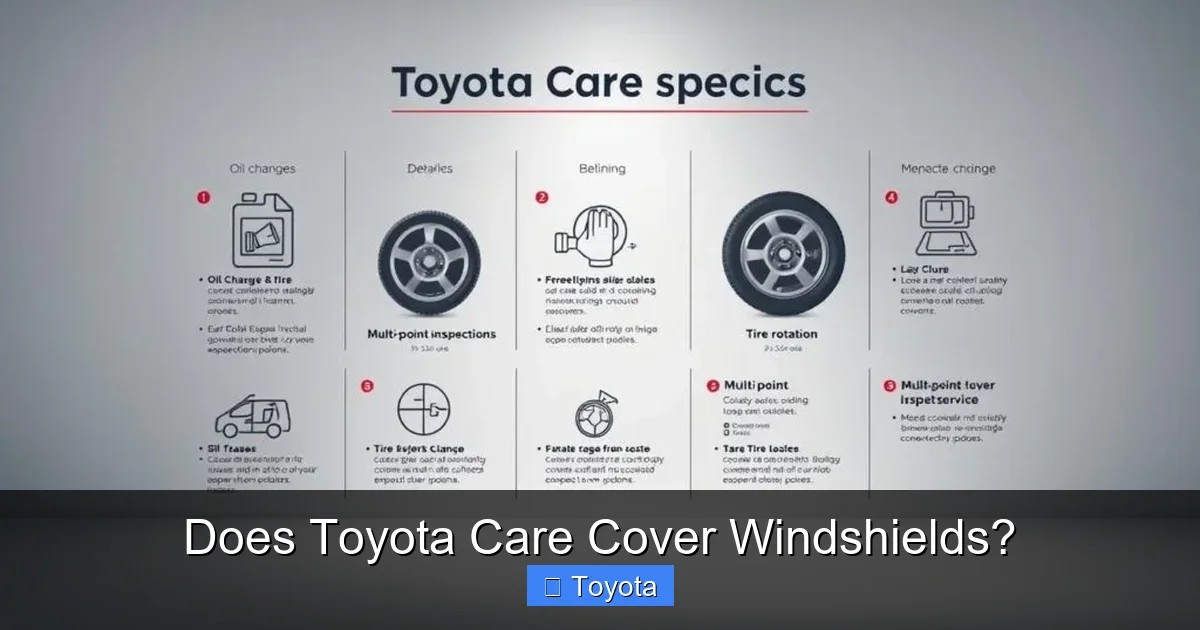
Let’s start with the basics. Toyota Care is a no-cost, 2-year or 25,000-mile (whichever comes first) scheduled maintenance plan that comes standard with every new Toyota vehicle. It’s designed to help keep your car running smoothly during the early years of ownership. The plan covers routine services like oil changes, tire rotations, multi-point inspections, and fluid top-offs — all performed by certified Toyota technicians using genuine Toyota parts.
But here’s the catch: Toyota Care is focused on preventive maintenance, not repairs due to accidents, wear and tear, or environmental damage. That means things like brake pads, wiper blades, and yes — windshields — aren’t covered under the standard plan unless they’re directly tied to a mechanical failure that’s part of the maintenance schedule.
So, while Toyota Care is a fantastic value for keeping up with regular upkeep, it’s not a catch-all for every possible issue your car might face. And unfortunately, that includes windshield damage.
Does Toyota Care Cover Windshields? The Straight Answer

Visual guide about Does Toyota Care Cover Windshields?
Image source: vehiclebright.com
Now, let’s get to the heart of the question: does Toyota Care cover windshields?
The straightforward answer is **no** — Toyota Care does not cover windshield repairs or replacements under normal circumstances. Windshield damage, whether from a flying rock on the highway or a sudden temperature change, is considered external damage and falls outside the scope of routine maintenance.
Toyota Care is designed to cover scheduled services that keep your vehicle in optimal condition. Think of it like a health plan for your car — it covers check-ups, vaccinations (oil changes), and basic screenings (inspections), but not emergency room visits for injuries. A cracked windshield is more like an injury — something that happens unexpectedly and isn’t part of regular upkeep.
That said, there are rare exceptions. If a windshield issue is directly caused by a mechanical failure that *is* covered under Toyota Care — for example, a malfunctioning wiper motor that leads to excessive pressure and cracks the glass — then there might be a case for coverage. But these situations are extremely uncommon and would require thorough documentation and approval from Toyota.
In nearly all real-world cases, though, windshield damage is treated as a separate issue. Whether it’s a small chip from a gravel road or a full crack from a fallen tree branch, you’ll need to look elsewhere for coverage.
What Actually Covers Windshield Damage?

Visual guide about Does Toyota Care Cover Windshields?
Image source: vehiclebright.com
So if Toyota Care doesn’t cover windshields, what does?
The most common source of windshield coverage is your **comprehensive auto insurance**. Most standard car insurance policies include comprehensive coverage, which protects against non-collision damage — things like theft, vandalism, weather events, and yes, flying debris that cracks your windshield.
Here’s the good news: many insurance companies treat windshield repairs as a priority. In fact, in several states (like Florida, Kentucky, and South Carolina), insurers are required by law to cover windshield repairs with **no deductible**. Even in other states, many companies waive the deductible for windshield repairs because they’re relatively inexpensive and quick to fix — often taking less than an hour.
For example, if you’re driving down the highway and a small rock hits your windshield, creating a chip the size of a dime, you can usually get it repaired for free through your insurance. The repair involves injecting a special resin into the chip, which restores structural integrity and prevents the crack from spreading. This is not only cost-effective but also safer — a compromised windshield can weaken the roof support in a rollover accident.
If the damage is too large or in the driver’s line of sight, a full replacement may be necessary. While this is more expensive — typically ranging from $200 to $500 depending on the vehicle — comprehensive insurance often covers most or all of the cost, especially if you have a low or waived deductible.
Optional Toyota Protection Plans That May Include Glass Coverage
Visual guide about Does Toyota Care Cover Windshields?
Image source: vehiclebright.com
While the standard Toyota Care plan doesn’t cover windshields, Toyota does offer **optional extended protection plans** that might include glass coverage. These are worth considering if you want extra peace of mind, especially if you live in an area with rough roads, frequent hail, or high traffic density.
One such plan is the **Toyota Extra Care Vehicle Protection Plan**, an extended service contract that can be purchased at the time of vehicle purchase or lease. This plan goes beyond routine maintenance and can cover a wide range of mechanical and electrical components — and in some cases, includes **glass protection** as an add-on or built-in feature.
For example, certain versions of the Extra Care plan offer “Glass Coverage” that pays for repairs or replacements due to cracks, chips, or breaks caused by road debris, vandalism, or weather. This coverage often comes with no deductible and may even include free recalibration of advanced driver-assistance systems (ADAS) like lane departure warning or automatic emergency braking — which rely on cameras mounted behind the windshield.
Another option is the **Toyota Care Plus** plan, which extends the original Toyota Care maintenance coverage for up to 4 years or 45,000 miles. While it still focuses on maintenance, some dealerships bundle it with additional perks, including windshield protection, especially when sold as part of a “protection package” at the time of purchase.
It’s important to note that these plans are **not automatically included** — you have to opt in and pay an additional fee. But for drivers who want comprehensive protection, they can be a smart investment. Be sure to ask your Toyota dealer about available glass protection options and read the fine print to understand what’s covered and what’s not.
Dealer-Added Windshield Protection: Is It Worth It?
When you’re finalizing the purchase of your new Toyota, the sales team might offer you a “windshield protection plan” or “glass coverage” as an add-on. These are typically third-party plans sold through the dealership, not directly from Toyota, and they promise to cover repairs or replacements for a set period — often 3 to 5 years.
So, are these plans worth it?
It depends.
On one hand, these plans can offer convenience. If you get a chip, you can often drive into the dealership, and they’ll handle the repair or replacement at no extra cost. Some even offer mobile service, where a technician comes to your home or office to fix the windshield.
On the other hand, many of these plans are **redundant if you already have comprehensive insurance**. Since most insurers cover windshield repairs with no deductible, paying $150–$300 for a separate plan might not make financial sense — especially if you rarely drive on gravel roads or in high-risk areas.
That said, there are scenarios where a dealer-added plan could be valuable:
– You live in an area with frequent hail storms or construction zones.
– You lease your vehicle and want to avoid out-of-pocket costs at the end of the lease.
– Your insurance has a high deductible, and you want to avoid paying $100+ for a repair.
– You drive a luxury or high-tech vehicle where windshield replacement is expensive (e.g., models with built-in cameras or sensors).
Before signing up, ask these questions:
– What’s the coverage limit? (Some plans cap at one repair per year.)
– Is recalibration of ADAS included?
– Can I use any repair shop, or must I go through the dealer?
– What’s the cancellation policy?
If the plan is reasonably priced and fills a real gap in your coverage, it might be worth considering. But don’t feel pressured — you can always add protection later or rely on your insurance.
How to Handle Windshield Damage: Practical Tips
Even if Toyota Care doesn’t cover your windshield, you’re not helpless. Here’s how to handle windshield damage like a pro:
Act Fast on Chips and Cracks
The moment you notice a chip or crack, take action. Small chips can often be repaired if addressed within a few days. But if left untreated, temperature changes, road vibrations, or even washing your car can cause the damage to spread. Once a crack exceeds 6 inches or is in the driver’s line of sight, repair may no longer be an option — and you’ll need a full replacement.
Document the Damage
Take clear photos of the damage from multiple angles. This is helpful for insurance claims and for getting accurate quotes from repair shops. Note the location, size, and depth of the chip or crack.
Check Your Insurance First
Call your insurance provider or check your policy online. Ask if windshield repairs are covered with no deductible. Many companies have partnerships with repair networks like Safelite, which can schedule mobile service at your convenience.
Get Multiple Quotes
Even if insurance covers the cost, it’s smart to compare prices. Some shops charge more for OEM (original equipment manufacturer) glass, while others use high-quality aftermarket glass that’s just as safe. Make sure the shop recalibrates any ADAS features after replacement — this is critical for safety and may be required by law in some states.
Consider OEM vs. Aftermarket Glass
OEM windshields are made by the same manufacturer as your original glass and are guaranteed to fit perfectly. Aftermarket glass is often cheaper and widely available, but quality can vary. For vehicles with advanced safety systems, OEM is usually recommended to ensure proper camera alignment.
Prevent Future Damage
While you can’t control everything, you can reduce risk:
– Maintain a safe following distance to avoid debris from the car ahead.
– Avoid driving behind large trucks or construction vehicles.
– Park in covered areas when possible to protect against hail and falling branches.
– Use a windshield sunshade in extreme temperatures to reduce stress on the glass.
Real-Life Example: A Toyota Owner’s Windshield Story
Let’s look at a real-world scenario to bring this all together.
Sarah bought a new Toyota RAV4 Hybrid and was thrilled with the included Toyota Care plan. A few months later, while driving on a rural highway, a small rock kicked up by a passing truck hit her windshield, leaving a chip near the edge.
She called her Toyota dealer, hoping Toyota Care would cover the repair. After checking her plan details, the service advisor explained that windshield damage isn’t included. Disappointed but not surprised, Sarah checked her auto insurance policy and discovered she had comprehensive coverage with a $0 deductible for glass repairs.
She scheduled a mobile repair with her insurer’s preferred provider. A technician came to her office the next day, fixed the chip in 20 minutes, and recalibrated the lane departure camera — all at no cost to her.
Six months later, during a hailstorm, Sarah’s windshield developed a large crack. This time, a full replacement was needed. Again, her insurance covered the entire cost, including OEM glass and ADAS recalibration.
Sarah’s story highlights an important lesson: while Toyota Care is a great perk, it’s not a substitute for insurance or optional protection plans. By understanding her coverage options, she avoided out-of-pocket expenses and kept her RAV4 safe and road-ready.
Conclusion: Plan Ahead for Windshield Protection
So, does Toyota Care cover windshields? The answer remains no — not under the standard complimentary maintenance plan. Toyota Care is designed for scheduled services, not unexpected damage like cracked glass.
But that doesn’t mean you’re left unprotected. Comprehensive auto insurance is your best defense against windshield damage, often covering repairs and replacements with little or no cost to you. Optional Toyota protection plans and dealer add-ons can provide extra peace of mind, especially for high-risk drivers.
The key is to be proactive. Understand what your insurance covers, consider your driving environment, and don’t ignore small chips. A quick repair today can save you from a costly replacement tomorrow.
Ultimately, while Toyota Care won’t fix your windshield, it’s still a valuable part of your ownership experience — just one piece of a larger protection puzzle. Combine it with the right insurance and optional coverage, and you’ll be ready for whatever the road throws your way.
Frequently Asked Questions
Does Toyota Care cover windshield repairs?
No, Toyota Care does not cover windshield repairs or replacements. It only includes scheduled maintenance services like oil changes and tire rotations.
Will my auto insurance cover a cracked windshield?
Most comprehensive auto insurance policies cover windshield damage, often with no deductible, especially for repairs. Check your policy for details.
Can I add windshield protection to my Toyota Care plan?
Toyota Care itself cannot be upgraded to include glass coverage, but you can purchase optional plans like Toyota Extra Care that may include it.
Is windshield replacement expensive?
Costs vary from $200 to $500 or more, depending on the vehicle. Models with advanced safety systems may require more expensive OEM glass and recalibration.
Should I repair or replace a chipped windshield?
Small chips can often be repaired if caught early. Cracks longer than 6 inches or in the driver’s line of sight usually require full replacement.
Do I need to recalibrate my car after a windshield replacement?
Yes, if your vehicle has ADAS features like lane departure warning or automatic braking, recalibration is essential for safety and may be required by law.