
Is the Toyota 4.6 V8 a Good Engine?

The Toyota 4.6 V8 is widely regarded as one of the most reliable and durable engines in its class. Known for smooth power delivery, low maintenance needs, and longevity, it powers popular models like the Tundra and Land Cruiser with confidence.
Key Takeaways
- Exceptional Reliability: The 4.6L V8 is built with Toyota’s legendary engineering, offering long-term dependability with proper maintenance.
- Smooth and Quiet Operation: Thanks to advanced design and balance, this engine runs quietly and smoothly, even under load.
- Proven Track Record: Used in high-mileage vehicles like the Tundra and Sequoia, it has earned trust from owners and mechanics alike.
- Modest Power Output: While not the most powerful V8, it delivers consistent torque ideal for towing and daily driving.
- Fuel Economy Considerations: Expect lower fuel efficiency compared to smaller engines, but it’s reasonable for a full-size V8.
- Low Maintenance Costs: With fewer reported issues and widely available parts, upkeep is affordable over time.
- Great for Towing and Off-Roading: Its torque-rich performance makes it a favorite for RVs, trailers, and rugged terrain.
📑 Table of Contents
- Is the Toyota 4.6 V8 a Good Engine?
- Engine Overview: The 1UR-FE 4.6L V8
- Performance and Power Delivery
- Reliability and Longevity
- Fuel Economy and Efficiency
- Maintenance and Common Issues
- Towing, Off-Roading, and Real-World Use
- Comparisons to Other Engines
- Owner Experiences and Testimonials
- Conclusion: Is the Toyota 4.6 V8 Worth It?
Is the Toyota 4.6 V8 a Good Engine?
When it comes to choosing a vehicle, especially a full-size truck or SUV, the engine is often the deciding factor. You want something strong, reliable, and built to last—something that won’t leave you stranded or drain your wallet with constant repairs. That’s why so many people ask: Is the Toyota 4.6 V8 a good engine?
The short answer? Yes—it absolutely is. The Toyota 4.6-liter V8, officially known as the 1UR-FE, has earned a stellar reputation over the past two decades. Found under the hood of popular models like the Toyota Tundra, Sequoia, Land Cruiser, and even the Lexus LX 570 (in a slightly different 5.7L variant), this engine blends Toyota’s hallmark durability with respectable performance. It’s not the flashiest V8 on the market, but it’s one of the most dependable.
What makes the 4.6 V8 stand out isn’t raw horsepower or cutting-edge turbocharging—it’s consistency. Toyota designed this engine for real-world use: hauling trailers, driving across continents, and surviving harsh conditions without complaint. Whether you’re a weekend warrior towing a boat or a daily commuter who values peace of mind, this engine delivers. And with proper care, it can easily surpass 300,000 miles—something few engines can claim.
Engine Overview: The 1UR-FE 4.6L V8
Visual guide about Is the Toyota 4.6 V8 a Good Engine?
Image source: i.ytimg.com
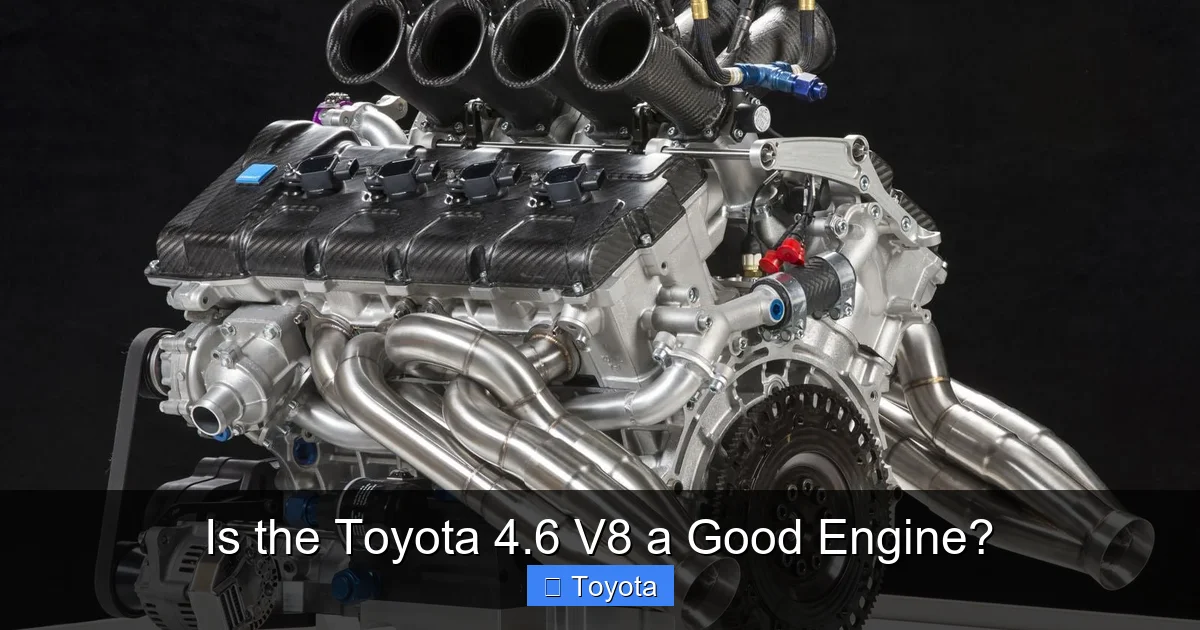
Let’s start with the basics. The Toyota 4.6 V8, or 1UR-FE, is a naturally aspirated, 32-valve V8 engine with dual overhead camshafts (DOHC). It features an aluminum block and cylinder heads, which helps reduce weight while maintaining strength. With a displacement of 4.6 liters (281 cubic inches), it produces around 310–381 horsepower and 325–367 lb-ft of torque, depending on the model and model year.
This engine was introduced in 2007 and quickly became a staple in Toyota’s full-size lineup. It replaced older V8s like the 4.7L 2UZ-FE, offering better fuel efficiency, lower emissions, and improved refinement. Unlike some competitors that jumped straight to turbocharged or hybrid powertrains, Toyota stuck with a traditional V8 design—proving that sometimes, simplicity is strength.
One of the key design features of the 1UR-FE is its use of Toyota’s Variable Valve Timing with intelligence (VVT-i). This system adjusts the timing of the intake and exhaust valves to optimize performance, fuel economy, and emissions across different driving conditions. It’s a smart, reliable technology that enhances efficiency without sacrificing power.
Another strength? The engine’s bore and stroke dimensions (94mm x 83mm) create a slightly oversquare design, which favors high-rpm performance and responsiveness. Combined with a 10.8:1 compression ratio, it runs smoothly on regular 87-octane fuel—something not all V8s can claim.
Performance and Power Delivery
Visual guide about Is the Toyota 4.6 V8 a Good Engine?
Image source: s1.cdn.autoevolution.com
Now, let’s talk about how the 4.6 V8 actually feels on the road. If you’re expecting neck-snapping acceleration like a sports car, you might be slightly disappointed. But if you value smooth, linear power and strong low-end torque, you’ll love this engine.
The 4.6L V8 isn’t built for drag racing—it’s built for real-world driving. It delivers its peak torque early in the RPM range, usually around 3,400–4,000 rpm. That means you get strong pulling power right off the line, which is perfect for merging onto highways, climbing hills, or towing a trailer. In the Tundra, for example, this engine can tow up to 6,500–7,000 pounds, depending on configuration—more than enough for most RVs, boats, or campers.
Acceleration is steady and predictable. The Tundra with the 4.6 V8 goes from 0 to 60 mph in about 7.5 to 8 seconds—not lightning-fast, but more than adequate for a full-size truck. The engine revs smoothly up to its 6,000 rpm redline, and the sound is deep and muscular without being obnoxious. It’s the kind of engine that makes you feel confident, not overwhelmed.
Drivers often praise the 4.6 V8 for its refinement. Unlike some older V8s that feel clunky or rough, this engine is quiet at idle and barely noticeable during cruising. Toyota engineers did an excellent job balancing the internals and damping vibrations, resulting in a driving experience that’s both powerful and comfortable.
Reliability and Longevity
Visual guide about Is the Toyota 4.6 V8 a Good Engine?
Image source: charlesandhudson.com
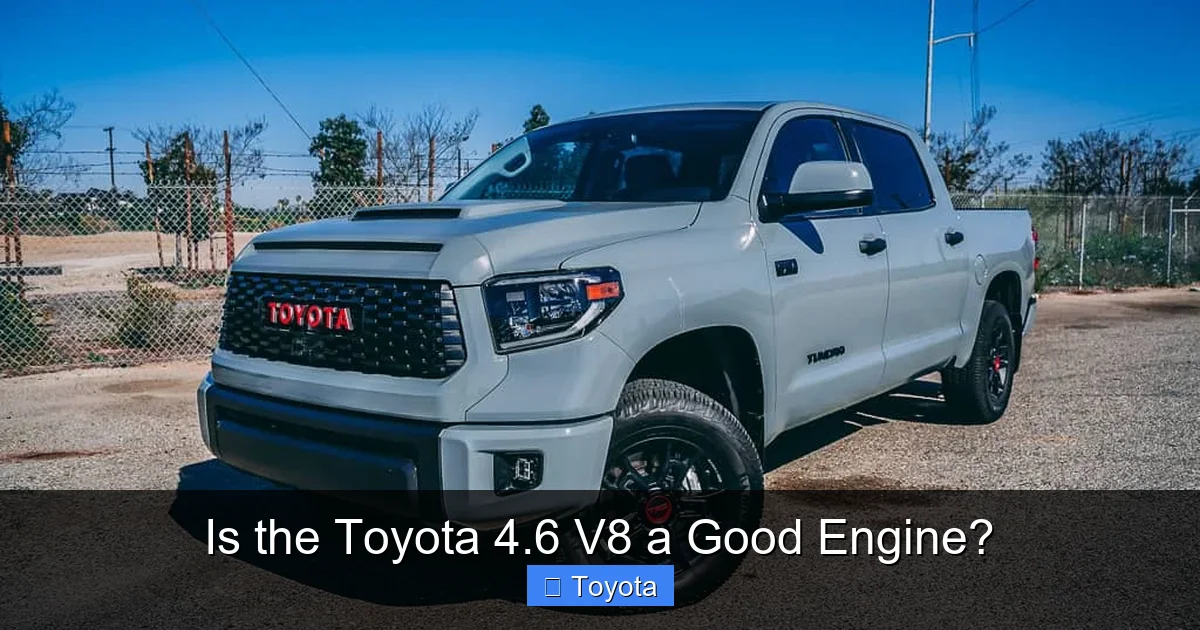
Here’s where the Toyota 4.6 V8 truly shines: reliability. Toyota has a reputation for building engines that last, and the 1UR-FE is no exception. Thousands of owners have reported driving their Tundras, Sequoias, and Land Cruisers well past 250,000 miles with minimal issues—some even hitting 400,000 miles with proper maintenance.
So, what makes it so durable? Several factors contribute:
First, the engine uses a robust cast-iron cylinder liner inside the aluminum block. This provides excellent wear resistance and helps maintain cylinder integrity over time. Second, Toyota uses high-quality materials and tight manufacturing tolerances, reducing the risk of premature wear or failure.
Third, the 4.6 V8 has a timing chain instead of a timing belt. Timing chains are more durable and typically last the life of the engine, eliminating the need for expensive replacements every 60,000–100,000 miles.
Common issues with the 1UR-FE are rare, but they do exist. Some owners have reported minor oil consumption—usually less than a quart per 3,000 miles—which is considered normal for high-mileage V8s. A few early models had issues with the Variable Valve Timing (VVT-i) solenoids, but these were mostly resolved in later production years.
One area to watch is the water pump. While not a frequent failure, some 4.6 V8s have experienced water pump leaks around 150,000–200,000 miles. Replacing it isn’t overly expensive, especially if caught early.
Overall, though, the engine’s reliability is outstanding. Consumer Reports, J.D. Power, and real-world owner forums consistently rank Toyota’s V8-powered vehicles among the most dependable on the road.
Fuel Economy and Efficiency
Let’s be honest: a 4.6-liter V8 isn’t going to win any fuel economy awards. But compared to other full-size V8 engines, the 1UR-FE holds its own.
In the Toyota Tundra, the 4.6 V8 delivers an EPA-estimated 13–15 mpg in the city and 17–19 mpg on the highway, depending on drivetrain (2WD vs. 4WD) and cab configuration. That’s not great by today’s hybrid or turbo-four standards, but it’s competitive for a naturally aspirated V8 in a heavy truck.
For comparison, the Ford F-150 with a 5.0L V8 gets similar numbers, and the Chevrolet Silverado with a 5.3L V8 is only slightly better. The 4.6 V8’s efficiency comes from its aluminum construction, VVT-i system, and optimized combustion design.
Real-world driving often results in slightly lower mileage—especially if you’re towing, driving in stop-and-go traffic, or using 4WD. But for drivers who need V8 power and don’t want to sacrifice too much fuel economy, the 4.6L strikes a reasonable balance.
One tip to improve fuel efficiency? Keep up with regular maintenance. Clean air filters, fresh spark plugs, and proper tire pressure can make a noticeable difference. Also, avoid aggressive driving—flooring the throttle wastes fuel and increases engine wear.
Maintenance and Common Issues
One of the biggest advantages of the Toyota 4.6 V8 is its low maintenance requirements. Toyota designed this engine to be owner-friendly, with long service intervals and durable components.
Here’s a quick maintenance checklist:
- Oil Changes: Every 5,000–7,500 miles with synthetic oil. Toyota recommends 0W-20 or 5W-20 for most climates.
- Spark Plugs: Replace every 100,000 miles. The 4.6 V8 uses iridium-tipped plugs, which last much longer than standard copper ones.
- Air Filter: Inspect every 15,000 miles and replace as needed. A dirty filter reduces performance and fuel economy.
- Coolant: Flush and replace every 100,000 miles or 10 years.
- Transmission Fluid: Change every 60,000–100,000 miles, depending on driving conditions.
As for common issues, most are minor and preventable with regular care. Some owners report:
- Oil Consumption: A small amount of oil burn is normal, especially after 150,000 miles. Monitor levels and top off as needed.
- VVT-i Solenoid Problems: Can cause rough idle or reduced performance. Usually fixed with a $100–$200 part replacement.
- Water Pump Leaks: Watch for coolant stains under the engine. Early replacement prevents overheating.
- Exhaust Manifold Cracks: Rare, but possible in high-mileage engines. Causes ticking noise and reduced performance.
The good news? Most repairs are straightforward and don’t require specialized tools. Parts are widely available and reasonably priced, especially compared to European or luxury brands.
Towing, Off-Roading, and Real-World Use
If you’re considering a vehicle with the 4.6 V8, chances are you need it for more than just commuting. Whether you’re towing a trailer, exploring backroads, or hauling gear, this engine is built for work.
Towing capacity is one of its strongest suits. In the Tundra, the 4.6 V8 can pull up to 6,800 pounds with the right setup—enough for most travel trailers, fishing boats, or utility trailers. The engine’s low-end torque ensures smooth acceleration even when fully loaded, and the 6-speed automatic transmission (in most models) provides confident gear shifts.
Off-road performance is another highlight. In the Land Cruiser and Sequoia, the 4.6 V8 pairs with advanced 4WD systems, locking differentials, and terrain management modes. The engine delivers consistent power across steep inclines, rocky trails, and muddy paths. It’s not as high-revving as a performance engine, but its reliability and torque make it ideal for slow, technical driving.
Many overlanders and adventurers choose Toyota vehicles with the 4.6 V8 precisely because they know it won’t let them down in remote areas. With proper maintenance, these engines have crossed deserts, climbed mountains, and survived extreme temperatures—all while running on regular gas.
Comparisons to Other Engines
How does the Toyota 4.6 V8 stack up against the competition? Let’s compare it to a few key rivals.
Ford 5.0L V8 (Coyote): The Ford F-150’s 5.0L V8 makes more horsepower (up to 400 hp) and slightly better fuel economy. But it’s more complex, with higher maintenance costs and more reported issues like carbon buildup and timing chain problems. The Toyota 4.6 V8 wins on simplicity and longevity.
Chevrolet 5.3L V8 (EcoTec3): GM’s 5.3L V8 is efficient and powerful, but it uses direct injection, which can lead to carbon buildup on intake valves over time. The Toyota 4.6 V8 uses port injection, which is cleaner and easier to maintain.
Toyota 5.7L V8 (3UR-FE): Found in later Tundras and Sequoias, the 5.7L makes more power (381 hp) but consumes more fuel. The 4.6L is more efficient and nearly as capable for most users.
In short, the 4.6 V8 may not be the most powerful or efficient, but it’s one of the most balanced and reliable options in its class.
Owner Experiences and Testimonials
Nothing speaks louder than real-world feedback. Across forums like TundraTalk, Land Cruiser forums, and Reddit, owners consistently praise the 4.6 V8.
One Tundra owner with 280,000 miles said: “I’ve towed my 7,000-pound trailer across the country twice. The engine never missed a beat. I change the oil, rotate the tires, and drive. That’s it.”
A Land Cruiser enthusiast shared: “I’ve taken my 2008 LC through the Rub’ al Khali desert. Temperatures hit 120°F, and the engine ran cool and smooth the whole time. Toyota built this thing to last.”
Even mechanics agree. A Toyota-certified technician noted: “We see these engines come in with 200,000+ miles and barely any wear. As long as the owner changes the oil and doesn’t neglect maintenance, they just keep going.”
These stories aren’t outliers—they’re the norm. The 4.6 V8 has earned its reputation through years of proven performance.
Conclusion: Is the Toyota 4.6 V8 Worth It?
So, is the Toyota 4.6 V8 a good engine? Without a doubt—yes.
It may not have the latest tech or the highest horsepower numbers, but it delivers exactly what most drivers need: reliability, smooth power, and long-term value. Whether you’re buying a used Tundra, a rugged Land Cruiser, or a family-friendly Sequoia, the 4.6 V8 gives you confidence on every drive.
It’s an engine built for real life—not just specs on a brochure. It tows, it hauls, it explores, and it lasts. And in a world where so many engines are overcomplicated and fragile, that’s a rare and valuable thing.
If you’re looking for a V8 that won’t let you down, the Toyota 4.6 V8 is one of the best choices you can make.
Frequently Asked Questions
How long does the Toyota 4.6 V8 last?
With proper maintenance, the Toyota 4.6 V8 can easily last 250,000 to 300,000 miles or more. Many owners report driving their vehicles beyond 400,000 miles without major engine issues.
What vehicles use the Toyota 4.6 V8 engine?
The 4.6L V8 is found in the Toyota Tundra (2007–2017), Sequoia (2008–2021), Land Cruiser (2008–2021), and the Lexus LX 570 (as a 5.7L variant).
Does the Toyota 4.6 V8 consume a lot of oil?
A small amount of oil consumption—up to a quart per 3,000 miles—is considered normal, especially in high-mileage engines. Regular oil level checks are recommended.
Can the Toyota 4.6 V8 run on regular gas?
Yes, the 4.6 V8 is designed to run efficiently on regular 87-octane gasoline, making it cost-effective and convenient for daily use.
Is the Toyota 4.6 V8 good for towing?
Absolutely. The engine’s strong low-end torque allows it to tow up to 6,800 pounds in the Tundra, making it ideal for trailers, boats, and campers.
What are common problems with the Toyota 4.6 V8?
Minor issues include occasional VVT-i solenoid faults, water pump leaks, and slight oil consumption. Most are inexpensive to fix and preventable with regular maintenance.
