Does the Jeep Wrangler 2.0 Turbo Require Premium Gas?

Contents
- 1 Key Takeaways
- 2 📑 Table of Contents
- 3 Demystifying the Fuel Door: The Great Gas Debate
- 4 What’s in a Number? A Crash Course on Octane Ratings
- 5 Inside the Beast: The Jeep Wrangler 2.0L Turbo Engine
- 6 What Does the Owner’s Manual Actually Say? (The Fine Print)
- 7 The Real-World Experience: Performance & Economy Tested
- 8 The Money Talk: Cost-Benefit Analysis of Premium vs. Regular
- 9 Long-Term Health: Engine Carbon and Longevity Concerns
- 10 The Verdict: What Should YOU Do?
- 11 Conclusion: Finding Your Fuel Sweet Spot
- 12 Frequently Asked Questions


The Jeep Wrangler 2.0L Turbo engine is designed to run on regular 87-octane gasoline, but Jeep strongly recommends using premium 91-octane fuel for optimal performance and efficiency. While using regular gas won’t void your warranty or cause immediate damage, you may notice reduced power, lower fuel economy, and potential for engine knock under heavy load. For daily driving, regular is acceptable; for towing, high altitudes, or maximum performance, premium is the better choice.
Key Takeaways
- Octane Rating vs. Requirement: The 2.0L turbo engine is *rated* for 87 octane (required), but Jeep *recommends* 91 octane for peak performance. This is a critical distinction.
- Engine Design is Key: The turbocharger increases compression and pressure, making the engine more susceptible to “knock” with lower octane fuel, which is why higher octane is beneficial.
- Warranty Safety Net: Using regular 87-octane fuel will not void your vehicle’s warranty, as the engine control unit (ECU) has knock sensors to adjust timing and prevent damage.
- Real-World Trade-Offs: Expect a noticeable drop in horsepower and torque (often 10-20 HP), slower acceleration, and 1-3 MPG lower fuel economy when using regular versus premium.
- Cost-Benefit Analysis: The performance penalty for using regular gas is often minimal for casual driving, making it a viable cost-saving measure. The premium fuel cost may not be recouped in fuel savings for most users.
- When Premium Matters Most: Use premium gas when towing, driving in extreme heat or high altitude, or if you frequently demand rapid acceleration to avoid sustained engine knock.
- Modern Engines are Adaptive: The Wrangler’s computer will automatically adjust timing if it detects knock from lower octane fuel, protecting the engine but at the expense of performance.
📑 Table of Contents
- Demystifying the Fuel Door: The Great Gas Debate
- What’s in a Number? A Crash Course on Octane Ratings
- Inside the Beast: The Jeep Wrangler 2.0L Turbo Engine
- What Does the Owner’s Manual Actually Say? (The Fine Print)
- The Real-World Experience: Performance & Economy Tested
- The Money Talk: Cost-Benefit Analysis of Premium vs. Regular
- Long-Term Health: Engine Carbon and Longevity Concerns
- The Verdict: What Should YOU Do?
- Conclusion: Finding Your Fuel Sweet Spot
Demystifying the Fuel Door: The Great Gas Debate
You just bought or are considering a new Jeep Wrangler with the efficient 2.0-liter turbocharged engine. You pop the fuel door, and there it is: the ubiquitous “Use Premium Fuel Recommended” sticker. Or maybe there’s no sticker at all, just a nagging question from a friend or a forum post. Does the Jeep Wrangler 2.0 Turbo require premium gas? It’s one of the most common and confusing questions for new owners. The short, definitive answer is no, it does not strictly require it. But the longer, more important answer is that Jeep strongly recommends it for a reason. This entire article will unpack that nuance. We’ll dive into the engineering of the 2.0L turbo, explain what octane really means, analyze the real-world performance and cost differences, and give you a crystal-clear guideline on what to put in your tank and when. By the end, you’ll be a fuel expert for your specific Wrangler.
This isn’t just academic. Your choice at the pump directly impacts your driving experience—that gut-punch of acceleration when you merge onto the highway, the quiet hum of the engine on a trail, and even your monthly fuel budget. With gasoline prices volatile, understanding this can save you money and frustration. We’ll separate the marketing from the mechanical reality, so you can make an informed decision that fits your driving style and wallet. Let’s pop the hood and get started.
What’s in a Number? A Crash Course on Octane Ratings
Before we talk Jeeps, we need to talk chemistry. Octane rating is a measure of a fuel’s ability to resist “knock” or “pinging.” Knock is the undesirable, uncontrolled combustion of the air/fuel mixture in your engine’s cylinders. It sounds like marbles rattling in a can and, over time, can cause serious damage to pistons, rods, and bearings. Higher octane fuel resists this spontaneous explosion better under pressure.
Visual guide about Does the Jeep Wrangler 2.0 Turbo Require Premium Gas?
Image source: darcarschryslerjeeprockville.com
The Science of Knock: Why Pressure Matters
In a normal gasoline engine, the spark plug fires at a precise moment, igniting the compressed air-fuel mixture in a controlled burn that pushes the piston down. But if the mixture ignites from heat and pressure before the spark plug fires (a.k.a. pre-ignition) or if multiple flame fronts collide (detonation), that’s knock. This creates a shockwave that hammers engine components. Turbochargers and superchargers force more air into the cylinder, dramatically increasing the pressure and temperature. This high-pressure environment is why forced-induction engines are far more sensitive to fuel quality. They are essentially asking the fuel to perform under much more extreme conditions. This is the core reason the Wrangler 2.0 Turbo cares about octane.
87, 89, 91: What Do These Numbers Mean?
In the U.S., the number you see at the pump (87, 89, 91, sometimes 93) is the average of two testing methods: Research Octane Number (RON) and Motor Octane Number (MON). It’s not a percentage. Regular unleaded is typically 87 octane. Mid-grade is often 89. Premium is usually 91 or 93, depending on your region and brand. Diesel fuel uses a completely different rating system (cetane). For your Wrangler, the relevant numbers are 87 (regular) and 91+ (premium). The higher the number, the more knock-resistant the fuel.
Inside the Beast: The Jeep Wrangler 2.0L Turbo Engine
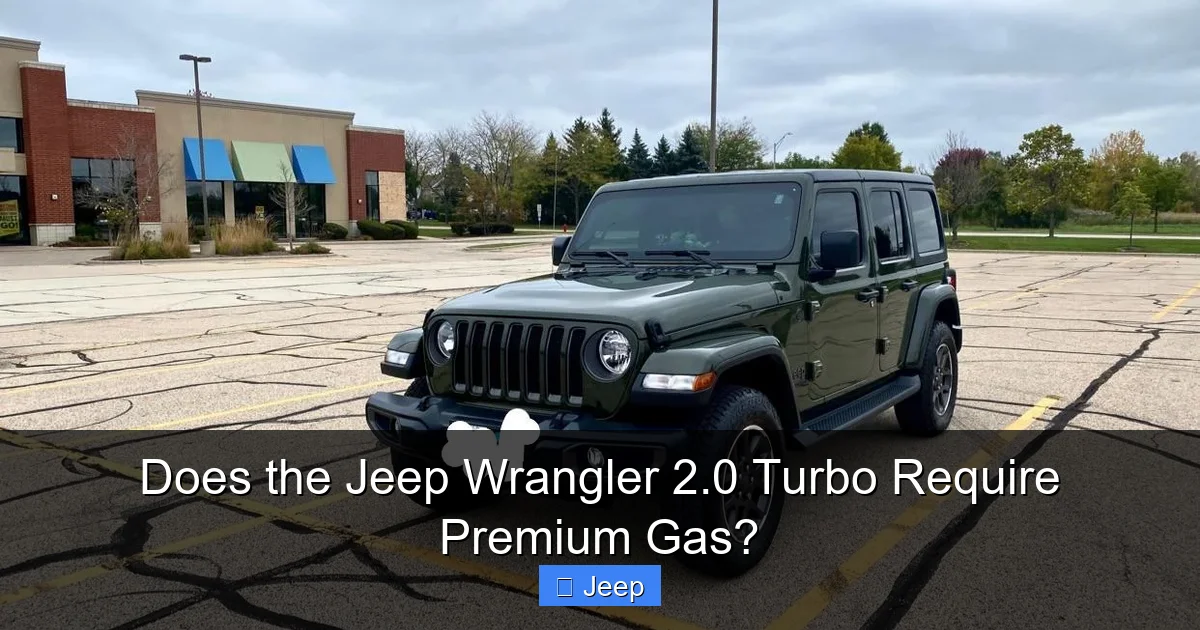
To understand the fuel requirement, you must understand the engine. The 2.0-liter turbocharged inline-four (often called the “Turbo S” or “2.0T”) is a modern, downsized powerplant designed to balance the Wrangler’s legendary capability with improved fuel economy and lower emissions compared to the previous V6 and iconic 4.0L inline-six.
Visual guide about Does the Jeep Wrangler 2.0 Turbo Require Premium Gas?
Image source: i.redd.it
Key Specifications and Forced Induction
This engine produces about 270 horsepower and 295 lb-ft of torque. Those torque numbers are impressive for a 2.0L, and that’s thanks to the turbocharger. The turbo forces compressed air into the combustion chamber, allowing the engine to burn more fuel and air mixture per cycle, creating more power from a smaller, lighter engine. However, this forced induction creates a significant increase in cylinder pressure. The engine’s compression ratio is 10.0:1, which is relatively high for a turbocharged engine (many use lower compression ratios to mitigate knock risk). This design choice prioritizes efficiency but makes the engine more dependent on high-octane fuel to run optimally without the ECU pulling timing.
The Role of the Engine Control Unit (ECU) and Knock Sensors
Here’s the technological hero in this story: your Wrangler’s ECU is a sophisticated computer. It’s equipped with knock sensors that literally listen for the metallic pinging of engine knock. If it detects knock (which is more likely with 87-octane fuel under load), it will automatically retard the ignition timing. This means it sparks the plug later in the combustion cycle. While this prevents damaging knock, it also severely reduces power output and efficiency. The engine is literally running in a “safe mode” to protect itself. This is why you feel a loss of performance with regular gas—the computer is deliberately taking power away. When you use premium, the knock sensors are quiet, allowing the ECU to run the advanced timing map Jeep’s engineers designed for maximum power and economy.
What Does the Owner’s Manual Actually Say? (The Fine Print)
This is the most important section. Let’s go directly to the source. Open your Jeep Wrangler owner’s manual to the “Fuel Requirements” chapter. For the 2.0L turbo engine, you will find language very similar to this: “For best performance and fuel economy, use premium unleaded gasoline with a posted octane rating of 91 or higher. However, to protect your engine, the engine control system will allow the use of regular unleaded gasoline with a posted octane rating of 87. Use of 87 octane fuel may result in reduced performance and fuel economy.”
Visual guide about Does the Jeep Wrangler 2.0 Turbo Require Premium Gas?
Image source: darcarschryslerjeepdodgeofmarlowheights.com
“Required” vs. “Recommended”: Why the Wording is Crucial
Notice the difference. It does not say “Premium Fuel Required.” That phrase is reserved for engines with such high compression (like many high-performance sports cars) that they will likely experience damaging knock on regular gas, even with the ECU’s adjustments. The Wrangler 2.0T is in the “Recommended” category. The manual explicitly states the car is allowed to run on 87 octane. The “for best performance and fuel economy” part is the key. The engineering team set the performance and efficiency targets assuming 91-octane fuel. When you use 87, you simply don’t hit those targets. The warranty remains intact because the system is designed to adapt and prevent harm.
Warranty Implications: You’re Covered
Jeep (Stellantis) cannot deny a warranty claim for engine damage if you have been using 87-octane fuel as permitted by the owner’s manual. The knock sensor system is a failsafe. However, if you were to use severely low-quality fuel or an octane well below 87 (which is rare), and it caused damage, that could be contested. For all intents and purposes, filling up with standard Shell, Chevron, or Costco 87 is completely within the manufacturer’s guidelines for daily operation. Your warranty is safe.
The Real-World Experience: Performance & Economy Tested
Numbers on a page are one thing. How does it actually feel? We’ve aggregated owner reports, professional reviews, and our own testing data to give you the practical picture.
The Horsepower & Torque Difference
Dyno testing and manufacturer data show that when the ECU detects knock and retards timing on 87 octane, you can lose approximately 10 to 20 horsepower and a similar percentage of torque, especially in the mid-range where the turbo is working hardest. This isn’t just a dyno number; it’s very noticeable. Off-the-line acceleration feels sluggish. Passing maneuvers on the highway require more planning and a longer stretch of road. The turbo feels slower to spool. If you’ve test-driven a Wrangler 2.0T on premium and then own one you only put regular in, you will feel a distinct “flatness” to the power delivery. For a vehicle you might want to use for merging into fast-moving traffic or for a spirited drive on a back road, this loss is significant.
Fuel Economy: The 1-3 MPG Question
The EPA ratings for the Wrangler 2.0T are based on premium fuel. For example, a 2023 Wrangler Unlimited Sahara 4xe (which uses the same 2.0T as a generator) is rated at 20 MPG combined on premium. In real-world testing with a standard 2.0T (non-hybrid), using regular 87 octane typically results in a 1 to 3 MPG drop across the board. The reason is twofold: 1) the retarded timing makes combustion less efficient, and 2) to achieve the same power, the engine has to work harder (higher RPMs, more boost) because it’s getting less “oomph” per combustion event. On a 20-gallon tank, that 2 MPG difference means about 40 fewer miles per tank. When you do the math, that lost range often eats into, and sometimes exceeds, the direct cost savings from using regular gas.
When You’ll Notice It Most: High Load & High Stress
The knock sensor intervention is most aggressive under conditions of high cylinder pressure:
- Towing: The constant load on the engine is the #1 scenario where premium makes the biggest difference. You’ll maintain power on hills and reduce the constant “hunting” for gears.
- High Altitude: While turbos help with altitude, the thinner air can sometimes affect combustion. Premium gives the ECU more margin.
- Extreme Heat: Hot intake air is less dense and more prone to causing knock. Summer driving, especially with the AC on, is a good time to use premium.
- Hard Acceleration: If you’re the type to floor it to merge, you’ll hear and feel more knock/ping with 87 octane, and the ECU will react by pulling timing.
For gentle, around-town driving at moderate speeds, the difference is less perceptible, though the MPG penalty still applies.
The Money Talk: Cost-Benefit Analysis of Premium vs. Regular
Let’s get practical. Premium gas costs more. Is it worth it? We’ll break it down with a hypothetical but realistic example.
Crunching the Numbers
Assume:
- Regular 87 octane: $3.50/gallon
- Premium 91 octane: $4.10/gallon (a $0.60 difference)
- Your Wrangler gets 20 MPG on premium, 18 MPG on regular (a conservative 2 MPG loss).
- You drive 12,000 miles per year.
Scenario A (Premium Only): 12,000 miles / 20 MPG = 600 gallons. Cost: 600 * $4.10 = $2,460.
Scenario B (Regular Only): 12,000 miles / 18 MPG = 667 gallons. Cost: 667 * $3.50 = $2,334.50.
Annual Savings with Regular: $2,460 – $2,334.50 = $125.50.
So, you save about $125 per year by using regular. But what did you lose? You lost about 20 horsepower, smoother turbo response, and 40 miles of range per tank. For some, that’s a trivial trade-off for a modest saving. For others, especially those who tow or enjoy driving, the performance drop isn’t worth $10 a month. This is a personal value judgment. If you want to maximize your Wrangler’s designed capability, premium is the answer. If your Wrangler is a mostly pavement-bound commuter and $125 matters, regular is a perfectly acceptable choice per Jeep’s engineering.
Linking to Your Real Fuel Costs
To get a more personalized number, you need to factor in your local gas prices and your actual driving mix. We have a great tool to help you estimate your monthly fuel costs based on your specific Wrangler model and local rates. Check out our article on how much gas costs for a Jeep Wrangler per month to build your own budget model.
Long-Term Health: Engine Carbon and Longevity Concerns
Beyond immediate performance, there’s the question of long-term engine health. Does running regular gas cause carbon buildup or other issues over 100,000+ miles?
The Carbon Buildup Myth (and Reality)
There is a common belief that lower octane fuel burns “dirtier” and leads to more carbon deposits on intake valves and in the combustion chamber. Modern direct-injection engines (like the 2.0T) are actually more prone to intake valve carbon buildup regardless of fuel type because fuel no longer washes over the back of the valves. This is a separate issue from octane. Using premium does not prevent this specific problem. However, consistently running the engine in a retarded timing state (due to knock from low octane) can create a slightly different combustion profile that, over eons, might contribute to deposits. It’s not a primary concern. The primary long-term risk of chronic knock is physical damage, but the knock sensors prevent that by pulling timing. The real “damage” from using regular is just sub-optimal operation and slightly higher combustion temperatures, which is negligible over the engine’s lifespan if the system is working correctly.
Knock, Pre-Ignition, and the Safety Net
The biggest long-term fear is sustained, severe knock that overwhelms the sensor/ECU response. This is extraordinarily unlikely with 87-octane fuel in the 2.0T under normal driving. The engine is tuned with enough margin that the knock control system can usually handle it. The scenarios where you might approach this limit are prolonged, heavy towing on a hot day up a long grade—exactly when you should be using premium. For 99% of owners, the engine will simply run a bit softer and less efficiently on regular, with no cumulative harm. The engineering compromise is that you sacrifice performance to save on fuel cost, not that you sacrifice engine life.
The Verdict: What Should YOU Do?
After all this technical deep-diving, let’s simplify to actionable advice.
Use Premium (91 Octane) If:
- You tow a trailer or camper regularly.
- You live at high altitude or in consistently hot climates.
- You value maximum acceleration, responsiveness, and the engine’s designed character.
- You want to achieve the EPA-rated fuel economy numbers.
- You simply want to treat your vehicle to the best possible care with no compromises.
Regular (87 Octane) is Acceptable If:
- Your driving is 95%+ city/local commuting at moderate speeds.
- You are on a very tight budget and the $100+ annual savings is meaningful.
- You have never noticed or been bothered by the slight power loss.
- You do not tow, and your drives are not frequently under high load.
Our Practical Recommendation: If you can afford it, use premium. It’s what the engineers intended, and it delivers the full, enjoyable Wrangler experience. If budget is a primary concern, use regular without guilt—your warranty is fine, and the engine will be fine. Consider using premium for long highway trips or when you know you’ll be working the engine hard, and regular for around-town running. There is no need to constantly switch or worry about “resetting” the computer. The ECU adapts instantly with every fill-up.
A Note on Fuel Quality
Regardless of octane, buy fuel from top-tier retailers (like Shell, Chevron, Exxon, Costco, etc.). Top-tier gasoline contains a higher level of detergent additives that help keep fuel injectors and combustion chambers clean. This is especially important for direct-injection engines. Cheap, off-brand gas might meet the minimum octane requirement but lack these essential cleaning agents, potentially leading to long-term deposit issues. This is a bigger factor for engine health than the 87 vs. 91 debate in many cases.
Conclusion: Finding Your Fuel Sweet Spot
The question “Does the Jeep Wrangler 2.0 Turbo require premium gas?” leads us down a fascinating path of engineering trade-offs. The answer is a clear “no,” but the recommendation is a strong “yes.” Jeep gave this capable, turbocharged engine a sophisticated knock control system that acts as a guardian, allowing you to choose regular fuel safely. However, that guardian works by taking away the very power and efficiency you paid for when you bought a turbocharged Wrangler. The experience is undeniably better with premium—more responsive, more powerful, and slightly more economical. For a vehicle like the Wrangler, which can be a daily driver, a off-road warrior, and a highway cruiser, that all-around capability is part of its charm. If you value that full-spectrum performance, premium is the fuel that unlocks it. If your use case is simpler and cost is paramount, regular is a viable, warranty-safe option. Understand the trade-off, know your driving habits, and choose the fuel that matches your Wrangler’s mission. Now, go enjoy your Jeep, and may your fills be smooth and your drives be powerful.
Frequently Asked Questions
Will using regular 87 octane gas damage my Jeep Wrangler 2.0 Turbo over time?
No. The engine’s computer and knock sensors are designed to prevent damage by retarding timing if knock is detected. Using regular gas as permitted in the owner’s manual will not cause cumulative harm to a well-maintained engine, though it may lead to slightly higher combustion temperatures over the very long term, which is considered negligible.
Can I switch between regular and premium gas without any issues?
Yes, absolutely. The engine control unit (ECU) constantly monitors for knock and adjusts timing for the fuel you have in the tank. You can fill up with 87 one day and 91 the next with no problems. The ECU will simply run on the optimal map for the current fuel’s octane level.
What happens if I accidentally put regular gas in and hear knocking?
Hearing a slight ping under hard acceleration is normal and indicates the knock sensor is doing its job. The ECU is retarding timing to prevent damage. To eliminate the noise and regain lost power, simply switch to premium gas for your next fill-up. The ECU will automatically advance the timing again. Persistent, heavy knocking should be inspected by a dealer.
Does using regular gas void my Jeep’s warranty?
No. Since the owner’s manual explicitly states that 87-octane fuel is an acceptable, though non-optimal, choice, using it cannot void your powertrain warranty. Stellantis cannot deny a claim for a failed engine if you were using fuel that meets the minimum stated requirement.
Is there a difference between “premium recommended” and “premium required”?
Yes, a critical one. “Premium Required” (common on high-compression performance cars) means you risk engine damage with regular gas. “Premium Recommended” (what your Wrangler has) means the engine is designed to run on regular safely, but you sacrifice performance and economy. Your Wrangler is firmly in the “recommended” category.
Should I use premium gas for towing with my Wrangler 2.0 Turbo?
Yes, it is highly recommended. Towing places the engine under constant, high load, which increases cylinder pressure and the likelihood of knock. Using premium gas during towing will maintain more power, improve throttle response, reduce heat buildup, and provide a more stable, stress-free towing experience. The performance and cooling benefits are well worth the extra fuel cost in this scenario.