

Does a Muffler Delete Void the Dodge Warranty?

Contents
- 1 Key Takeaways
- 2 📑 Table of Contents
- 3 What Is a Muffler Delete?
- 4 How Dodge Warranties Work
- 5 Does a Muffler Delete Void the Warranty? The Legal Reality
- 6 When a Muffler Delete Can Cause Problems
- 7 How to Protect Your Warranty When Modifying
- 8 What to Do If Your Warranty Claim Is Denied
- 9 Final Thoughts: Sound vs. Security
- 10 Frequently Asked Questions

Car Tire Inflator
Interior Cleaner Spray

Tire Shine Spray

Battery Terminal Cleaner
A muffler delete doesn’t automatically void your Dodge warranty, but it can impact specific repairs if the modification causes damage. Dodge follows federal laws that protect consumers, meaning they must prove the mod caused the issue before denying coverage. Always document your changes and understand your rights under the Magnuson-Moss Warranty Act.
If you’ve ever stood behind your Dodge Charger, Challenger, or Ram truck and thought, “This thing needs more growl,” you’re not alone. The deep, throaty rumble of a performance exhaust is one of the most satisfying upgrades a car enthusiast can make. And for many, that journey starts with something called a muffler delete—a modification that removes the stock muffler to create a louder, more aggressive exhaust note.
But here’s the big question: Does a muffler delete void the Dodge warranty? It’s a concern that keeps many owners up at night, especially when they’re driving a brand-new vehicle still under factory protection. You want the sound, the style, the thrill—but not at the cost of losing coverage on your engine, transmission, or emissions system. The good news? The answer isn’t as scary as some dealerships might make it seem.
Understanding your warranty rights starts with knowing the difference between “voiding” a warranty and “denying a claim.” A muffler delete won’t automatically cancel your entire Dodge warranty, but it can influence whether Dodge will pay for certain repairs—especially if they believe the modification caused the damage. The key lies in federal law, manufacturer policies, and how you document your vehicle’s condition. In this guide, we’ll break down everything you need to know about muffler deletes, warranty implications, and how to modify your Dodge safely and smartly.
Key Takeaways
- A muffler delete alone won’t void your entire Dodge warranty: Only repairs related to the modification may be denied if Dodge can prove the muffler delete caused the problem.
- The Magnuson-Moss Warranty Act protects you: This federal law prevents manufacturers from voiding warranties simply because you installed aftermarket parts, unless they directly cause damage.
- Dodge may deny claims on exhaust or engine components: If a dealership determines that the muffler delete led to engine strain, overheating, or exhaust system failure, those specific repairs might not be covered.
- Document everything before and after the mod: Keep receipts, photos, and service records to prove the muffler delete wasn’t responsible for unrelated mechanical issues.
- Dealer discretion plays a role: Some Dodge service centers may be more lenient than others, so choose a reputable dealer who understands performance modifications.
- Consider a cat-back or axle-back exhaust instead: These upgrades offer better sound and performance without removing critical emissions components, reducing warranty risks.
- Check your vehicle’s specific warranty terms: Powertrain, bumper-to-bumper, and emissions warranties have different coverage rules—know what’s protected.
📑 Table of Contents
What Is a Muffler Delete?
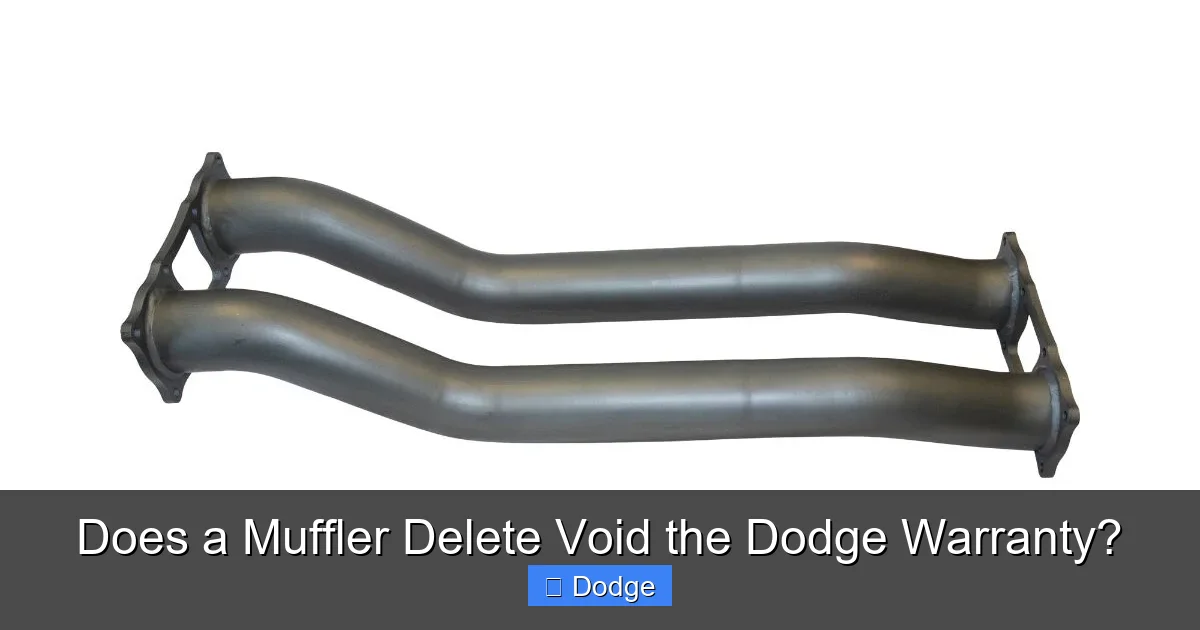
A muffler delete is a popular aftermarket modification where the factory-installed muffler is removed from the exhaust system and replaced with a straight pipe or a less restrictive resonator. The goal? To reduce backpressure, increase exhaust flow, and produce a louder, more aggressive sound. For many Dodge owners—especially those with V8 engines like the 5.7L HEMI or 6.4L SRT—this mod delivers that muscle car roar they’ve been craving.
How It Works
The muffler’s primary job is to reduce noise by using internal chambers and sound-dampening materials to quiet the exhaust gases. When you delete it, those gases exit the system more freely, creating a deeper, more resonant tone. Some people also believe it improves performance, though the gains are usually minimal—typically just a few horsepower at most, and often only noticeable on a dyno.
Types of Muffler Deletes
There are a few ways to go about a muffler delete:
- Full Muffler Delete: The entire muffler is removed and replaced with a straight pipe. This gives the loudest sound but may trigger check engine lights or fail emissions tests in some states.
- Resonator Delete: Only the resonator (a smaller chamber behind the muffler) is removed. This offers a moderate increase in sound without going full race car.
- Catted vs. Catless: Some deletes also remove the catalytic converter, but this is illegal in most states and will definitely affect emissions compliance and warranty coverage.
It’s important to note that while a muffler delete changes the sound and appearance of your exhaust, it doesn’t fundamentally alter the engine’s operation—unless it’s done improperly or combined with other mods.
How Dodge Warranties Work

Visual guide about Does a Muffler Delete Void the Dodge Warranty?
Image source: vehiclefreak.com
Before we dive into whether a muffler delete voids your warranty, let’s clarify what a Dodge warranty actually covers. Dodge offers several types of warranties, each with different terms and durations:
Bumper-to-Bumper Warranty
This is the most comprehensive coverage, typically lasting 3 years or 36,000 miles (whichever comes first). It covers nearly every component of your vehicle, from the infotainment system to the suspension, as long as the issue isn’t due to wear and tear, misuse, or modifications.
Powertrain Warranty
Dodge’s powertrain warranty is more generous, often lasting 5 years or 60,000 miles. It covers major components like the engine, transmission, driveshaft, and differential. This is where most owners worry about modifications—because if something goes wrong with the engine, they want Dodge to foot the bill.
Emissions Warranty
Required by federal law, this warranty covers emissions-related parts (like oxygen sensors, catalytic converters, and the ECU) for up to 8 years or 80,000 miles. Any modification that affects emissions—such as removing a catalytic converter—can jeopardize this coverage.
Corrosion and Rust Warranty
This covers perforation rust for 5 years, regardless of mileage. It’s not affected by exhaust mods, but it’s good to know it exists.
The key takeaway? Your warranty isn’t a single, all-or-nothing contract. It’s a collection of protections, and modifications only affect the parts they directly impact.
Does a Muffler Delete Void the Warranty? The Legal Reality
Visual guide about Does a Muffler Delete Void the Dodge Warranty?
Image source: i.redd.it
Now for the million-dollar question: Does a muffler delete void the Dodge warranty? The short answer is no—not automatically. But the longer, more accurate answer is: it depends.
The Magnuson-Moss Warranty Act
This is the law that protects you. Enacted in 1975, the Magnuson-Moss Warranty Act is a federal regulation that governs consumer product warranties. One of its most important provisions is that manufacturers cannot void a warranty simply because you used an aftermarket part—unless they can prove that part caused the damage.
In other words, Dodge can’t say, “You deleted your muffler, so your entire warranty is canceled.” But they can say, “We won’t cover your engine repair because the muffler delete caused excessive backpressure and led to overheating.”
What Dodge Can and Cannot Do
Dodge (like all automakers) is allowed to deny warranty claims if they can demonstrate a causal link between the modification and the failure. For example:
- If your engine overheats and the dealer finds that the muffler delete disrupted exhaust flow, leading to increased engine temperatures, they may deny the claim.
- If your transmission fails and there’s no evidence the muffler delete played a role, Dodge must cover the repair under the powertrain warranty.
The burden of proof is on the manufacturer. They can’t just assume the mod caused the problem—they need evidence.
Real-World Examples
Let’s say you install a muffler delete on your 2022 Dodge Charger R/T. A few months later, your check engine light comes on, and the dealer diagnoses a faulty oxygen sensor. If the sensor failed due to age or a manufacturing defect, Dodge must replace it under warranty—even with the muffler delete. But if the sensor is damaged because the new exhaust setup caused excessive heat or improper air-fuel ratios, Dodge may deny the claim.
Another scenario: You experience a transmission failure. Unless Dodge can prove the muffler delete somehow stressed the transmission (which is unlikely), they’re required to cover the repair.
When a Muffler Delete Can Cause Problems
Visual guide about Does a Muffler Delete Void the Dodge Warranty?
Image source: outbackequipment.com.au
While a muffler delete won’t void your entire warranty, it can create situations where Dodge denies specific claims. Here’s how:
Increased Engine Stress
Removing the muffler changes exhaust backpressure. While modern engines are designed to adapt, a significant change can confuse the engine control unit (ECU). This may lead to:
- Rich or lean air-fuel mixtures
- Increased exhaust gas temperatures
- Check engine lights (especially P0420 or P0430 codes related to catalytic converter efficiency)
If these issues cause damage—like a melted catalytic converter or warped exhaust valves—Dodge may argue the muffler delete was the root cause.
Emissions System Complications
Even if you don’t remove the catalytic converter, a muffler delete can affect emissions readings. Some states require annual inspections, and a louder, less restrictive exhaust may fail sound or emissions tests. If your vehicle fails inspection and you need repairs to pass, those might not be covered if tied to the modification.
Dealer Bias and Documentation
Unfortunately, not all dealerships are created equal. Some service advisors may be performance-friendly and understand mods. Others may see a muffler delete and assume the worst. If you don’t have documentation—photos, receipts, dyno results—you’re at the mercy of the dealer’s interpretation.
How to Protect Your Warranty When Modifying
You don’t have to choose between performance and protection. With the right approach, you can enjoy a louder exhaust while keeping your warranty intact.
Choose Safer Alternatives
Instead of a full muffler delete, consider these options:
- Cat-Back Exhaust System: Replaces everything from the catalytic converter back. Offers better sound and performance without removing emissions components.
- Axle-Back Exhaust: Only replaces the muffler and tailpipes. Easier to install and less likely to trigger warranty issues.
- Resonator Delete: A milder change that adds sound without going full race car.
These mods are less likely to affect engine performance or emissions, making them safer for warranty purposes.
Document Everything
Before and after the modification:
- Take photos of the stock exhaust system.
- Keep receipts for parts and labor.
- Get a pre-mod inspection from a trusted mechanic.
- Save dyno sheets or performance logs if available.
If a warranty claim arises, this documentation can help prove the muffler delete wasn’t responsible.
Use Reputable Shops and Parts
Install your muffler delete at a reputable performance shop that specializes in Dodge vehicles. Use high-quality, bolt-on parts rather than welding or cutting unless absolutely necessary. A clean, professional install looks better to dealers and reduces the risk of damage.
Know Your Dealer
Some Dodge dealerships have performance divisions or technicians who understand mods. If possible, choose a dealer with a history of working with modified vehicles. You can also call ahead and ask about their policy on aftermarket exhaust systems.
Consider a Warranty Extension
If you’re planning multiple mods, look into extended warranty plans that cover modified vehicles. Some third-party providers offer coverage for performance-tuned cars, though they may exclude certain components.
What to Do If Your Warranty Claim Is Denied
If Dodge denies a warranty claim and you believe it’s unfair, you have options:
Request a Detailed Explanation
Ask the dealer for a written report explaining why the claim was denied. They must provide evidence linking the muffler delete to the failure.
Get a Second Opinion
Take your vehicle to an independent mechanic or performance shop. If they confirm the issue is unrelated to the muffler delete, you can use that report to appeal the decision.
Contact Dodge Customer Service
If the dealer won’t budge, escalate the issue to Dodge’s national customer service team. They may override the dealer’s decision, especially if the Magnuson-Moss Act applies.
File a Complaint
If all else fails, you can file a complaint with the Federal Trade Commission (FTC) or your state’s consumer protection agency. The FTC enforces the Magnuson-Moss Act and can investigate unfair warranty practices.
Final Thoughts: Sound vs. Security
A muffler delete can transform the way your Dodge sounds and feels on the road. That deep, rumbling exhaust note is music to the ears of any muscle car lover. But it’s important to go in with your eyes open.
The truth is, a muffler delete doesn’t automatically void your Dodge warranty—but it can complicate things. By understanding your rights, choosing the right modifications, and documenting everything, you can enjoy the best of both worlds: performance and protection.
Remember, the goal isn’t to trick the system or hide your mods. It’s to make informed decisions that keep your vehicle running strong and your warranty intact. Whether you’re cruising in a Charger, tearing up the track in a Challenger, or hauling gear in a Ram, your Dodge deserves to sound as good as it looks—without costing you peace of mind.
Frequently Asked Questions
Will a muffler delete void my entire Dodge warranty?
No, a muffler delete won’t void your entire warranty. Only repairs directly linked to the modification may be denied if Dodge can prove it caused the damage.
Can Dodge deny a warranty claim just because I have a muffler delete?
No, Dodge cannot deny a claim solely because of a muffler delete. They must provide evidence that the modification caused the specific failure.
Is a muffler delete legal?
It depends on your state. Some states allow muffler deletes as long as the vehicle passes noise and emissions tests, while others prohibit any modification that increases exhaust noise.
Will a muffler delete improve performance?
The performance gains are usually minimal—typically 5-10 horsepower at most. The main benefit is improved sound, not significant power increases.
Can I reinstall the stock muffler to restore warranty coverage?
Reinstalling the stock muffler may help if you need to pass an inspection or visit a dealer, but it doesn’t erase the modification history. Documentation is still key.
What’s a safer alternative to a muffler delete?
A cat-back or axle-back exhaust system offers better sound and performance without removing emissions components, reducing the risk to your warranty.


