
Does a 2004 Toyota Tacoma Have a Timing Belt or Chain?

The 2004 Toyota Tacoma is equipped with a timing chain, not a timing belt, for its 2.4L and 3.4L engines. Timing chains are designed to last the lifetime of the engine with proper maintenance, offering greater durability and reducing the risk of sudden, catastrophic failure compared to belts. This means you won’t face a scheduled, expensive replacement service every 60,000-100,000 miles, but you must prioritize regular oil changes to ensure the chain’s tensioners and lubrication system function correctly.
If you own a 2004 Toyota Tacoma or are considering buying one, you’ve likely asked the million-dollar question that haunts every used car buyer: “Does this thing have a timing belt or a timing chain?” It’s a critical piece of information that speaks to your future maintenance costs and the engine’s inherent reliability. The short, wonderful answer for 2004 Tacoma owners is that your truck has a timing chain. But don’t click away just yet! Knowing it’s a chain is only the beginning. Understanding what that means for your truck’s care, what to listen for, and why this component is the unsung hero (or potential villain) of your 2.4L or 3.4L engine is what truly empowers you as an owner. This guide will walk you through everything you need to know, turning a simple yes/no answer into a comprehensive knowledge base for keeping your Tacoma’s heart beating strong for years to come.
Key Takeaways
- Timing Chain, Not Belt: All 2004 Toyota Tacoma models (2.4L 2RZ-FE and 3.4L 5VZ-FE engines) use a robust timing chain system, which is a significant upgrade in longevity over a timing belt.
- Lifetime Design with Caveats: While Toyota designed the chain to last the engine’s life, its longevity is 100% dependent on consistent, high-quality oil changes to lubricate the chain and its hydraulic tensioner.
- No Scheduled Replacement: Unlike timing belts, there is no manufacturer-recommended mileage or time interval for replacing the timing chain on a 2004 Tacoma. Maintenance focuses on prevention, not replacement.
- Failure Signs Are Subtle: A failing timing chain often gives warnings like rattling noises from the front of the engine (especially on cold starts), poor performance, or check engine lights for cam/crank sensor codes, unlike a belt that can snap without warning.
- Maintenance is Key: The #1 thing you can do to protect your timing chain is to use the correct oil viscosity and change it on schedule. Using the right kind of oil for your Toyota Tacoma is non-negotiable for chain health.
- Cost of Neglect is Extreme: If a timing chain fails or stretches excessively, it will cause the engine’s valves and pistons to collide, resulting in catastrophic, often terminal, engine damage that requires a full rebuild or replacement.
- Different from Serpentine Belt: Do not confuse the internal timing chain with the external serpentine (drive) belt. The serpentine belt powers accessories like the alternator and power steering and does wear out; learn how long a Toyota serpentine belt lasts for proper accessory maintenance.
📑 Table of Contents
- The Great Divide: Timing Belts vs. Timing Chains Explained
- The 2004 Toyota Tacoma: Engine by Engine Breakdown
- Why a Chain? Toyota’s Engineering Philosophy for Trucks
- Maintenance Isn’t Optional: Protecting Your Timing Chain
- Warning Signs: How to Know Your Timing Chain Might Be in Trouble
- What Happens If a Timing Chain Fails on a 2004 Tacoma?
- Conclusion: Peace of Mind Through Knowledge and Care
The Great Divide: Timing Belts vs. Timing Chains Explained
Before we dive into the Tacoma specifics, let’s clear up the confusion. Both timing belts and chains serve the exact same fundamental purpose: they synchronize the rotation of the crankshaft (which is connected to the pistons) and the camshaft(s) (which opens and closes the valves). This precise choreography must happen thousands of times per minute. If this synchronization is lost—which happens if the belt breaks or the chain skips teeth—the pistons and valves can collide inside the sealed combustion chamber. This is called “interference engine” damage, and it’s almost always fatal for the engine.
What is a Timing Belt?
A timing belt is typically made of reinforced rubber with teeth that mesh with gears on the crankshaft and camshaft(s). Its primary advantages are that it’s quieter, cheaper to manufacture, and doesn’t require internal lubrication. However, it’s a consumable item. Rubber degrades over time due to heat, humidity, and stress. Manufacturers mandate its replacement as a preventive measure, usually between 60,000 and 100,000 miles. The cost of a timing belt service—which often includes replacing the water pump, tensioners, and idler pulleys—can range from $500 to over $1,000. It’s a known, scheduled expense.
What is a Timing Chain?
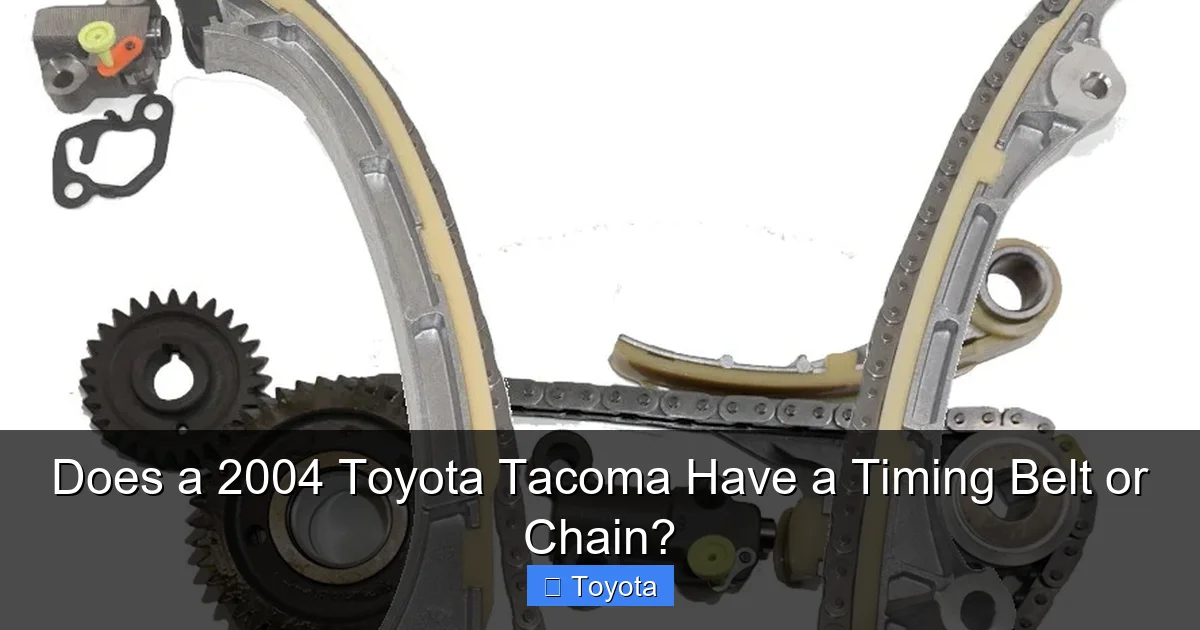
A timing chain is, as the name suggests, a metal chain (similar to a bicycle chain but much stronger and more精密) that runs inside the engine, lubricated by engine oil. It’s designed to be a “lifetime” component, meaning it should last the entire lifespan of the engine without scheduled replacement. Chains are stronger, don’t degrade from environmental factors like rubber does, and are self-tensioning via hydraulic tensioners. The trade-off is that they are noisier (a characteristic, faint rattle is normal), more expensive to manufacture initially, and their longevity is absolutely dependent on pristine internal engine lubrication. A neglected oil change is the #1 killer of timing chains and their tensioners.
The 2004 Toyota Tacoma: Engine by Engine Breakdown
For the 2004 model year, Toyota offered two primary gasoline engines for the Tacoma. The good news is that both are chain-driven. This was part of Toyota’s long-standing engineering philosophy for its trucks and many of its larger engines, prioritizing durability and low long-term maintenance.
Visual guide about Does a 2004 Toyota Tacoma Have a Timing Belt or Chain?
Image source: simplecarguides.com
The 2.4L 2RZ-FE Inline-Four (2WD and Some 4WD Models)
This workhorse of an engine is found in many base and mid-level trims. It is a non-interference engine design, which is an extra layer of safety. Even in the unlikely event of a timing component failure, the pistons and valves cannot physically collide, preventing catastrophic damage. However, the engine would still stop running and require repair. The 2RZ-FE uses a single overhead cam (SOHC) design with a timing chain. Its chain is located on the front of the engine and is lubricated by oil from the pump. The hydraulic tensioner maintains proper slack.
The 3.4L 5VZ-FE V6 (Most 4WD and Higher Trims)
The legendary 3.4L V6 is the engine that built the Tacoma’s reputation for bulletproof reliability and power. It’s a dual overhead cam (DOHC) engine, meaning it has two camshafts per cylinder head (four total) to operate the valves more efficiently. This requires a more complex timing system. It uses a single, long timing chain that runs across the front of the engine, with separate chains for each bank in some configurations or a master chain, depending on the exact sub-model. Crucially, the 5VZ-FE is an interference engine. If the timing chain skips or breaks, the pistons will absolutely hit the valves, causing severe, expensive damage. This underscores the critical importance of oil maintenance for this engine. The chain tensioner is hydraulic, relying on consistent oil pressure.
So, to be 100% clear for your 2004 Tacoma:
- 2.4L Inline-Four (2RZ-FE): Timing Chain. Non-interference engine.
- 3.4L V6 (5VZ-FE): Timing Chain. Interference engine. Requires vigilant oil maintenance.
Why a Chain? Toyota’s Engineering Philosophy for Trucks
Toyota’s decision to use a timing chain in the Tacoma, especially the V6, wasn’t an accident. It was a deliberate choice aligned with the truck’s intended purpose: hard work, durability, and low ownership cost over decades. A timing belt replacement is a significant labor-intensive service. For a vehicle marketed as a no-nonsense, go-anywhere workhorse, the idea of a $1,000 service every 7-10 years was less appealing than an engineered solution that, with basic care, would never need attention. The chain system, when fed clean oil at the correct pressure, can easily surpass 300,000 miles. This “fit and forget” mentality for the core timing mechanism is a key part of why Tacomas from this era hold their value and reputation so well. It’s one less scheduled headache for the owner.
Visual guide about Does a 2004 Toyota Tacoma Have a Timing Belt or Chain?
Image source: cdn11.bigcommerce.com
Maintenance Isn’t Optional: Protecting Your Timing Chain
Saying your Tacoma has a chain means “no scheduled replacement,” not “no maintenance.” In fact, chain maintenance is all about prevention, and it’s simpler but more constant than belt replacement. The lifeblood of your timing chain is engine oil.
Visual guide about Does a 2004 Toyota Tacoma Have a Timing Belt or Chain?
Image source: thedailyautomotive.com
The #1 Rule: impeccable Oil Change Discipline
This cannot be overstated. The hydraulic tensioner that keeps the chain taut uses oil pressure. The chain itself rides on oil-coated guides and sprockets. If your oil is old, sludgy, or the wrong viscosity, several bad things happen:
- Sludge Formation: Dirty oil can form sludge that clogs the tiny oil passages feeding the tensioner and chain, causing it to lose tension and slap or jump.
- Increased Wear: Poor lubrication accelerates wear on the chain links and the teeth of the cam and crank sprockets.
- Tensioner Failure: The hydraulic tensioner can fail if it doesn’t get clean oil, leading to excessive chain slack and noise, eventually leading to failure.
Stick to the severe service schedule if you do a lot of short trips, towing, or dusty driving. Use high-quality oil. For the 2004 Tacoma, Toyota recommends 5W-30. Using a heavier oil like 10W-30 in very cold climates can cause slow oil pressure buildup on startup, which can cause a brief chain rattle until pressure builds—this is usually normal but highlights the oil’s role.
You should also be mindful of your engine’s oil capacity. Running low on oil is a direct path to chain disaster. Check your oil level regularly.
Other Supporting Systems
While oil is king, other components support the chain system:
- Oil Pump: Must be in good working order to provide adequate pressure. A failing oil pump can starve the chain of oil.
- Chain Guides & Tensioner: These are plastic or composite parts that guide the chain and maintain tension. They can wear or break over extreme mileage, but this is rare with proper oil. A failure here will cause loud, metallic rattling.
- Cam/Crank Sensors: These sensors tell the computer the position of the shafts. If they fail, you’ll get a check engine light and poor running, but they don’t cause chain failure. However, codes like P0011-P0017 can indicate cam/crank correlation issues, which could point to a chain that has stretched excessively.
Warning Signs: How to Know Your Timing Chain Might Be in Trouble
Because a chain is inside the engine, you can’t just look at it. You must rely on symptoms. Here’s what to listen for and look for:
The Classic Symptom: Rattling Noise
The most common sign of a failing timing chain or tensioner is a persistent, metallic rattling or slapping noise from the front top of the engine. It’s often most noticeable on cold starts, when oil is thick and hasn’t fully circulated to the tensioner yet. The noise should quiet down or disappear within 1-2 seconds as oil pressure builds. If the rattle lasts longer, happens at all engine speeds, or gets louder over time, it’s a major red flag. A trained mechanic can often confirm this with a stethoscope.
Performance Issues and Check Engine Lights
As a chain stretches (which happens minutely over hundreds of thousands of miles), it can throw off the exact timing between the crank and cams. The engine’s computer is very sensitive to this. You might experience:
- Rough idle
- Loss of power, especially in the RPM range where your power band is
- Poor fuel economy
- A check engine light with codes related to camshaft position, crankshaft position, or variable valve timing (VVT) systems (if equipped). On the 3.4L V6, look for codes like P0010, P0011, P0012, etc.
Visual Inspection (For the Adventurous)
With some skill, you can remove the upper timing cover (on the 3.4L V6, it’s behind the power steering pump and accessories) to visually inspect the chain and tensioner for excessive slack or wear. This is not a casual DIY job for most, as it involves disturbing the timing components. If you suspect a problem, this is a job for a professional.
What Happens If a Timing Chain Fails on a 2004 Tacoma?
This is the nightmare scenario, and the outcome depends entirely on which engine you have.
For the 2.4L 2RZ-FE (Non-Interference)
If the chain were to break or jump teeth (extremely unlikely with proper oil maintenance), the engine would simply stall and stop running. The pistons and valves cannot meet, so there is no internal collision damage. The repair would involve removing the cylinder head(s), replacing the chain, guides, tensioner, and any damaged components, and then reinstalling. It’s a major, expensive repair (likely $2,000-$3,000+), but it’s an engine rebuild, not an engine replacement. The core block is fine.
For the 3.4L 5VZ-FE (Interference)
This is the catastrophic scenario. If the chain fails, the pistons will collide with the open valves. This bends valves, punches holes in pistons, damages cylinder heads, and likely destroys the crankshaft and camshafts. The engine is effectively destroyed. The only repair is a complete engine replacement or a full, meticulous rebuild. The cost will be $4,000-$8,000+ or more. This is why the “lifetime” claim on chains comes with the huge asterisk of “with proper oil changes.” Your diligence with oil is the only thing standing between you and a totaled engine in a 3.4L Tacoma.
Conclusion: Peace of Mind Through Knowledge and Care
So, does a 2004 Toyota Tacoma have a timing belt or chain? It has a chain. And that’s fantastic news for your long-term ownership costs and peace of mind. You’ve dodged the bullet of a known, expensive, scheduled replacement service. However, you’ve traded that certainty for a different kind of responsibility: unwavering commitment to engine oil maintenance. Your Tacoma’s timing chain is a testament to Toyota’s over-engineering for durability, but it’s not indestructible. It’s a living part inside a hot, dirty environment that depends entirely on clean oil to survive.
Your action plan is simple: Use the correct oil, change it on time, every time, and never ignore a persistent front-of-engine rattle. Combine that with keeping an ear out for unusual noises and addressing check engine lights promptly, and your 2004 Tacoma’s timing chain will likely hum along silently for the next 200,000 miles. It’s this combination of robust factory design and responsible ownership that makes these trucks legends. You don’t need to save for a timing belt job; you just need to be a good friend to your engine by feeding it clean oil. Do that, and your timing chain will be the last thing you ever have to worry about.
Frequently Asked Questions
Can a timing chain last the lifetime of a 2004 Toyota Tacoma engine?
Yes, it is designed to. With flawless oil change history using the correct oil, a timing chain in a 2004 Tacoma can easily last 300,000+ miles. “Lifetime” in the owner’s manual refers to the vehicle’s warranty period, but the engineering intent is for it to never need replacement under normal use.
What is the average cost to replace a timing chain on a 2004 Tacoma if it fails?
The cost is extremely high due to labor intensity. For the 2.4L, expect $2,500-$4,000. For the 3.4L V6 (interference engine), the cost is often $5,000-$8,000+ because failure typically requires a full engine rebuild or replacement. This is why prevention via oil changes is so critical.
Is a timing chain quieter than a timing belt?
Actually, no. Timing chains are generally noisier. You may hear a faint, normal mechanical rattle from the timing chain area, especially on cold starts, which usually quiets as oil pressure builds. Timing belts are quieter but require replacement. A loud, persistent rattle is a sign of a problem.
How is a timing chain tensioner adjusted on a 2004 Tacoma?
It is not manually adjusted. The 2004 Tacoma uses a hydraulic timing chain tensioner. It automatically maintains proper tension using engine oil pressure. If the tensioner fails, the chain will become loose and noisy, requiring replacement of the tensioner and potentially the chain.
Does the 2004 Tacoma’s timing chain also drive the water pump?
No. Unlike some engines where the timing belt drives the water pump, the timing chain in the 2004 Tacoma only synchronizes the crankshaft and camshaft(s). The water pump is driven by the serpentine (drive) belt. This is a benefit, as a failed water pump won’t immediately destroy the engine like a belt-driven pump failure can on some models.
What’s the single most important thing I can do for my timing chain’s health?
Change your engine oil and filter on schedule, without exception, using the Toyota-approved viscosity (typically 5W-30). This ensures the hydraulic tensioner is always pressurized and the chain is properly lubricated, preventing sludge buildup and excessive wear. Neglecting oil changes is the fastest way to cause a timing chain failure.
