
Does a 2003 Toyota Corolla Have a Timing Belt or Chain?

Yes, your 2003 Toyota Corolla is equipped with a timing belt, not a chain. This is a critical maintenance item that must be replaced according to the factory schedule, typically every 60,000 to 90,000 miles, to prevent catastrophic engine failure. Ignoring this service can lead to a complete engine rebuild, costing thousands. Always verify your specific vehicle’s maintenance history and follow Toyota’s guidelines precisely for this non-negotiable service.
Key Takeaways
- The 2003 Corolla uses a timing belt: All 2003 Toyota Corolla models, regardless of trim (LE, CE, S) or engine (1ZZ-FE 1.8L), came from the factory with a rubber timing belt, not a metal chain.
- Replacement is mandatory and time-sensitive: The belt must be replaced based on mileage (60k-90k miles) or time (7-10 years), whichever comes first, as rubber degrades with age.
- Failure is catastrophic for the engine: If the belt snaps, the pistons will collide with open valves, causing severe, often total, engine damage in these “interference” engines.
- Replacement is a major, costly service: It’s not just the belt; you replace the tensioner, pulleys, and water pump (often recommended), making it a $800-$1,500+ job at a shop.
- DIY is possible but advanced: While mechanically skilled owners can do it, it requires specialty tools, precise timing marks, and a methodical approach to avoid destroying the engine.
- Inspect it regularly: A visual inspection for cracks, glazing, or oil contamination during other services can provide early warning before it fails.
- Follow the manual, not just mileage: Your owner’s manual is the ultimate source. If the original belt is still on a 20-year-old car, it’s a ticking time bomb regardless of miles.
📑 Table of Contents
- The Direct Answer: It’s a Timing Belt
- Why the Timing System Matters So Much
- Replacement Intervals, Costs, and What’s Included
- The Grim Consequences of a Timing Belt Failure
- How to Inspect and Monitor Your Timing Belt
- Debunking Myths and Addressing Common Questions
- Conclusion: A Non-Negotiable Service Item
The Direct Answer: It’s a Timing Belt
If you own or are considering buying a 2003 Toyota Corolla, one of the most important questions you can ask about its mechanical health is about its timing system. The short, definitive answer is: the 2003 Toyota Corolla has a timing belt. Every single 2003 Corolla, from the base model to the sporty S trim, powered by the 1ZZ-FE 1.8-liter four-cylinder engine, relies on a rubber timing belt to synchronize the rotation of the crankshaft and camshaft(s).
This is a crucial piece of information because the maintenance requirements and failure consequences for a timing belt are vastly different from those of a timing chain. A timing chain is a robust, lubricated metal chain designed to last the life of the engine. A timing belt is a consumable wear item, made of reinforced rubber with teeth that mesh with gears. It will wear out, stretch, and eventually break if not replaced on schedule. Knowing your Corolla has a belt shifts it from a “set-it-and-forget-it” component to a critical, scheduled maintenance item you must plan and budget for.
How Can You Be Absolutely Sure?
While the year and model are a dead giveaway, you can always confirm yourself. The most reliable method is a physical inspection. Look for a plastic or metal cover on the front of the engine (usually near the timing belt itself). Removing this cover will reveal the belt. You can also consult your owner’s manual—the maintenance schedule section will explicitly list “Timing Belt” replacement intervals. Finally, a trusted mechanic can identify it in seconds. Don’t guess; the cost of being wrong is far too high.
Why the Timing System Matters So Much
To understand why this single fact about your 2003 Corolla is so pivotal, you need to grasp what the timing system does and the two fundamental engine designs it relates to: interference and non-interference.
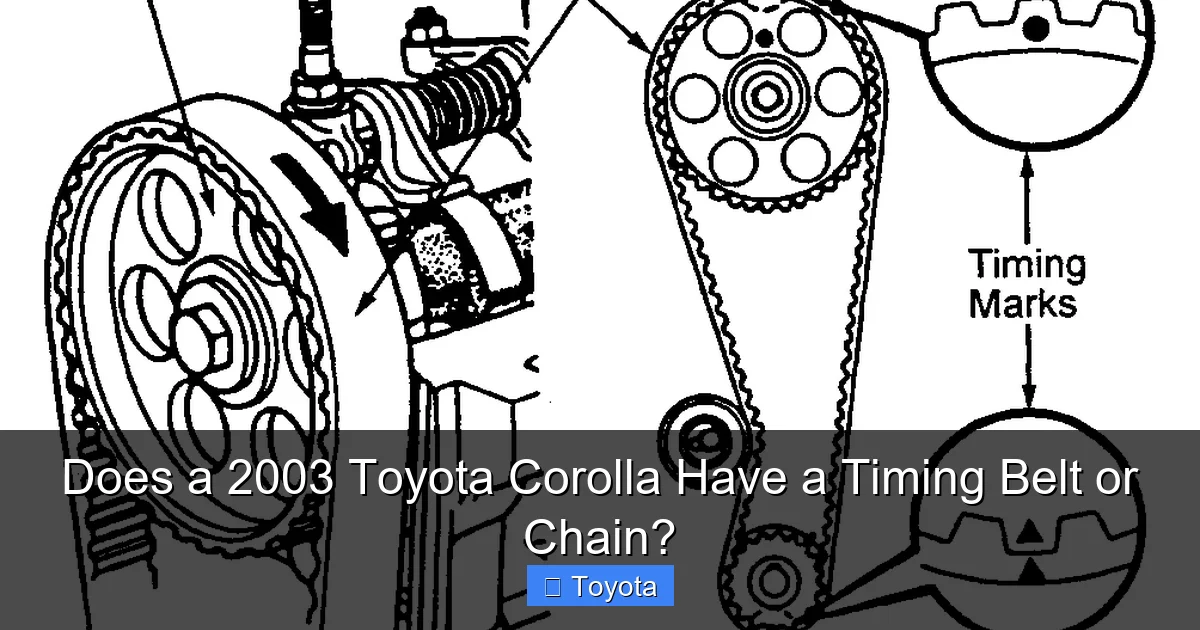
Visual guide about Does a 2003 Toyota Corolla Have a Timing Belt or Chain?
Image source: 2carpros.com
The timing belt (or chain) is the maestro of your engine’s internal orchestra. It ensures the crankshaft (which controls the pistons) and the camshaft(s) (which control the valves) are perfectly synchronized. The pistons move up and down in the cylinders, while the valves open and close to let air/fuel in and exhaust out. This all happens hundreds of times per minute. If the belt slips or breaks, this synchronization is lost.
Interference Engine Design: The Critical Factor
The 1ZZ-FE engine in your 2003 Corolla is an interference engine. This means there is not enough clearance between the pistons at the top of their stroke and the valves when they are fully open. In a perfectly timed engine, they never touch. But if the belt breaks, the pistons continue moving up and down freely while the valves, no longer controlled, may fall into the cylinder’s path. This results in the piston smashing into the valve—a violent collision that bends or breaks the valve, cracks the piston, and damages the cylinder head. This is not a minor repair; it is an engine failure.
In contrast, a non-interference engine has enough space that even if the belt breaks, the pistons and valves won’t collide. While still bad, it’s less likely to cause total destruction. Your 2003 Corolla’s interference design makes its timing belt a non-negotiable, high-stakes maintenance item. This is why articles like What Happens If A Toyota Timing Belt Breaks are essential reading for any owner of this vintage.
Replacement Intervals, Costs, and What’s Included
So, you know you have a belt and you know it will break. The next logical questions are: when, and how much?
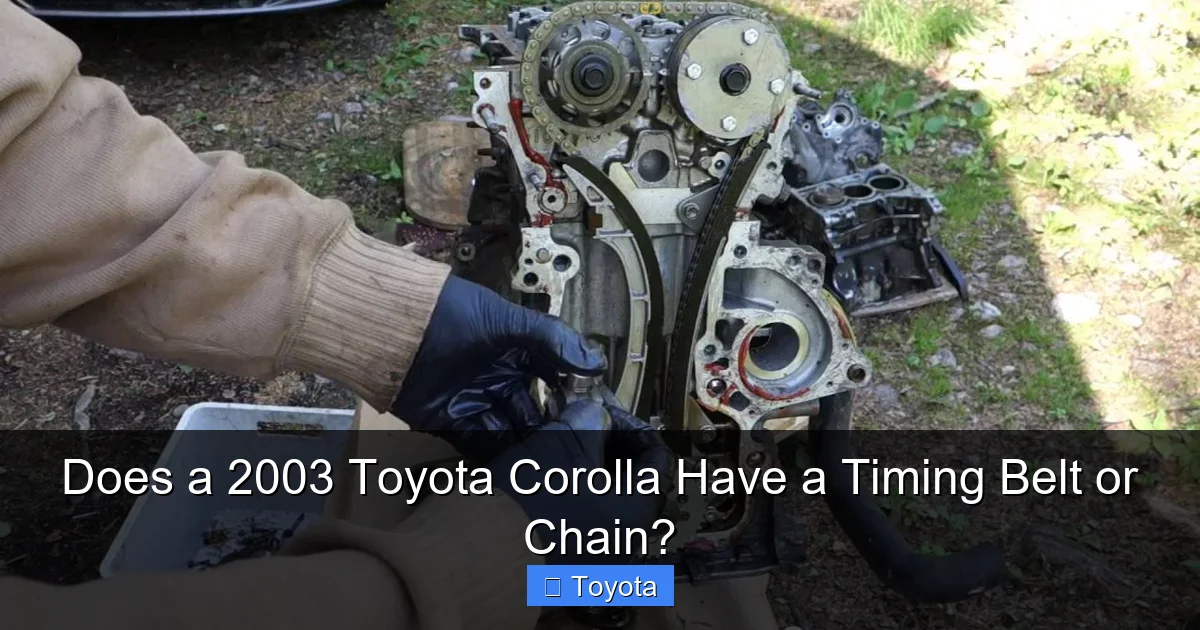
Visual guide about Does a 2003 Toyota Corolla Have a Timing Belt or Chain?
Image source: i.ytimg.com
The Official Schedule
Toyota’s original maintenance schedule for the 2003 Corolla with the 1ZZ-FE engine calls for a timing belt replacement every 60,000 miles or every 5 years, whichever comes first. However, many mechanics and Toyota specialists recommend extending this to 90,000 miles or 7-10 years based on improved belt materials and real-world longevity, provided the belt shows no signs of wear. The safest path is to adhere to the more conservative recommendation in your owner’s manual. If you don’t have the manual, the 60k/5-year rule is the absolute minimum benchmark. For a 2024-owned 2003 Corolla with 150,000 miles, if the original belt is still on it, it must be replaced immediately, regardless of its apparent condition. Age alone degrades rubber.
The Real Cost of a Timing Belt Job
This is where the “belt” myth can fool people. You don’t just buy a $50 rubber belt and pop it on. A timing belt replacement is one of the most labor-intensive services on a car. The mechanic must remove the engine’s front accessories (alternator, power steering pump, etc.), often the harmonic balancer, and the timing covers to access the belt. Because they are already deep in the engine, it is considered extremely wise and cost-effective to replace all associated parts at the same time. This “while you’re in there” approach includes:
- The Timing Belt Itself: The new rubber belt.
- Tensioner and Idler Pulleys: These are the wheels that guide and tension the belt. They have bearings that wear out. Replacing them with the belt is standard practice to avoid a future failure.
- Water Pump: On the 1ZZ-FE, the water pump is driven by the timing belt. Since the labor to access it is already being done, replacing a $50 water pump now saves you $1,000 in labor later if it fails. It’s almost always recommended.
- Other Components: Serpentine belt, thermostat, and any seals or gaskets in the timing cover area are often replaced proactively.
Because of this extensive labor, the total cost for a complete timing belt service (belt, tensioner, pulleys, water pump) at a reputable independent shop typically ranges from $800 to $1,500. At a dealership, it can be higher. DIY cost can be cut to $300-$500 for parts only, but you assume all the risk and need the tools. For context on other routine maintenance costs for your Corolla, understanding fluid capacities is key, which you can find in our guide on How Many Quarts Of Oil Does A Toyota Corolla Take.
The Grim Consequences of a Timing Belt Failure
Let’s be brutally clear about what happens if you ignore the maintenance schedule and your timing belt breaks on the 1ZZ-FE engine.
Visual guide about Does a 2003 Toyota Corolla Have a Timing Belt or Chain?
Image source: img.pcauto.com
The moment the belt snaps, the camshaft(s) stop spinning. The valves, which were just opened by the camshaft, will be held open by their springs. The pistons, driven by the still-spinning crankshaft, continue their travel upward. In an interference engine, at least one piston will slam into an open valve with immense force.
The Damage Cascade
The initial impact typically bends the valve stems. This bent valve then collides with the piston again on the next cycle, shattering the piston crown. Metal fragments from the shattered piston and broken valve then scatter through the cylinder, potentially scoring the cylinder walls and damaging the cylinder head. The broken timing belt itself can also wrap around the crankshaft pulley, causing damage there.
The result is an engine that will not run, makes a horrifying clattering noise if you try to crank it, and requires a complete teardown. The repair involves:
- Removing the cylinder head.
- Replacing all damaged valves, valve springs, and guides.
- Inspecting and likely repairing or replacing pistons and connecting rods.
- Resurfacing or replacing the cylinder head.
- Replacing the timing belt, tensioner, etc.
This is, in essence, a complete engine rebuild. The cost easily exceeds $3,000 to $5,000 or more, often surpassing the value of the 2003 Corolla itself. This catastrophic failure is 100% preventable with a $1,000 timing belt service. The choice is stark and simple.
How to Inspect and Monitor Your Timing Belt
Since you can’t see the belt while driving, proactive inspection is your best friend. Here’s how to stay ahead of the problem.
Visual Inspection During Other Services
The timing belt is hidden behind plastic or metal covers on the front of the engine. A competent mechanic can remove these covers in about 30 minutes to visually inspect the belt. You should request this inspection if:
- You’re having any other front-end engine work done (e.g., alternator replacement, serpentine belt change).
- You’re performing your own oil changes and are comfortable removing the covers.
- The car is approaching its service interval and you want to assess the belt’s condition before committing to the full job.
What to look for: cracks in the rubber (especially between the teeth), glazing (a shiny, hardened surface), chunking (missing chunks of rubber), oil or coolant contamination (from a leaking seal or gasket), and any frayed or exposed cords. A belt in good condition should look clean, have no cracks, and have sharp, defined teeth.
Listening for Symptoms (Though Rare)
A timing belt rarely gives warning before failure. However, a failing tensioner or idler pulley bearing might make a high-pitched squeaking or chirping noise from the timing cover area, especially on cold starts. A very loose belt might slap against the cover. These are indirect signs that the entire timing system should be inspected immediately. Don’t rely on noises as your primary warning system.
Debunking Myths and Addressing Common Questions
Let’s clear up some frequent points of confusion surrounding the 2003 Corolla’s timing system.
Myth: “I Heard Some Corollas Have Chains”
This is a common mix-up. Toyota did use timing chains in some models and engines. For Corollas, the switch from belts to chains in the U.S. market for the base 4-cylinder engine happened later. The 1ZZ-FE engine, used from 2000-2007, always had a belt. The 2ZZ-GE engine (in the 2003-2006 Corolla XRS) also used a belt. You start seeing chains in the base Corolla engines with the later ZR series (around 2009+). So, for a 2003, it is unequivocally a belt. This is different from, say, the Toyota Tundra, where the switch to chains happened much earlier, as detailed in articles like What Year Toyota Tundra Has A Timing Chain.
Myth: “My Mechanic Said It Looks Fine, So I Can Wait”
This is the most dangerous advice. A timing belt can look perfect externally and have internal cord damage or have simply aged beyond its material limits. The only truly safe way to “know” is to replace it on schedule. A visual inspection is a snapshot; it cannot predict the next 10,000 miles of stress and heat. Trust the schedule, not a hopeful glance.
What About the 2004+ Models?
If you’re looking at a newer used Corolla, be aware that the engine changed. The 2004-2008 Corollas (with the 1ZZ-FE) also have a timing belt. The major shift to a timing chain in the base Corolla engine occurred with the 2009 model year and the introduction of the 1ZR-FE engine. So, if you’re cross-shopping a 2003 with a 2009, that’s a fundamental difference in long-term maintenance costs and risk profiles.
Conclusion: A Non-Negotiable Service Item
There is no ambiguity for the 2003 Toyota Corolla. It has a timing belt. This is not a “maybe” or a “check your VIN” situation. It is a fixed, engineered fact. This knowledge transforms how you view your ownership experience. That $1,000 timing belt service isn’t an optional upsell; it’s the price of admission to keeping your 20-year-old Corolla running reliably and avoiding a $4,000 paperweight. It is the single most important scheduled maintenance item on this vehicle. When budgeting for your Corolla’s upkeep, prioritize this service above almost everything else. Find a trusted, experienced mechanic who understands the critical nature of this job, use high-quality parts (OEM or premium aftermarket), and follow the schedule without exception. By respecting this simple, hard fact about your car’s design, you protect your investment and ensure your Corolla can deliver many more thousands of miles of faithful, economical service.
Frequently Asked Questions
Does a 2003 Toyota Corolla have a timing belt or chain?
Yes, the 2003 Toyota Corolla with the 1.8L 1ZZ-FE engine has a timing belt. All 2003 Corolla models used this belt-driven engine, which is an interference design requiring strict adherence to replacement intervals.
What are the signs my 2003 Corolla’s timing belt is failing?
Timing belts rarely give advance warning. The only reliable indicators are visible cracks, glazing, or contamination during an inspection. A squealing noise from the timing cover area might indicate a failing tensioner or idler pulley, which should prompt an immediate full inspection.
Can I replace the timing belt myself on a 2003 Corolla?
It is possible for advanced DIYers with the correct tools (including a torque wrench, harmonic balancer puller, and dial indicator) and a thorough, model-specific repair manual. However, it is a complex, critical job where a single mistake in timing can destroy the engine. Most owners should leave this to a professional.
How much does it cost to replace the timing belt on a 2003 Corolla?
A complete replacement including the belt, tensioner, idler pulleys, and often the water pump typically costs between $800 and $1,500 at an independent repair shop. DIY parts-only cost is $300-$500, but you must have the skill and tools.
What happens if I skip the timing belt replacement?
If the belt breaks, the interference engine design will cause the pistons to collide with the valves, resulting in severe engine damage. Repair costs for a rebuild or replacement engine will far exceed $3,000 and often exceed the car’s value, effectively totaling the engine.
Should I replace the water pump with the timing belt?
Absolutely yes. The water pump is driven by the timing belt on this engine. Since the labor to access it is already being done, replacing the relatively inexpensive water pump now is highly recommended to avoid a future, separate, costly repair.