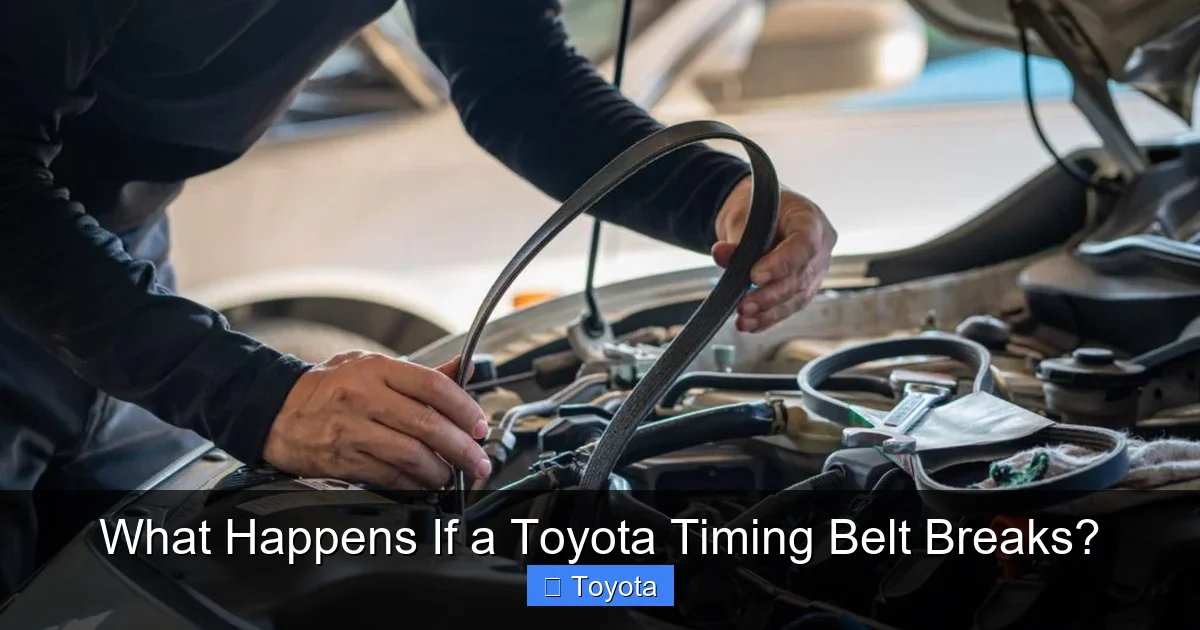
What Happens If a Toyota Timing Belt Breaks?

Contents
- 1 Key Takeaways
- 2 📑 Table of Contents
- 3 What Happens If a Toyota Timing Belt Breaks?
- 4 Understanding the Timing Belt’s Role in Your Toyota
- 5 Interference vs. Non-Interference Engines: Why It Matters
- 6 Symptoms of a Failing Timing Belt
- 7 What Happens When the Timing Belt Actually Breaks?
- 8 How to Prevent Timing Belt Failure
- 9 What to Do If Your Timing Belt Breaks
- 10 Conclusion
- 11 Frequently Asked Questions

Car Jump Starter

Car Ambient Light Kit

Car Roof Rack Cross Bars

Engine Oil Additive
If a Toyota timing belt breaks, it can cause catastrophic engine damage, especially in interference engines. This often leads to bent valves, damaged pistons, and expensive repairs—sometimes requiring a full engine rebuild or replacement.
Key Takeaways
- Engine Damage Risk: A broken timing belt in many Toyota models can cause the pistons and valves to collide, leading to severe internal damage.
- <>Interference vs. Non-Interference Engines: Knowing your Toyota’s engine type is critical—interference engines are far more vulnerable to damage from a broken belt.
- Sudden Engine Stall: The engine will stop running immediately when the timing belt snaps, often without warning.
- Costly Repairs: Repairing damage from a broken timing belt can cost thousands of dollars, far more than routine belt replacement.
- Preventive Maintenance is Key: Replacing the timing belt at recommended intervals (usually 60,000–100,000 miles) prevents failure and protects your engine.
- Watch for Warning Signs: Squealing noises, engine misfires, oil leaks near the timing cover, or difficulty starting can signal a worn belt.
- Don’t Ignore the Manual: Always follow your Toyota owner’s manual for timing belt replacement schedules—your car’s longevity depends on it.
📑 Table of Contents
- What Happens If a Toyota Timing Belt Breaks?
- Understanding the Timing Belt’s Role in Your Toyota
- Interference vs. Non-Interference Engines: Why It Matters
- Symptoms of a Failing Timing Belt
- What Happens When the Timing Belt Actually Breaks?
- How to Prevent Timing Belt Failure
- What to Do If Your Timing Belt Breaks
- Conclusion
What Happens If a Toyota Timing Belt Breaks?
Imagine you’re driving down the highway in your trusty Toyota Camry or Corolla, enjoying a smooth ride, when suddenly—your engine stops. No sputtering, no warning lights, just a complete shutdown. You pull over, pop the hood, and discover the culprit: a broken timing belt. It sounds dramatic, but it’s a real risk for Toyota owners who skip routine maintenance.
The timing belt is one of the most critical yet often overlooked components in your vehicle. It synchronizes the rotation of the crankshaft and camshaft, ensuring that the engine’s valves open and close at the right times during the combustion cycle. When this belt fails, the delicate timing of your engine is thrown off—sometimes with devastating consequences.
In many Toyota models, especially those with interference engines, a broken timing belt doesn’t just mean your car won’t start. It can lead to bent valves, damaged pistons, cracked cylinder heads, and even destroyed cylinder walls. The repair bill can easily run into the thousands, sometimes exceeding the value of the car itself. That’s why understanding what happens when a Toyota timing belt breaks—and how to prevent it—is essential for every Toyota owner.
Understanding the Timing Belt’s Role in Your Toyota

Visual guide about What Happens If a Toyota Timing Belt Breaks?
Image source: foxrunauto.com
To grasp why a broken timing belt is such a big deal, you first need to understand what it does. Think of the timing belt as the conductor of an orchestra. It ensures that all the moving parts in your engine work together in perfect harmony.
Inside your Toyota’s engine, the pistons move up and down in the cylinders while the valves open and close to let in air and fuel and release exhaust gases. The timing belt connects the crankshaft (which moves the pistons) to the camshaft (which operates the valves). This connection ensures that the valves open and close at precisely the right moments relative to the piston’s position.
For example, during the intake stroke, the intake valve must open as the piston moves down. If the timing is off—even by a fraction of a second—the valve might still be open when the piston reaches the top of its stroke. In a non-interference engine, there’s enough space between the piston and valve to prevent contact. But in an interference engine, which most modern Toyotas use, the piston and valve occupy the same space at different times. If the timing belt breaks, the synchronization stops, and the piston can smash into the valve.
This collision can bend or break the valve, damage the piston, and even crack the cylinder head. The result? A ruined engine.
How the Timing Belt Works
The timing belt is made of reinforced rubber with fiberglass or Kevlar cords for strength. It’s designed to last for tens of thousands of miles, but it’s not indestructible. Over time, heat, oil exposure, and normal wear cause the belt to crack, fray, or lose tension.
Unlike a serpentine belt (which powers accessories like the alternator and air conditioning), the timing belt is hidden inside the engine, protected by a cover. This makes it harder to inspect, which is why regular replacement based on mileage or time is so important.
Most Toyota timing belts need to be replaced every 60,000 to 100,000 miles, depending on the model and engine type. Some newer models use timing chains instead of belts, which are more durable and often last the life of the vehicle. But if your Toyota has a timing belt, it’s a ticking time bomb if not maintained.
Timing Belt vs. Timing Chain: What’s the Difference?
You might be wondering why some cars use belts and others use chains. The answer comes down to cost, noise, and durability.
Timing belts are quieter and lighter, which helps improve fuel efficiency and reduce engine noise. They’re also less expensive to manufacture, which is why many automakers, including Toyota, used them in older and mid-range models. However, they require regular replacement.
Timing chains, on the other hand, are made of metal and are much more durable. They can last 150,000 miles or more and often don’t need replacement unless there’s a problem. But they’re heavier, noisier, and more expensive to produce.
Toyota has gradually shifted toward timing chains in newer models, especially in performance and luxury vehicles. For example, the Toyota Camry switched from a timing belt to a timing chain in the 2007 model year for the 4-cylinder engine. But many older models—like the 1990s Corolla, Camry, and 4Runner—still use timing belts and require careful maintenance.
Interference vs. Non-Interference Engines: Why It Matters
Visual guide about What Happens If a Toyota Timing Belt Breaks?
Image source: rerev.com
One of the most important factors in determining the severity of a timing belt failure is whether your Toyota has an interference or non-interference engine.
An interference engine is designed so that the pistons and valves occupy the same space in the cylinder at different times during the engine cycle. This allows for higher compression and better performance, but it also means that if the timing belt breaks, the piston can collide with the valve.
A non-interference engine has enough clearance between the piston and valve that even if the timing belt fails, they won’t touch. The engine will stop running, but no internal damage occurs.
Most modern Toyota engines are interference designs. For example:
– The 2.2L 5S-FE engine in the 1990s Camry
– The 1.8L 1ZZ-FE in the Corolla and Matrix
– The 2.4L 2AZ-FE in the RAV4 and Camry
If your Toyota has one of these engines, a broken timing belt can cause serious damage.
How to Check If Your Toyota Has an Interference Engine
You can usually find this information in your owner’s manual or by searching online using your vehicle’s year, make, model, and engine code. Websites like TimingBeltKit.com or RepairPal have databases that list whether your engine is interference or non-interference.
Alternatively, you can consult a trusted mechanic or Toyota dealership. They can confirm your engine type and advise on the recommended timing belt replacement interval.
Knowing your engine type is the first step in preventing catastrophic failure. If you have an interference engine, replacing the timing belt on schedule isn’t just maintenance—it’s essential protection.
Symptoms of a Failing Timing Belt

Visual guide about What Happens If a Toyota Timing Belt Breaks?
Image source: rerev.com
Timing belts don’t usually break without some warning signs. While the failure can be sudden, there are often clues that the belt is wearing out.
Recognizing these symptoms early can save you from a costly repair.
Engine Misfires or Rough Idling
As the timing belt wears, it can slip or stretch slightly. This causes the camshaft to turn out of sync with the crankshaft, leading to misfires. You might notice the engine running rough, especially at idle, or feel a loss of power when accelerating.
For example, if your Toyota Camry suddenly starts jerking or hesitating when you press the gas, it could be a sign of timing belt wear—especially if the check engine light comes on.
Unusual Noises from the Engine
A failing timing belt may produce a ticking or slapping sound from the front of the engine. This is often caused by the belt slapping against the timing cover due to looseness or misalignment.
You might also hear a high-pitched squealing noise, similar to a slipping serpentine belt. While this can also be caused by a bad tensioner or idler pulley, it’s worth having it checked immediately.
Oil Leaks Near the Timing Cover
The timing belt is housed behind a cover that seals it from engine oil. If the gasket around the timing cover fails, oil can leak onto the belt. Oil degrades the rubber, causing it to swell, crack, or lose grip.
If you notice oil dripping from the front of your engine or see oil residue around the timing cover, have it inspected. Continuing to drive with an oil-soaked belt increases the risk of sudden failure.
Difficulty Starting the Engine
A worn timing belt can cause the engine to turn over slowly or fail to start. This happens because the camshaft isn’t turning properly, so the valves aren’t opening and closing at the right times.
If your Toyota cranks but won’t start, and you’ve ruled out battery or fuel issues, the timing belt could be the culprit.
Visible Damage During Inspection
If you’re handy and decide to inspect the timing belt yourself (not recommended unless you’re experienced), look for cracks, fraying, missing teeth, or glazing on the belt surface. These are clear signs it needs replacement.
However, removing the timing cover is complex and requires precise reassembly. One mistake can throw off the engine timing and cause damage. That’s why most experts recommend leaving this job to a professional.
What Happens When the Timing Belt Actually Breaks?
Now for the scary part: what actually happens when the belt snaps?
The moment the timing belt breaks, the camshaft stops turning. But the crankshaft, driven by the momentum of the pistons and the car’s motion, continues to spin—at least for a split second.
In an interference engine, this means the pistons keep moving up and down while the valves are stuck in whatever position they were in when the belt broke. If a valve was open when the piston reached the top of its stroke, they collide.
The result? Bent valves, damaged pistons, and possibly a cracked cylinder head or block. In severe cases, the engine may seize completely.
Immediate Consequences
– The engine stops running instantly.
– The car loses power steering and brake assist (in most models).
– The check engine light may or may not come on—depending on when the ECU detects the problem.
– You’ll need to be towed to a repair shop.
Long-Term Damage
The extent of the damage depends on engine speed and design. If the belt breaks at idle, the damage might be minimal. But if it breaks at highway speeds, the force of the collision can be devastating.
Common damage includes:
– Bent or broken valves
– Scored or cracked pistons
– Damaged cylinder heads
– Worn camshafts or crankshafts
In many cases, the only fix is a complete engine rebuild or replacement—costing $3,000 to $7,000 or more.
Real-World Example
Take the case of a 2002 Toyota Camry with the 2.4L 2AZ-FE engine. The owner ignored the timing belt replacement recommendation at 90,000 miles. At 110,000 miles, while driving at 65 mph on the freeway, the belt snapped. The engine stopped, and the car coasted to a stop.
Upon inspection, the mechanic found three bent valves and a cracked piston. The repair quote: $4,200 for a used engine replacement. The car was only worth $3,500.
This is a classic example of how a $500 preventive repair could have saved thousands.
How to Prevent Timing Belt Failure
The good news? Timing belt failure is almost entirely preventable with proper maintenance.
Follow the Manufacturer’s Schedule
Your Toyota owner’s manual specifies when to replace the timing belt. This is usually based on mileage (e.g., every 90,000 miles) or time (e.g., every 7 years), whichever comes first.
For example:
– 1995–2001 Toyota Camry (5S-FE engine): Replace every 90,000 miles
– 2000–2004 Toyota Celica (1ZZ-FE engine): Replace every 90,000 miles
– 2001–2006 Toyota RAV4 (2AZ-FE engine): Replace every 90,000 miles
Even if your car has low mileage, rubber degrades over time. A 10-year-old belt with only 50,000 miles can still fail.
Replace the Entire Timing Belt Kit
When replacing the timing belt, always replace the entire kit, including:
– The timing belt
– Tensioner pulley
– Idler pulleys
– Water pump (often driven by the timing belt)
The water pump is a common failure point and is difficult to access separately. Replacing it during the timing belt job saves labor costs and prevents future issues.
Use OEM or High-Quality Aftermarket Parts
Don’t skimp on parts. Cheap belts may fail prematurely. Use OEM (Original Equipment Manufacturer) parts or reputable aftermarket brands like Gates, Aisin, or Continental.
Have It Done by a Qualified Mechanic
Timing belt replacement is a complex job that requires precise alignment of the crankshaft and camshaft. One tooth off can cause engine damage.
Choose a mechanic with experience in Toyota engines. Many dealerships and independent shops specialize in Japanese imports and have the tools and knowledge to do the job right.
Keep Records
After replacing the timing belt, keep the receipt and note the mileage. This helps you track when the next replacement is due and adds value if you sell the car.
What to Do If Your Timing Belt Breaks
If the worst happens and your timing belt breaks, here’s what to do:
Pull Over Safely
As soon as the engine stops, steer the car to the shoulder. Turn on your hazard lights. If you’re on a busy road, stay in the car with your seatbelt on until it’s safe to exit.
Do Not Attempt to Restart the Engine
Cranking the engine after a timing belt break can cause further damage. Even if it starts, internal damage may already be done.
Call a Tow Truck
Have the vehicle towed to a repair shop. Do not drive it.
Get a Professional Inspection
A mechanic will perform a compression test or leak-down test to check for valve or piston damage. They may also remove the cylinder head for visual inspection.
Weigh Your Options
Depending on the damage and the car’s value, you may choose to:
– Repair the engine (if cost-effective)
– Replace the engine with a used or remanufactured one
– Sell the car for parts or scrap
In many cases, especially with older Toyotas, replacing the engine isn’t worth the cost. But for a well-maintained vehicle with low mileage, it might be the best option.
Conclusion
A broken timing belt in a Toyota can be a nightmare—but it doesn’t have to be. By understanding how the timing belt works, knowing your engine type, and following the recommended maintenance schedule, you can avoid catastrophic engine damage.
The cost of replacing a timing belt is a small price to pay compared to the thousands you could spend on engine repairs. Think of it as an investment in your car’s longevity and your peace of mind.
Don’t wait for the belt to break. Check your owner’s manual today, find out when your timing belt was last replaced, and schedule service if it’s overdue. Your Toyota—and your wallet—will thank you.
Frequently Asked Questions
Can a Toyota run without a timing belt?
No, a Toyota with a timing belt cannot run without it. The timing belt is essential for synchronizing the engine’s valves and pistons. If it breaks or is removed, the engine will not start or will stop immediately.
How much does it cost to replace a Toyota timing belt?
The cost to replace a Toyota timing belt typically ranges from $500 to $1,200, depending on the model, engine, and labor rates. This includes the belt, tensioner, idler pulleys, and often the water pump.
Can I drive my Toyota if the timing belt is cracked?
No, you should not drive your Toyota if the timing belt is cracked. Even small cracks can lead to sudden failure, which may cause severe engine damage. Have it inspected and replaced immediately.
How often should a Toyota timing belt be replaced?
Most Toyota timing belts should be replaced every 60,000 to 100,000 miles or every 7 to 10 years, whichever comes first. Always check your owner’s manual for the specific recommendation for your model.
What happens if the timing belt breaks while driving?
If the timing belt breaks while driving, the engine will stop running immediately. In interference engines, this can cause the pistons to collide with the valves, leading to bent valves, damaged pistons, and potentially a ruined engine.
Can a broken timing belt be repaired?
A broken timing belt itself can be replaced, but if it caused internal engine damage, repairs may include replacing valves, pistons, or even the entire engine. The extent of the damage determines whether repair is feasible or cost-effective.