Do Jeep Wranglers Have Blind Spot Monitoring

Contents
- 1 Key Takeaways
- 2 📑 Table of Contents
- 3 The Evolution of Safety Tech in the Wrangler
- 4 How Factory Blind Spot Monitoring Works on a Wrangler
- 5 The Real-World Limitations and Quirks
- 6 Aftermarket Blind Spot Monitoring for Wranglers
- 7 Practical Tips for Wrangler Owners (With or Without BSM)
- 8 The Future and Final Thoughts
- 9 Frequently Asked Questions


Blind Spot Monitoring (BSM) is not standard on all Jeep Wranglers but became an available option starting with the 2020 JL model generation, typically on higher trims like Sahara, 4xe, and Rubicon. The system uses radar sensors to alert you of vehicles in your blind spots. However, its functionality can be limited by the Wrangler’s iconic removable doors and aftermarket accessories like large bumpers or bike racks. For older models or those without factory BSM, reliable aftermarket systems can be professionally installed.
If you’re a Jeep Wrangler owner or prospective buyer, you know the iconic open-air experience comes with a unique set of characteristics. One common concern for any driver, but especially for those in a boxy, high-riding vehicle like the Wrangler, is the dreaded blind spot. That invisible zone beside and behind you where other vehicles can hide. In today’s automotive world, Blind Spot Monitoring (BSM) is a nearly ubiquitous safety feature. So, the big question for the Jeep community is: Do Jeep Wranglers have Blind Spot Monitoring? The answer isn’t a simple yes or no—it’s a nuanced “it depends.” Let’s dive deep into everything you need to know about blind spot technology in the legendary Wrangler, from factory availability to aftermarket upgrades and the real-world quirks of using this tech in an off-road icon.
Key Takeaways
- Not Standard, But Available: Blind Spot Monitoring is an optional feature on newer Jeep Wranglers (2020+ JL and 2024+ JL refresh), not a standard inclusion across all trims.
- Trim-Dependent: You’ll typically find BSM packaged with higher trim levels like Sahara, 4xe, Willys, Sport S, and Rubicon, often as part of a safety or technology group.
- Sensor Placement is Key: The system uses radar sensors located in the rear bumper. Aftermarket bumpers, trailer hitches, or even dirt/grime can obstruct these sensors and impair function.
- Doors-Off Mode Affects Alerts: While BSM generally remains active with doors removed, the visual blind spot indicator in the mirror may be less effective if you also remove the mirror or use a mirror relocation kit.
- Aftermarket Solutions Exist: For Wranglers without factory BSM, high-quality aftermarket systems can be added, but professional installation is crucial for proper sensor placement and integration.
- Limitations with Cargo: Large items stored in the rear, such as a bike rack or a dog ramp, can block the radar’s field of view, rendering the system ineffective for vehicles approaching from behind.
- Always Supplement with Good Habits: BSM is a powerful aid, but it is not a substitute for proper shoulder checks and mirror adjustment, especially in a vehicle with significant blind spots like the Wrangler.
📑 Table of Contents
The Evolution of Safety Tech in the Wrangler
To understand the current state of BSM in the Wrangler, we need a quick history lesson. For decades, the Jeep Wrangler prioritized rugged capability, simplicity, and off-road prowess over the suite of advanced driver-assistance systems (ADAS) found in mainstream family crossovers. Basic safety meant seatbelts and a sturdy frame. As the automotive landscape shifted in the 2010s with increasing demand for safety tech, so did the Wrangler, but at a deliberate, Jeep-like pace.
The Turning Point: The JL Generation (2019-Present)
The introduction of the fourth-generation Wrangler (codenamed JL) for the 2019 model year marked a significant leap forward in available technology. While the 2019 model year had a limited rollout, the 2020 model year saw a broader availability of safety packages. It was here, on select JL models, that Jeep finally began offering Blind Spot Monitoring as a factory option. This was a major shift, acknowledging that even the most hardcore off-roader might appreciate a little electronic help during the daily school run or highway merge.
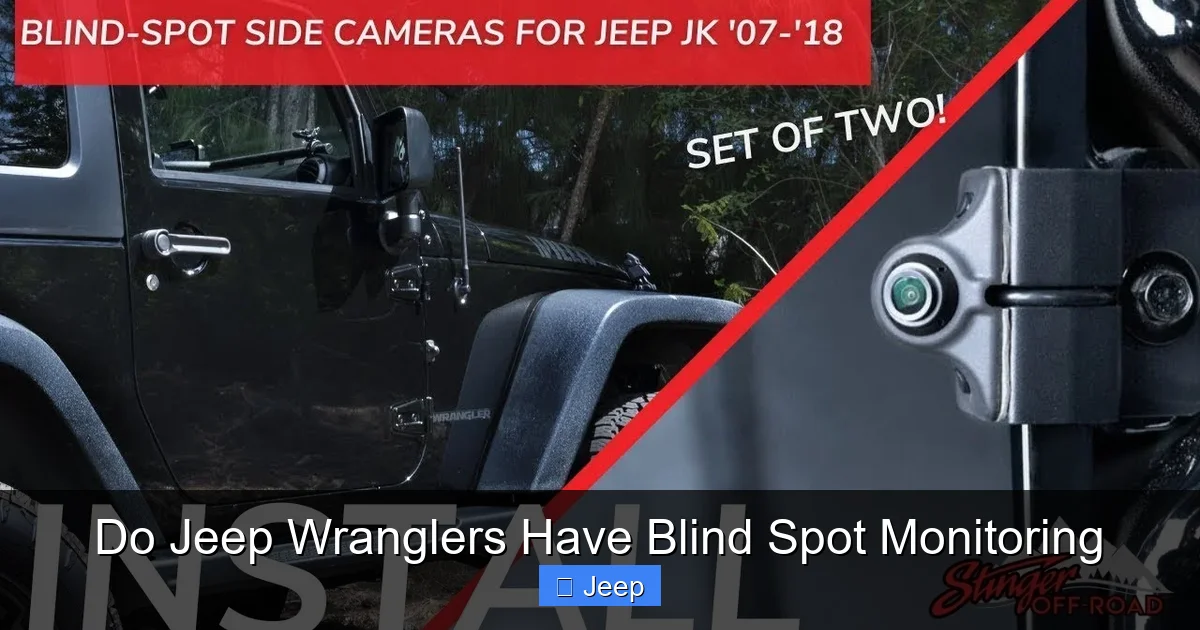
For the previous JK generation (2007-2018), factory-installed blind spot monitoring was virtually non-existent. The technology simply wasn’t part of Jeep’s offering for that platform. Owners of these older Wranglers who desired BSM had to look exclusively to the aftermarket.
The 2024 Refresh and Beyond
The recent mild refresh of the JL for the 2024 model year has continued to expand available safety tech. For the 2024 Wrangler, Blind Spot Monitoring is now more widely available, often bundled with features like Rear Cross Path Detection and Rear Auto Braking within a “Safety & Security” or “Technology” group. This means more trim levels than ever before can be equipped with it from the factory, but it still rarely comes standard on the base Sport model.
How Factory Blind Spot Monitoring Works on a Wrangler
So, if your Wrangler has it, how does the system actually function? The principle is the same as in any other vehicle, but the implementation is tailored to the Wrangler’s unique design.
Visual guide about Do Jeep Wranglers Have Blind Spot Monitoring
Image source: i.ytimg.com
The Hardware: Where Are the Sensors?
Factory BSM on the Jeep Wrangler JL relies on radar sensors. These are not cameras; they use radio waves to detect objects. The sensors are cleverly integrated into the rear bumper. On most models, you’ll find one sensor embedded in each corner of the rear bumper fascia. These radar sensors have a specific field of view that extends laterally rearward from the sides of your vehicle, covering the classic blind spot zones.
This placement is both logical and challenging. It’s logical because the rear bumper is a protected, central location. It’s challenging because the Wrangler’s rear bumper is often the first place owners modify. Aftermarket steel bumpers, trailer hitches, or even spare tire carriers can physically block the radar’s signal. If you’ve installed a heavy-duty rear bumper, there’s a very real chance your factory BSM sensors are now useless. Jeep designs the system to work with the original equipment bumper.
The Alerts: What You See and Hear
The system is designed to be intuitive but not intrusive. Here’s the sequence:
- Detection: When a vehicle enters your blind spot, the radar sensor on that side locks onto it.
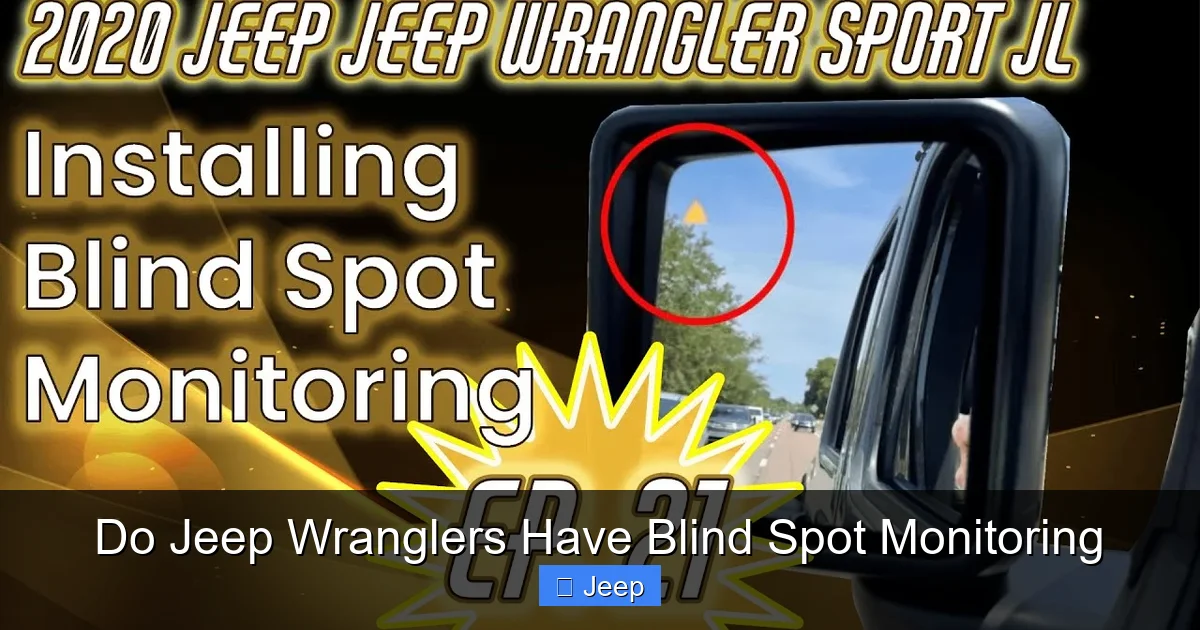
- Visual Alert: A small, amber or yellow icon (usually a car or a triangle) illuminates in the corresponding side mirror’s lens. If your Wrangler has the LED lighting package, this is often a clear, integrated light. If you have basic mirrors, it may be a separate small light on the mirror housing.
- Audible Alert (Conditional): If you activate your turn signal in the direction of the occupied blind spot, the system will emit a rapid, distinctive beeping tone to warn you of the potential conflict. This is the crucial “don’t change lanes” alert.
It’s important to note that there is no “blind spot camera” display on the Wrangler’s infotainment screen for this feature. The alert is purely mirror-based (and audible with the turn signal). This keeps the system simple and robust, but it means you must glance at your mirror to see the warning.
The Real-World Limitations and Quirks
Having the hardware is one thing; having it work perfectly in every situation is another. The Jeep Wrangler’s very nature introduces some unique considerations for BSM.
Visual guide about Do Jeep Wranglers Have Blind Spot Monitoring
Image source: i.ytimg.com
The “Doors Off” Dilemma
This is the most famous Wrangler-specific quirk. Many Wrangler owners regularly drive with their doors removed for the ultimate open-air experience. So, what happens to BSM? The good news is that the system itself remains active. The radar sensors in the rear bumper still function. The problem lies with the visual indicator in the side mirror.
If you remove the door, you typically also remove the entire door shell, which includes the side mirror assembly (unless you have a mirror relocation kit). Without the factory mirror in place, there is no place for the blind spot icon to light up. Some aftermarket mirror relocation brackets for the windshield pillar include a small port to connect the factory mirror’s wiring, allowing the indicator to function. Others do not. Therefore, driving doors-off often means you lose the primary visual cue for BSM, relying solely on the audible beep when signaling. This makes the “shoulder check” absolutely non-negotiable.
The Aftermarket Bumper and Accessory Problem
As mentioned, the rear bumper is the sensor’s home. The aftermarket ecosystem for Wranglers is massive, and one of the most popular upgrades is a heavy-duty steel rear bumper, often with a integrated spare tire carrier or a 2-inch receiver hitch. If any metal or even a thick plastic obstruction is placed directly in front of the sensor’s “face,” it can absorb or block the radar waves.
Similarly, large accessories attached to the rear tailgate, like a full-size spare tire on a swing-out carrier or a large cargo basket, can create a shadow zone behind the vehicle where the radar cannot “see.” The system’s effective range and coverage will be diminished. Before installing any rear-mounted accessory, it’s wise to consider its potential impact on your factory BSM (and rearview camera).
Cargo and the Rearward View
Even without a permanent bumper modification, what you carry in the back can be an issue. A fully loaded roof rack extends rearward, but the bigger threat is in the cargo area. A large dog crate, a full set of recovery gear, or a bike rack mounted to the rear tailgate (like some popular hitch-mounted carriers) can physically block the radar’s field of view. The sensors are designed to see over typical small items, but a substantial obstruction will degrade performance. This is a common-sense limitation in any vehicle with BSM, but the Wrangler’s versatile, gear-hauling nature makes it a frequent reality.
Weather and Sensor Contamination
Radar sensors are generally more resilient to dirt, snow, and rain than cameras, but they are not invincible. A thick coating of mud, packed snow, or even a large bird dropping directly over the sensor can attenuate the signal. The Wrangler is no stranger to getting dirty, so periodic cleaning of the rear bumper sensor areas (a quick rinse with a hose) is good maintenance to ensure optimal function.
Aftermarket Blind Spot Monitoring for Wranglers
For the vast number of Wrangler owners with JK models or JL models without the factory option, the aftermarket world offers compelling solutions. The question “Can I add blind spot monitoring to my car?” has a very positive answer for the Wrangler.
Visual guide about Do Jeep Wranglers Have Blind Spot Monitoring
Image source: carid.com
How Aftermarket Systems Work
Aftermarket BSM systems for the Wrangler typically use a similar radar-based approach. The most common and effective kits include:
- Dual Radar Sensors: Two small, waterproof radar modules that you install in the rear bumper, usually in the same corners as the factory system. They are designed to be surface-mounted or recessed.
- Central Control Module: The brain that processes the radar signals.
- Mirror-Mounted Indicators: These are often LED strips that stick to the inside of your side mirrors or, more permanently, replace the mirror glass with a special indicator-integrated unit.
- Audible Buzzer: A speaker that provides the warning beep.
- Wiring Harness: To connect everything to your vehicle’s power and lighting systems (typically tapped into the rear tail light circuits for power and the turn signal for the chime trigger).
Installation: Professional is the Word
While some kits are marketed as “DIY,” professional installation is highly recommended for the Wrangler. Why?
- Bumper Drilling: You will likely need to drill holes in your rear bumper to mount the sensors cleanly and ensure a proper seal against water and dust.
- Wiring Routing: Running wires from the rear bumper, through the tailgate hinge area, and into the vehicle’s interior requires knowledge of the Wrangler’s specific wiring paths to avoid pinching, exposure, or interference with the tailgate’s operation.
- Integration: The system must be correctly tied into the vehicle’s turn signal circuit to trigger the audible alert only when you signal. A poor integration can lead to constant beeping or no beep at all.
- Calibration: Some advanced systems require a simple calibration procedure after installation.
A bad installation can lead to a system that doesn’t work, gives false alerts, or causes electrical gremlins. For a vehicle you may be taking off-road, you want wiring that is secure and protected from vibration and elements. If you’re considering this upgrade, our detailed guide on adding blind spot monitoring to any car covers the process, costs, and what to look for in a kit, which is directly applicable to the Wrangler.
Popular Aftermarket Brands for Jeeps
Several reputable brands produce systems compatible with the Wrangler JK and JL. Names like VANSTAR, Alloy USA, and TSC (Towing and Safety Corp) offer kits specifically designed for Jeep applications. These often include trim-specific mounting brackets and wiring adapters to make the job easier for a professional installer. When shopping, look for systems with good reviews from actual Wrangler owners and clear, model-specific instructions.
Practical Tips for Wrangler Owners (With or Without BSM)
Regardless of whether your Wrangler has factory or aftermarket BSM, maximizing its effectiveness and maintaining overall safety requires some Wrangler-specific know-how.
1. Perfect Your Mirror Setup First
The classic “V” mirror adjustment (seeing your own car’s side in the mirror) creates massive blind spots. The optimal setup for minimizing blind spots—with or without BSM—is to adjust your side mirrors outward much further than you might think. You should be able to see a sliver of your own car’s rear quarter panel in the mirror’s innermost edge, with the rest of the mirror showing the adjacent lane. This “BGE” (Blindspot Glare Elimination) setting drastically reduces the area BSM needs to cover. Spend 10 minutes in a parking lot getting this right.
2. The Shoulder Check is Sacred
BSM is an aid, not a replacement for human vigilance. The Wrangler’s tall, straight-up greenhouse design means its blind spots are geometrically larger than a lower sedan’s. Always perform a quick over-the-shoulder glance before changing lanes, especially if your BSM indicator is not illuminated (remember, it only works for moving vehicles). This habit is your final, fail-safe line of defense.
3. Be Mindful of Your Rear “Fleet”
If you use your Wrangler as a gear hauler, regularly assess what’s in the back. A large bike rack attached to the tailgate or spare tire carrier is a common sight. Be aware that this can create a significant shadow zone directly behind you, where a fast-approaching motorcycle or car might not be detected by your BSM until it’s very close. In these situations, rely more heavily on your mirrors and a shoulder check.
4. Keep Sensors Clean
Make it a habit to include the rear bumper sensor areas in your regular wash routine. Use a gentle stream of water and a soft brush to clear away mud, sand, and snow. Avoid using high-pressure wascers directly at the sensor seals, as this could force water inside.
5. Understand System Limits in Extreme Conditions
Heavy rain, dense fog, or thick snow can degrade radar performance, though less so than cameras. Also, the system is designed for passenger vehicles. It may not detect motorcycles, bicycles, or very small objects as reliably. It also typically does not detect vehicles approaching from more than two or three lanes over. Don’t let a “clear” BSM indicator give you a false sense of security to make an aggressive lane change in busy, multi-lane traffic.
The Future and Final Thoughts
As Jeep continues to update the Wrangler, we can expect the suite of available safety features to grow. Future models may see BSM become standard on more trims, or be integrated with more comprehensive systems like 360-degree camera views that can digitally highlight blind spots. For now, the reality is this: Blind Spot Monitoring is a valuable, available option on newer Wranglers, but it is not a universal feature. Its effectiveness is intertwined with the vehicle’s customizability—the very thing that makes the Wrangler great can also hinder its high-tech aids.
For the daily driver who values a little extra peace of mind on the highway, seeking out a JL model (2020+) with the appropriate safety package is the simplest path. For the JK owner or the JL owner without it, a quality aftermarket system is a fantastic project that adds a significant layer of safety. However, no system can overcome the fundamental physics of a boxy vehicle. The best “blind spot monitoring” system in a Wrangler will always be the driver’s own attentive eyes, coupled with properly adjusted mirrors. technology is a wonderful tool, but in the world of the Jeep Wrangler, traditional driving skills remain the most essential tool of all.
Frequently Asked Questions
Can I add blind spot monitoring to an older Jeep Wrangler JK?
Yes, you can. Aftermarket blind spot monitoring kits are available for the JK generation (2007-2018). These kits require professional installation to integrate the radar sensors into the rear bumper and connect the mirror indicators and audible alerts to your vehicle’s electrical system.
Will my blind spot monitoring work if I take my doors off?
The radar sensors in the rear bumper will continue to function with the doors off. However, the visual indicator is in the side mirror. If you remove the mirror or use a basic relocation kit without wiring for the indicator light, you will lose the visual alert and only have the audible beep (when signaling) to warn you.
Does a aftermarket steel rear bumper block the factory blind spot sensors?
Very likely, yes. Factory BSM sensors are designed to work with the original equipment bumper. A solid steel aftermarket bumper installed directly over the sensor location will almost certainly block the radar signal, rendering the system inoperative. Some aftermarket bumpers are designed with cutouts for factory sensors, but you must verify compatibility before purchase.
Is blind spot monitoring worth it on a Wrangler?
For drivers who frequently use their Wrangler for highway commuting or family duties, BSM is a worthwhile safety aid that helps mitigate the Wrangler’s inherent blind spots. However, it should be viewed as a supplement to, not a replacement for, proper mirror adjustment and diligent shoulder checks.
Can towing a trailer affect my Wrangler’s blind spot monitoring?
Yes. The system is calibrated for the length of the Wrangler itself. When towing a trailer, the trailer extends the vehicle’s profile, and the BSM sensors may not detect vehicles alongside the trailer. Many vehicles automatically disable BSM when a trailer is connected. Check your owner’s manual, but assume BSM is not reliable for blind spots created by a trailer.
Does the 2024 Jeep Wrangler have standard blind spot monitoring?
No, it is not standard on the base Sport trim. For the 2024 model year, Blind Spot Monitoring with Rear Cross Path Detection is available as part of optional safety packages on most trims, including Sport S, Sahara, 4xe, Willys, and Rubicon. It is rarely included as a standard feature on the absolute base model.