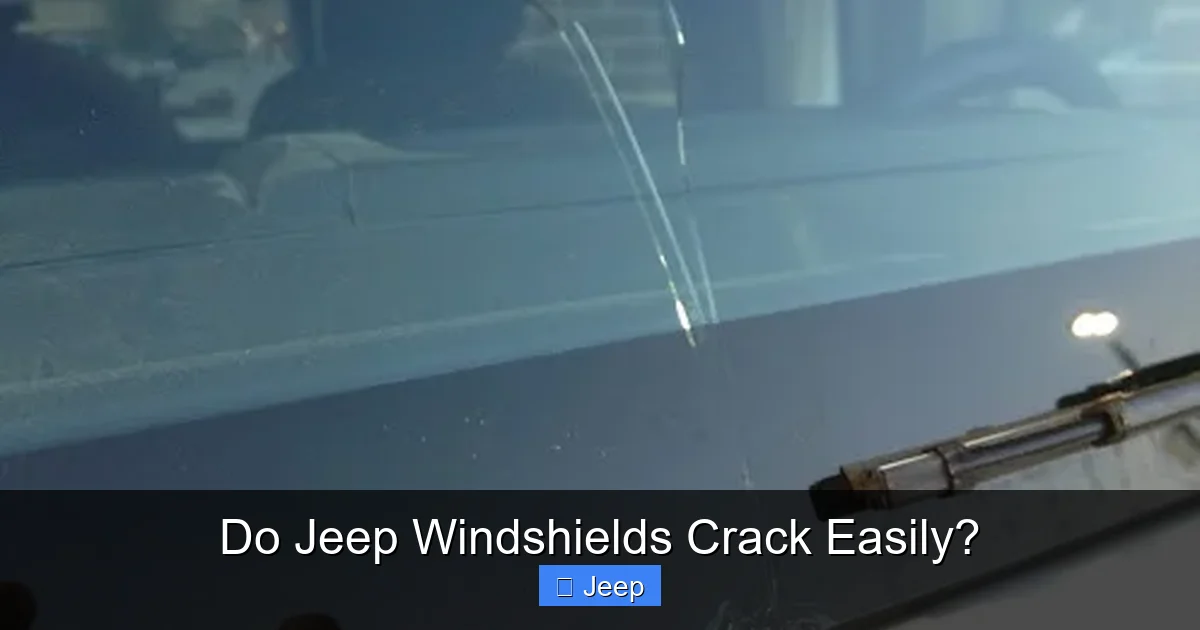
Do Jeep Windshields Crack Easily?

Contents
- 1 Key Takeaways
- 2 📑 Table of Contents
- 3 The Truth About Jeep Windshields: Myth vs. Reality
- 4 What Makes Any Windshield Vulnerable? The Science of Glass
- 5 Jeep-Specific Factors That Increase Risk
- 6 Real-World Damage Scenarios: How It Actually Happens
- 7 Protecting Your Investment: Prevention and Proactive Care
- 8 When Cracks Happen: Repair vs. Replacement
- 9 Conclusion: Embracing the Jeep Lifestyle with Clear Eyes
- 10 Frequently Asked Questions

Car Windshield Wiper Blades

Windshield Washer Fluid
Car Phone Holder

Steering Wheel Cover
While Jeep windshields aren’t inherently fragile, their design and typical use cases make them more susceptible to cracks. Off-roading, stone chips, and even everyday debris can cause damage. Proper prevention and timely repairs are crucial to avoid costly replacements.
Key Takeaways
- Jeep windshields are not made of weaker glass: They use standard automotive laminated glass, but their upright design and common use expose them to more direct impacts.
- Off-roading is the primary risk factor: Rocks, gravel, and tree branches kicked up on trails are the leading cause of chips and cracks in Jeeps.
- Stone chips are the most common culprit: Even highway driving behind trucks can launch small stones at high velocity, creating immediate damage.
- Prevention is significantly more cost-effective: Investing in protective films, careful parking, and following trail etiquette can save hundreds in repair costs.
- Small chips can often be repaired: Cracks under 6-12 inches (depending on location) are usually repairable, but delays lead to expansion.
- Insurance often covers replacements: Comprehensive coverage typically pays for windshield replacement, sometimes with a deductible, but frequent claims can raise premiums.
- Aftermarket vs. OEM glass matters: Original Equipment Manufacturer (OEM) glass ensures proper fit and safety ratings, while quality aftermarket can be a cost-effective alternative.
📑 Table of Contents
- The Truth About Jeep Windshields: Myth vs. Reality
- What Makes Any Windshield Vulnerable? The Science of Glass
- Jeep-Specific Factors That Increase Risk
- Real-World Damage Scenarios: How It Actually Happens
- Protecting Your Investment: Prevention and Proactive Care
- When Cracks Happen: Repair vs. Replacement
- Conclusion: Embracing the Jeep Lifestyle with Clear Eyes
The Truth About Jeep Windshields: Myth vs. Reality
If you own a Jeep or are thinking about buying one, you’ve probably heard the whispers in forums, at trailheads, and from fellow owners: “Do Jeep windshields crack easily?” It’s a valid concern, born from the iconic vehicle’s association with adventure, rocks, and rugged terrain. The short answer is: they are not inherently more fragile than any other vehicle’s windshield, but the way Jeeps are used absolutely puts them at a higher risk for damage.
Think of it this way. Your daily-driven sedan or crossover spends most of its life on paved roads, where the main threats are highway debris and the occasional hailstorm. A Jeep, especially a Wrangler, Gladiator, or older Cherokee, is a different beast. It’s a tool for exploration, often purpose-built to leave the pavement behind. That very purpose—the joy of off-roading—is what exposes its glass to a relentless barrage of environmental hazards. So the question isn’t about the quality of the glass itself, but about the context in which that glass operates.
In this deep dive, we’ll separate fact from fiction. We’ll look at the science of automotive glass, what makes a Jeep’s windshield uniquely vulnerable, the real-world scenarios that lead to cracks, and most importantly, what you can do to prevent, protect, and properly address damage when it inevitably occurs. By the end, you’ll have a clear, practical understanding of windshield stewardship for your beloved Jeep.
What Makes Any Windshield Vulnerable? The Science of Glass
Before we single out Jeeps, let’s establish a baseline. All modern automotive windshields are made of laminated safety glass. This isn’t the single pane of glass you might picture. It’s a sandwich: two layers of curved glass bonded together by a tough, transparent polyvinyl butyral (PVB) interlayer. This design is crucial for safety. In a major impact, the glass may shatter, but the PVB layer holds the pieces together, preventing dangerous shards from flying into the cabin and maintaining structural integrity for the roof.
Visual guide about Do Jeep Windshields Crack Easily?
Image source: cartireinflator.com
The Enemy: Stress Chips and Thermal Shock
Windshields fail from two primary mechanisms:
- Impact Damage: This is the most common. A stone, piece of gravel, or other hard object strikes the glass with kinetic energy. If the force is concentrated on a small point (like a sharp edge of a rock), it can create a chip (a small piece of glass missing) or a bullseye crack (a circular pattern radiating from the impact point). The PVB layer often contains the damage to a small area initially.
- Stress Cracks: These start at the edge of the glass, not from a direct impact. They are caused by extreme temperature differentials or structural flex. For example, blasting the defroster on a deeply frozen windshield can create rapid expansion on the inner layer, leading to a crack. Similarly, a hard impact to the vehicle’s frame (like a pothole) can flex the body and put stress on the glass seal.
Once a chip or crack exists, it’s a weak point. Temperature changes, driving vibrations, and even air pressure changes can cause it to extend. A tiny chip can spiderweb across your entire view in a matter of days or weeks. This is why immediate attention is critical.
Jeep-Specific Factors That Increase Risk
Now we get to the heart of the matter. Jeeps, particularly the Wrangler (TJ, JK, JL, JT) and Gladiator, have design philosophies and typical use cases that dramatically increase their exposure to the two failure modes above.

Visual guide about Do Jeep Windshields Crack Easily?
Image source: rsautoglass.ca
The Upright Windshield Design
Look at a Jeep Wrangler’s profile. Its windshield is nearly vertical. Compare that to the sloped, aerodynamic windshields of modern crossovers and sedans. This upright design is iconic and functional—it provides excellent outward visibility, a critical feature for off-road navigation and obstacle placement. However, it also presents a larger, more direct surface area to anything flying up from the road or trail. A sloped windshield tends to deflect more debris upward and over the roof. An upright one offers less deflection, making it a bigger target. This is a fundamental engineering trade-off Jeep made for capability.
The Off-Roading multiplier
This is the biggest factor by far. Off-roading isn’t just driving on a dirt road. It involves:
- Rock Crawling: Tires literally push and scrape against stones. Rocks are displaced, rolled, and sometimes launched backward by the tires. These “tire kick-up” rocks are the number one cause of windshield damage on the trail. They are often sharp, jagged, and launched with surprising force.
- Following Others: Off-roading is often a group activity. If you’re following another vehicle, you are directly in the line of fire of whatever their tires eject. This is a universal truth among all off-roaders, but it’s a constant hazard for Jeeps that frequently travel in convoys.
- Overhanging Vegetation: Branches and twigs can scratch the glass or, if larger, cause impact damage.
- Dust and Sand: While not causing immediate cracks, constant abrasion from sand and dust can etch the outer layer of glass over time, creating a hazy, weakened surface more prone to chipping.
For Jeep owners who rarely venture off pavement, the risk is much lower, closer to that of a typical SUV. But for the core Jeep demographic, this exposure is a daily or weekly reality. It’s also worth noting that aftermarket modifications like lift kits change the vehicle’s geometry. A significant lift can increase the angle of approach and alter how debris is directed, sometimes making the windshield more vulnerable to direct hits from certain obstacles. If you’ve installed a lift, understanding this change in exposure is part of responsible ownership.
Age, Vibration, and Factory Stress
Older Jeeps, particularly classic models (like the CJ series or early YJ/TJ), can develop stress cracks over time due to the cumulative effect of years of trail vibration and frame flex. The bond between the glass and the urethane seal can degrade. Additionally, improper installation during a previous replacement can leave the glass stressed or not seated correctly, making it a ticking time bomb for cracks.
Real-World Damage Scenarios: How It Actually Happens
Let’s move from theory to the trailhead. Here are the most common, real-world situations that lead to a cracked Jeep windshield:

Visual guide about Do Jeep Windshields Crack Easily?
Image source: differencebetweenshoes.com
The “Highway Truck Tailgate” Special
You’re cruising on the interstate at 70 mph, following a dump truck or a construction vehicle. A small pebble, dislodged from its load, zips backward like a bullet. *PING*. You hear it, see a small chip or star crack appear instantly. This happens to every vehicle, but Jeep owners often do more highway driving to reach remote trailheads, increasing exposure. The high speed magnifies the impact force exponentially.
The “Fellow Jeeper’s Back Tires” Incident
You’re on a beautiful, rocky trail, navigating a technical section in a convoy. The Jeep in front of you nudges a basketball-sized rock. It rolls, then gets caught in the tread and launched backward directly toward your driver’s side windshield. You see it coming and have zero time to react. This is the classic, heart-sinking moment every off-roader fears. It’s not malice; it’s physics. It underscores the importance of maintaining a safe following distance *on the trail*, which is often harder than on road.
The “Low-Hanging Branch” Surprise
On a forested trail, a branch you didn’t see or thought was clear scrapes across the top edge of the windshield. This can cause a long, horizontal crack along the seal. It’s less common than rock chips but still a frequent report in Jeep forums, especially among those who enjoy greenfield trails.
The “Sudden Temperature Shock” Event
It’s a brutally cold morning. You start your Jeep, crank the heat and defroster to max to clear the frost, and within minutes, you hear a *crack*. A pre-existing, microscopic flaw or stress in the glass gave way to the rapid temperature change between the freezing cold outer pane and the warming inner pane. This can happen to any car, but Jeeps, with their removable tops and doors, are often exposed to the full extremes of the elements more than a climate-controlled sedan.
The “Vibration Fatigue” Failure
You own a 2005 Jeep Wrangler with 200,000 miles of mixed use. One day, you notice a small crack at the corner of the windshield with no apparent impact. Over years, the constant torsional twisting of the body on rough roads has slowly stressed the glass at its mounting points until it finally gave way. This is less common but a reality for high-mileage, heavily used Jeeps.
Protecting Your Investment: Prevention and Proactive Care
You can’t eliminate risk—that’s part of the adventure. But you can drastically reduce it. An ounce of prevention is worth a pound of auto glass quotes.
Driving and Trail Etiquette
- Increase Following Distance: On trails, give the vehicle in front extra room. This gives you time to see and react to debris they kick up. On highways, stay back from trucks.
- Know Your Line: When off-roading, carefully choose your path. Avoid areas where rocks are loose and likely to roll. Sometimes going slightly slower or taking a different line prevents a tire from catching and launching a stone.
- Communicate: In a convoy, use hand signals or radios to warn of obstacles. A simple “Rock!” from the lead vehicle can save the whole group’s glass.
Physical Protection: Films and Covers
This is your most effective line of defense.
- Windshield Protection Film: This is a clear, urethane-based film (similar to paint protection film) applied to the exterior of the windshield. It’s not a scratch-proof shield, but it’s incredibly effective at absorbing the energy of small stones and sand, preventing chips and scratches. High-quality films from brands like XPEL or 3M can last for years and are a favorite among serious off-roaders. The cost of a full windshield film application is often less than one insurance deductible for a replacement.
- Bug Deflectors / Wind Deflectors: These mounted on the hood can help divert some debris and bugs upward and over the windshield. Their effectiveness against stones is limited but they do help with bug splatter and minor sand abrasion.
- Soft Top & Door Storage: When your Jeep is parked, especially in areas with potential falling debris (like under trees during a storm or in a gravel parking lot), consider keeping the soft top up and doors on. A parked car with a soft top down and no doors is a giant, vulnerable glass target.
Smart Parking and Daily Habits
- Park Away from Trees: Avoid parking under large trees if possible. Acorns, branches, and even sap can cause damage or create messy, corrosive clean-up.
- Garage It: If you have a garage, use it. It protects from virtually all environmental hazards, from hail to vandalism to tree limbs.
- Gentle Defrosting: On cold mornings, use the heater on a lower setting to warm the glass gradually. Never use hot water to de-ice, as the thermal shock can crack even intact glass.
For those who frequently carry gear inside, ensure it’s securely stowed. A loose cooler or tool kit sliding around during off-road maneuvers can potentially impact the windshield from the inside. Investing in quality floor mats can also prevent small, hard objects from sliding forward under braking.
When Cracks Happen: Repair vs. Replacement
So, the ping happened. You have a chip. Now what? Time is your enemy. Here is the decision framework.
The “Repairable” Zone
Most chips and small cracks can be repaired, not replaced. A professional resin injection process cleans out the air from the chip and fills it with a clear, strong resin that restores structural integrity and clarity. You should seek repair immediately, within days of the damage occurring. The longer you wait, the more likely dirt and moisture will work their way into the crack, making repair impossible or less effective.
General repairability guidelines:
- Chips (bullseye, star break) are almost always repairable if caught early.
- Cracks under 6-12 inches in length are often repairable, depending on their location.
- Critical No-Repair Zone: Any damage that extends to the edge of the glass (within about 2 inches) compromises the seal and structural strength. This must be replaced.
- Driver’s Line of Sight: Even a repaired crack in the direct driver’s sightline (the swept area of the wipers) can cause optical distortion. Many states have laws prohibiting repairs in this zone, and it’s a safety hazard. Replacement is usually recommended.
The Replacement Process: OEM vs. Aftermarket
If replacement is necessary, you have choices.
- OEM (Original Equipment Manufacturer): Glass made by the same company that supplied the glass for your Jeep at the factory (e.g., Saint-Gobain Sekurit, PPG). It will have the exact same specifications, fit, and safety certifications (like DOT and AS standards). It’s the gold standard for fit and clarity but is more expensive.
- OEE (Original Equipment Equivalent): High-quality aftermarket glass made by companies that also supply OEMs but sold under their own brand. It meets all safety standards and is often indistinguishable from OEM. This is a very common and cost-effective choice.
- Aftermarket: A broad category. Some aftermarket glass is excellent (made in the same factories as OEM), while lower-tier options may have slight fit issues or optical distortion. Always choose a reputable auto glass shop that uses quality parts.
Installation is everything. A perfect piece of glass installed poorly is a disaster. The urethane seal must be applied correctly, and the glass must be positioned perfectly. Always use a shop certified by the Auto Glass Safety Council (AGSC) or with excellent local reviews. For Jeeps with sensors (rain-sensing wipers, ADAS cameras), recalibration may be required after replacement, adding to the cost and complexity.
Insurance and Cost Considerations
Windshield replacement is a common comprehensive insurance claim. Check your policy: you may have a deductible (often $500-$1000), or you may have “full glass coverage” with a lower or $0 deductible. Get a quote from your insurance company first. However, be aware that multiple glass claims can sometimes lead to higher premiums or non-renewal, so weigh the cost of a deductible against the out-of-pocket price. For a minor chip repair, paying out-of-pocket is almost always cheaper and better for your insurance record.
Conclusion: Embracing the Jeep Lifestyle with Clear Eyes
So, do Jeep windshields crack easily? The evidence shows they face a disproportionate amount of abuse due to their design and the adventures they’re built for. An upright windshield on a vehicle that regularly traverses rocky terrain is a combination that statistically leads to more glass incidents than a commuter sedan. But this isn’t a flaw; it’s a characteristic. It’s the price of admission for a vehicle that delivers unmatched capability and fun.
The key takeaway is proactive ownership. Don’t be the owner who ignores a small chip until it spreads. Don’t hit the trails without a plan for following distance. Invest in a high-quality protective film if you’re a frequent off-roader. Understand your repair options and have a trusted auto glass shop in your contacts. By respecting the vulnerability of that front pane of glass, you protect not just your wallet, but your safety and your uninterrupted enjoyment of the Jeep lifestyle. The trail will always throw rocks your way—it’s how you prepare for them that defines your journey.
Frequently Asked Questions
Are Jeep windshields more prone to cracking than other SUVs?
Yes, statistically they are more prone due to their nearly vertical design, which offers less deflection of debris, and their frequent use in off-road environments where rock kick-up is common. A typical family SUV with a sloped windshield has a natural advantage in deflecting projectiles.
What is the single most effective thing I can do to protect my Jeep’s windshield?
Installing a high-quality, professional-grade windshield protection film is the most effective proactive measure. It absorbs the energy of small stones and sand, preventing chips and scratches. For trail use, maintaining a safe following distance from the vehicle ahead is the most critical driving habit.
Can a chip in my Jeep’s windshield always be repaired?
No. Repairability depends on size, type, and location. Small chips and short cracks (usually under 6 inches) away from the edge and not in the driver’s direct line of sight are excellent candidates for repair. Damage at the edge or long cracks in the sight line typically require full replacement to ensure safety and structural integrity.
How much does it cost to replace a Jeep Wrangler windshield?
Costs vary widely by region, model year, and whether you choose OEM or aftermarket glass. For a Jeep Wrangler (JL/JT), expect a range from $400 to $900 for the glass and professional installation. If your vehicle has a rain-sensing wiper module or forward-facing camera (on newer models), additional calibration costs can add $150-$300. Always get multiple quotes.
Will my insurance cover a cracked Jeep windshield?
Most comprehensive auto insurance policies cover windshield damage from non-collision events like rocks, vandalism, or hail. You will typically pay your comprehensive deductible unless you have specific “full glass coverage” which lowers or waives it. Check your policy details. Remember, filing a claim may affect your renewal premium depending on your insurer’s policies and claim history.
Is aftermarket glass for a Jeep safe and reliable?
High-quality aftermarket glass (OEE) that meets DOT and AS safety standards is perfectly safe and reliable. It must provide the same structural support and optical clarity as OEM. The key is choosing a reputable auto glass shop that sources from top-tier manufacturers. Avoid the cheapest options, as poor fit or optical distortion can be dangerous. For Jeeps with advanced safety sensors, ensure the aftermarket glass is compatible and that the shop can perform necessary recalibrations.