
Car Cover Theft: How to Secure Your Cover and Protect Your Car

Quick Answer
The best way to reduce car cover theft is to use a fitted cover with reinforced grommets and a vinyl-coated security cable with a padlock. Remember that securing the cover does not secure the vehicle, so follow NHTSA vehicle theft prevention guidance underneath it.
Best ways to secure a car cover
- Use locking grommets: Choose a cover with reinforced holes designed for a security cable.
- Add a coated cable: Run a vinyl-coated steel cable through the grommets beneath the vehicle and lock it.
- Secure the fit: Use the cover’s straps or buckles to reduce loose fabric that can be grabbed or lifted.
- Park visibly: Favor a garage, driveway, monitored lot, or well-lit location when possible.
- Protect the vehicle: Lock the doors, remove the keys, hide valuables, and keep the vehicle’s anti-theft systems active.
My simple rule
- Treat cover security and vehicle security as two separate jobs, and do both every time you park.
Car cover theft is easy to overlook until you walk outside and find an expensive cover missing. An unsecured cover can often be removed much faster than most owners expect.
I treat the problem in two layers: keep the cover difficult to remove, then make sure the vehicle underneath remains properly secured. This guide explains both without turning a simple car cover into an overcomplicated security project.
In This Guide
- Can a Car Cover Be Stolen, and Does It Protect the Car?
- How Do You Stop Someone From Stealing a Car Cover?
- Which Car Cover Security Method Works Best?
- Can a Car Cover Help Prevent Vehicle Theft?
- What Should You Avoid When Locking a Car Cover?
- What Should You Do If Your Cover or Vehicle Is Stolen?
- Frequently Asked Questions
Can a Car Cover Be Stolen, and Does It Protect the Car?
Yes. A car cover can be stolen when someone can simply lift it from the vehicle and carry it away without defeating a lock, cable, or other restraint.
Definition: Car cover theft means the unauthorized removal or taking of the protective cover itself. It is different from vehicle theft, although both security problems can happen at the same location.
I couldn’t find a major national automotive authority that tracks stolen car covers as a separate crime category. That means broad claims about how frequently covers are stolen should be treated cautiously.
Vehicle theft is much better documented. NHTSA reports that more than 650,000 vehicles were stolen in the United States during 2025, or roughly one every 48 seconds.
Why an unsecured cover is vulnerable
A cover without a locking point relies mostly on elastic hems, mirror pockets, and ordinary straps. Those features help with fit, but they are not the same as a theft-deterrent lock.
- Elastic hems: Hold fabric around the bumpers but can usually be lifted by hand.
- Wind straps: Reduce movement yet may use quick-release buckles rather than locks.
- Loose universal covers: Give someone more fabric to grab and may be easier to pull away.
- Unlocked grommets: Provide a security point only when a cable or lock is actually installed.
Before assuming theft, check whether strong wind moved the cover. Look nearby, inspect broken buckles, and review any available camera footage.
Does the cover itself protect the vehicle from theft?
Only indirectly. A cover can hide the vehicle’s appearance and items visible through the windows, but it does not lock the doors or immobilize the engine.
I would never rely on fabric as the main theft deterrent. The vehicle underneath should be secured exactly as if no cover were present.
Section Takeaway: A car cover can be stolen independently of the vehicle. Secure the cover with dedicated hardware, while treating the car’s normal anti-theft protection as a separate layer.
How Do You Stop Someone From Stealing a Car Cover?
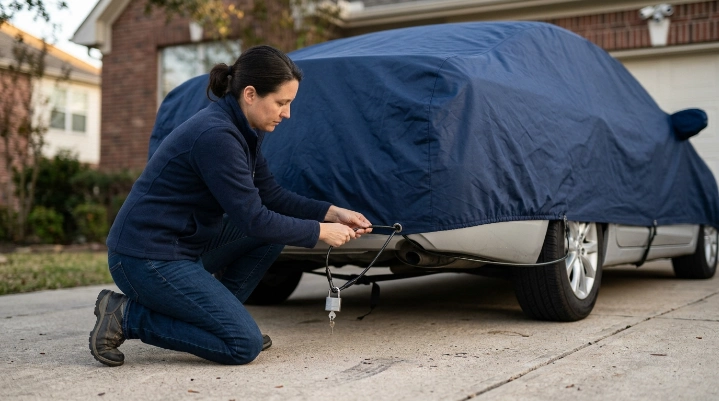
The most practical setup is a fitted cover with reinforced grommets, a coated security cable, and a padlock. Add good parking habits when the vehicle stays outside overnight.
1. Start with a cover designed to be secured
Look near the lower center of each side for reinforced grommets or another manufacturer-approved locking point. The surrounding fabric should be reinforced so normal cable tension does not tear it.
A custom-fit or correctly sized cover also helps. Excess fabric makes the cover easier to grab and allows more movement during wind.
2. Thread a coated cable through the grommets
Run the security cable from one reinforced grommet underneath the vehicle to the grommet on the opposite side. A vinyl or similar protective coating reduces the chance of bare metal contacting painted or finished surfaces.
Keep the cable on a safe path beneath the vehicle. Never wrap it around brake lines, wiring, exhaust components, steering parts, or suspension components.
3. Position the padlock away from the paint
The padlock should hang below the cover rather than resting against a door, rocker panel, wheel arch, or bumper. Repeated contact between a metal lock and paint can create damage as the cover moves.
I like enough cable tension to remove obvious slack without pulling hard on the fabric. More tension does not automatically mean better security.
4. Use straps for fit, not as your only lock
Underbody straps and buckle systems are useful because they help keep a cover in place during wind. However, a standard plastic buckle should not be treated like a security lock.
Use the straps together with the cable when your cover includes both systems. Each one solves a different problem.
5. Add an alarm where the risk justifies it
A small motion or vibration alarm can add an audible layer if someone starts lifting or disturbing the cover. Place it where normal wind movement is unlikely to trigger constant false alarms.
A driveway camera or monitored parking area can provide another layer. Cameras do not physically secure the cover, but they can increase visibility around the parked vehicle.
6. Choose the parking location carefully
A lock works better when the vehicle is not isolated. Whenever possible, use a garage, private driveway, controlled-access parking area, or visible space with good lighting.
If outdoor parking is unavoidable, I focus on reducing opportunity. A properly fitted, locked cover requires more time and effort to remove than a loose cover someone can simply pull away.
Section Takeaway: For most drivers, the useful combination is reinforced grommets, a coated cable, a padlock, secure fit, and visible parking. Straps alone are better for wind control than theft prevention.
Which Car Cover Security Method Works Best?
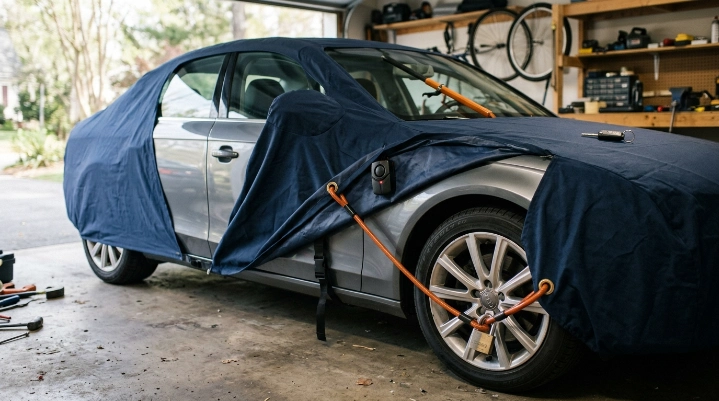
A coated cable and padlock provide the most direct protection against casual removal of the cover. Vehicle anti-theft equipment remains necessary because cover locks and vehicle locks protect different things.
| Security Method | Main Protection | Best Use | Main Limitation |
|---|---|---|---|
| Coated cable + padlock | Car cover | Deterring quick removal of a grommet-equipped cover | Can still be defeated with enough time or cutting tools |
| Underbody buckle straps | Cover fit | Reducing lifting and flapping in wind | Ordinary buckles are not true security locks |
| Motion alarm | Tampering alert | Adding noise when a cover is disturbed | Needs power and careful placement to limit false alarms |
| Steering-wheel lock | Vehicle | Visible vehicle theft deterrence | Does not secure the car cover |
| Immobilizer or recovery system | Vehicle | Preventing unauthorized starting or helping recover a stolen vehicle | Does not keep someone from taking the cover |
No single row solves every problem. My preferred setup combines physical cover security with the vehicle’s existing alarm, immobilizer, locks, and other theft-deterrent features.
A cable lock should mainly make casual removal less convenient. I would not describe any ordinary car-cover lock as theft-proof.
Can a Car Cover Help Prevent Vehicle Theft?
A cover may reduce casual visibility, but it is not a substitute for an actual vehicle security system. Lock the vehicle and activate its normal anti-theft features before installing the cover.
NHTSA groups vehicle anti-theft measures into visible or audible deterrents, immobilizing devices, and recovery systems. Those measures protect the vehicle in ways a fabric cover cannot.
- Lock every door: Do this even when the vehicle is parked at home.
- Close the windows: Do not assume the cover prevents access to them.
- Take the key: Never leave the key or spare key inside the covered vehicle.
- Remove visible valuables: Keep tempting items out of sight before covering the car.
- Use the immobilizer: Keep factory theft-deterrent systems enabled when equipped.
- Consider visible deterrence: A steering-wheel lock can create another obstacle on appropriate vehicles.
The layered approach also appears in long-standing automotive guidance from Edmunds’ auto insurance resources. The basic idea is simple: do not expect one device to stop every theft method.
For broader ownership and security information, Kelley Blue Book’s car advice section is another useful reference. I prefer broad, established resources over relying on unsupported claims about a particular gadget.
A covered car can also create a false sense of security. Make your final check after the cover is installed: doors locked, windows closed, keys removed, cable secured, and parking area reasonably visible.
What Should You Avoid When Locking a Car Cover?
Most problems come from routing the cable incorrectly, putting metal against the paint, or assuming every strap is a theft deterrent. A simple installation should never interfere with vehicle components.
- Don’t lock to mechanical parts: Avoid brake lines, exhaust parts, wiring, suspension pieces, and steering components.
- Don’t let metal hit paint: Keep padlocks and bare cable ends away from body panels.
- Don’t overtighten: Excess tension can stress grommets, seams, and cover fabric.
- Don’t punch holes casually: An unreinforced hole can tear when the cable is pulled.
- Don’t cover a dirty car carelessly: Dirt between fabric and paint can become abrasive when the cover moves.
- Don’t confuse wind straps with locks: Quick-release plastic buckles usually focus on retention rather than theft resistance.
- Don’t ignore local parking rules: If the vehicle sits on a public road, check whether local rules affect vehicle-cover use or plate visibility.
One detail matters more than it seems: the lock should not swing against the car. Even a secure cover can become a paint-care problem if its hardware repeatedly taps the same panel.
I also inspect the grommets periodically. If the surrounding fabric stretches, cracks, or begins tearing, repair or replace the cover before relying on that point again.
What Should You Do If Your Cover or Vehicle Is Stolen?
If only the car cover disappears, first check the vehicle for damage and confirm that wind did not move the cover. Review available camera footage before assuming exactly what happened.
If the cover was stolen but the vehicle remains
- Photograph the vehicle, parking area, damaged straps, broken grommets, or other evidence.
- Check doors, windows, wheels, trim, and accessible exterior components for signs of tampering.
- Save relevant security-camera recordings before they are automatically overwritten.
- Notify property management or parking security when applicable.
- Consider filing a police report, especially if property was damaged or other theft occurred.
- Do not confront a suspected thief yourself.
Before replacing the cover, identify the weak point in the previous setup. Adding another unsecured cover to the same location may simply recreate the problem.
If the vehicle itself is stolen
Contact police immediately and make a stolen-vehicle report. Be ready to provide the license plate number, make, model, color, Vehicle Identification Number, and identifying details.
NHTSA also advises contacting your insurance company promptly and says to file the claim within 24 hours of the vehicle being stolen. Keep the police report or case number available for the insurer.
If the vehicle has an active recovery or tracking system, give that information to law enforcement. Do not attempt to recover a stolen vehicle by confronting a suspect on your own.
If you discover the vehicle before authorities do, notify the police and insurer. That helps prevent confusion over its stolen status.
Frequently Asked Questions
Will a cable lock completely prevent car cover theft?
No. A cable and padlock are mainly deterrents that make quick removal more difficult. Someone with enough time and suitable cutting tools may still defeat ordinary cover hardware, so combine the lock with secure parking and sensible vehicle security.
What is the best lock for a car cover?
A corrosion-resistant padlock used with a vinyl-coated steel cable and reinforced cover grommets is a practical setup for most drivers. The cable should fit beneath the vehicle without being routed around mechanical components or touching painted bodywork.
Are car cover straps enough to prevent theft?
Usually not. Standard straps and buckles are mainly designed to improve fit and help prevent wind from lifting the cover, while a cable and padlock create a more meaningful barrier against casual removal.
Can a thief cut a car cover security cable?
Yes, depending on the cable and tools involved. The purpose of a typical cover cable is to increase the effort and time required to take the cover, not to make the setup impossible to defeat.
What if my car cover doesn’t have security grommets?
The safest option is a cover designed with reinforced locking points or a manufacturer-approved grommet solution. Avoid cutting an unsupported hole through ordinary cover fabric because tension around that opening can cause the material to tear.
Can I leave a locked car cover on during long-term storage?
Yes, provided the cover is suitable for the storage environment and both the vehicle and cover are clean and dry. Check the fit, cable, grommets, moisture levels, and fabric periodically rather than leaving the setup completely unattended.
Does covering a car make the vehicle itself harder to steal?
A cover can conceal some visual details, but it does not immobilize the vehicle or lock its doors. Use the cover as an additional layer while relying on vehicle locks, alarms, immobilizers, visible deterrents, and recovery systems for actual vehicle theft protection.
Final Takeaway: The easiest car cover to steal is one that can be pulled off without encountering a lock. Use reinforced grommets, a coated cable, a padlock, a secure fit, and smart parking while keeping the vehicle underneath fully locked and protected.
Before your next overnight parking session, spend a few seconds checking both layers. Secure the cover first, then confirm the car itself is protected.
