
Car Cover Fitment Issues: Causes, Fixes, and How to Get the Right Fit

Quick Answer
Most car cover fitment issues come from choosing the wrong vehicle configuration, buying an incorrect universal size, or ignoring accessories that change the car’s shape. A properly fitted cover should follow the vehicle’s basic contours, reach over both bumpers, and stay secure without excessive stretching or large loose sections; you can also check your vehicle specifications through a trusted source such as Edmunds before selecting a size.
Common Fitment Problems
- Cover too short: The cover cannot seat around both bumpers without excessive tension.
- Cover too loose: Extra fabric gathers around the roof, doors, or lower body and can flap in wind.
- Mirror pockets misaligned: The selected pattern may not match your exact model, trim, or mirror configuration.
- Spoiler creates tension: A factory or aftermarket spoiler can change the length and shape the cover must accommodate.
- Roof accessories interfere: Roof racks, cargo rails, light bars, and other equipment can make a standard pattern unsuitable.
- Wind lifts the cover: Loose fitment and poor securing allow air to get underneath the fabric.
Before Replacing the Cover
- Confirm the vehicle year, make, model, body style, trim, and exterior accessories before assuming the cover itself is defective.
Car cover fitment issues can turn a simple protective accessory into a daily frustration. I’ve seen covers that looked like the correct size on paper become obviously wrong once the mirrors, spoiler, or bumper shape came into play.
This guide explains how to diagnose those problems without guessing. I’ll cover tight covers, loose covers, universal sizing, mirror alignment, accessories, wind, and the point where exchanging the cover makes more sense than trying to force it to work.
In This Guide
What Causes Car Cover Fitment Issues?
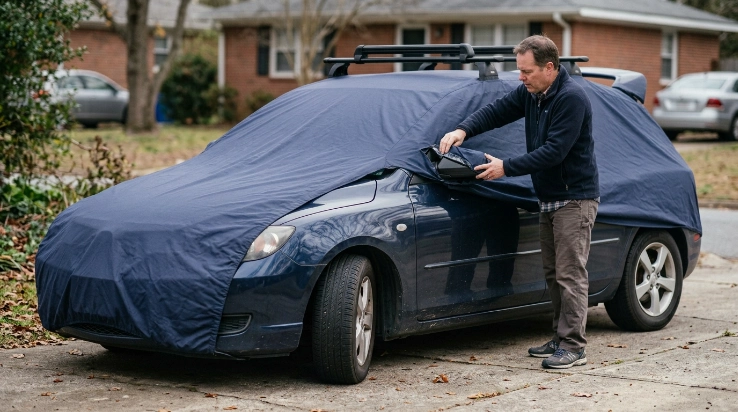
Car cover fitment issues happen when the dimensions or pattern of the cover do not match the vehicle’s actual exterior profile. The mismatch can involve overall size, body style, mirrors, bumpers, spoilers, roof equipment, antennas, or other features.
A car cover is more shape-sensitive than it looks. Two vehicles with similar overall lengths can still require completely different patterns.
Wrong year, make, model, or body style
The first thing I check is the vehicle information used when the cover was ordered. An incorrect model year or body style can move mirror pockets, change bumper coverage, or alter the roofline enough to cause trouble.
- Model year: A redesign or facelift may change exterior dimensions.
- Body style: Sedan, coupe, hatchback, wagon, SUV, and pickup versions can differ substantially.
- Cab configuration: Trucks may have regular, extended, or crew cabs.
- Bed length: Pickup covers must match the bed and cab combination.
- Trim level: Sport and off-road trims sometimes add spoilers, flares, or other exterior pieces.
If you’re unsure which vehicle configuration you own, confirm it before ordering another cover. The National Highway Traffic Safety Administration also provides vehicle and VIN resources that can help verify vehicle information.
Factory and aftermarket accessories
Accessories are one of the easiest details to overlook. A cover patterned for a stock vehicle may not have enough fabric in the right places for added equipment.
- Rear spoilers or wings
- Roof racks and crossbars
- Running boards
- Fender flares
- Brush guards
- Light bars
- Bed racks
- Bike or cargo accessories
- Non-standard mirrors
- Fixed exterior antennas
Custom-cover manufacturers commonly ask owners to identify exterior equipment because those features affect the finished pattern. Some unusual or modified vehicles may even require individual measurements.
Universal sizing compromises
A universal cover is built to fit a range of vehicles rather than one exact body shape. That makes sizing convenient, but it also creates more room for imperfect fitment.
A universal cover can be the correct nominal size while still looking loose around the mirrors or roof. The same cover may feel tighter around a wide bumper or tall rear section.
| Fitment Symptom | Likely Cause | What to Check |
|---|---|---|
| Will not reach rear bumper | Cover too short or wrong body configuration | Vehicle length, body style, spoiler |
| Large fabric folds around doors | Cover oversized | Universal size range and body dimensions |
| Mirror pockets sit forward or backward | Incorrect custom pattern | Year, model, trim, mirror type |
| Cover hangs above lower body | Cover too small or vehicle too tall | Vehicle height and accessory clearance |
| Tight spot over rear deck | Spoiler or wing not accommodated | Factory and aftermarket rear equipment |
| Cover repeatedly lifts in wind | Loose fit or poor securing | Elastic hems, straps, tie-down points |
Section Takeaway: Most fitment failures start with incorrect vehicle details, universal sizing compromises, or exterior accessories that were not considered when the cover was selected.
How Should a Car Cover Fit?
A properly sized car cover should sit close enough to the vehicle to avoid excessive movement without being stretched like a drum. It should cover the major painted surfaces and remain seated around the front and rear ends.
Think fitted, not strained. A few natural folds are normal, especially with non-custom covers.
Signs of a good fit
- Front alignment: The designated front section sits over the correct bumper.
- Rear coverage: The opposite hem reaches and stays around the rear bumper.
- Roof position: The center of the cover roughly follows the center of the roof.
- Mirror alignment: Dedicated mirror pockets reach the mirrors without twisting the whole cover.
- Side coverage: The fabric hangs reasonably evenly along both sides.
- Hem tension: Elastic sections hold the cover without requiring extreme stretching.
Custom covers normally follow the body more closely than universal ones. Manufacturers can pattern them around vehicle-specific features such as mirror positions and antenna locations.
Does a car cover need to be perfectly tight?
No. Perfectly skin-tight fitment is not required for normal vehicle protection.
In fact, trying to eliminate every wrinkle can encourage owners to buy a cover that’s too small. What matters more is predictable coverage and secure positioning.
Outdoor use deserves extra attention because wind can work underneath loose fabric. Proper securing becomes more important as exposure increases.
- Seat elastic hems fully around the vehicle.
- Use the manufacturer’s intended tie-down system.
- Check that the cover cannot easily slide sideways.
- Avoid improvising with hard objects against painted surfaces.
- Inspect fitment after strong wind or severe weather.
Fit is also tied to cover life. Repeated flapping can stress fabric, seams, elastic sections, and attachment points.
Section Takeaway: A good car cover fit is secure and balanced, not excessively tight. The cover should stay positioned without large loose sections or heavily strained seams.
Why Is My Car Cover Too Tight?
A car cover that feels excessively tight is usually undersized or encountering an exterior feature the pattern did not account for. Do not assume you simply need to pull harder.
The cover is the wrong size
Universal covers normally use vehicle-size ranges. If your car sits near the upper limit of one range, a smaller cover may technically look close but still fail to reach the bumpers correctly.
I pay particular attention to whether the tension exists everywhere or at one location. Uniform tightness suggests sizing, while one tight spot usually points to a feature mismatch.
A spoiler or roof accessory is taking up fabric
A spoiler changes more than the height at the rear. Fabric must travel over that added shape before reaching the bumper.
Roof racks create the same problem vertically. A cover designed around a bare roof may lose several inches of effective side coverage once it passes over rack hardware.
- Remove detachable accessories when practical.
- Check whether the manufacturer offers an accessory-specific pattern.
- Do not force mirror pockets onto mirrors they cannot reach naturally.
- Confirm whether your trim includes a factory spoiler or aerodynamic package.
Mirror pockets do not line up
Misaligned mirror pockets are a strong clue that the pattern is wrong. Stretching one pocket into place can pull the entire cover off-center.
If both pockets miss in the same direction, recheck front-to-rear orientation first. If the orientation is correct, verify the exact vehicle application.
Should you stretch a tight car cover?
Only normal installation tension should be necessary. Stop if you’re placing obvious strain on seams, hems, mirror pockets, or delicate accessories.
A cover that cannot reach its intended securing points is not a good fit. Replacing it is usually better than repeatedly forcing it onto the vehicle.
Section Takeaway: Excessive tension is a diagnosis clue. Determine whether the entire cover is undersized or whether one vehicle feature is consuming the missing space.
Why Is My Car Cover Too Loose?
A loose car cover is usually oversized, designed for a broader range of body shapes, or not installed and secured correctly. Outdoor wind can make a minor sizing problem much more noticeable.
How much looseness is normal?
Some loose fabric is expected with universal and semi-custom covers. Large hanging sections, repeated ballooning, or easy sideways movement are different.
- Normal: Small folds around complex curves.
- Questionable: Deep folds hanging along several body panels.
- Poor fit: Cover can shift far enough to expose major painted areas.
- Outdoor concern: Wind repeatedly inflates or lifts large sections.
Wind-related movement deserves attention because the cover is constantly rubbing and loading its attachment points. Cover manufacturers recommend correct hem placement and proper tie-downs to reduce movement.
Can straps fix an oversized cover?
Straps can stabilize modest looseness, but they cannot turn a substantially oversized cover into a correctly sized one. Think of straps as retention devices rather than sizing devices.
Over-tightening a strap can simply gather excess material into another area. It may also concentrate load around a limited attachment point.
Is a loose cover bad for paint?
The risk depends on the cover material, cleanliness, environment, and amount of movement. A dirty vehicle, dirty cover, and repeated wind movement are a poor combination.
Keep both surfaces clean before installation. If an outdoor cover constantly flaps despite correct securing, fitment should be reconsidered.
You can compare vehicle dimensions through resources such as Kelley Blue Book when you’re double-checking whether a universal cover’s stated size range matches your vehicle.
Section Takeaway: Mild looseness can be normal, especially with universal covers. Excess fabric that shifts, balloons, or repeatedly flaps usually means you need a better size or pattern rather than tighter straps.
How Do You Check Car Cover Size and Fitment?
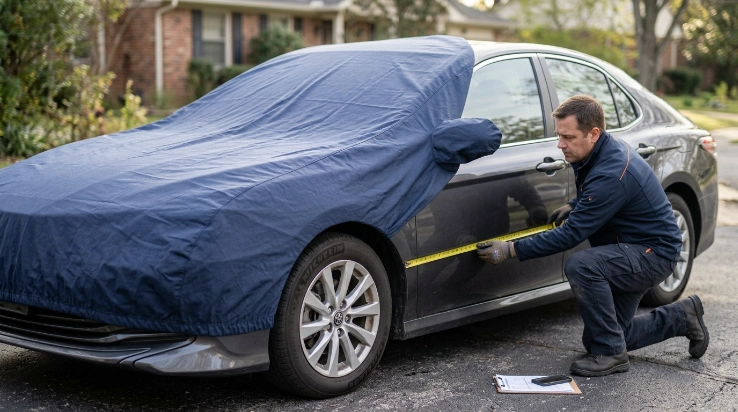
Start with the vehicle’s exact identity, then check dimensions only if the cover uses a size range or your vehicle has been modified. Custom-fit products are usually selected by vehicle application instead of owner measurements.
Step 1: Confirm the exact vehicle configuration
- Confirm the model year.
- Confirm the manufacturer and model.
- Identify the body style.
- Identify the trim when it affects exterior equipment.
- For pickups, confirm cab and bed configuration.
- List exterior accessories that change the vehicle’s profile.
Do not rely only on what the vehicle “looks like.” Cars within one model family can have different body dimensions and exterior hardware.
Step 2: Check the dimensions required by the cover maker
Universal-cover companies often size products around basic exterior dimensions. Follow that manufacturer’s measuring instructions because definitions can vary.
Common dimensions include:
- Overall length: Frontmost to rearmost body point specified by the manufacturer.
- Body width: Width across the body at the specified location.
- Overall height: Vertical height used by the sizing chart.
Don’t automatically include mirrors, antennas, racks, or other projections unless the sizing instructions say to include them. Doing so can push you into the wrong size bracket.
Step 3: Compare your numbers with verified vehicle specifications
Published vehicle specifications make a useful sanity check. Sources such as Car and Driver often list length, width, wheelbase, and height for current models.
Use the measurements requested by the cover manufacturer as the final standard. Different databases may also define measurements differently.
Step 4: Test the cover’s natural installation position
Install the cover according to its orientation markings. Do not immediately tighten straps or modify anything.
- Center the cover over the roof.
- Seat the front hem.
- Align mirror pockets if equipped.
- Pull the cover toward the rear.
- Check bumper coverage.
- Compare side-to-side hanging depth.
If the cover only fits after being pulled significantly off-center, the size or pattern is questionable. Correct installation should not require sacrificing one area to cover another.
Step 5: Inspect high-stress areas
Look closely at mirror pockets, spoiler corners, antenna locations, roof-rack contact areas, and elastic hems. These points often reveal a fitment problem before the large body panels do.
As of 2026, vehicle trims continue to include increasingly varied exterior packages and factory accessories. Exact trim and equipment details therefore matter when a custom-pattern manufacturer differentiates between configurations.
Section Takeaway: Verify vehicle identity first and measurements second. A correct size should install naturally without pulling the entire cover out of alignment.
Can You Fix a Poorly Fitting Car Cover?
Minor installation problems can often be corrected, but a fundamentally wrong size or pattern should usually be exchanged. Altering a new cover before checking the seller’s return policy can turn a simple exchange into a permanent problem.
What to try before exchanging it
- Check orientation: Make sure the front and rear are not reversed.
- Recenter the cover: Align the roof section before stretching it over the bumpers.
- Seat mirror pockets: Install them before applying strong tension elsewhere.
- Remove detachable accessories: Take off temporary items that were not part of the cover’s intended fit.
- Check securing hardware: Use straps and tie-downs only as directed.
- Verify the order: Compare the product label with your exact vehicle configuration.
If those steps solve the issue, you probably had an installation problem rather than a sizing problem. That happens more often than people expect.
When should you exchange the cover?
An exchange makes sense when the cover cannot provide balanced coverage after correct installation. Persistent mirror misalignment is another strong reason.
- The cover will not reach both bumpers.
- Seams appear heavily strained during normal installation.
- Mirror pockets are clearly misplaced.
- Large areas of fabric hang loose despite proper centering.
- An accessory prevents the cover from seating correctly.
- The product application does not match your exact vehicle.
Contact the seller before cutting holes, adding grommets, sewing straps, or permanently altering the fabric. Modification can affect return or warranty eligibility.
What about antennas?
Some cover systems use a dedicated antenna pocket or a manufacturer-approved grommet procedure. Follow the instructions supplied with your specific cover rather than cutting the fabric based on guesswork.
Position the entire cover correctly before marking an antenna location. An off-center cover can put the hole in the wrong place permanently.
What if the vehicle has major modifications?
Modified vehicles may need a specialty or truly custom cover. This becomes more important when modifications alter overall height, width, length, or major body contours.
- Large wings
- Wide-body conversions
- Oversized fender flares
- Permanent roof equipment
- Heavy-duty bumpers
- Bed racks
- Exterior-mounted equipment
For unusual builds, take clear photographs and measurements before contacting a custom-cover manufacturer. That information helps establish which areas differ from the stock vehicle.
For broader vehicle ownership and product reliability research, Consumer Reports Cars is another useful independent automotive reference.
Section Takeaway: Correct installation can solve small problems, but straps and stretching cannot repair a fundamentally incorrect pattern. Exchange an obviously wrong cover before permanently modifying it.
Car Cover Fitment FAQ
Should a car cover fit tight or loose?
A car cover should fit securely without excessive stretching. Small folds can be normal, particularly with universal covers, but the cover should not hang in large loose sections or require extreme force to reach the front and rear bumpers.
Why doesn’t my car cover reach the rear bumper?
The cover may be undersized, installed backward, or intended for a different vehicle configuration. A spoiler, roof accessory, or other exterior feature can also consume fabric and prevent the rear hem from reaching its intended position.
Can I use a larger car cover than my vehicle needs?
A slightly roomy universal cover may work when its retention system keeps it stable. A substantially oversized cover can gather, shift, and catch wind, so moving to a closer size is usually the better solution.
Why don’t the mirror pockets match my mirrors?
First confirm the cover’s front-to-rear orientation. If the cover is centered correctly and both mirror pockets remain misplaced, recheck the ordered year, model, body style, trim, and mirror configuration because the pattern may not match your vehicle.
Will a car cover fit over a spoiler?
Only if the cover was designed with enough room for that spoiler or has sufficient sizing allowance. Large factory spoilers and aftermarket wings can alter fit enough to require a different pattern or custom cover.
Can a roof rack cause car cover fitment problems?
Yes. Roof racks, crossbars, cargo systems, and other roof-mounted accessories increase the profile the fabric must cover, which can reduce side coverage and create additional tension around the roof and bumpers.
How do I stop my car cover from blowing off?
First make sure the cover is the correct size and the elastic hems are properly seated. Then use the manufacturer’s intended tie-down or retention system; if a loose cover continues ballooning or shifting, correcting the fit is more effective than simply adding tension.
Final Takeaway
Most car cover fitment issues are easier to diagnose when you stop looking at the cover as one big piece of fabric. Check where the mismatch begins: bumper, mirrors, roof, spoiler, sides, or overall length.
Confirm the exact vehicle configuration before buying another cover. For universal covers, compare the manufacturer’s sizing method with accurate vehicle dimensions rather than relying on labels such as small, medium, or large alone.
- Too tight everywhere: Recheck the size.
- Tight in one location: Look for an accessory or pattern mismatch.
- Loose everywhere: Consider a smaller or more vehicle-specific cover.
- Mirror pockets misaligned: Verify the exact application.
- Wind movement: Correct the fit before relying on extra straps.
- Modified vehicle: Consider a custom pattern.
A cover should protect the car without becoming a project every time you install it. Get the fit right first, and daily use becomes much easier.
