Can I Use a Dryer Outlet to Charge Tesla

Contents
- 1 Key Takeaways
- 2 📑 Table of Contents
- 3 Understanding Your Dryer Outlet: It’s Not Just “A 240V Plug”
- 4 How Tesla Charging Actually Works: The Mobile Connector & Adapters
- 5 The NEMA 14-50: The Ideal (But Not Universal) Dryer Outlet Solution
- 6 Safety Considerations: This is Not a DIY Project for the Faint of Heart
- 7 The Installation Process: What to Expect
- 8 Alternatives and Comparisons: Is There a Better Way?
- 9 Conclusion: The Verdict on Dryer Outlet Charging
- 10 Frequently Asked Questions

Car Trash Can

Car Wireless Charger Mount

Car Battery Tester

Portable Work Light
Yes, you can often use a dryer outlet to charge your Tesla, but it’s not as simple as plugging in. You typically need a specific adapter and a compatible outlet type, like a NEMA 14-50. Safety is paramount—improper setup can cause fire hazards. Always consult a licensed electrician for installation to ensure your home’s electrical system can handle the load.
So, you’re looking at your garage’s dedicated dryer outlet and thinking, “Hey, that’s a 240V plug right there. Can I just plug my Tesla into that?” It’s a brilliant, logical question for any new Tesla owner wanting a cheap, easy charging solution. The short answer is: sometimes, but with major caveats and critical safety steps. Using a dryer outlet to charge a Tesla is a popular topic in EV owner forums, and for good reason—it seems like the perfect hack. But before you go hunting for an adapter, let’s unpack everything you need to know, from the electrical nitty-gritty to the real-world pros and cons.
Key Takeaways
- Adapter Required: Tesla’s Mobile Connector needs a specific adapter (like the NEMA 14-50) to plug into a dryer outlet; it doesn’t connect directly.
- Outlet Compatibility is Key: Not all dryer outlets work. The 4-prong NEMA 14-50 (50-amp, 240V) is the gold standard. Older 3-prong outlets (NEMA 10-30) are risky and often incompatible.
- Safety First: Using the wrong outlet or adapter can overheat wires, trip breakers, or cause fires. A dedicated circuit and professional load calculation are non-negotiable.
- Professional Installation is Mandatory: Hiring a licensed electrician ensures code compliance, proper grounding, and safe, reliable charging. DIY installations are dangerous and void warranties.
- Charging Speed Varies: A NEMA 14-50 provides about 25-30 miles of range per hour. A standard 3-prong dryer outlet (if adapted) is much slower and not recommended for daily use.
- Consider Your Needs: For occasional charging, a dryer outlet *might* work with the right gear. For daily driving, a dedicated 50-amp circuit or a Wall Connector is a far superior, safer investment.
- Other EVs May Differ: While Tesla needs its own adapter, other EVs like the Nissan Ariya use different plugs. Always verify compatibility before attempting to charge any electric vehicle on a dryer circuit.
📑 Table of Contents
- Understanding Your Dryer Outlet: It’s Not Just “A 240V Plug”
- How Tesla Charging Actually Works: The Mobile Connector & Adapters
- The NEMA 14-50: The Ideal (But Not Universal) Dryer Outlet Solution
- Safety Considerations: This is Not a DIY Project for the Faint of Heart
- The Installation Process: What to Expect
- Alternatives and Comparisons: Is There a Better Way?
- Conclusion: The Verdict on Dryer Outlet Charging
Understanding Your Dryer Outlet: It’s Not Just “A 240V Plug”
First, we need to demystify what’s actually behind that outlet. In North America, clothes dryers typically run on a 240-volt circuit, which is fantastic for EV charging because it’s much faster than a standard 120V household outlet. However, there are several common types of dryer outlets, and they are not created equal. The two most common you’ll encounter are the older NEMA 10-30 and the newer NEMA 14-50. There’s also the NEMA 14-30, which is common for electric ranges and some dryers.
The Old Guard: NEMA 10-30 (3-Prong)
The NEMA 10-30 is the classic 3-prong (two hot blades and a neutral/ground combined) outlet found in many homes built before the 1990s. It’s rated for 30 amps. This is a major red flag for Tesla charging. Tesla’s Mobile Connector, the cable that comes with the car, does not have a native adapter for a 10-30 outlet. You can find third-party “cheater” adapters that combine the neutral and ground, but this is highly discouraged by Tesla and electrical experts. The 10-30 circuit and wiring are often older, may not be properly grounded for a modern EV’s requirements, and the 30-amp limit means slower charging. It’s a compromise that introduces significant safety risks for minimal benefit.
The Modern Standard: NEMA 14-50 (4-Prong)
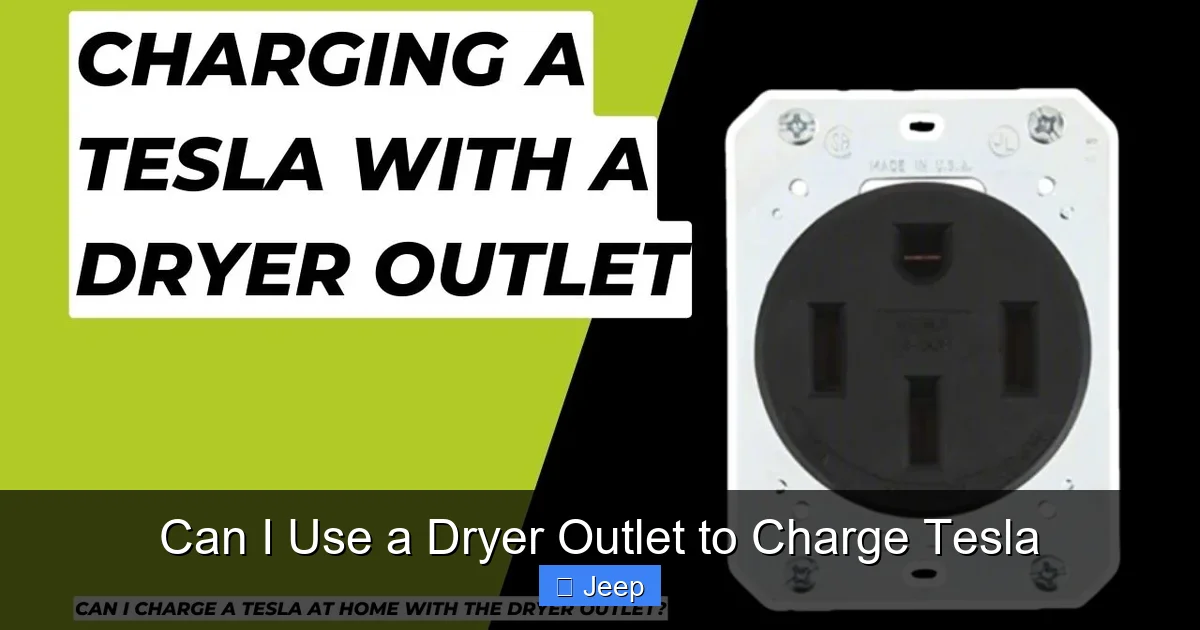
The NEMA 14-50 is the 4-prong (two hot blades, a neutral, and a separate ground) outlet that has become the de facto standard for RV parks and, increasingly, for home EV charging. It’s rated for 50 amps at 240 volts. This is the outlet everyone is talking about when they say “dryer outlet charging.” It’s robust, has a dedicated ground, and matches perfectly with Tesla’s official NEMA 14-50 adapter for the Mobile Connector. If you have one of these, you’re in the best possible position for a simple, effective dryer outlet charge.
The Middle Child: NEMA 14-30
This is a 4-prong, 30-amp outlet. It’s common for electric ranges and some newer dryers. Tesla also offers an official adapter for this. The charging speed will be slower than a 14-50 (about 22 miles of range per hour vs. 30+), but it’s a safe and code-compliant option if you have one. The key is that it has the separate ground pin, which is critical for safety.
How Tesla Charging Actually Works: The Mobile Connector & Adapters
Your Tesla doesn’t plug directly into a wall. It uses a device called the Mobile Connector (formerly the Universal Mobile Connector or UMC). This is a sophisticated, intelligent charging cable that communicates with your car. On one end is the Tesla connector that plugs into your car. On the other end is a removable plug adapter that matches your outlet type. Tesla sells a variety of these adapters separately. The one for a NEMA 14-50 is the most popular for “dryer outlet” charging.

Visual guide about Can I Use a Dryer Outlet to Charge Tesla
Image source: ev-america.com
Here’s the crucial part: the Mobile Connector is designed to deliver power based on the adapter you use. Plug in the 14-50 adapter, and it knows to draw up to 40 amps (80% of the circuit’s 50-amp capacity, per electrical code for continuous loads). This is safe and efficient. If you were to use a non-Tesla adapter or a “dumb” adapter that doesn’t communicate, you lose this intelligent current management, which is a huge safety hazard. You must use the proper, Tesla-branded or certified adapter that correctly identifies the circuit’s capacity to the car.
The NEMA 14-50: The Ideal (But Not Universal) Dryer Outlet Solution
If your goal is to use an existing dryer outlet, having a NEMA 14-50 is hitting the jackpot. The setup is beautifully simple:

Visual guide about Can I Use a Dryer Outlet to Charge Tesla
Image source: ev-america.com
- You have a dedicated 50-amp, 240V circuit with a 14-50 outlet installed for your dryer.
- You purchase the official Tesla NEMA 14-50 adapter for your Mobile Connector (about $45).
- You plug the adapter into the Mobile Connector, plug that into the wall outlet, and then plug the Tesla end into your car.
- Set the charging amperage in your car’s menu (it will default to the max safe level for that adapter, usually 32A or 40A).
This will give you a very respectable 25-30 miles of range added per hour. For a Model 3 with a 50 kWh battery, that’s a 0-100% charge in about 8-10 hours from empty—perfect for overnight charging. It’s essentially a “poor man’s” Wall Connector, using your existing electrical work.
But What If I Have a NEMA 10-30 (3-Prong)?
This is where things get dangerous and complicated. As mentioned, Tesla does not make an adapter for this. Third-party adapters exist that combine the neutral and ground into the ground pin of a 14-50 plug. This creates a “shared neutral” scenario that can be dangerous, especially if the wiring in your wall is old or incorrect. The neutral wire can carry current back to the panel, potentially causing overheating in ways the circuit breaker might not detect. Tesla explicitly warns against using these adapters. The only safe path here is to have an electrician upgrade the outlet to a 14-50 or install a new dedicated circuit. Do not risk it.
Safety Considerations: This is Not a DIY Project for the Faint of Heart
Let’s be brutally clear: messing with 240V electrical circuits is serious business. A mistake can lead to melted wires, electrical fires, damage to your Tesla’s expensive onboard charger, or electrocution. Here are the non-negotiable safety pillars:
Visual guide about Can I Use a Dryer Outlet to Charge Tesla
Image source: ev-america.com
1. Dedicated Circuit is Mandatory
The dryer outlet circuit must be dedicated. It cannot serve any other outlets or appliances. If your dryer shares this circuit with other things, the constant high draw from the Tesla will cause the breaker to trip constantly and create a fire risk from an overloaded circuit.
2. Wire Gauge and Breaker Size Must Match
A NEMA 14-50 outlet requires a 50-amp breaker and at least 6-gauge copper wire (or 4-gauge aluminum). If your existing dryer circuit has smaller wire (like 8-gauge for a 40-amp breaker), you cannot simply replace the breaker with a 50-amp one. The wire would overheat. An electrician must verify the entire circuit, from panel to outlet, is rated for 50 amps.
3. Proper Grounding and Bonding
The separate ground pin in a 14-50 is critical. Your electrical panel must be properly grounded, and the outlet’s ground must be connected correctly to that system. An old, ungrounded, or poorly grounded circuit is unacceptable for EV charging.
4. Load Calculation and Panel Capacity
Before anything is installed, an electrician must perform a load calculation on your main electrical panel. Adding a 40-amp continuous load (what the Tesla will draw) is significant. If your panel is already near capacity with an AC unit, stove, etc., you may need a panel upgrade. This is a common and costly finding.
5. Permits and Inspections
Most jurisdictions require a permit for a new 240V circuit. The work must be inspected. This isn’t bureaucracy; it’s a critical safety net. A permit ensures a professional does the work to code, and an inspection verifies it’s safe. Skipping this is illegal and dangerous, and it will void your homeowner’s insurance in case of a fire.
The Installation Process: What to Expect
Assuming you have a compatible NEMA 14-50 outlet already in place and your panel has capacity, the “installation” is just buying the adapter. But for most people, the process involves hiring an electrician. Here’s the typical flow:
- Consultation & Quote: An electrician visits, checks your panel, confirms the dryer outlet type and wiring, and provides a quote. If you don’t have a suitable outlet, they’ll quote for running a new dedicated circuit from the panel to your garage.
- Permitting: The electrician pulls the necessary permit from your city/town.
- Installation: They install the outlet (if new) or verify the existing one. They ensure the breaker matches the wire gauge and that all connections are tight and correct.
- Inspection: The work is inspected by a local building official.
- You Buy the Adapter: Once the outlet is confirmed safe and to code, you purchase the official Tesla NEMA 14-50 adapter and start charging.
Cost: If you already have a perfect 14-50 outlet, your cost is just the ~$45 adapter. If you need a new circuit installed, expect $300 – $800+ depending on distance from the panel, panel capacity, and local labor rates. This is where articles on the cost to install a 220V outlet for Tesla become very relevant, as the principles and costs are nearly identical.
Alternatives and Comparisons: Is There a Better Way?
While the dryer outlet hack is enticing, it’s often a compromise. Let’s look at the landscape of home charging options.
The Dedicated Wall Connector
This is Tesla’s hardwired, permanent home charging station. It requires a dedicated circuit (usually 60-amp for max speed) but offers faster charging (up to 44 miles of range per hour), a sleek design, and features like Wi-Fi connectivity and power sharing for multiple units. It’s the professional, future-proof solution. The installation cost is higher than a simple outlet, but the convenience and speed are superior.
The NEMA 14-30 Outlet
If you have this 30-amp, 4-prong outlet (common for ranges), the official Tesla adapter provides a safe, 24-amp charge (~22 miles/hour). It’s a great middle ground if you don’t want to run new wire but have this outlet type available.
Standard 120V (NEMA 5-15)
This is the ubiquitous household outlet. It works with the adapter that comes with your Mobile Connector. It’s painfully slow—only 3-5 miles of range per hour. It’s useful only for trickle charging when you have no other option for several days.
Public Charging Networks
For longer trips or if home charging isn’t feasible, Tesla’s Supercharger network is unparalleled. There are also third-party networks (like Electrify America, EVgo) that require an adapter for Tesla, which is a different can of worms. For daily life, home charging is king.
It’s also worth noting that the EV world is expanding beyond Tesla. If you’re considering other brands, charging compatibility varies. For instance, a Nissan Ariya cannot use a Tesla Supercharger natively without an adapter (which doesn’t exist yet from Tesla). So, while we’re focused on Tesla here, the charging infrastructure question is brand-specific. Even for plug-in hybrids like the Jeep 4xe, the cost and method of charging differ, though the principle of using a 240V outlet for faster replenishment is the same.
Conclusion: The Verdict on Dryer Outlet Charging
Can you use a dryer outlet to charge your Tesla? Yes, but only if it’s a 4-prong NEMA 14-50 (or 14-30) outlet, and you use the correct official Tesla adapter. If you have an older 3-prong 10-30 outlet, the answer is a hard no—do not attempt it with third-party adapters. The risks of fire and equipment damage are too high.
The NEMA 14-50 setup is a fantastic, cost-effective way to get reliable 240V charging if the outlet already exists and is on a dedicated, properly sized circuit. It turns a 20-amp, 120V “trickle” into a robust overnight fill-up. However, it is still using an outlet not primarily designed for daily EV charging stress. For ultimate convenience, safety, and speed, investing in a dedicated Tesla Wall Connector on a new 60-amp circuit is the gold standard.
Your final step, after verifying your outlet type, is to call a licensed, insured electrician. Show them your Tesla’s charging specifications and your existing outlet. Let them make the final call on safety and capacity. This isn’t the place to save a few bucks. A safe, code-compliant installation protects your home, your vehicle, and your family. Once that’s done, you’ll join the ranks of EV owners enjoying the simple pleasure of plugging in at home and waking up to a “full tank” every morning.
Frequently Asked Questions
Can I use any 240V dryer outlet to charge my Tesla?
No. You must have a 4-prong NEMA 14-50 or 14-30 outlet. Older 3-prong NEMA 10-30 outlets are unsafe for Tesla charging with standard adapters and should be upgraded by an electrician.
Is it safe to charge my Tesla from a dryer outlet?
It is safe only if the outlet is a properly installed, dedicated NEMA 14-50 or 14-30 circuit with the correct wire gauge and breaker size. Always have a licensed electrician verify the setup before plugging in.
How fast will my Tesla charge from a dryer outlet?
A NEMA 14-50 outlet provides about 25-30 miles of range per hour. A NEMA 14-30 provides about 22 miles per hour. A standard 120V outlet adds only 3-5 miles per hour.
What is the cost to install a proper outlet for Tesla charging?
If you already have a suitable NEMA 14-50 outlet, the cost is just the $45 Tesla adapter. Installing a new dedicated 50-amp circuit typically costs $300 to $800+, depending on your home’s electrical setup and local labor rates. For a detailed breakdown, see our guide on the cost to install a 220V outlet for Tesla.
Can other electric vehicles, like a Nissan Ariya, use a Tesla charger or dryer outlet?
No. The Tesla connector is proprietary. A Nissan Ariya uses the CCS Combo or CHAdeMO plug and cannot physically connect to a Tesla connector or outlet without a third-party adapter, which currently doesn’t exist for DC fast charging. For home AC charging, each EV brand uses its own cable and compatible outlet adapters.
What is the best outlet type for home Tesla charging?
The best long-term solution is a dedicated Tesla Wall Connector on a 60-amp circuit. For using existing outlets, the NEMA 14-50 is the best and most common option, offering a great balance of speed and safety if the circuit is properly installed.