
Can I Get My Bmw Oil Change Anywhere

Yes, you can get your BMW oil change at many reputable independent shops, but it’s critical they use the exact oil specification (LL-04, LL-17 FE+, etc.) your model requires. Using the wrong oil or a shop unfamiliar with BMW’s systems can lead to expensive engine damage and potential warranty issues. Always verify the shop’s competence with BMWs before they touch your drain plug.
So, you’re staring at that “Oil Service” light on your BMW’s dash. Maybe you’re near the end of your lease, or you just want to save a few bucks this time. The big question pops into your head: “Can I get my BMW oil change anywhere?” It’s a totally fair question. After all, an oil change is a simple, routine maintenance task, right? Well, with a BMW—and most modern European cars, for that matter—the answer is a firm “It depends.” It’s not about *if* you can find someone to turn a wrench and drain the old oil. It’s about finding someone who understands the *why* behind the specific oil your BMW’s high-performance, precision-engineered heart requires. Let’s break down everything you need to know to make a smart, safe decision for your Ultimate Driving Machine.
Key Takeaways
- BMW oil specifications are non-negotiable: Your engine is designed for a specific BMW Longlife (LL) oil standard. Using anything else, even “high-quality” generic synthetic, risks premature wear and damage.
- You have options beyond the dealership: Qualified independent shops and mobile mechanics can perform the service, but you must vet them for BMW-specific knowledge and the correct oil.
- Warranty protection depends on documentation: To maintain your factory warranty, you must use the correct oil, filter, and follow service intervals. Keep detailed receipts with oil specs listed.
- Cost savings are possible, but not guaranteed: Independent shops often charge less for labor, but ensure they aren’t cutting corners on parts or oil quality to achieve that price.
- Communication is your best defense: Always ask “What specific BMW Longlife specification will you use?” and “Do you have the correct filter for my chassis number?” before authorizing work.
📑 Table of Contents
- Understanding Why BMW Oil Changes Are Different
- Dealership vs. Independent Shop: The Core Question
- Protecting Your Warranty: The Record-Keeping Imperative
- How to Vet Any Shop for Your BMW Oil Change
- Special Considerations: Diesel, Older Models, and High-Mileage Engines
- The Bottom Line: Your Action Plan
Understanding Why BMW Oil Changes Are Different
Before we talk about the “where,” we have to talk about the “what.” A BMW isn’t your average commuter car. Its engine is a symphony of tight tolerances, advanced turbocharging, and often, sophisticated emissions systems like selective catalytic reduction (SCR) and diesel particulate filters (DPF). The oil in these engines does far more than just lubricate. It’s a critical component in the engine’s overall system design.
The Crucial Role of BMW-Approved Longlife (LL) Oils
BMW engineers spend thousands of hours testing and approving specific oil formulations. These aren’t just “good” oils; they are formulated to meet exacting BMW Longlife (LL) specifications. Common ones you’ll see are LL-01 (for older models), LL-04 (for many current gasoline and diesel models, especially with DPFs), and the newer LL-17 FE+ (designed for even greater fuel efficiency and emissions protection).
These specs dictate everything: the base stock quality, additive package (detergents, anti-wear agents, friction modifiers), viscosity characteristics under extreme heat and cold, and compatibility with engine seals and emissions components. Using an oil that is merely “synthetic” or “5W-30” without the correct LL specification is like putting regular gasoline in a car that requires premium. It might run for a while, but over time, it will cause harm. You risk increased sludge formation, inadequate protection for turbochargers, and accelerated wear on critical components. In a DPF-equipped diesel, the wrong ash content can clog the filter, leading to a $3,000+ replacement.
The Dangers of the “Generic Synthetic” Shortcut
Many quick-lube shops and even some independent garages will tell you they have a “high-quality synthetic” that’s “just as good” or even “better” than the dealer’s oil. This is often well-intentioned but dangerously misinformed. The additive packages in generic oils are designed for a broad range of engines, not the specific demands of a BMW’s N20, B48, or B57 engine. They may lack the necessary detergent levels to keep a BMW’s ring packs clean or the correct friction modifiers for the engine’s timing chain system. The short-term savings of a cheaper oil change can lead to long-term, catastrophic engine costs. It’s simply not a risk worth taking.
Dealership vs. Independent Shop: The Core Question
Now, back to the central question: where can you go? You have three primary options: the BMW dealership, an independent European/specialty shop, and a general repair shop or quick-lube chain. Let’s evaluate them.
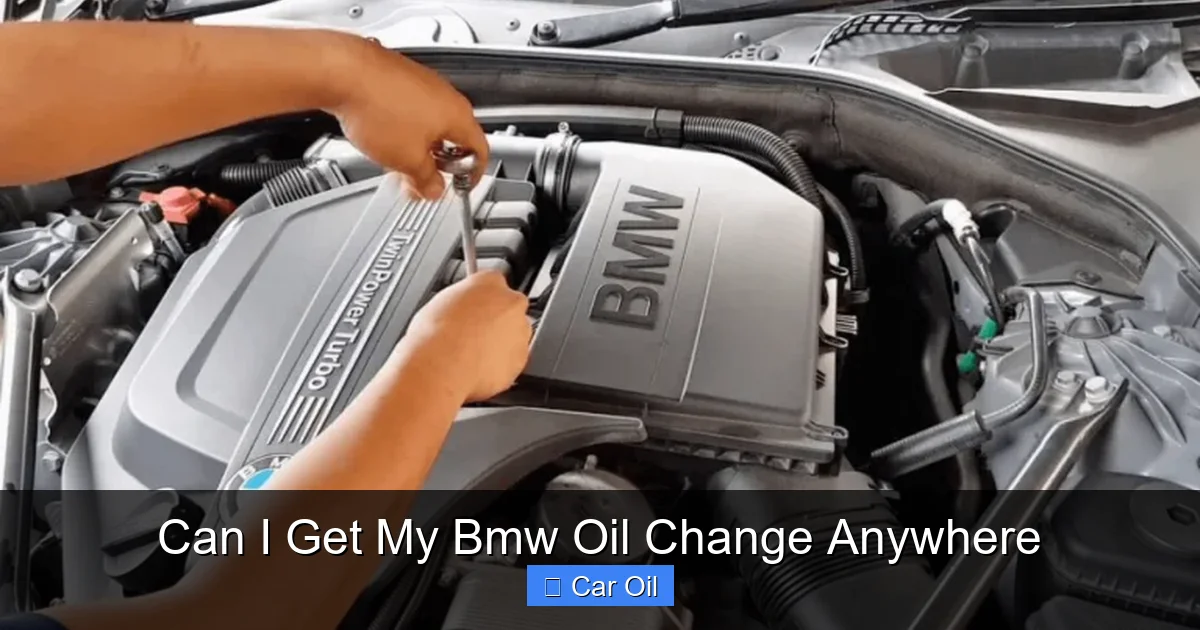
Visual guide about Can I Get My Bmw Oil Change Anywhere
Image source: bmwinsights.com
The BMW Dealership: The Gold Standard (At a Price)
The dealership is the safest, most straightforward option.
- Pros: Technicians are factory-trained on your specific model. They use genuine BMW parts and filters, and they have direct access to the latest technical service bulletins and software updates. They will without fail use the correct, BMW-branded LL-04 or LL-17 FE+ oil. Your service history is impeccably documented in BMW’s system, which is a major plus for warranty claims and future resale value.
- Cons: It is almost always the most expensive option. Labor rates are premium, and parts are OEM-priced. For a simple oil change, you’re paying a significant premium for that brand assurance and integrated record-keeping.
Independent European/Specialty Shops: The Sweet Spot (If You Choose Wisely)
This is where you can find excellent value and expertise, but it requires research. These shops live and breathe BMW, Audi, Mercedes, etc.
- Pros: Labor rates are typically 30-50% lower than the dealer. The mechanics are often passionate experts who have worked on hundreds of BMWs. They frequently use high-quality aftermarket parts (like Mann, Mahle, or Febi Bilstein filters, which are often OEM suppliers) and, most importantly, will source the correct specification oil from brands like Liqui Moly, Ravenol, or Mobil 1 that carry the LL-04 or LL-17 FE+ approval. Many will even show you the bottle with the spec printed on it.
- Cons: Not all independent shops are created equal. You must vet them. Their work may not automatically upload to BMW’s central system (though they should provide detailed invoices).
Practical Tip: Search online for “BMW specialist [Your City]” or “European auto repair [Your City].” Read reviews specifically mentioning oil changes and BMWs. Call and ask the service advisor: “What specific BMW Longlife specification do you use for a 2018 330i?” If they hesitate, say “LL-04,” or try to sell you on a “BMW equivalent,” hang up and call the next shop. A competent shop will answer immediately and confidently.
General Repair Shops & Quick-Lube Chains: Proceed with Extreme Caution
This is the high-risk zone for your BMW. Places like Jiffy Lube, Midas, or a local general mechanic may be fantastic for Fords and Chevys, but they are a gamble for your BMW.
- The Risks: Their primary oil supplier (often a national brand like Valvoline, Pennzoil, or Shell) may have an LL-04 oil, but the individual technician may not know to select it. The standard stock is usually a generic “European Car” formula that may not meet the latest specs. They also often use cheap, no-name filters that can have poor sealing or media that doesn’t trap particles effectively. Technicians may not be trained to properly reset the service interval indicator via the BMW-specific procedure (which often involves the iDrive menu or a special tool, not just a dash button).
- The Verdict: We strongly advise against using these establishments for your BMW’s oil changes unless you have personally verified, multiple times, that they: 1) Have the correct, specified LL oil in stock for your model year, 2) Use a high-quality filter (Mann, Mahle, OEM), and 3) Know how to reset the service light correctly. The potential for a $500 mistake to save $30 is not worth it.
Protecting Your Warranty: The Record-Keeping Imperative
A common myth is that you must go to the dealership to maintain your factory warranty. This is false. The Magnuson-Moss Warranty Act (in the U.S.) protects you. The dealership cannot require you to use only their services to maintain the warranty. However, they can require that maintenance be performed correctly using the proper parts and fluids as specified in your owner’s manual.
Visual guide about Can I Get My Bmw Oil Change Anywhere
Image source: bmwinsights.com
What Your Warranty Really Requires
To keep your powertrain warranty intact when servicing elsewhere, you must:
- Use the correct oil: The exact specification (e.g., BMW LL-04 0W-30) listed in your manual.
- Use the correct filter: An OEM BMW filter or a high-quality aftermarket filter (Mann, Mahle, Bosch) that meets BMW’s standards.
- Follow the interval: Change the oil at the interval BMW prescribes, whether it’s based on time/mileage or the flexible “Condition-Based Service” system.
- Keep impeccable records: This is the most important step. Your invoice must clearly list:
- Date and mileage.
- Vehicle Identification Number (VIN).
- The full, specific oil specification used (e.g., “Liqui Moly Leichtlauf High Tech LL-04 5W-30”)—not just “synthetic oil.”
- The filter part number or brand/model.
- The shop’s name, address, and contact info.
Keep these invoices in your vehicle’s service portfolio. If a warranty claim arises, you present this documentation to prove the service was performed to BMW’s standards. If you go to a reputable independent shop, they will understand this and provide such an invoice without you having to ask. If they won’t, that’s a red flag.
How to Vet Any Shop for Your BMW Oil Change
You’ve found a promising independent shop. Don’t just drop the keys. Ask these questions:
Visual guide about Can I Get My Bmw Oil Change Anywhere
Image source: bmwinsights.com
- “What specific BMW Longlife specification will you use for my car, and can you show me the bottle?” The answer must be a specific LL number (LL-01, LL-04, LL-17 FE+). If they say “we use a European oil,” that’s not good enough.
- “What brand and model of filter do you install?” Acceptable answers: Mann, Mahle, Febi Bilstein, or genuine BMW. Avoid shops that say “our house brand” or can’t name a specific brand.
- “How do you reset the service indicator?” They should describe a process involving the iDrive system or a diagnostic tool. If they say “there’s a button on the dash,” they are likely incorrect for most modern BMWs.
- “Can I see a sample invoice before you start?” Ensure they will list the oil specification and filter details on the final invoice.
- “Do you perform a multi-point inspection and check for any software updates?” A good BMW shop will do this as part of the service, checking belts, hoses, fluid levels, and offering to update the vehicle’s software if relevant.
Observing the shop’s cleanliness and the types of cars in the lot can also be telling. A shop with a few other BMWs, Audis, and Mercedes is a great sign.
Special Considerations: Diesel, Older Models, and High-Mileage Engines
Not all BMW oil change scenarios are created equal.
Diesel Engines (DPF/SCR Equipped)
If your BMW has a diesel engine (like the 320d, 328d, or older 535d), the oil specification is even more critical. Low-ash (Low-SAPS) oils like LL-04 are mandatory to prevent clogging the Diesel Particulate Filter (DPF) and poisoning the SCR system (which uses AdBlue). Using the wrong oil here is a direct path to a very expensive emissions system failure. Always double-confirm LL-04 for diesel models.
Older BMWs (Pre-2004-ish)
Very old BMWs (E36, early E46 generations) may not require a specific “Longlife” oil. They often use traditional 5W-30 or 10W-40 mineral or synthetic oils. However, the principle remains: use the viscosity and quality grade (often BMW-approved or ACEA A3/B4) specified in the original manual. For these, a high-quality synthetic from a reputable brand meeting the correct specs is usually fine.
High-Mileage Engines (150k+ Miles)
If your BMW has very high mileage, you might consider a high-mileage oil formulation. However, this is tricky. You must find a high-mileage oil that is also BMW LL-04 or LL-17 FE+ approved. This is a narrow category. Often, the best approach is to stick with the correct LL specification oil but perhaps use a slightly thicker viscosity if recommended for your climate (e.g., 0W-30 vs. 5W-30), and consider using a top-tier oil additive like Marvel Mystery Oil or Liqui Moly Motor Save in the crankcase between changes to help condition older seals. Always consult with a trusted BMW specialist before deviating from the spec.
The Bottom Line: Your Action Plan
So, can you get your BMW oil change anywhere? The practical answer is: You can get it done at any shop that will use the correct oil and filter, and provide you with a perfect invoice. Here is your step-by-step plan:
- Find Your Spec: Open your owner’s manual or check the oil cap under the hood. Find the exact BMW Longlife specification (e.g., LL-04, LL-17 FE+) and viscosity (e.g., 0W-30, 5W-30).
- Find Your Shop: Search for “BMW specialist” or “European auto repair” in your area. Check Google and Yelp reviews. Look for comments about oil changes and attention to detail.
- Call and Vet: Use the questions from Section 4. Their answers are your first test. If they are hesitant or vague, move on.
- Get It in Writing: Before work begins, confirm on the work order that they will use [Specific Oil Brand & LL Spec] and a [Specific Filter Brand]. Ensure the final invoice will list these details.
- Check the Work: When you pick up the car, check the oil cap. It should have the correct oil (often the cap itself says “Longlife” or the oil bottle may be left in the car). Verify the service light is reset correctly. Review the invoice immediately.
By following this process, you protect your engine, your wallet, and your warranty. You can absolutely save money over the dealership, but you must be an informed and vigilant consumer. Your BMW is an investment; its maintenance is not a place to cut corners blindly.
Final Thought: The relationship you build with a trustworthy, knowledgeable independent BMW specialist can be invaluable. They learn your car’s history, can catch small problems before they become big ones, and often provide more personalized service than a busy dealership service department. Finding that shop is worth the effort. And if you’re ever in a pinch and just need to add a quart to top off between services, knowing exactly what spec to buy is half the battle. That’s a topic we cover in detail in our guide on what kind of oil to add to your car.
Frequently Asked Questions
Can I use regular motor oil in my BMW?
No. Modern BMW engines require specific BMW Longlife (LL) synthetic oils (like LL-04 or LL-17 FE+). Regular conventional oil or generic synthetic oil does not meet the stringent requirements for wear protection, emissions compatibility, and fuel economy, and will cause damage over time.
Will getting an oil change at an independent shop void my BMW warranty?
Not if it’s done correctly. The warranty requires proper maintenance with the correct parts and fluids. As long as you use the specified BMW LL oil, a quality filter, keep perfect records with the oil spec listed on the invoice, and follow the correct intervals, your warranty remains valid regardless of where the service is performed.
How much cheaper is an independent shop vs. a BMW dealership for an oil change?
Typically, you can save 30-50%. A dealership oil change for a modern BMW often runs $150-$250+ depending on the model and oil type. A reputable independent shop using the correct LL-04 oil and a quality filter will usually charge between $90 and $160 for the same service.
What happens if the shop uses the wrong oil?
Using incorrect oil can lead to increased engine wear, sludge buildup, turbocharger failure, and in diesels, catastrophic clogging of the Diesel Particulate Filter (DPF). These failures are not covered by warranty if discovered, as they result from improper maintenance. The repair costs can easily exceed $5,000.
Do I need a special tool to reset the service light on my BMW?
For most modern BMWs (roughly 2004 and newer), resetting the service indicator requires accessing the vehicle’s computer through the iDrive menu or with a diagnostic scan tool. It is not a simple button-press under the dash like on older cars. A competent shop will have the knowledge or a basic tool to do this correctly.
Is it okay to use a “BMW-approved” oil from a brand like Mobil 1 or Castrol?
Yes, absolutely. Many major oil manufacturers produce oils that carry the official BMW LL-04 or LL-17 FE+ approval. Look for the specific LL specification on the bottle, not just the brand name. Brands like Mobil 1, Castrol, Liqui Moly, and Ravenol all have approved formulations. The key is the spec, not the brand name alone.