
Can Autozone Register a Bmw Battery?

No, AutoZone typically cannot register a BMW battery. BMW vehicles require proprietary software to register a new battery with the car’s computer system, a service AutoZone does not provide. Skipping this registration can lead to charging errors and damage to your BMW’s sensitive electrical components. For a correct replacement, you must visit a BMW dealer, an independent BMW specialist, or use specialized tools yourself.
Key Takeaways
- BMW battery registration is mandatory: It’s not optional; it’s a required step to sync the new battery with the car’s Intelligent Battery Sensor (IBS) and charging system.
- AutoZone lacks the necessary BMW-specific software: Their standard diagnostic tools are designed for mainstream vehicles and cannot access BMW’s proprietary registration systems.
- Using the wrong battery or skipping registration causes harm: It can trigger warning lights, cause overcharging/undercharging, and damage the IBS or alternator over time.
- Professional registration requires BMW-specific tools: Dealerships use ISTA, while independents may use tools like BimmerLink, Carly, or Autel’s BMW-specific software.
- You can register a BMW battery yourself: With the right aftermarket tool and a compatible smartphone app, DIY registration is possible for tech-savvy owners.
- Always match the battery type exactly: BMWs are programmed for either AGM (Absorbent Glass Mat) or flooded lead-acid batteries. Using the wrong type will cause problems even if registered.
- General battery health checks are still useful: Before replacing, testing your old battery with a multimeter can confirm it’s the issue. Learn how to test a car battery with a multimeter to avoid unnecessary replacements.
[FEATURED_IMAGE_PLACEHOLDER]
📑 Table of Contents
- Can AutoZone Register a BMW Battery? The Complete Answer
- Understanding the “Why”: What is BMW Battery Registration?
- Why BMWs Need This: Protecting Your Investment
- AutoZone’s Role: What They Can and Cannot Do
- How to Properly Register Your BMW Battery: Your Options
- What Happens If You Skip the Registration? The Real Risks
- Conclusion: The Bottom Line on AutoZone and BMW Batteries
Can AutoZone Register a BMW Battery? The Complete Answer
So, your BMW’s battery has finally given up the ghost. The dashboard is lit up like a Christmas tree, the engine cranks slowly, or it just clicks. You’ve diagnosed the problem: a dead battery. You head to your local AutoZone, a trusted name for parts and quick service. You pick up a high-quality battery, maybe even one they recommend for your BMW. Then, the inevitable question pops into your head: Can AutoZone register a BMW battery?
The short, direct answer is almost always no. While AutoZone excels at selling batteries and installing them in most cars, BMW’s unique battery registration process falls outside their standard service capabilities. This isn’t about them being unwilling; it’s about a fundamental technological barrier. To understand why, we need to dive into what battery registration actually is and why BMWs are so particular about it.
This article will be your definitive guide. We’ll explain the critical “why” behind BMW battery registration, detail exactly what AutoZone can and cannot do, and provide you with all your practical options for getting this essential service done correctly. Replacing a battery in a modern BMW is not just a simple swap; it’s a computer procedure. Doing it wrong can lead to expensive headaches down the road.
Understanding the “Why”: What is BMW Battery Registration?
Before we judge AutoZone’s capabilities, we must understand the problem they would need to solve. Battery registration is not a BMW conspiracy to sell more dealer services. It’s a necessary function of the car’s sophisticated Intelligent Battery Sensor (IBS) and engine control unit (ECU).
Visual guide about Can Autozone Register a Bmw Battery?
Image source: bmwinsights.com
What Is Battery Registration, Exactly?
Battery registration is a software process that tells your BMW’s computer: “Hey, a new battery has been installed. Here are its specifications (type, capacity, age, manufacturer). Please adjust your charging algorithm accordingly.” The IBS constantly monitors battery health, voltage, current, and temperature. The car’s charging system then uses this data to precisely control the alternator’s output.
For example, a brand-new AGM battery can handle a higher charging voltage than an old, failing flooded battery. The car’s system, if properly registered, will start with a “learning phase” where it applies a slightly higher voltage to fully saturate the new AGM battery before settling into a maintenance charge. Without registration, the car uses its old, learned data from the previous battery, which can lead to undercharging (leaving the new battery weak) or overcharging (cooking the new battery and potentially damaging the IBS).
The Role of the Intelligent Battery Sensor (IBS)
The IBS is a small but mighty module, often located on the negative battery terminal. It’s the car’s battery accountant. It tracks the state of charge, health, and even calculates the battery’s “age” in terms of charge cycles. When you register a new battery, you are essentially resetting this accountant’s books and giving it a fresh profile to track. Failing to do this confuses the IBS, leading to inaccurate state-of-charge readings and improper charging. This can cause the infamous “battery charge warning” or “check engine” lights to illuminate, and over months, can degrade the new battery prematurely.
One common misconception is that you only need to register if the battery is a different type (e.g., switching from flooded to AGM). While matching the type is crucial, BMW’s system is designed to learn the specific characteristics of *each individual battery*. Even if you replace an AGM with an identical new AGM, registration is required. The system treats the new battery as a new entity with its own capacity and health curve.
Why BMWs Need This: Protecting Your Investment
You might think, “My old non-BMW car never needed this!” You’re right. This level of integration is a hallmark of modern German engineering, for better or worse. The primary goals are reliability, efficiency, and longevity of the electrical system.
Visual guide about Can Autozone Register a Bmw Battery?
Image source: vehicleanswers.com
Preventing Charging System Errors
A BMW’s alternator is not a simple, dumb device. It’s a variable-output unit controlled by the DME (Digital Motor Electronics). The DME relies on data from the IBS to decide how much power to generate. If the IBS is working with old data, the DME might command the alternator to charge at 14.8 volts constantly (overcharging) or only 13.5 volts (undercharging). Both scenarios are bad. Overcharging boils the battery acid, warps plates, and shortens life. Undercharging leads to sulfation, where lead sulfate crystals harden on the plates, permanently reducing capacity. Neither is good for a $200-$400 battery.
Safeguarding the Electrical Architecture
Modern BMWs are packed with sensitive electronics: infotainment computers, multiple control modules, advanced driver-assist systems. A consistently over or under-charged battery creates voltage spikes and sags that can stress these components. While one bad battery might not fry your iDrive system immediately, it contributes to an unstable electrical environment. The registration process ensures the charging voltage is optimized for the new battery’s chemistry, providing a stable power supply to the entire car. This is part of BMW’s holistic approach to vehicle longevity.
Furthermore, many BMW models will not clear certain fault codes related to the charging system or IBS until a new battery is successfully registered. You could replace the battery, but the warning light will persist, and you’ll be stuck at the dealer for a diagnostic fee anyway. Registration closes the loop on the repair.
AutoZone’s Role: What They Can and Cannot Do
Now, back to the original question. Let’s be clear about what a visit to AutoZone will accomplish.
Visual guide about Can Autozone Register a Bmw Battery?
Image source: m.media-amazon.com
What Services AutoZone Confidently Provides
AutoZone is a fantastic resource for BMW owners in many ways:
- Battery Sales: They carry batteries from reputable brands like Duralast, Optima, and Bosch that are physically compatible with many BMW models. Their staff can look up the correct group size (e.g., Group 49, H8, L3) and recommended Cold Cranking Amps (CCA) for your specific BMW using their interchange books or system.
- Battery Testing: They will test your old battery for free using a load tester. This is a valuable first step to confirm the battery is the culprit. A weak battery might just need a proper charge. Understanding battery drain causes is also useful; you can read more about what can cause a car battery to drain to rule out other issues.
- Installation: For many BMWs, especially those with the battery in the trunk, their technicians can physically remove the old battery and install the new one safely. They’ll clean the terminals and ensure connections are tight.
- Terminal Cleaners & Supplies: They sell dielectric grease, terminal protectors, and cleaning brushes to help prevent future corrosion.
The Critical Gap: Software Access
Where they hit a hard wall is the software. AutoZone uses diagnostic tools like the Autel, Launch, or Snap-on scanners. These are incredible tools for reading and clearing generic OBD-II fault codes, performing basic system checks, and servicing the vast majority of vehicles on the road. However, BMW guards its proprietary registration protocol behind a paywall and specialized training.
The process requires:
- Access to BMW’s official ISTA (Integrated Service Technical Applications) software, which is only licensed to BMW dealerships and authorized independent shops who pay hefty subscription fees.
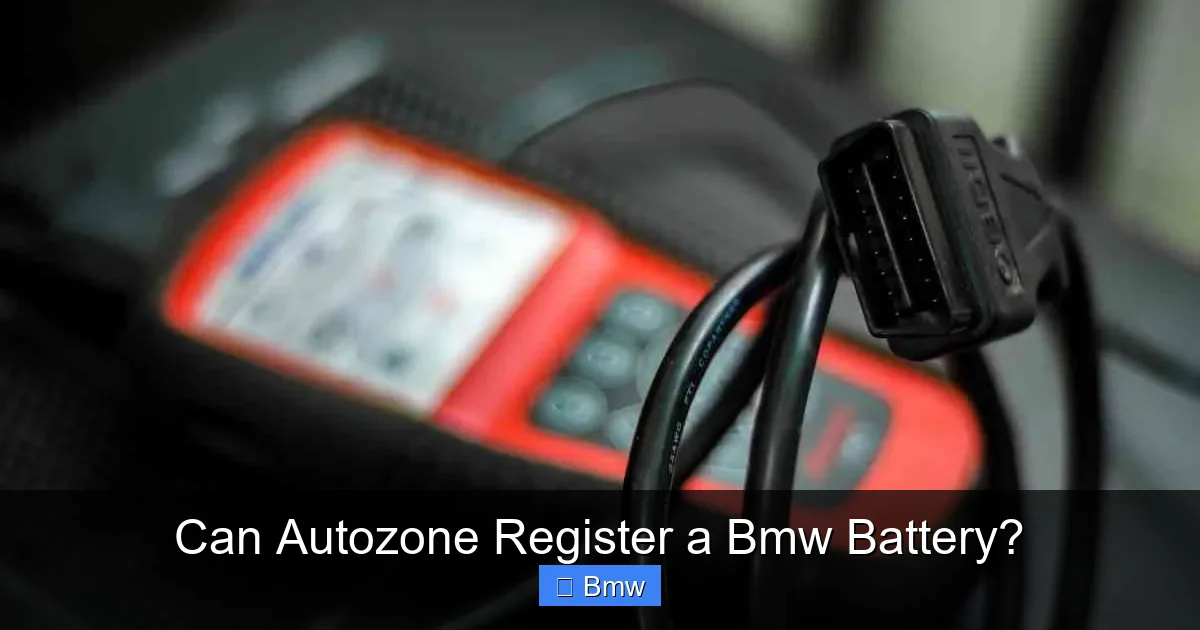
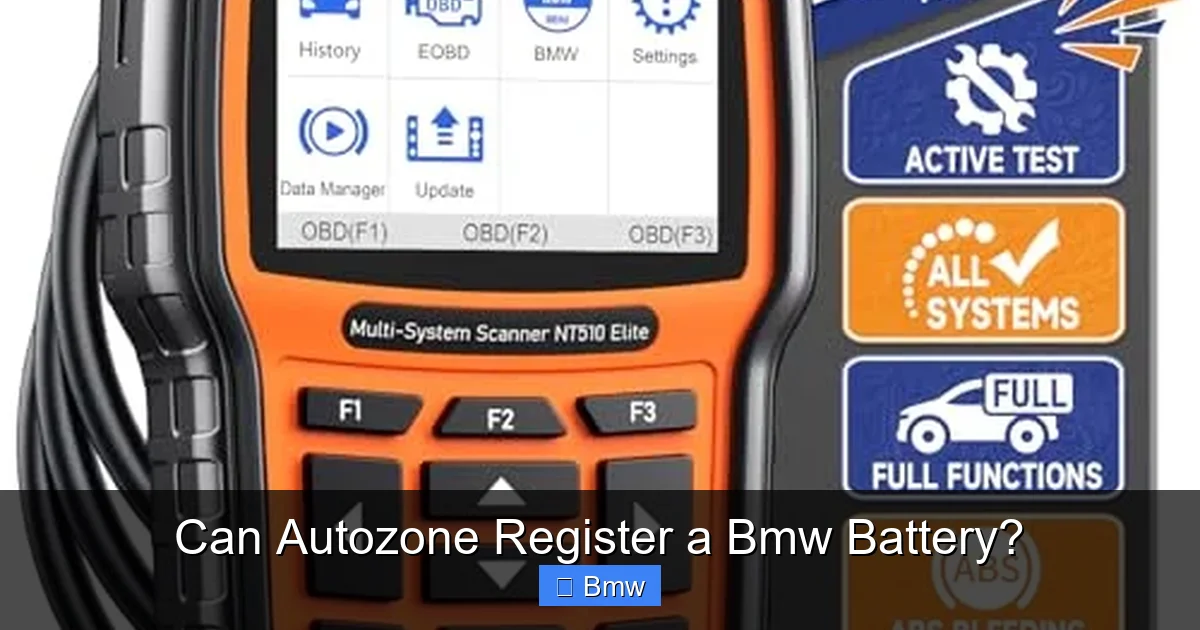
- OR, a third-party tool that has reverse-engineered and licensed the registration protocol from BMW. Tools like the BimmerLink app with a compatible OBD-II adapter, or the Carly adapter and app, or certain high-end Autel/MaxiSys scanners with BMW-specific software licenses, can perform the registration.
AutoZone’s business model is high-volume, low-complexity service. Investing in the specialized, subscription-based BMW software and training for a relatively small segment of their customer base is not feasible. Their technicians are not trained on the nuances of BMW’s IBS system. Therefore, while they will happily sell you the battery and install it, they will tell you upfront: “You’ll need to go somewhere else to get it registered.” This is honest and accurate.
It’s also worth noting that simply disconnecting the old battery and connecting the new one without registration will often cause the BMW to throw multiple error codes and may put the car into a “limp mode” or disable certain comfort features until the system relearns, which can take days of driving and still may not be perfect.
How to Properly Register Your BMW Battery: Your Options
Since AutoZone is out, what are your paths forward? You have three main options, ranked from most to least expensive.
Option 1: The BMW Dealership
This is the guaranteed, foolproof method. The dealership’s technicians have direct access to ISTA, the official BMW software. They will:
- Confirm the new battery type (AGM vs. flooded) matches the car’s original specification.
- Enter the new battery’s serial number, part number, and date of manufacture into the system.
- Perform the registration procedure, which resets the IBS and starts the new learning cycle.
- Clear any stored fault codes.
Cost: Typically $100 – $200+ for the registration service on top of the cost of the battery and any installation fee. It’s the most expensive route but offers peace of mind and a service receipt.
Option 2: An Independent BMW Specialist
This is often the best value. Independent repair shops that focus on BMWs (or German cars in general) almost always have the necessary tools. They may use:
- Official ISTA (if they have a subscription).
- Aftermarket tools like the BimmerLink app with a BimmerLink OBD-II adapter (a one-time hardware purchase).
- The Carly adapter and subscription service.
- High-end scanners from brands like Autel or Launch that have purchased the BMW software module.
These shops are usually significantly cheaper than the dealer, often charging $50-$120 for registration alone. They have the expertise to ensure the correct battery type is used and the process is done right. This is my top recommendation for most BMW owners. You can find these shops by searching for “independent BMW repair [your city]” or checking BMW-specific forums for recommendations.
Option 3: The DIY Route (If You’re Technically Inclined)
You can register the battery yourself if you’re willing to invest a little money and time. Here’s what you need:
- A compatible OBD-II adapter: Not all adapters work. For BimmerLink, you need their specific Bluetooth/WiFi adapter. For Carly, you need their Carly adapter. For the popular iCarSoft BMW scanner (a hardware tool), it has registration built-in. These adapters range from $40 to $150.
- A smartphone or laptop: The BimmerLink and Carly apps run on iOS/Android. The iCarSoft is a standalone tool.
- The correct battery: You must know your car’s exact battery type (AGM or flooded) and specifications. Your owner’s manual or a reputable parts store can confirm this. Using the wrong type is a critical error.
The process is generally straightforward: connect the adapter, open the app, select your model year, choose “Battery Registration,” enter the new battery’s details (you often have to type in the date code from the battery label), and follow the prompts. The app will communicate with the IBS and complete the process. Always disconnect the negative terminal first and last when physically swapping the battery to avoid electrical shorts.
Warning: DIY is only for those comfortable with technology. A mistake in entering the battery type (e.g., registering a flooded battery as AGM) can be worse than not registering at all. If you have any doubt, pay a professional.
What Happens If You Skip the Registration? The Real Risks
Some owners, after learning the cost and hassle, think, “What’s the worst that can happen? I’ll just drive it.” This is a gamble with your electrical system. The consequences aren’t always immediate, but they are real and cumulative.
Short-Term Symptoms
Right after a swap without registration, you might notice:
- Illuminated Warning Lights: The battery charge light (a little battery icon) or a check engine light will almost certainly come on. The IBS will report inconsistent data, triggering a fault.
- Erratic Charging Behavior: The alternator might not charge the battery properly, leading to a weak battery that struggles on cold starts after just a few weeks.
- Disabled Features: Some comfort features like automatic start-stop or even the power window “soft close” function may deactivate as the car goes into a protective mode.
Long-Term Damage
The insidious part is the slow degradation:
- IBS Failure: The IBS itself can be damaged by prolonged incorrect charging voltages. Replacing an IBS is expensive and labor-intensive.
- Alternator Strain: The alternator is forced to operate outside its designed parameters constantly, potentially shortening its lifespan.
- Battery Destruction: Your new, expensive battery will be ruined prematurely, either by sulfation from undercharging or electrolyte boiling from overcharging. You’ll be replacing it again much sooner than expected.
- Electrical Gremlins: An unstable voltage supply can cause all sorts of phantom issues—infotainment crashes, sensor errors, and unexplained system resets—that are notoriously difficult to diagnose.
In the end, skipping the $50-$200 registration fee to save a few bucks is a classic false economy. You risk a $400 battery, a $500+ alternator, and a $1,000+ IBS repair. The registration is a critical step in the battery replacement process, not an upsell.
Conclusion: The Bottom Line on AutoZone and BMW Batteries
So, can AutoZone register a BMW battery? The definitive answer is no. Their tools and training are not equipped for BMW’s proprietary systems. Their value lies in providing a quality, correctly sized battery and performing the physical swap. The registration step is a separate, specialized procedure.
Your best course of action is clear:
- Buy the correct battery from AutoZone (or another reputable parts store) by specifying your BMW’s exact group size and required type (AGM or flooded).
- Have AutoZone install it if you’re not comfortable with the physical removal, which can be tricky in some BMW models.
- Immediately take the car to a qualified specialist—either a BMW dealer or a trusted independent BMW shop—to perform the registration. If you’re handy and have the right tool, you can do it yourself right after installation.
Treat the registration as a non-negotiable part of the repair, like tightening the battery terminals. It’s the key that unlocks your BMW’s optimal performance and protects its sophisticated electrical heart. By understanding this process, you save yourself from future headaches and ensure your BMW continues to run as the engineers in Munich intended.
Frequently Asked Questions
Can I just drive my BMW to reset the computer after a new battery?
No. Driving without registration confuses the IBS. The car will not automatically relearn the new battery’s parameters correctly. You must perform the formal registration procedure via software to reset the learning cycle.
What if my BMW is older, like a 2006 E90? Does it still need registration?
Yes, likely. BMW introduced the IBS and battery registration around the 2002-2003 model year for many platforms. Most models from the mid-2000s onward require it. Always check your specific model’s requirements in a factory manual or with a BMW specialist.
Will disconnecting the battery terminal reset the system on its own?
No. Simply disconnecting the negative terminal for a “reset” does not perform the battery registration function. The IBS will retain its old data, and the charging system will not be updated. Registration is a distinct menu function in the diagnostic software.
Can I use any AGM battery, or does it have to be a BMW-branded one?
You do not need a BMW-branded (OE) battery. Any high-quality AGM battery that meets or exceeds your car’s specified CCA and capacity is fine. The registration process tells the car about the *type* (AGM) and capacity of the new battery, not the brand.
Is there a way to check if my battery has been properly registered?
Yes. After registration, the IBS should report the new battery’s “state of health” as 100% and “date of manufacture” as the new battery’s date. A BMW-specific diagnostic tool (like ISTA, BimmerLink, or Carly) can read this data. If it still shows the old battery’s date or a low health percentage, registration failed.
What’s the difference between battery registration and coding?
Registration is a specific, simple procedure that tells the car a new battery is installed and its type. Coding (or programming) is a broader term that can involve enabling/disabling vehicle features, updating module software, or making deeper changes to the car’s systems. Registration is a very basic, necessary form of coding for the battery system.
