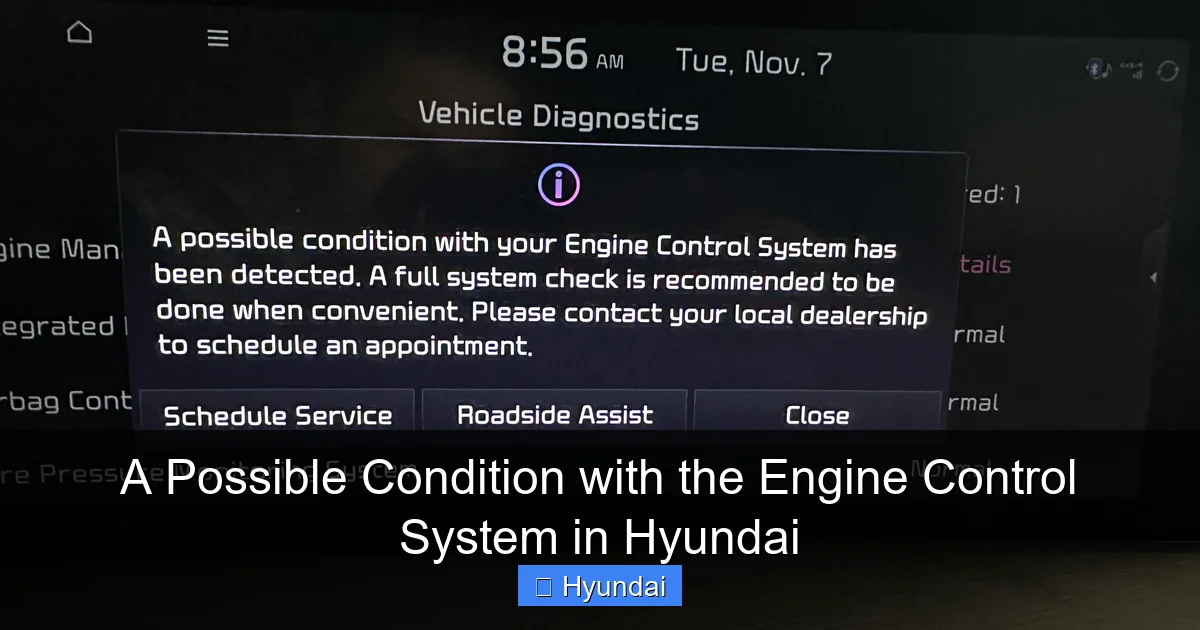
A Possible Condition with the Engine Control System in Hyundai

Contents
- 1 Key Takeaways
- 2 📑 Table of Contents
- 3 What Exactly is the Engine Control System?
- 4 Common Symptoms of a Faulty Engine Control System in Hyundai
- 5 Specific Known Issues in Hyundai Models
- 6 How to Diagnose the Problem Yourself
- 7 Repair and Maintenance: Fixing and Preventing Issues
- 8 When to Seek Professional Help
- 9 Conclusion: Knowledge is Power (and Savings)
- 10 Frequently Asked Questions


The engine control system in Hyundai vehicles, managed by the Engine Control Unit (ECU), is the car’s central brain. Faulty sensors, software glitches, or wiring issues can lead to rough running, stalling, and check engine lights. Understanding these potential problems helps you diagnose issues early, save on costly repairs, and keep your Hyundai running reliably.
Have you ever been driving your Hyundai, maybe a Sonata or Elantra, and felt it suddenly hesitate, shake, or even stall for no clear reason? Or maybe that mysterious check engine light has come on, and the diagnostic at the auto parts store gave you a code that didn’t quite explain the problem? You might be dealing with an issue in your vehicle’s engine control system. This isn’t just a single part but a complex network of computers, sensors, and actuators that work together every second your engine is running. For Hyundai owners, understanding this system is crucial because certain model years have known quirks. Let’s break down what could be going on, how to spot it, and what your next steps should be.
Key Takeaways
- The ECU is the Command Center: The Engine Control Unit (ECU) constantly reads data from dozens of sensors and adjusts fuel, air, and spark for optimal performance and emissions.
- Watch for Drivability Symptoms: Common signs of a fault include rough idle, hesitation, stalling, poor fuel economy, and a illuminated check engine light.
- Sensor Failures are Common Culprits: Issues often stem from the throttle position sensor, mass airflow sensor, oxygen sensors, or crankshaft position sensor.
- Software and Wiring Matter: Sometimes the problem isn’t a bad part but outdated ECU software or corroded/damaged wiring in the sensor network.
- 诊断 Requires Professional Tools: Proper diagnosis needs an OBD2 scanner to read manufacturer-specific fault codes, not just generic ones.
- Don’t Ignore the Check Engine Light: A steady light is a warning; a flashing light means severe misfire—stop driving immediately to prevent catalytic converter damage.
- Prevention is Key: Regular maintenance, like replacing engine air filters and using quality fuel, helps prevent sensor contamination and system strain.
📑 Table of Contents
- What Exactly is the Engine Control System?
- Common Symptoms of a Faulty Engine Control System in Hyundai
- Specific Known Issues in Hyundai Models
- How to Diagnose the Problem Yourself
- Repair and Maintenance: Fixing and Preventing Issues
- When to Seek Professional Help
- Conclusion: Knowledge is Power (and Savings)
What Exactly is the Engine Control System?
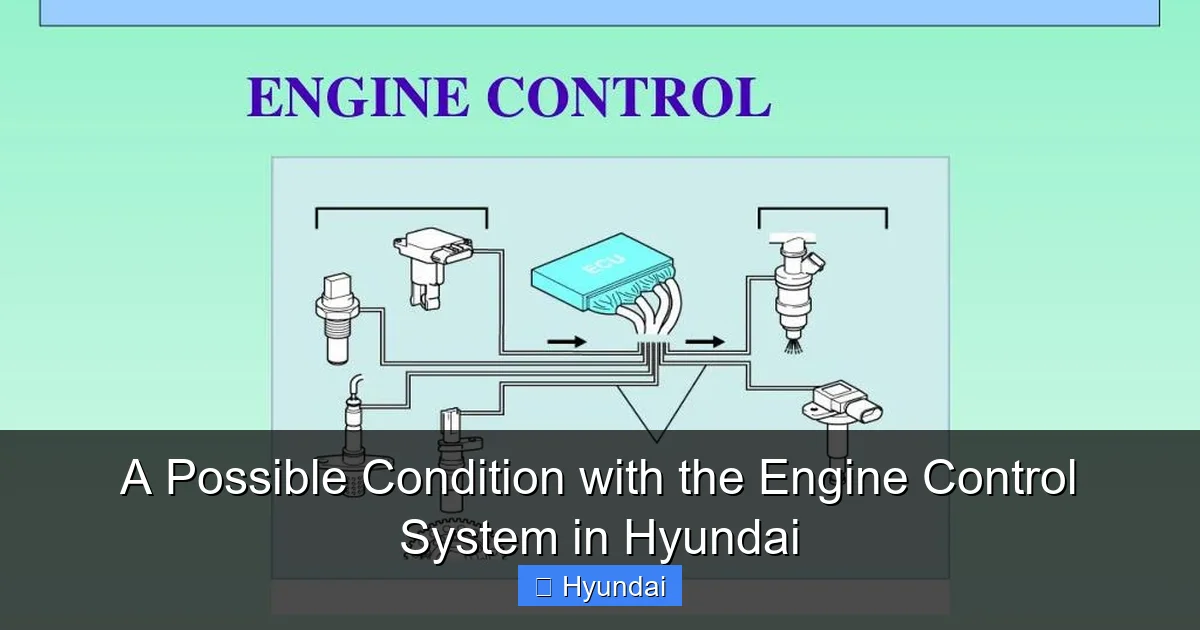
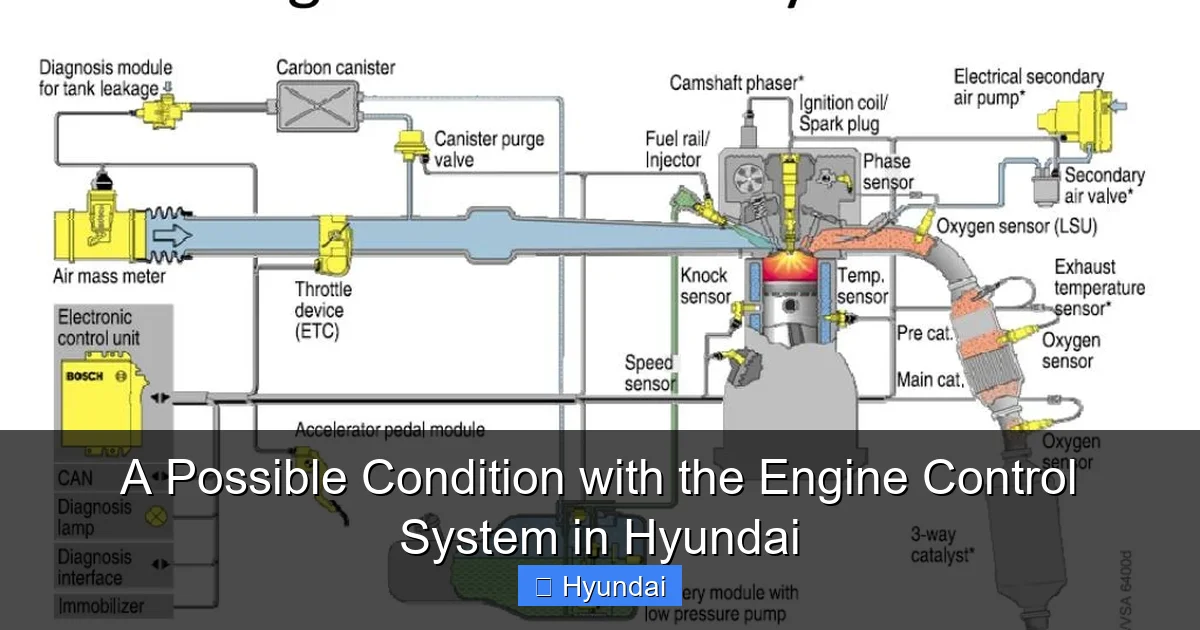
Think of your Hyundai’s engine control system as the nervous system and brain of your car’s powerplant. At its heart is the Engine Control Unit (ECU), a specialized computer. The ECU’s job is to gather real-time data from a fleet of sensors placed throughout the engine and exhaust. It then uses pre-programmed maps and calculations to tell the fuel injectors how much gas to spray, the ignition coils when to spark, the throttle body how far to open, and even the variable valve timing systems when to adjust. The goal is perfect combustion: maximum power, minimal emissions, and the best fuel economy possible for any given driving condition.
The Key Players: Sensors and Actuators
For the ECU to make these decisions, it needs accurate information. Here are the most critical sensors involved:
- Mass Airflow (MAF) Sensor: Measures the amount of air entering the engine. A dirty or failed MAF will cause a rich or lean air/fuel mixture.
- Throttle Position Sensor (TPS): Tells the ECU how far you’re pressing the gas pedal. Modern Hyundai “drive-by-wire” systems rely heavily on this signal.
- Oxygen (O2) Sensors: Located before and after the catalytic converter, they monitor exhaust oxygen levels to fine-tune fuel mixture and monitor catalyst efficiency.
- Crankshaft Position Sensor (CKP): Informs the ECU of engine speed and piston position. If it fails, the engine often won’t start or will stall immediately.
- Camshaft Position Sensor (CMP): Works with the CKP for precise fuel injection and valve timing, especially in engines with Variable Valve Timing (VVT).
The ECU then commands actuators like fuel injectors, ignition coils, the idle air control valve (or throttle plate motor), and VVT solenoids to execute its commands. A breakdown in communication between any sensor and the ECU, or a failure of an actuator, can throw the entire system into disarray.
Common Symptoms of a Faulty Engine Control System in Hyundai
Because the ECU is so central, a problem can manifest in many confusing ways. These symptoms are your car’s way of asking for help. Paying attention early can prevent a small issue from becoming a major engine repair.
Visual guide about A Possible Condition with the Engine Control System in Hyundai
Image source: gillsc.com
The Tell-Tale Check Engine Light
This is the most obvious and common indicator. The ECU constantly monitors all its sensors. If a sensor’s reading is out of expected range or a circuit has an issue, it stores a Diagnostic Trouble Code (DTC) and illuminates the Malfunction Indicator Lamp (MIL)—the check engine light. A steady light is a “warning” that you should get checked soon. A flashing check engine light is a “severe” warning, typically indicating a misfire that is raw fuel dumping into the exhaust, which can overheat and destroy the catalytic converter. If your light is flashing, pull over safely and shut off the engine.
Drivability and Performance Issues
Before the light even comes on, you might feel something is off:
- Rough Idle or Stalling: The engine may shudder, feel lumpy, or even die when stopped at a light. This often points to a faulty idle air control circuit, a dirty throttle body, or a failing crankshaft position sensor.
- Hesitation, Sagging, or Misfires: When you press the accelerator, the car may hesitate, feel like it’s “sagging,” or jerk. This is a classic sign of a lean condition (too much air, not enough fuel), often from a bad MAF sensor, vacuum leak, or weak fuel pump—all information the ECU uses.
- Poor Fuel Economy: If you’re suddenly filling up more often, a sensor like the O2 sensor or MAF could be sending bad data, causing the ECU to over-fuel.
- Hard Starting or No-Start: A complete failure of the crankshaft position sensor is a frequent cause of a Hyundai that cranks but won’t start, as the ECU has no way to know when to fire the spark plugs.
- Reduced Power / “Limp Mode”: Some faults are so serious the ECU will intentionally limit engine power to protect itself. This feels like a massive, unexplained loss of acceleration.
Specific Known Issues in Hyundai Models
While any car can have sensor failures, certain Hyundai models from the early 2010s through the late 2010s have reported more frequent issues, often related to specific components or software.
Visual guide about A Possible Condition with the Engine Control System in Hyundai
Image source: image.slideserve.com
Throttle-by-Wire System Glitches
Hyundai switched to electronic throttle control (ETC)—”drive-by-wire”—across most of its lineup years ago. Instead of a physical cable, a motor on the throttle body opens and closes the throttle plate based on the TPS signal and ECU commands. Common problems include:
- Throttle body carbon buildup causing erratic idle.
- Failing throttle body motor or position sensor.
- Software glitches in the ECU’s throttle control logic, which may require a dealer-level software update/reflash. Some owners report intermittent acceleration loss that resets after turning the car off and on.
If you experience sudden, unintended acceleration or a “stuck” throttle feeling (though rare), this is a critical safety issue. While Hyundai-specific, the diagnostic approach for throttle faults shares similarities with other brands. For instance, the procedure to reset the electronic throttle control system on a Dodge Charger involves a specific pedal and key sequence to recalibrate the system after cleaning or repair. Hyundai systems often require similar, but sometimes dealer-only, recalibration procedures after throttle body work.
Oxygen Sensor and Catalytic Converter Monitor Failures
Hyundai vehicles, particularly the 1.6L and 2.0L engines in Sonatas and Elantras from 2011-2016, have seen a higher incidence of O2 sensor failures and, subsequently, catalytic converter efficiency codes (like P0420). A failing upstream O2 sensor can cause poor fuel economy and drivability. The downstream sensor monitors the cat. If it fails or if the cat itself degrades, it triggers a code. Sometimes, a failing sensor can damage the catalytic converter, leading to a very expensive repair.
Crankshaft Position Sensor Failures
This is a classic failure point on many Hyundai and Kia models with the Theta II engines (2.4L and 2.0L turbo). The CKP sensor, often located near the engine’s harmonic balancer, can fail due to heat and vibration. The classic symptom is a no-start condition where the engine cranks normally but doesn’t fire. Replacing the sensor is usually straightforward but requires proper indexing during installation.
How to Diagnose the Problem Yourself
Before you panic or head straight to a mechanic, there are some basic steps you can take. However, be warned: diagnosing an engine control system issue is rarely as simple as “code X means part Y.”
Visual guide about A Possible Condition with the Engine Control System in Hyundai
Image source: image1.slideserve.com
Step 1: Read the Codes
You must retrieve the stored Diagnostic Trouble Codes (DTCs). You can:
- Use a basic OBD2 scanner: Any auto parts store will often do this for free. It will give you a code like “P0171” (System Too Lean) or “P0121” (Throttle Position Sensor A Circuit Range/Performance).
- Use a better scanner: A more advanced scanner (or a professional one) can read Hyundai’s manufacturer-specific codes, which provide much more precise information (e.g., “Crankshaft Position Sensor – Signal Implausible”).
Important: A code tells you which circuit or sensor the ECU has a problem with, not necessarily that the sensor itself is bad. A P0106 code for the MAP sensor could mean a bad sensor, a vacuum leak in the hose to the sensor, or even an ECU problem. This is where research and diagnostics come in.
Step 2: Perform Basic Visual and Physical Checks
With the code in hand, do a simple inspection:
- Check for disconnected or damaged wiring harnesses near the sensor in question. Look for chafed insulation, corrosion, or loose connectors.
- Inspect the sensor itself. Is it covered in oil, soot, or dirt? A dirty MAF sensor is a common cause of codes. MAF sensors should never be cleaned with standard cleaners; use MAF-specific spray.
- Check for vacuum leaks. Listen for hissing sounds with the engine running. A common trick is to carefully spray starter fluid (or propane) around suspected hose connections. If the engine RPM changes, you’ve found a leak. A large vacuum leak will often trigger a lean code (P0171/P0174).
- Ensure your battery is strong and connections are clean. A weak battery can cause voltage drops that confuse sensor readings and create false codes.
Step 3: Research TSBs and Common Problems
Search online for your specific Hyundai (year, model, engine size) plus the DTC you retrieved. You might find Technical Service Bulletins (TSBs) issued by Hyundai that describe a known problem and its official fix. For example, there are TSBs for certain Sonata models regarding software updates for erratic idle and stalling. This information is gold and can save you from replacing parts that aren’t actually faulty.
Repair and Maintenance: Fixing and Preventing Issues
Once you’ve narrowed down the issue, the path forward depends on the component.
Sensor Replacement and Cleaning
Many sensors are considered wear items. Replacing a bad crankshaft position sensor or a failed O2 sensor is a common repair. Always use quality, OEM-spec parts. Some sensors, like the MAF and throttle body, are sensitive to contamination. Cleaning the throttle body with the appropriate throttle body cleaner (not carburetor spray) can often resolve idle issues. However, after cleaning a throttle body on a Hyundai with ETC, you must perform a throttle body adaptation/relearning procedure using a scan tool. This is not optional; skipping it will cause poor idle and drivability. This is a step where professional help is often needed, as the procedure is not user-friendly on many models.
ECU Software Updates (Reflashing)
This is a critical and often overlooked fix. Many “sensor” complaints are actually solved by updating the ECU’s software. Hyundai periodically releases updates to improve drivability, shift logic (in automatics), and fix false codes. A dealer or well-equipped independent shop can connect their diagnostic computer and check for and apply any available updates for your VIN. This is frequently the solution for intermittent stalling or rough idle complaints where no hard parts are found to be defective.
The Importance of Core Maintenance
You can prevent many engine control system problems by maintaining the engine’s health:
- Engine Air Filter: A clogged air filter restricts airflow, causing the MAF sensor to work harder and potentially give inaccurate readings, leading to a lean condition. Change it regularly.
- Fuel Quality: Use top-tier detergent gasoline. Poor-quality fuel can lead to carbon buildup on throttle bodies and intake valves, and contaminate sensors.
- Oil Changes: This might seem unrelated, but clean oil at the proper level is vital. Low oil or severely degraded oil can cause variable valve timing (VVT) system issues, which the ECU monitors. Understanding how the oil system in a car works shows why neglecting it can trigger multiple warning lights and performance issues. The oil pressure and VVT system are intimately linked to engine management.
- PCV System: A faulty Positive Crankcase Ventilation valve can cause oil vapor to be pulled into the intake, coating the MAF sensor and throttle body in oily gunk, leading to failures.
When to Seek Professional Help
Diagnosing these systems can be a deep rabbit hole. Here’s when to call a pro, especially one familiar with Hyundai:
- You have a code but no obvious bad part. Intermittent faults, electrical gremlins, and software issues require advanced diagnostics like live data streaming (watching sensor values in real-time) and voltage testing.
- The check engine light is flashing. This is an emergency to prevent catalytic converter damage.
- You suspect a throttle body or ECU software issue. These almost always require a dealer-level scan tool for adaptation and reflashing. Generic OBD2 tools cannot do this on most Hyundais.
- The problem is safety-critical. Any issue involving unintended acceleration, steering, or braking must be addressed immediately by professionals.
For complex electrical issues, a specialist might use a lab scope to check sensor signal waveforms, something far beyond typical DIY. While general check engine light diagnostics are common across brands—as seen in articles about what causes the check engine light on a Honda Civic—the specific software and adaptation procedures for Hyundai’s systems are proprietary and often require a dealer subscription.
Conclusion: Knowledge is Power (and Savings)
The engine control system in your Hyundai is a marvel of modern engineering, but it’s not infallible. By recognizing the early symptoms—a rough idle, a sudden check engine light, poor fuel economy—and understanding the common culprits like faulty sensors or outdated software, you empower yourself as a vehicle owner. Start with the simple, free step of reading the codes. Do your research on your specific model year. Perform basic visual checks. Often, the solution is a relatively inexpensive sensor replacement or a necessary software update. However, don’t be afraid to invest in a professional diagnosis when the problem is elusive. A correct diagnosis the first time saves you from buying and installing the wrong parts. Remember, proactive maintenance—clean air, clean fuel, and clean oil—is your best defense against keeping your Hyundai’s vital computer systems happy and your engine running smoothly for years to come.
Frequently Asked Questions
What is the engine control system in a Hyundai?
The engine control system in a Hyundai is a network centered around the Engine Control Unit (ECU). It uses data from sensors across the engine to manage fuel injection, ignition timing, throttle position, and emissions systems for optimal performance and efficiency.
What are the most common symptoms of a failing engine control system?
The most common symptoms include a persistent or flashing check engine light, rough or uneven idle, engine stalling, hesitation or loss of power during acceleration, poor fuel economy, and hard starting conditions.
How much does it cost to fix an engine control system problem in a Hyundai?
The cost varies wildly. Replacing a single sensor like a crankshaft position sensor might cost $150-$300. A throttle body replacement with required software adaptation can be $500-$900. An ECU software update (reflash) from a dealer typically costs $100-$200. Major wiring harness repairs are the most expensive.
Can I diagnose and fix an engine control system issue myself?
You can start by retrieving the check engine codes using an OBD2 scanner, which is often free at auto parts stores. Basic visual inspections for damaged wiring or dirty sensors are also DIY-friendly. However, interpreting the codes correctly, performing live data diagnostics, and especially completing software adaptations or ECU reflashing almost always require professional tools and expertise.
Is a check engine light always serious?
Not always. A steady light indicates a problem that needs attention soon but may not be immediately dangerous. However, a flashing check engine light is extremely serious and indicates a severe engine misfire that is dumping unburned fuel into the exhaust, risking catastrophic damage to the catalytic converter. You should stop driving immediately if the light is flashing.
Will an engine control system problem fail my emissions test?
Almost certainly yes. The engine control system directly manages all emissions-related components. If the ECU detects a fault that affects emissions, it will set a code and turn on the check engine light. In most regions, a vehicle with an illuminated check engine light will automatically fail an emissions inspection.