
Can a Ford F150 Tow 10000 Lbs

Yes, a Ford F150 can tow 10,000 lbs, but not every single one can. This maximum rating is reserved for specific model years, engine combinations, and configurations equipped with the Max Trailer Tow Package. Your truck’s exact capacity is found on its door jamb sticker. Achieving this safely requires proper setup, including the correct hitch, trailer brakes, and weight distribution. Always know your truck’s specific limits before hitting the road with a heavy load.
Key Takeaways
- Max tow ratings vary widely: A Ford F150’s towing capacity can range from 5,000 lbs to over 14,000 lbs depending on engine, drivetrain, cab, and bed configuration.
- The 3.5L EcoBoost V6 is key: For many recent model years, the highest tow ratings, including the 10,000+ lb capability, are achieved with the twin-turbo 3.5L V6 engine and the Max Trailer Tow Package.
- Payload is not tow capacity: Payload (what you carry *in* the truck) and tow capacity (what you pull *behind* it) are separate, critical ratings. Overloading either is dangerous.
- The door sticker is law: Your truck’s certified towing capacities are listed on a yellow sticker on the driver’s door jamb. This is the only number you should trust for your specific vehicle.
- Real-world towing is different: Hitting a max rating on a flat, dry road is one thing. Safe towing in mountains, wind, or with a poorly balanced trailer requires significant margin below that max number.
- Proper equipment is non-negotiable: Towing 10,000 lbs safely requires a weight-distributing hitch, a trailer with its own braking system, and often a tow mirror package and transmission cooler.
- Compare to other trucks: While capable, a half-ton F150 at its max has less margin than a heavy-duty truck. For regular 10k+ towing, models like the GMC 2500 or GMC Canyon in its top configuration might offer more robust cooling and braking systems for the job.
📑 Table of Contents
- So, Can Your Ford F150 Really Tow 10000 Pounds?
- Decoding the Jargon: What “Tow Capacity” Actually Means
- Engine, Configuration, and the Path to 10,000 Lbs
- Real-World Towing: The Gap Between the Sticker and the Road
- Maximizing Your F150’s Towing Potential: A Practical Checklist
- Debunking Myths: What “They” Say Isn’t Always True
- Conclusion: Knowledge is the Key to Safe 10,000-Lb Towing
So, Can Your Ford F150 Really Tow 10000 Pounds?
Let’s cut to the chase. You’ve got a big job—a large boat, a spacious camper, or a heavy equipment trailer. You look at your trusty Ford F150 and ask: “Can this truck pull 10,000 pounds?” The answer is a qualified, but enthusiastic, yes. But before you hitch up and hit the road, you need to understand the critical details. That simple “yes” comes with a mountain of asterisks, fine print, and real-world considerations. Towing 10,000 lbs is a serious undertaking that sits right at the upper limits of what a half-ton pickup like the F150 is designed to do. Doing it safely, legally, and without shredding your truck’s components requires you to be an expert on your specific vehicle’s capabilities.
The Ford F150 is America’s best-selling truck for a reason. Its range of configurations is staggering, from a basic work truck to a luxurious Platinum or Raptor. This variety means its towing capacity isn’t a single number. It’s a spectrum. At the low end, a base V6 or V8 in a certain configuration might be rated for just 5,000 lbs. At the high end, a properly equipped model with the right engine and packages can be rated for over 14,000 lbs. That 10,000-pound mark you’re asking about? It lives comfortably in that upper half of the spectrum. But to find out if your F150 is in that club, you need to become a detective.
Decoding the Jargon: What “Tow Capacity” Actually Means
Before we dive into engines and packages, we must clarify the terminology. The number 10,000 lbs is often thrown around as a “tow rating,” but understanding the supporting cast of numbers is what separates a safe tower from a risky one.

Visual guide about Can a Ford F150 Tow 10000 Lbs
Image source: landcruiserrestorations.com
Gross Combined Weight Rating (GCWR)
This is the most important number for heavy towing. The GCWR is the maximum allowable total weight of everything: the truck itself (with all its fluids, passengers, and cargo), plus the fully loaded trailer and its cargo. It’s the system’s ultimate limit. Your truck’s engine, transmission, axles, and frame are engineered to handle this combined total. If your truck weighs 6,000 lbs loaded and your trailer weighs 9,500 lbs loaded, your GCWR is being stressed to 15,500 lbs. You must ensure your specific truck’s GCWR is higher than this combined weight. The 10,000-lb trailer number is meaningless without knowing your truck’s weight and GCWR.
Gross Vehicle Weight Rating (GVWR) & Payload
GVWR is the maximum safe weight of the truck itself. Subtract the truck’s “curb weight” (its weight with all fluids but no people or cargo) from the GVWR, and you get your payload capacity. This is what you can carry in the cab and bed. Here’s the critical link: when you hook up a trailer, some of the trailer’s weight is transferred to the truck’s rear axle via the hitch. This is called “tongue weight.” That tongue weight eats into your payload. If you’re towing a 10,000-lb trailer, the tongue weight could easily be 1,000 to 1,500 lbs. That weight must be subtracted from your payload allowance for passengers, fuel, and cargo in the truck. You can exceed your payload limit while being under your tow rating, and that is just as dangerous.
The Door Jamb Sticker: Your Truck’s Birth Certificate
Forget marketing brochures and internet forums. The only source of truth for your specific F150 is the yellow and white certification label on the driver’s side door jamb. This sticker lists the factory-certified GVWR, GAWR (Gross Axle Weight Rating for front and rear), and, most importantly, the GCWR. For later models (roughly 2015+), it may also list maximum trailer weights for different configurations. This sticker accounts for your truck’s exact build—its cab size (SuperCrew vs. Regular Cab), bed length (5.5′ vs. 8′), drive type (4×2 vs. 4×4), and optional packages. This is the number you must use for all calculations.
Engine, Configuration, and the Path to 10,000 Lbs
Now for the fun part: figuring out which F150s can actually achieve a 10,000-lb tow rating. The formula is simple: the right engine + the right drivetrain + the right cab/bed combo + the Max Trailer Tow Package. We’ll break it down by recent generations, as capabilities have shifted significantly.
Visual guide about Can a Ford F150 Tow 10000 Lbs
Image source: vehq.com
The 3.5L EcoBoost V6: The 10,000-Lb Workhorse
Since its introduction for the 2011 model year, Ford’s twin-turbocharged 3.5-liter V6 (the EcoBoost) has been the powerhouse for maximum F150 towing. Its combination of low-end torque (470 lb-ft in later versions) and sustained power makes it ideal for heavy loads. For the current generation (2021-present), when paired with the Max Trailer Tow Package and in a conducive configuration (typically a 4×2, Regular or SuperCab with a 6.5′ or 8′ bed), the 3.5L EcoBoost can tow up to 14,000 lbs. So, 10,000 lbs is well within its capability. The key is the Max Trailer Tow Package, which includes a heavy-duty radiator, upgraded front axle, trailer brake controller, and a specific rear axle ratio (often 3.73:1 or 4.10:1). Without this package, the tow rating drops significantly.
For the previous generation (2015-2020), the story is similar but with slightly lower peak numbers. A 2015-2020 F150 with the 3.5L EcoBoost and the Max Trailer Tow Package could tow up to 12,000 – 13,200 lbs depending on the exact year and configuration. Again, 10,000 lbs is comfortably in the range. However, note that moving to a 4×4 model, a larger SuperCrew cab, or a shorter bed all reduce the maximum rating due to increased weight and altered weight distribution. A 4×4 SuperCrew 5.5′ bed with the 3.5L EcoBoost and tow package might see its max rating dip to around 10,500 – 11,000 lbs—still clearing your 10k goal, but with less margin.
The 5.0L V8 and Other Engines
The iconic 5.0L Coyote V8 is a fantastic engine, but its peak towing numbers are generally a step below the 3.5L EcoBoost in the same generation. In the current (2021+) models, the 5.0L V8 with the Max Trailer Tow Package maxes out at 13,000 lbs. So it can also handle 10,000 lbs with ease in the right configuration. In the 2015-2020 generation, the 5.0L V8’s max was around 11,000-12,000 lbs with the package. The naturally aspirated 3.3L V6 and the hybrid 3.5L PowerBoost V6 have their own ratings, but they typically peak below the 10,000-lb mark, especially in common crew cab configurations. The PowerBoost, for instance, is rated for up to 11,000 lbs in optimal setups, but real-world reports suggest its hybrid system’s cooling can be a limiting factor for sustained, heavy mountain towing.
Model Year Matters: The 2015+ Revolution
If you’re looking at a used F150, the model year is crucial. The 2015 redesign brought an all-aluminum body, which saved significant weight. This weight savings, combined with more powerful engine options, dramatically increased maximum tow ratings across the board. A 2014 or older F150 with a 5.0L V8 might have a max rating around 9,000-10,000 lbs in its most capable configuration, but those older body-on-frame steel trucks are heavier, leaving less room for payload and trailer weight within the GCWR. For reliably exceeding 10,000 lbs, your focus should be on 2015 and newer models equipped with the 3.5L EcoBoost or 5.0L V8 and the proper tow package.
When comparing to other vehicles in its class, it’s useful to see how the F150 stacks up. For example, the GMC Sierra 1500 with its 6.2L V8 offers very similar maximum tow ratings to a comparable F150. The choice often comes down to personal preference in design, interior, and specific feature packages rather than a clear tow capacity winner in the half-ton segment.
Real-World Towing: The Gap Between the Sticker and the Road
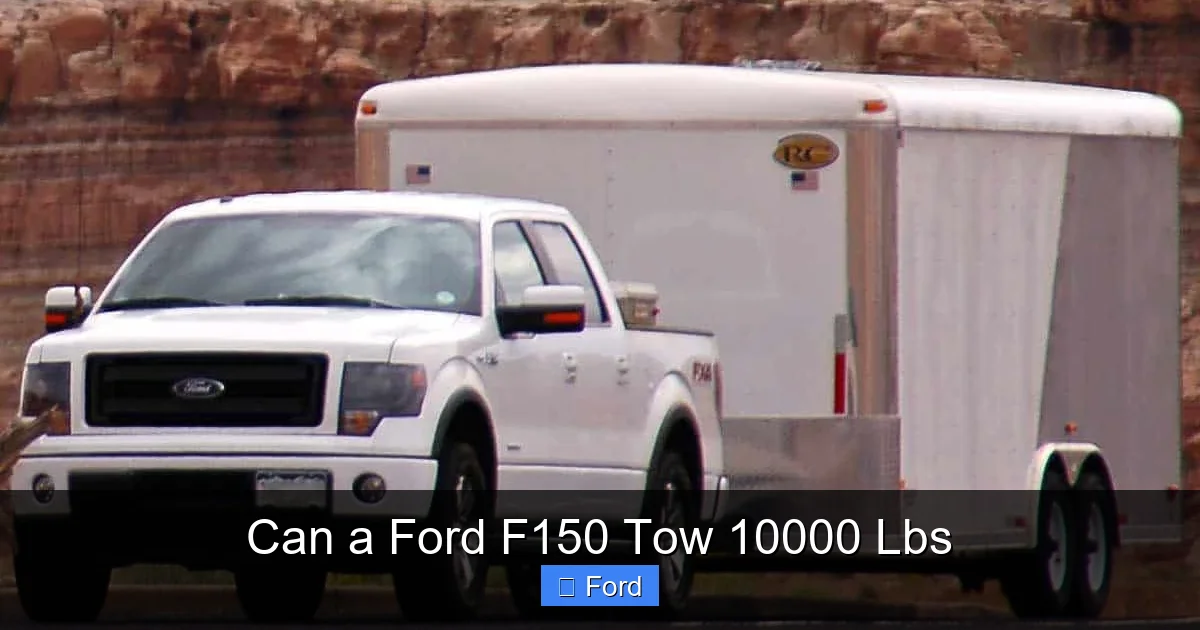
Here is where dreams of effortless 10,000-lb towing meet reality. That number on the sticker is a rigid, legal limit under ideal, controlled conditions. The real world is rarely ideal.
Visual guide about Can a Ford F150 Tow 10000 Lbs
Image source: vehq.com
Mountain Passes, Headwinds, and the “Feel” of the Load
Towing a 10,000-lb trailer up a 6% grade at altitude is not the same as towing it on a flat Texas highway. Your engine will be working hard, the transmission will be searching for the right gear, and you’ll feel the momentum drain. The F150’s 10-speed automatic is generally excellent at managing this, but it will downshift frequently. This is where cooling capacity becomes paramount. The Max Trailer Tow Package includes a heavy-duty radiator and often an auxiliary transmission fluid cooler. Without these, you risk overheating your transmission on a long mountain ascent, leading to catastrophic failure. This is a key reason why the package is not just a suggestion for 10k towing; it’s a requirement. Similarly, strong crosswinds can push a large trailer around. A stable tow requires a well-matched tow vehicle with a proper weight-distributing hitch.
The Weight-Distributing Hitch is Not Optional
For any trailer over about 5,000 lbs, and absolutely for 10,000 lbs, a weight-distributing hitch (WDH) is essential. A standard ball hitch simply transfers all the tongue weight to a single point on your truck’s frame, squashing the rear axle and lifting the front. This kills steering control and braking effectiveness. A WDH uses spring bars to spread that tongue weight across all axles—the truck’s front and rear, and the trailer’s axles. This keeps the truck level, maintains proper steering and brake bias, and creates a much more stable, sway-resistant system. Using a simple ball hitch for 10,000 lbs is dangerous and often violates the truck’s payload specifications because it concentrates too much weight on the rear axle.
Trailer Brakes: Your Second Braking System
In the U.S., any trailer over 3,000 lbs must have its own braking system. For a 10,000-lb trailer, this is a legal requirement and a safety imperative. Your F150’s brakes are designed to stop a 6,000-lb truck. Adding a 10,000-lb trailer multiplies the kinetic energy exponentially. The trailer’s electric brakes, controlled by an integrated brake controller in your truck’s cab (included in the tow package), are what do the majority of the work in stopping the combined unit. You must have a properly functioning, proportional brake controller and ensure the trailer’s brakes are adjusted and in good condition. Test them before every long trip.
If your towing needs consistently hover at or above 10,000 lbs, you might find a half-ton truck operating at its limit. In that case, stepping up to a heavy-duty three-quarter or one-ton truck like the GMC 2500 provides a massive safety margin. These trucks have stronger frames, more robust cooling systems, larger brakes, and typically higher GCWRs, making 10,000-lb towing a casual stroll rather than a maximum effort.
Maximizing Your F150’s Towing Potential: A Practical Checklist
So you’ve confirmed your door sticker shows a GCWR and tow rating that can handle a 10,000-lb trailer. Here’s your pre-trip checklist to make it happen safely and reliably.
1. Verify and Calculate
First, find your truck’s actual curb weight. This isn’t the generic number from a website; it’s the weight of your specific truck as it sits, with a full tank of fuel but no people or cargo. The best way is to drive it across a public scale (truck stops are perfect). Weigh the truck alone, then weigh it hitched to the trailer (with the trailer’s own weight on its wheels). The difference is your tongue weight. Now, add the truck’s curb weight + all passengers/cargo + tongue weight + loaded trailer weight. This total must be less than your GCWR. Also, ensure the front and rear axle weights are under their GAWRs listed on the door sticker.
2. Equip Correctly
- Hitch: A Class IV or V receiver with a weight-distributing hitch rated for at least 10,000 lbs. The shank and ball must match.
- Sway Control: Integrate the WDH’s built-in sway control or add a friction-based or hydraulic sway control device.
- Brake Controller: Use the one integrated in your truck (if equipped) or install a high-quality aftermarket proportional controller like a Tekonsha Prodigy.
- Mirrors: You need a clear view of the trailer’s sides. Extended tow mirrors are a must-have.
- Lights & Wiring: Ensure all trailer lights (brakes, turn signals, running lights) are functional and wired correctly to the truck’s 7-pin connector.
3. Load Smartly
Load your trailer with 60% of the cargo weight forward of the trailer’s axle(s). This ensures proper tongue weight (10-15% of the total trailer weight). Secure everything. A shifting load is a disaster. Distribute weight in the truck bed to help balance the tongue weight, but never exceed the truck’s GVWR or rear GAWR.
4. Drive Differently
Accelerate slowly and smoothly. Allow double or triple your normal stopping distance. Use lower gears for descents to avoid overheating your truck’s brakes. Take corners wider to avoid the trailer’s “off-tracking” where the trailer tires cut inside the truck’s path. Be hyper-aware of wind, especially from passing trucks or in mountain valleys. Constant, gentle steering corrections are normal.
Debunking Myths: What “They” Say Isn’t Always True
The world of truck towing is full of folklore. Let’s clear some up.
“All F150s Can Tow 10,000 Lbs”
Absolutely false. A base-model 2023 F150 XL SuperCrew 4×4 with the 3.3L V6 is rated for about 5,000 lbs. The configuration is everything. You must check your specific door sticker.
“Bigger Engine Always Means More Tow Capacity”
Not always. While the 3.5L EcoBoost and 5.0L V8 are the top dogs, a 4×4 SuperCrew with the 5.0L might have a lower rating than a 4×2 Regular Cab with the same engine, simply because the 4×4 SuperCrew is much heavier. The truck’s own weight eats into the GCWR margin available for the trailer.
“I Don’t Need a Weight-Distributing Hitch If My Truck Has a Tow Package”
This is a dangerous misconception. The factory tow package provides the wiring, brake controller, and often a hitch receiver. It does not automatically provide a weight-distributing hitch. For loads over about 5,000 lbs, a WDH is a separate, essential piece of safety equipment. Check your owner’s manual; it will specify the weight thresholds for using a WDH.
“My Tow Rating is My Target”
No. Your tow rating is your absolute legal and mechanical limit. Smart, safe towing means staying at least 10-20% below your max rated GCWR and tow capacity. This provides a crucial buffer for wind, hills, imperfect loading, and the unexpected. Aim to tow at 80-90% of your maximum capability for a comfortable, safe, and stress-free experience. If you’re constantly flirting with the max, you’re in the wrong truck. For perspective, a family hauler like the GMC Acadia is rated for around 4,000 lbs, highlighting how different vehicle types have vastly different design goals and limits.
Conclusion: Knowledge is the Key to Safe 10,000-Lb Towing
So, can a Ford F150 tow 10,000 pounds? The definitive answer is: Yes, a properly configured Ford F150 from the 2015 model year onward, equipped with the Max Trailer Tow Package and the 3.5L EcoBoost or 5.0L V8 engine, is engineered and certified to do so. But this article’s true purpose is to shift your question from “Can it?” to “Should I, and how do I do it safely?” The capability exists on paper, but realizing it in the real world demands respect for the numbers, the right equipment, and disciplined driving.
Your first and final step is to walk to your driver’s door, open it, and read the yellow sticker. Memorize your GCWR, GVWR, and GAWRs. Then, weigh your loaded truck and trailer to ensure you are within all those limits. Invest in a high-quality weight-distributing hitch with sway control and ensure your trailer brakes are perfect. Finally, drive with a margin of safety. Towing 10,000 lbs is a serious task that transforms your F150 from a comfortable family hauler into a piece of heavy machinery. Treat it with the seriousness it deserves, and your F150 will serve you faithfully for countless miles of successful, safe towing.
Frequently Asked Questions
What specific Ford F150 model years can reliably tow 10,000 lbs?
F150s from the 2015 model year and newer are your best bet. With the 3.5L EcoBoost V6 engine, 4×2 drivetrain, a regular or SuperCab with a long bed (6.5′ or 8′), and the Max Trailer Tow Package, these models often have max ratings from 11,000 to over 14,000 lbs, making 10,000 lbs well within their capability. Always verify with your specific truck’s door jamb sticker.
Does the Max Trailer Tow Package make a difference for 10,000 lb towing?
It makes all the difference. This package is not just a hitch and wiring. It includes a heavy-duty radiator, upgraded front axle, engine oil cooler, trailer brake controller, and a specific rear axle ratio (like 3.73 or 4.10). These components are essential for managing the heat and stress of sustained heavy towing. A truck without this package may have a much lower official tow rating and risks overheating on long grades.
How do I know if my payload is enough for a 10,000 lb trailer?
Calculate your tongue weight (typically 10-15% of the trailer’s loaded weight, so 1,000-1,500 lbs for 10k). Add your truck’s curb weight, all passengers, and all cargo in the bed/cab. This total must be less than your truck’s GVWR. More critically, the weight on your truck’s rear axle (truck weight + tongue weight) must be less than the rear GAWR on your door sticker. Exceeding payload can cause axle failure, poor handling, and brake failure.
Can I tow 10,000 lbs with a Ford F150 4×4?
Yes, but with less margin. The 4×4 system adds significant weight, which reduces the available GCWR for the trailer. A 4×4 model with the same engine and package will have a lower max tow rating than a 4×2. For example, a 4×4 SuperCrew might be rated for 10,500-11,000 lbs, just barely clearing 10,000 lbs. You must be even more diligent about staying under the max with cargo and passengers.
Do I need a special license to tow 10,000 lbs with an F150?
In most U.S. states, a standard Class D driver’s license is sufficient for a combination under 26,000 lbs GVWR (truck + trailer). A loaded F150 might weigh 6,500 lbs, and a 10,000-lb trailer might have a GVWR of 10,500 lbs, totaling ~17,000 lbs. This is generally under the 26,000 lb threshold. However, some states have specific rules based on trailer weight alone. Always check your local Department of Motor Vehicles (DMV) regulations, as they can vary.
Is towing 10,000 lbs hard on an F150’s transmission?
It can be if not done correctly. The 10-speed automatic in modern F150s is robust and well-suited for towing. The key is using the correct tow/haul mode, which holds gears longer and provides more engine braking. The Max Trailer Tow Package’s transmission cooler is critical for long, steep mountain grades. Without it, the transmission fluid can overheat, leading to premature wear or failure. Proper maintenance (fluid changes) is even more important for heavy-duty towing use.
