
What Kind of Oil Does a Toyota Highlander Hybrid Take?

Your Toyota Highlander Hybrid requires specific oil to protect its unique hybrid engine. Always use 0W-20 full synthetic oil meeting Toyota’s specifications. Using the correct oil ensures optimal fuel efficiency, engine longevity, and hybrid system performance. Consult your owner’s manual for exact recommendations based on your model year.
So, you’ve got a fantastic Toyota Highlander Hybrid. It’s a spacious, efficient family hauler that perfectly blends power and Prius-like frugality. But keeping that complex powertrain—a gasoline engine mated to electric motors—running smoothly for years to come hinges on one simple, often overlooked detail: the right oil. Getting the answer to “what kind of oil does a Toyota Highlander Hybrid take?” right isn’t just about following a rule; it’s about protecting a significant investment. Let’s dive deep into everything you need to know, from the exact specification to the “why” behind it.
This isn’t just generic car advice. The Highlander Hybrid’s gasoline engine works differently than a traditional SUV’s. It shuts off at stops, restarts seamlessly, and often operates at different, sometimes lower, RPMs. It needs an oil formulated for these specific demands. Using the wrong oil can gradually harm the engine and, by extension, the entire hybrid system’s efficiency and reliability. We’ll break it down clearly, so you can walk into any auto parts store or service center with absolute confidence.
Key Takeaways
- Official Requirement: All Toyota Highlander Hybrid models from 2014 onward require 0W-20 full synthetic oil that meets Toyota’s specific standards (like Toyota Genuine Motor Oil or API SP).
- Viscosity is Critical: The “0W-20” rating ensures proper cold-start flow and high-temperature protection, which is vital for the hybrid’s frequent engine start-stop cycles.
- Synthetic is Non-Negotiable: The hybrid system’s design and tighter engine tolerances mandate full synthetic oil for adequate protection and extended drain intervals.
- Capacity Varies: Oil capacity typically ranges from 4.8 to 5.0 quarts (with filter) depending on the specific model year and engine variant.
- Follow Recommended Intervals: Toyota often recommends oil changes every 10,000 miles or 12 months for Highlander Hybrids using 0W-20 synthetic, but always verify in your manual.
- Wrong Oil Risks Damage: Using incorrect viscosity or conventional oil can lead to increased wear, poor fuel economy, hybrid system strain, and potentially void your warranty.
- Check the Cap & Manual: Your oil filler cap usually states “0W-20,” but your owner’s manual is the final authority for your specific vehicle’s needs.
📑 Table of Contents
- Understanding the Unique Needs of a Hybrid Powertrain
- Official Toyota Recommendations: The Gold Standard
- Decoding the Oil Viscosity: What “0W-20” Really Means
- Synthetic vs. Conventional: Why There’s No Contest
- Oil Capacity and Change Intervals: Practical Maintenance
- The High Cost of Using the Wrong Oil
- Practical Tips and Final Checklist
Understanding the Unique Needs of a Hybrid Powertrain
Before we state the oil type, it’s helpful to understand why the Highlander Hybrid has such specific requirements. A conventional V6 or four-cylinder engine in a non-hybrid vehicle has a relatively predictable operating pattern. The Hybrid Synergy Drive system in the Highlander, however, introduces unique stresses and conditions that standard oils aren’t always designed to handle.
The Challenge of Frequent Start-Stop Cycles
One of the core hybrid functions is the automatic engine shut-off when you come to a complete stop, like at a red light. The engine then restarts instantly when you lift your foot from the brake. This happens dozens of times on a single commute. This constant cycling creates two main challenges for engine oil:
- Increased Fuel Dilution: During these frequent, short-running periods, especially in colder weather, unburned fuel can wash down the cylinder walls and mix with the oil. This dilutes the oil, reducing its viscosity and its ability to lubricate and protect metal surfaces.
- Wear During Cold Starts: The moment you press the accelerator and the engine kicks on, the vast majority of engine wear occurs. The oil must flow quickly to all critical parts to form a protective film before metal-on-metal contact happens.
This is where the “0W” part of our final answer becomes so crucial. The “W” stands for winter, and the number before it indicates cold-flow performance. A 0W oil is engineered to remain fluid and pumpable at extremely low temperatures (down to -40°C/-40°F), ensuring it reaches the engine’s vital components almost immediately upon startup, far quicker than a 5W or 10W oil.
Higher Operating Temperatures & Tighter Tolerances
Modern engines, especially those paired with hybrid systems for efficiency, are built with incredibly tight tolerances. They operate at higher temperatures and pressures to squeeze out every bit of efficiency. The oil must be thermally stable—meaning it resists breaking down and thinning out at high heat—and must have a robust additive package to prevent sludge and deposits under these severe conditions. Full synthetic oils are superior to conventional oils in all these areas, which is why they are a mandatory requirement.
Official Toyota Recommendations: The Gold Standard
Now for the direct answer, straight from the source. For all model years of the Toyota Highlander Hybrid (from its introduction as a hybrid for the 2014 model year through the current generation), Toyota specifies the use of 0W-20 full synthetic motor oil.
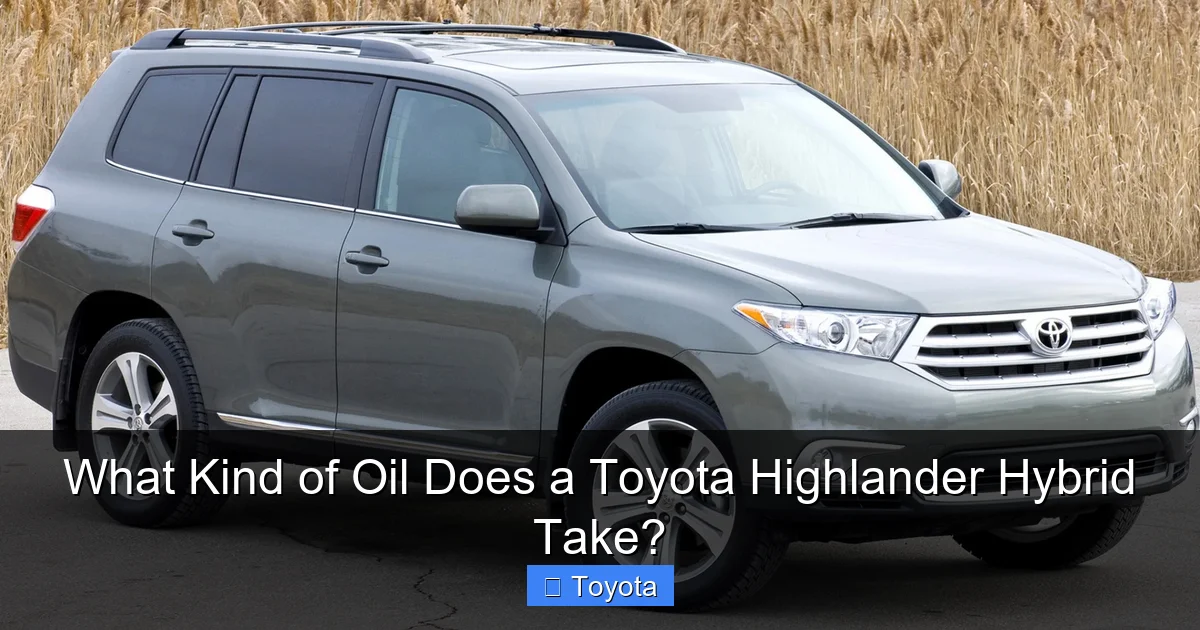
Visual guide about What Kind of Oil Does a Toyota Highlander Hybrid Take?
Image source: oilcapacityguide.com
The Exact Specification: API SP & Toyota Genuine
It’s not enough to simply buy any 0W-20 synthetic oil. The oil must meet the latest industry and Toyota-specific standards. For modern Highlander Hybrids, you should look for oils that meet:
- API SP (or current) Specification: This is the latest American Petroleum Institute standard for gasoline engine oils. It provides enhanced protection against low-speed pre-ignition (LSPI) in turbocharged engines (though the Highlander Hybrid’s NA engine isn’t turbocharged, the spec is the current benchmark) and improved wear protection.
- ILSAAC GF-6: The International Lubricant Standardization and Approval Committee standard, which is often paired with API SP.
- Toyota Genuine Motor Oil (TGMO) or Equivalent: Toyota’s own branded oil is formulated to their exact specifications. Many reputable aftermarket brands (like Mobil 1, Pennzoil Platinum, Castrol EDGE, Royal Purple, etc.) produce 0W-20 synthetics that explicitly state they meet or exceed Toyota’s requirements. The oil bottle will often say “Suitable for Toyota vehicles requiring 0W-20” or list Toyota TSNM 0W-20 approval.
Key Tip: Always check your owner’s manual. It will have a section titled “Lubrication” or “Engine Oil” and will list the exact viscosity (0W-20) and the required API or ILSAAC specification. It may also recommend Toyota Genuine Motor Oil or a specific equivalent brand. If you’ve lost your manual, a quick search for “Toyota Highlander Hybrid owner’s manual PDF” will find the official document on Toyota’s website.
Model Year Nuances
While the core requirement of 0W-20 full synthetic has remained consistent across all Highlander Hybrid model years (2014-present), there are minor details:
- 2014-2019 Models (XW50 Generation): These use the 2GR-FXE 3.5L V6 hybrid engine. Oil capacity is approximately 5.0 quarts (4.7L) with filter change.
- 2020-Present Models (XW70 Generation): The current model switched to the more efficient A25A-FXS 2.5L four-cylinder hybrid engine. Oil capacity is slightly lower, around 4.8 quarts (4.5L) with filter change. The oil specification remains the same: 0W-20 full synthetic.
This consistency is great news. Once you know your Highlander Hybrid needs 0W-20, that rule applies to every year of this hybrid model. For comparison, if you were looking at a non-hybrid Highlander with the V6, it traditionally used 0W-20 as well in recent years, but older models might have used 5W-30. You can find specifics for other Toyotas, like the Tacoma, in our dedicated guide on what kind of oil does a Toyota Tacoma take.
Decoding the Oil Viscosity: What “0W-20” Really Means
Viscosity is the oil’s resistance to flow. It’s the most critical number on the bottle for your engine’s health. Understanding the 0W-20 code helps you appreciate why this specific oil is chosen.

Visual guide about What Kind of Oil Does a Toyota Highlander Hybrid Take?
Image source: oilcapacityguide.com
The “0W” Part: Cold-Weather Performance
The “W” stands for winter. The number before it (0) is a measure of the oil’s viscosity at cold temperatures, tested at -30°C (-22°F). A lower number means the oil flows better in the cold.
- 0W: Flows like a single-weight 0-weight oil at startup in frigid conditions. This is the best possible cold-flow rating available. It guarantees the oil pumps to the top of the engine and coats all bearings, camshafts, and cylinder walls within seconds of turning the key.
- Why it matters for hybrids: As discussed, the hybrid system’s frequent restarts mean the engine is constantly experiencing cold-start wear conditions, even in summer. A 0W oil minimizes this wear dramatically compared to a 5W or 10W oil.
The “-20” Part: High-Temperature Protection
The number after the hyphen (20) indicates the oil’s viscosity at 100°C (212°F), which is normal engine operating temperature. A lower number means the oil is thinner at high heat.
- 20: This is a relatively low-viscosity grade. It’s designed to be fuel-efficient. Thinner oil creates less internal friction as it moves through the engine’s tight clearances, which directly translates to better miles-per-gallon—a key goal for any hybrid.
- The Balancing Act: The oil must be thin enough for efficiency but thick enough to maintain a protective film under high heat and load. Modern 0W-20 synthetic oils use advanced base stocks and additive packages to achieve this balance, providing protection comparable to older, thicker oils like 5W-30.
Can you use a different viscosity? The short, critical answer is no. Toyota engineered the Highlander Hybrid’s engine to precise specifications with 0W-20 oil in mind. Using a 5W-20, 5W-30, or any other grade is not recommended. It can lead to increased wear, poor cold-start protection (if using a higher “W” number), or even engine damage due to incorrect clearances and hydraulic lifter operation (if using a thicker oil). Always stick to 0W-20.
Synthetic vs. Conventional: Why There’s No Contest
This is a non-negotiable point: you must use full synthetic motor oil in your Toyota Highlander Hybrid. The owner’s manual will state this clearly. But why can’t you save a few bucks with a high-quality conventional oil?

Visual guide about What Kind of Oil Does a Toyota Highlander Hybrid Take?
Image source: oilcapacityguide.com
The Molecular Structure Advantage
Synthetic oils are man-made from modified petroleum or other base materials. Their molecular structure is uniform and tailored for performance. Conventional oils are refined from crude oil and contain a mix of different-sized molecules, including impurities.
- Better Temperature Range: Synthetics resist thickening in extreme cold and thinning in extreme heat far better than conventionals.
- Superior Cleanliness: They have a higher resistance to forming sludge and varnish, and their detergent/dispersant additives are more robust and longer-lasting.
- Longer Life: Synthetics are less susceptible to oxidation and thermal breakdown, which is why they allow for extended oil change intervals (like 10,000 miles).
Specific Demands of the Hybrid System
The Highlander Hybrid’s engine doesn’t always get thoroughly hot. Short trips, especially in cooler weather, can mean the engine oil doesn’t reach its optimal temperature for long enough to burn off fuel dilution and moisture. Conventional oils are more prone to forming acids and sludge under these “severe” operating conditions. Full synthetics are much more resilient. Furthermore, the tight tolerances of the modern engine require the superior lubrication film strength that only full synthetics can consistently provide. Using conventional oil in this application is a recipe for accelerated engine wear and potential long-term issues.
Oil Capacity and Change Intervals: Practical Maintenance
Knowing the right oil is one thing; knowing how much and how often is the other half of the equation.
How Much Oil Does It Take?
As noted earlier, capacity varies slightly by generation:
- 2014-2019 Highlander Hybrid (3.5L V6): Approximately 5.0 quarts (4.7 liters) with a new oil filter. Without filter change, it’s about 4.6 quarts.
- 2020-Present Highlander Hybrid (2.5L I4): Approximately 4.8 quarts (4.5 liters) with a new oil filter. Without filter change, it’s about 4.4 quarts.
Pro Tip: Always add oil gradually. After draining the old oil and replacing the filter, pour in about 4 quarts, wait a minute for it to settle, then check the dipstick. Add more in small increments until the level is at the “Full” mark. Do not overfill. Overfilling can cause aeration (foaming), which destroys the oil’s lubricating ability and can lead to engine damage. For precise capacity for your specific VIN or year, your owner’s manual is the definitive source. You can also find general capacity info in articles that explain how many quarts of oil does a car take.
Recommended Oil Change Intervals
This is where Toyota’s advice and real-world conditions meet. The official recommendation for Highlander Hybrids using 0W-20 full synthetic is typically every 10,000 miles or 12 months, whichever comes first. This is a “normal” driving schedule.
However, Toyota also defines “severe” driving conditions, which many of us actually experience. These include:
- Frequent short trips (less than 5 miles) in cold weather.
- Extended idling or prolonged operation in heavy traffic.
- Driving in extremely hot, dusty, or muddy conditions.
- Towing a trailer or carrying heavy cargo regularly.
If your driving falls under these severe conditions, Toyota often recommends shortening the interval to 5,000 miles or 6 months. The hybrid’s frequent engine-off periods can actually contribute to “severe” service because the oil may not get hot enough long enough to evaporate fuel dilution. When in doubt, a 5,000-7,000 mile interval is a very safe and conservative practice that will extend your engine’s life. Many technicians recommend this for hybrids regardless of the official “normal” schedule.
The High Cost of Using the Wrong Oil
It might seem like an exaggeration, but putting the wrong oil in your Highlander Hybrid isn’t just a minor misstep—it’s a direct path to expensive repairs. Let’s be clear about the risks.
Using the Wrong Viscosity (e.g., 5W-30)
If you use an oil that is too thick (higher second number, like 30 instead of 20):
- Increased Friction & Poor Fuel Economy: The thicker oil creates more drag on moving parts, directly fighting the hybrid’s efficiency goals. Your MPG will drop.
- Hard Starting & Wear: In cold weather, a 5W-30 flows slower than 0W-20. That means more seconds of dry, unlubricated start-up wear.
- Potential Hydraulic Issues: The engine’s hydraulic valve lifters and other precision components are designed for the flow characteristics of 0W-20. A thicker oil may not fill these lifters properly, causing noise (ticking) and potential damage.
If you use an oil that is too thin (lower second number, though 0W-20 is already very thin):
- Insufficient Film Strength: Under high load and temperature, the oil film may rupture, leading to metal-to-metal contact, scouring of bearings, and camshaft/lifter wear.
- Increased Oil Consumption: Thinner oil is more likely to slip past piston rings and get burned, leading to you needing to add oil between changes.
Using Conventional Oil Instead of Full Synthetic
The risks here are more about long-term degradation:
- Sludge & Deposit Formation: Conventional oil breaks down faster, especially under the hybrid’s unique operating patterns. This leads to harmful sludge clogging oil passages and varnish coating internal parts.
- Poor Protection in Extreme Conditions: It won’t handle the heat or cold as well, leading to accelerated wear during starts and high-speed operation.
- Shorter Drain Intervals: You’d have to change it every 3,000-5,000 miles, negating any cost savings and increasing environmental waste.
Warranty Implications: If engine or hybrid system damage occurs and an investigation reveals the use of non-specified oil, Toyota could deny warranty coverage for the repairs. It’s simply not worth the risk.
Practical Tips and Final Checklist
Let’s make this actionable. Here’s your step-by-step guide to never getting it wrong.
Your Oil Selection Checklist
- Look for “0W-20”: This is the first and most important filter. If the bottle doesn’t say 0W-20, don’t buy it.
- Ensure it says “Full Synthetic”: This is mandatory. The label must explicitly state “Full Synthetic Motor Oil.”
- Check for Approvals: Look for the API “starburst” symbol and the words “API SP” or “API SN” (SP is newer and preferred). Also, look for phrases like “Meets Toyota specifications,” “Recommended for Toyota,” or the ILSAAC GF-6 symbol.
- Buy the Right Quantity: Remember the capacity (~5 quarts). Buy a 5-quart jug to have enough for the change and a little extra to check the level. It’s better to have too much than too little, but don’t overfill.
- Trusted Brands: Major brands like Toyota Genuine, Mobil 1, Pennzoil Platinum, Castrol EDGE, Valvoline SynPower, and Royal Purple all make excellent 0W-20 synthetics that meet the required specs. When in doubt, choose a well-known brand with clear specifications on the back label.
What About Oil Additives or “High Mileage” Oils?
Generally, do not add oil additives to your Highlander Hybrid. Modern synthetic oils are complex, perfectly balanced formulations. Adding aftermarket additives (like “engine restore” or “stop smoke”) can disrupt this balance, damage sensors, or clog catalytic converters. They are almost always unnecessary and potentially harmful.
Regarding “High Mileage” oils: These are conventional or synthetic blends with extra seal conditioners and anti-wear additives for older engines with worn seals. If your Highlander Hybrid has over 150,000 miles and you notice minor oil seepage, a high-quality full synthetic 0W-20 labeled for high mileage (like Mobil 1 Extended Performance High Mileage) is an acceptable and often beneficial choice. However, for the vast majority of owners, a standard 0W-20 full synthetic is perfect. There’s no need to switch unless you have a specific, diagnosed seal issue.
In conclusion, the answer to “what kind of oil does a Toyota Highlander Hybrid take?” is beautifully simple: 0W-20 full synthetic oil meeting API SP/ILSAAC GF-6 and Toyota’s specifications. By sticking to this formula, respecting capacity and change intervals, and avoiding shortcuts, you are giving your Highlander Hybrid’s powertrain the best possible care. It’s the easiest, most cost-effective form of preventative maintenance you can perform, ensuring your hybrid family hauler delivers reliable, efficient service for hundreds of thousands of miles. When you pull into your driveway after a long day, you’ll have the peace of mind knowing you’ve protected your investment with the very best.
Frequently Asked Questions
Can I use 5W-20 oil in my Toyota Highlander Hybrid if 0W-20 is unavailable?
No, you should not. The 0W rating is specifically required for optimal cold-start flow and hybrid system protection. Using 5W-20 can lead to increased engine wear during startups and may not meet Toyota’s specifications for your engine. Always use the specified 0W-20.
Is Toyota Genuine Motor Oil the only brand I can use?
No. While Toyota Genuine Motor Oil is perfectly formulated for your vehicle, any full synthetic 0W-20 oil that meets the API SP and ILSAAC GF-6 specifications and explicitly states it is suitable for Toyota engines is an excellent and acceptable choice. Reputable aftermarket brands are more than adequate.
My 2017 Highlander Hybrid has 120,000 miles. Should I switch to a thicker oil like 5W-30?
No. The engine’s design and clearances are engineered for 0W-20. Switching to a thicker oil will reduce fuel efficiency, potentially cause cold-start wear, and may lead to hydraulic lifter noise or damage. Continue using 0W-20 full synthetic. For high-mileage engines, you can choose a “High Mileage” version of 0W-20 synthetic, which has additional seal conditioners.
How often should I really change the oil? The manual says 10,000 miles, but I’ve heard 5,000 for hybrids.
The 10,000-mile interval is for “normal” driving. Due to the hybrid’s frequent short trips and engine-off cycles, many technicians recommend a more conservative 5,000 to 7,000-mile interval for long-term engine health, especially if your driving includes many cold starts or severe conditions. This is a smart, low-cost insurance policy for your engine.
What happens if I accidentally put conventional oil in my Highlander Hybrid?
One accidental fill with conventional oil is not a disaster, but you should change it to full synthetic as soon as possible (within 1,000 miles). Conventional oil breaks down faster and offers inferior protection against the hybrid’s unique operating conditions. Do not resume a normal maintenance schedule with conventional oil; switch back to full synthetic 0W-20 immediately.
My owner’s manual says 0W-20, but the oil cap on my engine says 0W-16. Which one is correct?
This is an important clarification. Some newer, smaller-displacement Toyota engines (like in the Corolla or RAV4) use 0W-16. However, the Toyota Highlander Hybrid has never used 0W-16. It has consistently required 0W-20. If your cap says 0W-16, it may be from a different Toyota model or is incorrect. Your owner’s manual is the ultimate authority. For a Highlander Hybrid, it will always specify 0W-20. If you are ever unsure, double-check with a dealership or a trusted mechanic. For other Toyota models, like certain Camry trims, the requirement can differ—you can see examples for specific years in our guide on what kind of oil does a 2008 Toyota Camry take.