
What Does Ms Mean in Bmw

In BMW, “MS” stands for “Motorsport,” but it’s not the high-performance “M” badge. The MS designation typically refers to a factory-applied performance and styling package available on certain BMW models, offering sportier aesthetics, suspension tweaks, and sometimes mild power increases over the standard lineup. It’s a step below the full M treatment but above the base model, designed for drivers who want enhanced sportiness without the extreme cost or focus of a true M car.
So you’re looking at a BMW, maybe a sleek 3 Series or a sporty SUV, and you spot the “MS” badge on the trunk or side gills. Your mind might immediately jump to the legendary BMW M division—the high-performance gods of the Autobahn. But wait, this car doesn’t look quite like an M3 or X5 M. What gives? What does MS mean in BMW, anyway? Is it the same thing? If you’ve ever felt that moment of confusion, you’re not alone. The “MS” badge is one of BMW’s more subtle and often misunderstood designations. It sits in a fascinating middle ground between your everyday luxury sedan and a fire-breathing M machine. Let’s pop the hood, both literally and figuratively, and decode everything there is to know about BMW’s MS package.
Think of BMW’s model hierarchy like a ladder. At the bottom, you have your standard models—the 320i, the 530i. They’re comfortable, refined, and efficient. At the very top, perched on the summit, are the M models—the M3, M5, X5 M. These are built from the ground up with racing-derived engines, reinforced chassis, and track-ready everything. The MS badge represents a rung somewhere in the upper-middle of that ladder. It’s BMW’s way of saying, “This isn’t just a regular sedan; we’ve sprinkled in some of that Motorsport magic to make it significantly sportier.” It’s a factory-sanctioned tune-up, a performance and styling bundle designed to appeal to the enthusiast who wants more engagement but may not need—or want to pay for—the full M experience. Understanding this distinction is crucial, whether you’re shopping for a used BMW or just curious about the badges you see on the road.
Key Takeaways
- MS Means Motorsport: The “MS” on a BMW stands for “Motorsport,” indicating a factory-backed performance and styling enhancement package.
- Not an M Car: An MS model is fundamentally different and less extreme than a full BMW M (Motorsport) vehicle, which is a separately developed high-performance model.
- Package, Not a Model: MS is usually an optional package added to an existing model (like a 330i MS), not a standalone model series like the M3 or X5 M.
- Focus on Style & Sportiness: The MS package prioritizes aggressive aesthetics (body kits, wheels), sportier interior trim, and tuned suspension over massive power gains.
- Model Availability Varies: MS packages have been offered on various models over the years, including the 3 Series, 5 Series, Z4, and some SUVs, but availability is not consistent across all lines or generations.
- Resale & Perception: While desirable, MS models generally do not command the same premium or enthusiast respect as genuine M cars in the used market.
- Check the VIN & Docs: Always verify an MS designation by checking the vehicle’s build sheet or VIN decode, as aftermarket modifications can mimic the look.
📑 Table of Contents
- The Origin of “MS” in BMW: A Brief History
- What Does MS Stand For? Decoding the Acronym
- MS vs. M: Understanding the Fundamental Difference
- The MS Performance Package: What’s Actually Included?
- Which BMW Models Have Offered the MS Package?
- Is an MS BMW Worth the Extra Cost? The Buyer’s Guide
- How to Identify a Genuine MS BMW
- The Future of “MS” in the BMW Lineup
- Conclusion: Appreciating the Middle Ground
The Origin of “MS” in BMW: A Brief History
To truly grasp what MS means, we need to rewind the clock. The “MS” moniker has its roots deeply embedded in BMW’s racing heritage, much like the more famous “M.” However, while the “M” division (Motorsport GmbH) was officially founded in 1972 to oversee BMW’s racing activities and later its road-going performance cars, the “MS” badge took a different, more flexible path. It wasn’t a separate division but rather a marketing and engineering designation applied to specific, limited-run models or optional packages that embodied “Motorsport” spirit.
Early Appearances: The E30 320is and Beyond
One of the earliest and most famous uses of “MS” was on the E30 320is in the early 1990s. This wasn’t a full M3, but a model designed for markets where the M3’s larger engine incurred higher taxes. The 320is featured the S14 engine from the M3 but detuned to 192 hp, paired with a close-ratio gearbox. It had subtle Motorsport styling cues and is now a prized collector’s item. This set a precedent: MS as a “near-M” offering. In the 2000s, BMW used the “MS” badge more prominently on models like the E46 330i with the “MS Sport Package,” which included sport suspension, specific body styling, and unique wheels. It was BMW offering a curated sportier version directly from the factory, saving buyers from having to piece together aftermarket parts.
The philosophy has remained consistent: take a proven platform, enhance its dynamics and appearance with factory-developed parts, and badge it as “Motorsport.” It’s a bridge between the standard lineup and the M division’s thoroughbreds. This history explains why you might see MS badges on cars from different eras—it’s not a continuous model line but a recurring theme in BMW’s strategy to cater to performance-oriented customers at various price points.
What Does MS Stand For? Decoding the Acronym
Let’s cut to the chase. In the context of BMW badging, “MS” stands for “Motorsport.” It’s that simple. It signals a connection to BMW’s racing pedigree and engineering prowess. However, the critical nuance lies in how that Motorsport connection is implemented. Unlike the “M” badge, which denotes a vehicle developed by BMW M GmbH—a subsidiary with its own engineering teams, dedicated production lines, and often unique engines and chassis—the “MS” badge is applied to vehicles that are fundamentally mainstream BMWs that have been upgraded.
Visual guide about What Does Ms Mean in Bmw
Image source: i.pinimg.com
Think of it this way: the “M” badge is like a chef creating an entirely new, signature dish from scratch with the finest ingredients. The “MS” badge is that same chef taking a classic, beloved recipe and adding a special blend of spices, a premium cut of meat, and a unique presentation to elevate it. The base is the same, but the experience is noticeably enhanced. This means your BMW 330i with the MS package shares its core engine, transmission, and much of its chassis with the standard 330i. The “Motorsport” elements are specific additions: sport-tuned suspension (often lowering the ride height), more aggressive front and rear bumpers, side skirts, a rear spoiler, larger brakes, and distinctive wheels. Inside, you’ll find sport seats, an M-style steering wheel, and often aluminum or carbon fiber trim.
The MS Package vs. Aftermarket Mods
One key value proposition of a factory MS package is integration and warranty. Those parts were engineered to work together seamlessly on that specific chassis. They’re crash-tested, emissions-compliant, and (crucially) covered under the new car warranty when purchased from the dealer. This is different from buying an aftermarket body kit and coilovers. Those might look similar, but they come with potential fitment issues, unknown durability, and will almost certainly void warranty coverage on the affected components. The MS package offers the “M-look” and improved handling with the peace of mind of a factory accessory. It’s BMW’s official, turnkey solution for sportification.
MS vs. M: Understanding the Fundamental Difference
This is the most important section for any potential buyer. Confusing an MS model with an M model is a common and costly mistake. The differences go far beyond a badge. They represent fundamentally different philosophies and engineering investments.
Visual guide about What Does Ms Mean in Bmw
Image source: fireandsaw.com
Engineering Philosophy: Evolution vs. Revolution
A true BMW M car is a revolution. It starts with a clean sheet of paper. The M3, for example, has a unique engine (the S58 twin-turbo inline-6 in the latest G80 generation) not found in any standard 3 Series. It has extensive chassis bracing, unique suspension geometry, reinforced drivetrain components, upgraded brakes, and a vastly different interior focused on driver engagement with high-bolstered seats and specific trim. The goal is maximum performance, often at the expense of some daily comfort and cost.
An MS model is an evolution. It takes the standard production car—say, a G20 330i with its B48 turbocharged 2.0L 4-cylinder engine—and adds factory-approved performance and styling parts. The engine remains the same 255 hp unit (or whatever the standard output is). The transmission is the same. The core structure is identical. The MS package enhances the driving experience through better tires, stiffer springs/dampers, and quicker steering ratio (if available), but it does not fundamentally alter the car’s DNA. It’s a sportier version of a luxury sedan, not a sports sedan in its own right.
Performance Gap: A Noticeable Chasm
The performance difference is stark. Let’s use a concrete example from recent years: the F30 3 Series.
- BMW 330i (Standard): ~255 hp, 0-60 mph in ~5.5 seconds. Comfortable, refined.
- BMW 330i with M Sport Package (often badged MS): Same 255 hp engine. The M Sport package added sport seats, steering wheel, and styling. Performance was nearly identical to the standard car, but with better aesthetics and slight suspension tuning.
- BMW M340i (M Performance): ~382 hp from a tuned B58 engine, xDrive or RWD, 0-60 mph in ~4.1 seconds. Significantly more powerful, with M-specific tuning, brakes, and differential.
- BMW M3 (Full M): ~473 hp (or 503 hp in Competition), 0-60 mph in ~4.1 seconds (RWD) or 3.8 seconds (AWD). A completely different beast with a race-bred S58 engine, M xDrive, and track-focused chassis.
Notice how the true performance jump happens between the 330i and the M340i. The MS package on a 330i does not close that gap. It’s about feel and look, not outright speed. This is why the M340i (which sometimes carries “M Performance” badging, not “MS”) is a different category entirely. The “MS” badge, in many modern contexts, has been largely replaced by the “M Sport” package name for styling, but the core idea remains: a sportier, factory-enhanced non-M model.
The MS Performance Package: What’s Actually Included?
So, you’ve determined a car has an MS package. What does that actually get you? The content of an MS package has varied over the years and by model, but it generally falls into three categories: Exterior Styling, Chassis & Handling, and Interior Enhancements.
Visual guide about What Does Ms Mean in Bmw
Image source: motortrend.com
Exterior: The Aggressive Makeover
This is the most visible change. An MS package almost always includes:
- Front Bumper: A more aggressive design with larger air intakes, often incorporating a black mesh or lower splitter.
- Rear Bumper: Typically features a more pronounced diffuser element and sometimes larger exhaust tips (though actual exhaust may be unchanged).
- Side Sills: Adds a sportier contour to the lower body.
- Rear Spoiler: A subtle lip spoiler on the trunk lid.
- Wheels & Tires: Unique, larger-diameter wheel designs (e.g., 19″ or 20″ vs. standard 18″) wrapped in performance-oriented, often lower-profile tires. This is a significant handling upgrade.
- Shadowline or Dark Trim: Blacked-out window trim, grille accents, and sometimes mirror caps.
The goal is to make the car look lower, wider, and more purposeful—giving it that “M-lite” appearance from a distance.
Chassis & Handling: The Driving Feel
This is where the real magic happens for the driver:
- Suspension Tuning: Stiffer springs and dampers (shocks) for reduced body roll and more direct turn-in. Ride height is often lowered by 10-15mm.
- Steering: Some MS packages include a variable-ratio steering rack or simply a re-tuned steering mapping for more weight and feedback.
- Brakes: Larger diameter brake rotors and sometimes upgraded calipers (though rarely as large as full M brakes).
- Limited-Slip Differential: This is a big one. Some MS packages, particularly on rear-wheel-drive models, add a mechanical limited-slip differential (LSD). This is a major handling and traction upgrade, allowing the car to put power down more effectively during hard cornering. It’s a feature that truly blurs the line between MS and M Performance.
Interior: Sportier Cockpit
The cabin gets the Motorsport treatment too:
- Seats: Sport seats with more aggressive side bolsters for lateral support. Often in a combination of cloth and leather or full leather with contrast stitching.
- Steering Wheel: An M-style flat-bottom steering wheel, usually wrapped in leather with thumb rests and paddle shifters (if automatic).
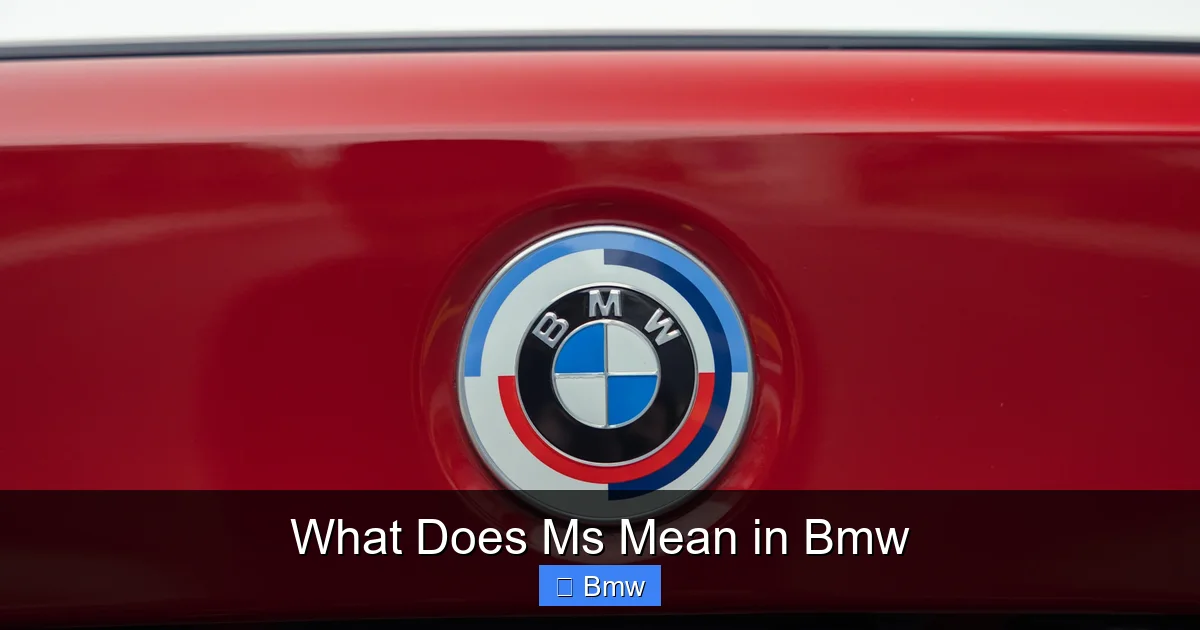
- Trim: Aluminum or carbon fiber interior accents, MS badging on the dash or sill plates.
- Gauges & Displays: Sometimes includes additional oil temperature and boost pressure gauges (in older turbo models) or specific M-themed digital display layouts.
It’s a cohesive theme that reminds you every time you get in that this is no ordinary BMW.
Which BMW Models Have Offered the MS Package?
The availability of the MS package is not universal. It has been offered on specific models and often only in certain markets (Europe has historically seen more MS packages than North America). Here’s a non-exhaustive list of notable MS-equipped models:
Past & Present Examples
- 3 Series (E30, E36, E46, F30, G20): Perhaps the most common home for MS. The E30 320is is legendary. The E46 330i MS Sport package was popular. The F30 330i/G20 330i offered an “M Sport” package that functioned as the modern equivalent of MS.
- 5 Series (E39, E60, F10, G30): Available on models like the 530i and 540i, adding sportier styling and suspension to the executive sedan.
- Z4 (E85/E86, E89, G29): The Z4 has frequently been offered with MS packages, emphasizing its roadster character with sportier setup and styling.
- X3, X5, X6: BMW’s SUVs have also received MS treatment, creating sportier versions of these family haulers with lowered suspension and aggressive bodywork.
- 1 Series (E87, F20): The hatchback 1 Series in Europe often had MS packages to enhance its hot-hatch appeal.
Important Note: In recent model years (G20 3 Series, G30 5 Series, etc.), BMW has largely standardized on calling the sport package the “M Sport” package. The badging might say “M Sport” instead of “MS,” but the concept is nearly identical: a factory performance and styling package for non-M models. The “MS” badge is more common on older models (pre-2016ish) and specific markets. Always check the exact build sheet or window sticker to confirm what “sport package” a car has, as terminology can be confusing.
Is an MS BMW Worth the Extra Cost? The Buyer’s Guide
This is the million-dollar question. You’re looking at two identical BMWs on a dealer lot: one standard, one with the MS package. The price difference might be $2,000-$5,000. Is it worth it? The answer depends entirely on your priorities.
The Case FOR Buying an MS Model
- Instant Style: It looks aggressive and factory-correct. No aftermarket guesswork. The body kit and wheels are designed to work together perfectly.
- Improved Driving Dynamics: The sport suspension, lower ride height, and performance tires (if equipped) make the car feel more connected and playful. The sport seats hold you in place better.
- Limited-Slip Differential: If your MS package includes an LSD, this is a game-changer for rear-wheel-drive models. It dramatically improves traction and cornering performance, making the car feel much more capable and safe at the limit.
- Warranty & Reliability: These are genuine BMW parts installed at the factory or dealership. They’re covered under the new car warranty (for the duration of the warranty period). You avoid the potential headaches of aftermarket part failures or fitment issues.
- Resale Value: In the BMW used market, an MS or M Sport package generally adds value over a base model. It’s a recognized desirable option that makes the car easier to sell.
The Case AGAINST Buying an MS Model
- Not an M Car: If your dream is to own a true BMW M, an MS model will not satisfy that. The performance gap is huge. Don’t buy an MS thinking it’s a poor man’s M3. It’s not.
- Ride Quality: The sport suspension is stiffer. If you value a plush, isolated ride, you will notice the difference. On rough roads, it can be busy.
- Potential for Higher Running Costs: Lower-profile performance tires on larger wheels are more expensive to replace and can be more prone to road damage. The sportier brakes may also have a higher replacement cost.
- Engine is Unchanged: The biggest disappointment for some is that the heart of the car—the engine—is identical to the standard model. You’re paying for handling and looks, not for more power. If you want more power, you need an M Performance model (like the M340i) or a full M car.
- Depreciation: While it holds value better than a base model, it doesn’t hold its value like a limited-production M car might. The premium paid new is not fully recouped.
Practical Tip: When test driving, drive a standard model and an MS model back-to-back on a road with some curves. Focus on the steering feel, body roll, and seat support. Also, check the window sticker (Monroney label) to see exactly what the MS package included. Was it just styling, or did it add the sport suspension and LSD? The specifics matter immensely to the value proposition.
How to Identify a Genuine MS BMW
Badge cloning and aftermarket modifications are real. How can you be sure that “MS” badge is factory-original? Here’s your detective checklist.
1. Decode the VIN
This is the gold standard. Use a paid BMW VIN decoder service (like BMW’s own VIN lookup on their website for some regions, or reputable third-party services). Enter the 17-digit Vehicle Identification Number. The decoder will list all factory-installed options and packages. Look for codes like “MSport” or specific package codes (e.g., “S544A” for M Sport package in some models). This will tell you definitively what the car left the factory with.
2. Inspect the Physical Badges
Factory-applied badges are usually very neat, with clean paint lines and consistent spacing. Aftermarket badges often look sloppy, with misaligned letters, paint bleed, or are applied over existing badge locations leaving residue. An original MS badge on the trunk lid will often be a separate piece applied over a blank panel, not the standard model’s badge location. Check for signs of removal.
3. Look for Cohesive Package Details
A genuine MS package is holistic. Don’t just look for the badge. Check if the car has the matching sport seats, M-style steering wheel, specific door sills with “MS” or “M Sport” illumination, and the correct wheel design that was offered for that model year’s MS package. If the car has an MS badge but a completely standard interior and wheels, it’s almost certainly a fake.
4. Check the Build Sheet/Window Sticker
The original window sticker (Monroney label) or the build sheet that comes with the car’s documents will list the “M Sport Package” or similar by name. This is your paper trail. If the current owner doesn’t have it, a VIN decode is your next best bet.
5. Beware of “MS-Lite” Aftermarket Kits
The aftermarket is full of “M Sport conversion kits” that add the bumpers, skirts, and badges to a standard car. These can look convincing but lack the suspension components and factory integration. The ride height and wheel gap might be off compared to a genuine MS model. A keen eye and a test drive comparing to a known genuine example will reveal differences in ride and handling.
In an era where badge engineering is common, doing your homework is essential to avoid overpaying for a modified car. Always verify before you buy.
The Future of “MS” in the BMW Lineup
Where is the MS badge heading? The automotive landscape is changing rapidly with electrification. BMW’s performance future is clearly centered on the “M” division, which now includes high-performance electric models like the i4 M50 and the upcoming i7 M70. The traditional role of the MS package as a gasoline-powered sport trim is evolving.
We are seeing the “M Sport” name become even more ubiquitous across the range, essentially becoming the default sport aesthetic package on most models. The performance content (suspension, LSD) may become more optional or bundled into separate “Dynamic Handling” packages. The clear demarcation is likely to be: Standard -> M Sport (style + mild handling) -> M Performance (significant power & handling upgrade, e.g., M340i, X3 M40i) -> M (full, dedicated performance model).
The standalone “MS” badge, as a distinct identifier separate from “M Sport,” may continue to fade into history for most mainstream models, surviving perhaps on special editions or specific markets. However, the concept it represents—a factory-enhanced, sportier version of the standard car—is alive and well. It’s just getting a new name and a potential powertrain update. For used car shoppers, understanding the legacy of the “MS” badge is key to understanding a whole generation of sportier BMWs that aren’t quite Ms but are far from ordinary.
Conclusion: Appreciating the Middle Ground
So, what does MS mean in BMW? It means “Motorsport,” but it’s a specific, historical flavor of Motorsport. It represents BMW’s answer to a customer who walks into a dealership, loves the look and feel of an M3 but needs the back seat space of a 3 Series or the fuel economy of a 2.0L engine. The MS package delivers the aesthetics, the seating position, the steering feel, and the chassis sharpness that whispers of the racetrack, all while keeping the core identity, efficiency, and (relative) affordability of the standard model.
It is not, and has never claimed to be, a substitute for a true M car. Those machines exist in a different universe of cost, complexity, and capability. But for thousands of drivers, an MS-badged BMW hits a sweet spot. It transforms a competent luxury car into a genuinely engaging driver’s car without breaking the bank or sacrificing daily usability. It’s the thoughtful, factory-engineered upgrade for the enthusiast who prioritizes driving pleasure over headline-grabbing horsepower numbers. When you see that “MS” badge now, you’ll know it’s not trying to be something it’s not. It’s simply a proud badge that says, “This BMW was built with a little extra Motorsport spirit in mind.” And in the world of premium automobiles, that’s a distinction worth understanding.
If you’re curious about how other manufacturers use similar letters and badges to denote performance or feature levels, you might find it interesting to read about what SXT means on Dodge vehicles, or explore Nissan’s DS drive mode. For a completely different context, you can learn about dashboard warning lights like the wrench symbol on a Honda. Each brand has its own language, and decoding them is part of the fun of being a car enthusiast.
Frequently Asked Questions
Is an MS BMW the same as an M BMW?
No, they are fundamentally different. An M BMW (like an M3 or X5 M) is a separately developed high-performance model with unique engines, chassis, and components. An MS BMW is a standard model with a factory-applied sport and styling package. The engine and core structure remain the same as the non-M model.
What does the MS package typically include on a BMW?
It usually includes sportier exterior bodywork (front/rear bumpers, side skirts), larger wheels and performance tires, a lowered and stiffened suspension, sport seats, an M-style steering wheel, and interior trim upgrades. Some packages may also add a limited-slip differential.
Does the MS package add horsepower?
Rarely. The MS package is primarily focused on aesthetics, handling, and interior sportiness. The engine and its output are typically identical to the standard model. For a significant power increase, you need to look at BMW’s M Performance models (like the M340i) or full M cars.
How can I tell if a used BMW has a genuine MS package?
Always verify by decoding the Vehicle Identification Number (VIN) using a reputable service. The factory build sheet will list all installed options. Also, look for a cohesive suite of MS-specific parts: the correct sport seats, steering wheel, door sills, and wheels. Be wary of cars with just the badge but standard interior and suspension.
Is buying a used BMW with an MS package a good value?
It can be. You get factory-integrated sport upgrades with warranty history (if CPO) at a lower cost than a full M model. The enhanced styling and handling make it more desirable than a base model, aiding resale. However, ensure the package includes the performance parts you want (like a limited-slip diff), and be prepared for potentially higher maintenance costs on sport tires and brakes.
Has BMW stopped using the MS badge?
The standalone “MS” badge is less common on newer models, having been largely replaced by the “M Sport” package name for styling and mild performance upgrades. The concept, however, is very much alive. The performance hierarchy is now often: Standard -> M Sport -> M Performance (M340i, X3 M40i) -> M.